

The End-to-End Tax Filing Journey Powered by TaxBuddy AI

Income tax filing has evolved significantly over the last few years. What was once a paperwork-heavy process involving multiple spreadsheets, physical documents, and repeated visits to tax professionals has become increasingly digital. Employers issue Form 16 electronically, banks report interest income online, brokers generate capital gains statements automatically, and the Income Tax Department makes financial information available through Form 26AS and the Annual Information Statement (AIS).
Despite these digital advancements, filing an Income Tax Return remains a complex exercise for many taxpayers. Information is scattered across different documents, tax laws change every financial year, and even a small omission can delay refunds or lead to notices. As a result, many taxpayers still spend hours collecting documents, verifying figures, selecting the correct ITR form, and ensuring that every source of income has been reported accurately.
Artificial Intelligence is beginning to simplify this experience. However, not every AI tool is designed for tax compliance. While general AI assistants can answer tax-related questions, filing an Income Tax Return requires a structured workflow that combines document processing, tax logic, government record validation, and filing expertise.
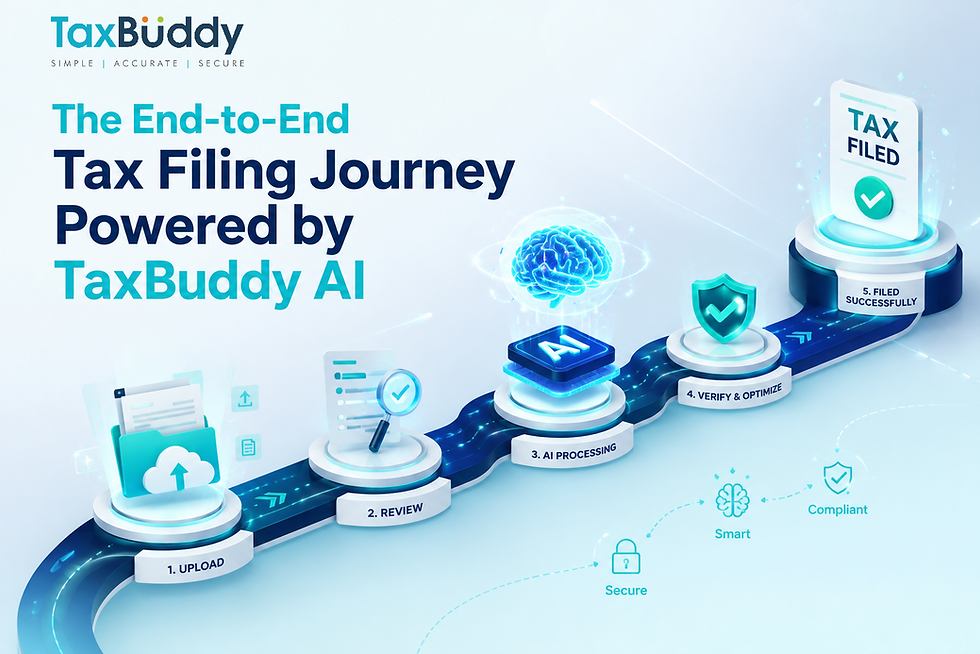
This is where TaxBuddy AI has been designed to make a difference. Rather than acting as a conversational assistant, it powers an end-to-end tax filing journey that guides taxpayers from the moment they begin collecting documents until their return is successfully filed.
Table of Contents
Why Tax Filing Still Feels Complicated
Income tax filing has become far more digital than it was a decade ago, but it has not necessarily become simpler. Most taxpayers receive their salary details through Form 16, download bank interest certificates online, access capital gains statements from brokers, and view reported transactions through the Annual Information Statement (AIS) and Form 26AS. Although this information is available electronically, it rarely exists in one place. Instead, taxpayers are expected to collect documents from multiple institutions, compare figures across different records, and ensure that every source of income has been reported accurately.
The complexity increases when an individual has more than one source of income. A salaried employee may also earn interest from fixed deposits, receive dividends, redeem mutual funds, sell shares, or earn freelance income during the year. Each of these transactions carries its own reporting requirements and may influence the choice of ITR form, tax computation, or disclosure obligations.
Tax laws also continue to evolve. Every financial year introduces changes in tax slabs, deductions, reporting formats, or filing requirements. Most taxpayers are therefore not just trying to complete a form; they are trying to understand whether they are applying the latest rules correctly. This often leads to repeated verification, uncertainty, and dependence on multiple websites or tax professionals before the return is finally submitted.
The result is that many taxpayers spend more time organising information than actually filing their Income Tax Return. What should ideally be a guided financial process often becomes a series of disconnected tasks.
Understanding the Modern Tax Filing Journey
An Income Tax Return is not prepared by filling in numbers one after another. It is the final outcome of a journey that begins much earlier with collecting financial information and ends only after the return has been successfully filed.
The journey starts with understanding the taxpayer's financial profile. This includes identifying every source of income earned during the financial year, whether from salary, investments, business, rental property, or other sources. Once these details are available, they need to be matched with supporting documents such as Form 16, AIS, Form 26AS, bank statements, and capital gains reports.
The next stage involves interpreting the information correctly. Income must be classified under the appropriate heads, eligible deductions must be identified, tax liability must be calculated under the applicable regime, and the correct ITR form must be selected. Every figure entered into the return must ultimately align with the records available to the Income Tax Department.
Only after these stages have been completed does the actual filing begin. Seen this way, filing an ITR is not a single activity but a connected process where every step influences the next. Missing information at the beginning often results in mistakes at the end.
How TaxBuddy AI Powers Every Stage of Filing
TaxBuddy AI has been designed around this complete journey rather than a single stage of tax filing. Instead of expecting taxpayers to manually organise documents, perform calculations, interpret tax provisions, and navigate multiple platforms, it provides a guided experience that connects these activities into one streamlined workflow.
The journey begins with document collection. Once taxpayers upload their tax documents and provide their PAN details, TaxBuddy AI assists in organising financial information so that users no longer have to manually consolidate data from different sources. The platform then guides taxpayers through the subsequent stages of filing, helping them understand what information is required, where it belongs, and whether additional details may be needed.
As taxpayers move through the filing journey, TaxBuddy AI applies tax workflows that are built specifically for Indian income tax compliance. Instead of relying on open-ended conversations, the system follows a structured approach that mirrors the actual filing process. This enables taxpayers to move from document upload to return preparation without repeatedly switching between tax portals, calculators, spreadsheets, or online articles.
For individuals with straightforward financial situations, the self-filing experience offers a fast and guided way to complete their return. Those with more complex tax profiles can also choose expert-assisted filing, ensuring that professional review complements AI-powered automation before the return is submitted.
From Documents to Filing: A Seamless Workflow
One of the biggest frustrations taxpayers face is moving between multiple systems during tax season. A single return may require them to access salary records from their employer, interest certificates from banks, capital gains reports from brokers, AIS from the Income Tax portal, and tax-saving investment proofs from various financial institutions. After gathering these documents, they often switch between spreadsheets, calculators, online guides, and the e-filing portal to prepare the final return.
This fragmented experience increases both the time required for filing and the possibility of errors.
TaxBuddy AI simplifies this journey by creating a continuous workflow where taxpayers progress naturally from one stage to the next. Instead of manually determining what should happen after each step, the platform guides users through document processing, tax computation, validation, and filing within a single experience.
This structured workflow reduces unnecessary repetition and allows taxpayers to focus on reviewing their financial information instead of managing the filing process itself. Rather than spending hours navigating different systems, they are able to complete their return through one connected journey designed specifically for tax compliance.
Built for Simple and Complex Tax Situations
Every taxpayer's financial situation is unique. While some individuals receive income only from salary, others may have multiple employers, rental income, capital gains, freelance earnings, foreign investments, business income, or Employee Stock Ownership Plans (ESOPs). The complexity of the return, therefore, varies considerably from one taxpayer to another.
TaxBuddy AI has been developed to support this diversity. The platform is designed to assist taxpayers across a wide range of financial situations by providing filing journeys that adapt to different income profiles rather than assuming every return follows the same pattern.
For taxpayers whose financial affairs are relatively straightforward, AI-powered self-filing provides an efficient and guided experience. For individuals whose returns involve specialised reporting requirements, TaxBuddy AI also offers expert-assisted filing. This ensures that complex tax situations receive professional attention without sacrificing the convenience and speed that AI brings to the filing process.
By combining automation with flexibility, TaxBuddy AI serves both first-time taxpayers and experienced investors through a single platform that scales according to individual filing needs.
Why Human Expertise Still Matters
Artificial Intelligence has dramatically improved the efficiency of tax filing, but certain aspects of taxation continue to require professional judgment.
Business income, foreign assets, capital gains involving multiple transactions, ESOP taxation, and cross-border income often involve interpretation rather than straightforward calculations. In such situations, applying the correct tax treatment depends on understanding both the taxpayer's financial circumstances and the applicable legal provisions.
Rather than attempting to replace tax professionals, TaxBuddy AI has been designed to work alongside them. Routine activities such as document organisation, workflow guidance, and tax computations can be automated, allowing experts to focus their attention on situations where experience and interpretation create the greatest value.
This combination of intelligent automation and human expertise gives taxpayers the confidence that their returns are not only prepared efficiently but also reviewed appropriately whenever additional complexity arises.
The Future of AI-Powered Tax Compliance
As India's tax ecosystem becomes increasingly digital, taxpayers will expect filing an Income Tax Return to become faster, simpler, and more intuitive. Government reporting systems continue to improve, financial institutions generate increasingly detailed digital records, and Artificial Intelligence is becoming capable of processing large volumes of information with remarkable efficiency.
The future of tax filing will therefore involve far less manual data entry and considerably more intelligent automation. AI will help taxpayers collect documents, organise financial information, identify missing details, perform calculations, and guide them through filing journeys that are personalised to their financial situations.
However, compliance will remain at the heart of tax filing. Tax rules will continue to evolve, reporting obligations will become more sophisticated, and taxpayers will still require confidence that their returns satisfy the latest legal requirements.
Purpose-built platforms such as TaxBuddy AI represent this next phase of tax technology. By combining automation, updated tax logic, structured workflows, and expert oversight, they demonstrate how Artificial Intelligence can simplify compliance without compromising accuracy.
Conclusion
Income tax filing has evolved from a paper-based exercise into a digital process, but the underlying responsibility remains unchanged. Every taxpayer is expected to report income accurately, claim eligible deductions correctly, and comply with the latest tax provisions. While digital records have reduced paperwork, they have also created a new challenge of managing information across multiple documents and platforms.
TaxBuddy AI addresses this challenge by transforming tax filing into a connected journey rather than a collection of isolated tasks. From organising documents and guiding taxpayers through every filing stage to offering expert review for complex situations, the platform simplifies what has traditionally been one of the most time-consuming financial responsibilities.
As Artificial Intelligence continues to reshape personal finance, the greatest value will come from solutions that are built for specific purposes. TaxBuddy AI demonstrates how specialised AI can make tax filing faster, more organised, and more reliable while giving taxpayers the confidence that every stage of the journey has been designed with compliance in mind.
FAQs
Q1. What is TaxBuddy AI?
TaxBuddy AI is an AI-powered income tax filing solution designed specifically for Indian taxpayers. It guides users through the complete tax filing journey, from document collection to return filing, while also offering expert-assisted support for complex cases.
Q2. How does TaxBuddy AI simplify tax filing?
TaxBuddy AI streamlines the filing process by organising tax documents, guiding taxpayers through each filing stage, applying updated tax workflows, and reducing the manual effort involved in preparing an Income Tax Return.
Q3. Can TaxBuddy AI be used by salaried employees?
Yes. Salaried taxpayers can use TaxBuddy AI for a guided self-filing experience, making it easier to prepare and file their returns accurately.
Q4. Does TaxBuddy AI support taxpayers with capital gains or business income?
Yes. TaxBuddy AI supports taxpayers with complex financial situations and also provides expert-assisted filing for cases involving capital gains, business income, foreign assets, ESOPs, and multiple income sources.
Q5. Is TaxBuddy AI suitable for first-time taxpayers?
Yes. Its guided workflow makes it easier for first-time taxpayers to understand each stage of filing and complete their Income Tax Return with confidence.
Q6. Does TaxBuddy AI replace tax professionals?
No. TaxBuddy AI automates routine filing activities while allowing taxpayers to seek expert review whenever professional judgement is required.
Q7. Why is tax filing still complicated despite digital records?
Although most financial records are available electronically, taxpayers still need to consolidate information from multiple sources, apply current tax rules, reconcile government records, and ensure complete and accurate reporting.
Q8. How does TaxBuddy AI improve filing accuracy?
By combining structured tax workflows, AI-powered guidance, updated compliance logic, and expert review where required, TaxBuddy AI helps reduce manual errors and simplifies the overall filing process.


