

Why TaxBuddy AI Is More Than a Chatbot? It's a Complete Tax Filing Assistant
- CA Pratik Bharda

- Jul 22
- 6 min read
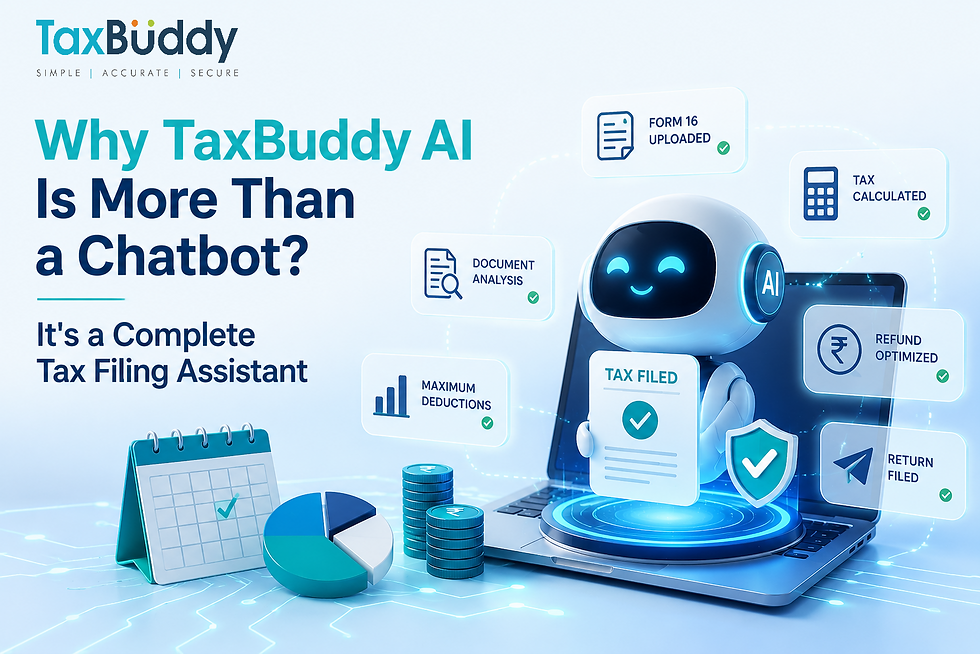
Artificial Intelligence has changed the way people interact with technology. Whether it is writing emails, planning travel, generating images, or answering questions, conversational AI has become part of everyday life. Taxation is no exception. Millions of taxpayers now ask AI assistants to explain deductions, compare tax regimes, calculate tax liability, or understand which Income Tax Return (ITR) form they may need to file. What once required reading government circulars or consulting lengthy tax guides can now be understood through a simple conversation.
This shift has also changed expectations. Many taxpayers no longer view AI as just a source of information. They expect it to help them complete the entire filing process. After all, if an AI assistant can explain tax rules, why should it not be able to prepare and file the return as well?
The answer lies in understanding the difference between conversation and compliance. Answering tax questions is one task. Filing an Income Tax Return is another. One focuses on providing information, while the other requires structured workflows, document validation, tax calculations, government record reconciliation, and adherence to constantly evolving tax rules.
That is why TaxBuddy AI has been built differently. It is not designed to function as a conversational chatbot alone. It has been developed as a complete tax filing assistant that helps taxpayers move from understanding taxation to actually completing their Income Tax Return with confidence.
Table of Contents
Why Chatbots Have Become Popular for Tax Queries
The rise of conversational AI has made financial information far more accessible than it was a few years ago. Instead of searching through multiple websites, taxpayers simply ask questions such as whether they should choose the old or new tax regime, whether bank interest is taxable, or how capital gains are calculated. AI explains these concepts in simple language, helping people understand taxation without requiring technical expertise.
This has been particularly valuable for first-time taxpayers who often find income tax terminology confusing. Chatbots reduce the effort involved in understanding tax provisions and allow users to learn at their own pace.
However, learning about taxation is only the beginning of the filing journey.
Why Filing an ITR Requires More Than Conversations
Preparing an Income Tax Return is not simply about answering a few tax-related questions. Every taxpayer has a unique financial profile shaped by salary income, investments, bank interest, capital gains, business income, rental income, deductions, and tax deducted at source. Much of this information is reported by different institutions and reflected in documents such as Form 16, Form 26AS, the Annual Information Statement (AIS), and the Taxpayer Information Summary (TIS).
An accurate return depends on bringing all these records together, identifying missing information, applying the latest tax rules, selecting the correct ITR form, and validating the final return before submission.
A conversational chatbot cannot independently manage this entire workflow simply through prompts. It responds to the information the user provides. If important details are omitted or misunderstood, the resulting guidance may also be incomplete.
Tax filing, therefore, requires something more structured than conversation alone.
What Makes TaxBuddy AI Different
This is where TaxBuddy AI takes a different approach.
Instead of acting only as a chatbot that answers tax questions, TaxBuddy AI has been designed around the complete filing journey of an Indian taxpayer. Every interaction is intended to move the taxpayer one step closer to filing a correct Income Tax Return rather than simply ending with an answer.
Once users begin their filing journey, TaxBuddy AI assists with document collection, information extraction, tax calculations, return preparation, and filing guidance within a single workflow. Rather than expecting taxpayers to repeatedly ask what to do next, the platform guides them through each stage in a structured manner.
This creates an experience that feels less like chatting with an AI and more like working with an intelligent tax assistant that understands the filing process from beginning to end.
From Tax Questions to Tax Filing
Most taxpayers begin their journey with questions.
They want to know which documents they need, whether they can claim a deduction, how tax on mutual funds works, or whether they should choose the old or new tax regime. While answering these questions is important, they represent only a small part of the filing process.
Eventually, taxpayers must collect documents, verify financial information, reconcile government records, prepare the return, and submit it correctly. These activities require structured workflows that extend well beyond conversation.
TaxBuddy AI bridges this gap by transforming tax guidance into actionable filing steps. Instead of leaving taxpayers to interpret advice on their own, it provides a guided journey that helps convert information into completed compliance.
Built Around Indian Income Tax Compliance
Income tax laws do not remain constant. Every assessment year introduces changes to tax provisions, ITR forms, reporting requirements, deductions, and filing procedures. What was applicable during one filing season may not remain valid during the next.
Because TaxBuddy AI has been developed specifically for Indian taxation, its filing workflows are designed around current compliance requirements rather than generic financial knowledge.
This purpose-built approach allows taxpayers to navigate changing tax rules without having to independently verify whether every conversational response reflects the latest filing requirements.
When AI and Human Expertise Work Together
Artificial Intelligence has become exceptionally good at automating repetitive tasks, processing information, and simplifying complex concepts. Yet certain tax situations still require professional judgement.
Capital gains, business income, foreign assets, ESOPs, RSUs, multiple employers, and complex deductions often involve interpretation that goes beyond automated calculations.
Instead of viewing AI and tax professionals as alternatives, TaxBuddy AI combines both strengths. Taxpayers with straightforward returns can complete their filing through a guided self-filing journey, while those with more complex financial situations can choose expert-assisted filing for additional confidence before submission.
This balance between automation and expertise helps reduce manual effort without compromising accuracy.
The Future of AI-Powered Tax Filing
Artificial Intelligence will continue to play an increasingly important role in tax compliance. Document processing, tax calculations, filing guidance, and taxpayer education will become more automated with every passing year.
The most successful AI systems, however, will not simply answer questions. They will guide users through complete compliance journeys while remaining aligned with changing tax laws and filing requirements.
Purpose-built tax AI represents this next stage of digital tax filing. Instead of functioning as a general conversational assistant, it becomes an intelligent filing companion that supports taxpayers from their first question to their final submission.
That is the direction in which TaxBuddy AI has been built.
Conclusion
Conversational AI has transformed how taxpayers learn about taxation. It has made complicated concepts easier to understand and reduced the time required to find reliable information. But filing an Income Tax Return involves much more than understanding tax rules.
It requires organising financial records, applying current tax provisions, validating information, reconciling government data, and completing a legally compliant return.
TaxBuddy AI has been designed with this complete journey in mind. Rather than functioning as a chatbot that simply answers questions, it combines intelligent automation, structured filing workflows, and expert assistance whenever required. The result is an AI-powered tax filing experience that helps taxpayers move beyond conversation and towards accurate, confident, and hassle-free compliance.
FAQs
Q1. Is TaxBuddy AI only a chatbot?
No. TaxBuddy AI is a complete tax filing assistant that guides taxpayers through document collection, tax calculations, return preparation, and filing support.
Q2. Can TaxBuddy AI answer tax questions?
Yes. It explains tax concepts, deductions, tax regimes, ITR forms, and other filing-related topics while also supporting the filing journey.
Q3. How is TaxBuddy AI different from a general chatbot?
Unlike general chatbots, TaxBuddy AI has been built specifically for Indian income tax filing and follows structured tax workflows instead of only conversational interactions.
Q4. Can TaxBuddy AI help with complex tax situations?
Yes. Taxpayers with capital gains, business income, foreign assets, ESOPs, RSUs, and other complex cases can choose expert-assisted filing.
Q5. Does TaxBuddy AI support self-filing?
Yes. TaxBuddy AI offers a guided self-filing experience for taxpayers with straightforward tax situations.
Q6. Are tax rules updated in TaxBuddy AI?
Yes. TaxBuddy AI is maintained in line with applicable tax provisions, filing workflows, and reporting requirements for the relevant assessment year.
Q7. Can beginners use TaxBuddy AI?
Absolutely. The guided filing journey makes it suitable for both first-time and experienced taxpayers.
Q8. Why is a complete tax filing assistant better than a chatbot?
Filing an Income Tax Return involves much more than answering questions. A complete filing assistant helps taxpayers move through the entire compliance process—from understanding tax rules to submitting an accurate return.


