

Managing Multiple Business Licenses Across Different Authorities in India

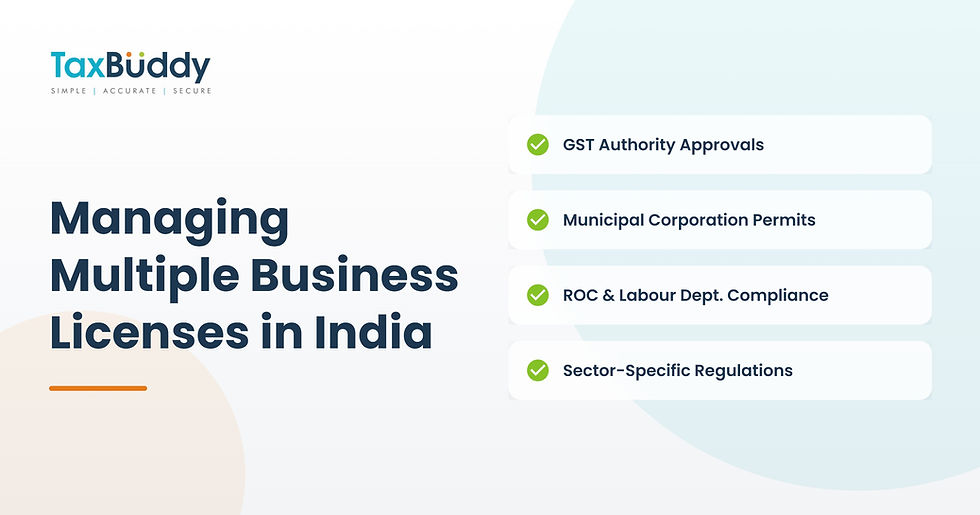
Managing multiple business licenses across different authorities in India requires structured planning, accurate record-keeping, and timely renewals. A single business entity operating under one PAN may need approvals from GST authorities, municipal corporations, ROC, labour departments, and sector-specific regulators. Each license has separate validity, jurisdiction, and compliance conditions. Without a centralised system, businesses risk penalties, cancellation of registrations, or tax disputes. Effective license management ensures smooth audits, correct income reporting under the Income-Tax Act, and proper alignment with GST and corporate regulations.
Managing multiple business licenses across different authorities involves identifying every required registration, mapping them to the correct legal entity and PAN, tracking renewal timelines, maintaining separate records for each activity, and ensuring proper reporting under tax and regulatory laws to prevent compliance gaps and penalties.
Table of Contents
Why Managing Multiple Business Licenses Across Different Authorities Is Complex
How the Income-Tax Act, 1961 Applies to Multiple Business Activities
How GST Registration Works for Multiple Businesses Under One PAN
Managing ROC, Shop and Establishment, and FSSAI Licenses Together
Role of Technology in Managing Business Licenses and Tax Compliance
Why Managing Multiple Business Licenses Across Different Authorities Is Complex
Managing multiple business licenses becomes complex because each authority functions independently, follows different laws, and applies separate compliance standards. A single business operating under one PAN may need approvals from GST authorities, municipal corporations, the Registrar of Companies (ROC), labour departments, food regulators, pollution boards, and local trade authorities.
Each license has its own jurisdiction, renewal cycle, documentation format, inspection rules, and penalties for non-compliance. Some are location-based, such as Shop and Establishment registration. Others are activity-based, such as FSSAI licenses for food businesses. When operations expand across states, additional registrations may be required.
The challenge increases when income from all activities must be consolidated for tax reporting while still maintaining activity-wise clarity. Without a structured system, missed renewals, mismatched records, or incorrect reporting may lead to penalties, cancellation of licenses, or scrutiny during assessments.
How the Income-Tax Act, 1961 Applies to Multiple Business Activities
The Income-Tax Act, 1961, does not restrict a person or entity from carrying out multiple business activities under one PAN. However, it requires proper classification and reporting of income under the head “Profits and Gains of Business or Profession.”
All business income must be accurately recorded. Even if activities differ in nature, such as trading, manufacturing, consulting, or retail, income must be aggregated for tax computation. At the same time, proper internal segregation of income and expenses is essential.
Section 44AA mandates the maintenance of books of account. When multiple businesses operate under one entity, separate ledgers for each activity help in:
Correct expense allocation
Clear profit analysis
Avoidance of disallowances
Smooth assessment proceedings
Failure to maintain proper records can lead to penalties and disallowance of deductions. Therefore, tax compliance depends heavily on organised documentation across all business streams.
How GST Registration Works for Multiple Businesses Under One PAN
GST registration is PAN-based. If multiple business activities operate within the same state under one legal entity, generally, one GSTIN is sufficient. However, separate registrations may be required when:
Business operations are in different states
Separate verticals require independent compliance tracking
Authorities mandate distinct registrations for operational clarity
Each GST registration involves separate return filing, reconciliation, and compliance obligations. Businesses operating in multiple states must track state-wise GST filings, tax payments, and input tax credit records.
Even when a single GSTIN is used, turnover from all activities must be consolidated while maintaining separate internal records. Proper reconciliation between GST returns and income-tax books is essential to avoid notices for a mismatch in turnover or tax liability.
Managing ROC, Shop and Establishment, and FSSAI Licenses Together
For companies registered under corporate law, the Memorandum of Association must permit the intended business activities. If a new activity is outside the existing object clause, amendment procedures may be required before expansion.
Shop and Establishment registration is location-specific. Each office, store, or branch may require separate registration depending on state regulations.
FSSAI licensing is premises-based and mandatory for food-related businesses. Manufacturing units, warehouses, and retail outlets may each require separate approval.
The key difficulty lies in synchronising these registrations. Each authority has independent renewal cycles and inspection procedures. Expiry of one license can impact banking operations, vendor contracts, or tax registrations. Coordinated monitoring is therefore critical.
Bank Accounts, KYC, and Multiple Business Licenses
Banks require complete KYC documentation linked to the legal entity. When multiple business activities are carried out under one entity, banks may request:
PAN and entity registration proof
GST registration
Trade licenses
Activity-specific approvals
Authorization documents
If activities operate across states with multiple GSTINs, banks may expect clarity on which account maps to which GST registration. While separate bank accounts may not always be mandatory, maintaining structured transaction tracking is advisable.
Clear segregation of receipts and expenses prevents confusion during audits, loan processing, or tax scrutiny. Inconsistent mapping between business activities and banking records often triggers compliance queries.
Record-Keeping Requirements Under the Income-Tax Act
Accurate record-keeping is central to managing multiple licenses and business streams. Businesses must maintain:
Activity-wise sales records
Expense allocation working papers
License copies and renewal acknowledgments
GST reconciliation statements
Bank transaction summaries
When overhead expenses such as rent, salaries, or utilities apply to multiple activities, allocation must be reasonable and documented. During assessment proceedings, tax authorities may question profit margins if the allocation appears arbitrary.
Maintaining structured records supports correct deduction claims and reduces risk during scrutiny assessments.
Best Practices for Managing Multiple Business Licenses
A centralised compliance approach significantly reduces risk. Effective practices include:
Maintaining a digital compliance register listing all licenses, issuing authorities, and expiry dates
Setting renewal reminders at least 30 to 45 days before expiry
Creating separate accounting cost centres for each business activity
Conducting quarterly compliance reviews
Mapping GST filings with income-tax turnover
Periodic review prevents last-minute renewals and compliance gaps. Structured internal systems also help during audits, funding rounds, or expansion into new jurisdictions.
Common Compliance Risks and How to Avoid Penalties
Common risks include:
Expired trade licenses
Mismatch between GST turnover and income-tax returns
Incorrect expense allocation
Operating outside permitted business objects
Missing state-specific registrations
Penalties may include fines, cancellation of registration, disallowance of expenses, or tax reassessment.
These risks can be minimised by:
Quarterly compliance audits
Professional review of license status
Cross-verification between GST and accounting records
Timely amendment of corporate documents when expanding activities
Early detection is far less costly than post-notice correction.
Role of Technology in Managing Business Licenses and Tax Compliance
As businesses expand into multiple locations, product lines, or service verticals, compliance complexity increases significantly. Manual tracking through spreadsheets, physical files, or scattered email records may work in the early stages, but it often becomes unreliable as operations scale. Missed renewal dates, misplaced documents, and inconsistent reporting across departments can lead to penalties, operational disruption, or regulatory notices.
Digital compliance systems bring structure, visibility, and accountability into the process. Instead of relying on memory or manual reminders, technology creates a centralized compliance framework where every license, registration, and filing obligation is recorded and monitored in one place.
Centralized storage of licenses and certificates
One of the biggest advantages of technology is secure digital storage. All licenses, such as GST registration, FSSAI approvals, Shop and Establishment certificates, trade licenses, and corporate filings, can be stored in an organised digital repository. Each document can be tagged with details such as issuing authority, jurisdiction, validity period, and related business activity. This eliminates dependency on physical files and ensures that documents are easily retrievable during inspections, audits, or bank verification processes.
Renewal alerts and automated reminders
License renewals are often time-sensitive. Missing a renewal deadline can lead to penalties or temporary suspension of operations. Technology platforms allow businesses to set automated alerts well before expiry dates. These reminders can be configured at multiple intervals, such as 60 days, 30 days, and 7 days before expiry. Automated reminders reduce human error and ensure that compliance deadlines are never overlooked.
GST and tax filing tracking
Businesses operating under multiple GST registrations or handling multiple business streams must reconcile turnover, tax payments, and input credits regularly. Digital systems help track GST return filing status, due dates, and reconciliation reports. Similarly, income-tax filing milestones such as advance tax payments, TDS filings, and annual return submissions can be monitored through structured dashboards. This improves accuracy and minimises the risk of mismatch between GST returns and income-tax records.
Document organization for audits and assessments
During tax assessments, inspections, or bank audits, authorities may request copies of licenses, financial statements, and reconciliation documents. Technology-driven documentation systems allow businesses to categorise and archive documents year-wise and activity-wise. This structured approach ensures faster response to notices and reduces stress during compliance reviews.
Integration with accounting systems
Modern compliance tools can integrate with accounting software to link financial transactions with specific business activities or GST registrations. This makes expense allocation transparent and supports accurate reporting under the Income-Tax framework. Automated reconciliation between accounting data and tax filings further reduces discrepancies.
Improved visibility across regulatory obligations
When compliance data is centralized, management gains better visibility into overall regulatory health. Dashboards can highlight pending renewals, upcoming filings, and incomplete documentation. This proactive oversight allows corrective action before issues escalate.
TaxBuddy supports businesses by offering structured tax filing assistance, organised document management, and compliance reminders within a technology-enabled framework. By combining tax compliance tracking with digital organisation, businesses can reduce administrative burden and maintain clarity across multiple licenses, GST registrations, and income-tax obligations. Integrated digital systems ultimately create a more predictable, audit-ready, and scalable compliance environment.
Conclusion
Managing multiple business licenses across different authorities requires coordination between tax reporting, GST compliance, banking documentation, and corporate filings. Structured record-keeping, timely renewals, and technology-backed monitoring reduce operational risk and prevent penalties. Businesses that centralise compliance tracking maintain smoother audits and clearer financial reporting.
For anyone looking for assistance in managing tax compliance and related filings, download the TaxBuddy mobile app for a simplified, secure, and hassle-free experience:
FAQs
Q1. Can multiple businesses operate under one PAN in India?
Yes. A single legal entity, such as a sole proprietorship, partnership firm, LLP, or company, can carry out multiple business activities under one PAN. However, all activities must be legally permitted under the entity’s formation documents, and proper accounting records must be maintained for each business stream to ensure accurate tax reporting and compliance.
Q2. Is separate GST registration required for each business activity?
Not always. If multiple activities operate under the same legal entity within one state, a single GST registration is generally sufficient. However, separate GST registrations are mandatory when operations are conducted in different states or when distinct business verticals require independent compliance tracking under the GST law.
Q3. Do different branches require separate licenses?
In many cases, yes. Licenses such as Shop and Establishment registration, FSSAI license, and certain municipal trade licenses are location-specific. Each branch, office, warehouse, or outlet may need separate approval depending on state laws and the nature of the business activity.
Q4. How does the Income-Tax Act treat income from multiple business activities?
All income from different business activities under the same legal entity is reported under the head “Profits and Gains of Business or Profession.” While total income is consolidated for tax computation, businesses must internally maintain activity-wise segregation of revenue and expenses to ensure accurate reporting and avoid disputes during assessment.
Q5. Is it mandatory to maintain separate books of accounts for each business activity?
The law requires proper maintenance of books of account. While completely separate books may not be mandatory in every case, maintaining separate ledgers or cost centres for each activity is strongly recommended. This helps in accurate profit computation, expense allocation, and smooth compliance during audits or scrutiny.
Q6. Can one bank account be used for multiple business activities?
If all activities belong to the same legal entity, one bank account may be used. However, transactions should be clearly identifiable and properly recorded. For better compliance, many businesses maintain structured transaction tagging or separate accounts to simplify reconciliation and audit processes.
Q7. What happens if one of the business licenses expires?
Operating with an expired license can lead to penalties, cancellation of registration, fines, or operational restrictions. In some cases, it may also impact GST registration, vendor contracts, or banking relationships. Regular monitoring of renewal timelines is essential to avoid disruption.
Q8. How should common expenses be allocated between multiple businesses?
Common expenses such as rent, utilities, or salaries should be allocated using a reasonable and documented method, such as turnover ratio, space usage, or time allocation. Improper or arbitrary allocation may lead to the disallowance of expenses during tax assessment.
Q9. Does adding a new business activity require amendment of company documents?
For companies, new business activities must align with the object clause in the Memorandum of Association. If the proposed activity is not covered, an amendment may be required before commencing operations. This ensures legal validity and prevents regulatory complications.
Q10. How do multiple GST registrations affect compliance?
When businesses operate in multiple states and hold separate GST registrations, each registration requires independent return filing, tax payment, and reconciliation. Businesses must ensure accurate mapping of invoices, input tax credit, and turnover to each GSTIN to prevent notices for mismatches.
Q11. What are the common compliance risks in managing multiple licenses?
Common risks include missed renewals, a mismatch between GST returns and income-tax records, incorrect expense allocation, operating without proper location-based approvals, and failing to update corporate documents when expanding activities. These risks can lead to penalties, scrutiny, or cancellation of registrations.
Q12. What is the best way to manage multiple business licenses efficiently?
The most effective approach is maintaining a centralized compliance register that tracks license type, issuing authority, validity period, renewal dates, and supporting documents. Digital tools and structured accounting systems significantly reduce manual errors and ensure audit-ready documentation across all regulatory authorities.


