

Can You Claim Deductions Under Section 80D and 80DDB Together?
- PRITI SIRDESHMUKH

- Aug 29, 2025
- 6 min read
Updated: Sep 1, 2025
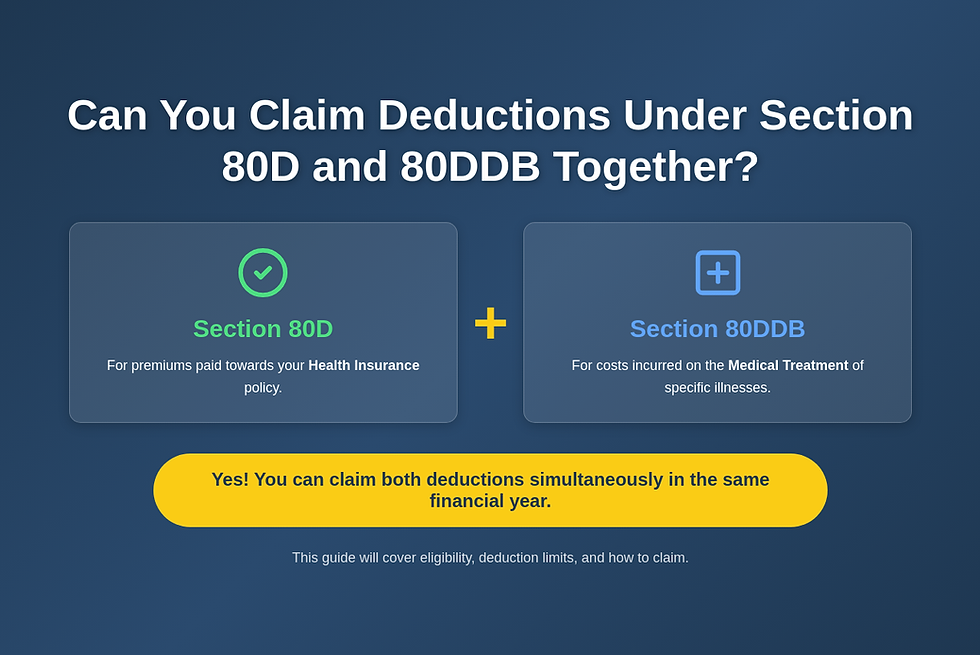
Yes. A person can absolutely claim 80D and 80DDB together in the same financial year. The Income Tax Act allows you to claim these deductions simultaneously because they serve different purposes. Section 80D relates to premiums paid for health insurance, while Section 80DDB covers costs for the medical treatment of specific illnesses. This article will explain each section, their deduction limits, and who is eligible to claim them. It will also provide a clear guide on how to claim both tax deductions for medical expenses.
Table of Index
What is Section 80D? Deduction for Health Insurance
A Section 80D deduction primarily encourages people to get health insurance for themselves and their families. This part of the tax law allows an individual or a Hindu Undivided Family (HUF) to lower their taxable income by the amount paid for health insurance premiums. The Section 80D deduction also includes a small sub-limit for preventive health check-ups. You can claim up to ₹5,000 for these check-ups, which is part of the overall 80D limit. It's important to know that premium payments must be made in any mode other than cash to qualify.
The 80D limit depends on the age of the individuals covered by the policy.
Category | Age | Maximum Deduction |
Self, Spouse, & Dependent Children | Under 60 years | ₹25,000 |
Self, Spouse, & Dependent Children | 60 years or older | ₹50,000 |
Parents | Under 60 years | ₹25,000 (additional) |
Parents | 60 years or older | ₹50,000 (additional) |
(Source: Income Tax Act, based on information from multiple sources)
For a complete guide, read our detailed article on Section 80D.
What is Section 80DDB? Deduction for Specified Diseases
A Section 80DDB deduction is available for expenses related to the actual medical treatment of specified critical illnesses. Unlike 80D, this is not for insurance premiums but for the money you spend on treatment. This benefit is available to resident individuals and HUFs for medical costs incurred for themselves or their dependents. Dependents include a spouse, children, parents, and even dependent siblings.
The deduction is limited to the actual amount spent on treatment or a set limit, whichever is lower. The 80DDB limit is ₹40,000 for a patient under 60 years of age. This limit increases to ₹1,00,000 if the individual receiving treatment is a senior citizen (60 years or older).
A crucial point for the Section 80DDB deduction is that any amount received from an insurer or an employer for the treatment must be subtracted from your claim amount. The list of illnesses that qualify is defined as per Rule 11DD of the Income Tax Rules. Some common examples include:
Malignant Cancers
Dementia
Parkinson's Disease
Chronic Renal Failure
AIDS
The Key Difference: 80D vs. 80DDB at a Glance
To claim 80D and 80DDB together correctly, understanding their fundamental differences is essential. The core distinction lies in what each section covers: one is for insurance premiums, and the other is for treatment costs. The difference between 80D and 80DDB is made clearer in the table below.
Parameter | Section 80D | Section 80DDB |
Purpose | Deduction for Health Insurance Premiums & Health Check-ups. | Deduction for money spent on treatment of specified critical diseases. |
Basis of Claim | Premium Paid. | Actual Medical Expenditure. |
Deduction Limit | Up to ₹1,00,000 (based on the age of self/family + parents). | Up to ₹1,00,000 (based on the patient's age). |
Documentation | Premium Payment Receipts. | Prescription from a specialist is required. |
Reimbursement Rule | Not applicable. | The deduction is reduced by any amount received from an insurer or employer. |
Practical Scenarios: Claiming 80D and 80DDB Together
Seeing a tax calculation with 80D and 80DDB in action makes it easier to understand. Here are a couple of examples.
Scenario 1: You and Your Non-Senior Citizen Parent
Imagine your age is 35 and your parent's age is 58.
You pay a health insurance premium of ₹20,000 for yourself. Your 80D claim is ₹20,000.
You also pay a premium of ₹22,000 for your parent. Your additional 80D claim is ₹22,000.
Your parent undergoes treatment for a specified disease costing ₹50,000. Your insurance policy covers ₹10,000 of this bill.
Your 80DDB calculation is based on the limit for a non-senior citizen (₹40,000) minus the insurance payment. So, your 80DDB claim is ₹40,000 - ₹10,000 = ₹30,000.
Your total claim for the year would be ₹20,000 + ₹22,000 + ₹30,000 = ₹72,000.
Scenario 2: You and Your Senior Citizen Parent
Now, let's say you are 40 and your parent is 65.
You pay a health insurance premium of ₹25,000 for yourself. Your 80D claim is ₹25,000.
You pay a premium of ₹45,000 for your senior citizen parent. Your additional 80D claim is ₹45,000.
Your parent receives treatment for a specified disease that costs ₹1,20,000. There is no insurance reimbursement for this treatment.
Your 80DDB claim is capped at the senior citizen limit. Since the actual expense is higher, your 80DDB claim is ₹1,00,000.
Your total deduction is ₹25,000 + ₹45,000 + ₹1,00,000 = ₹1,70,000.
How to Claim 80D & 80DDB in Your ITR: A Checklist
Knowing how to claim 80DDB and 80D properly ensures you get the tax benefits you are entitled to. Follow this simple checklist.
For Section 80D: Keep the premium payment receipts for your health insurance policy. Remember that payments, except for preventive health check-ups, must be made through banking channels, not cash.
For Section 80DDB: You MUST get a prescription from a qualified specialist confirming the disease. While Form 10-I is no longer mandatory to be filed, the prescription serves as essential proof.
Calculate Your Deduction: For your 80DDB claim, always remember to subtract any amount that was paid back by an insurance company or your employer.
File Your ITR: Enter the final amounts for each deduction in the correct schedules when you file your Income Tax Return. Both Section 80D and Section 80DDB are claimed under the Chapter VI-A deductions section.
Keep Records: You don't need to send these documents to the Income Tax Department when you file. However, you must keep them safely in your records in case your tax return is chosen for a detailed review.
Important Note: New Tax Regime vs. Old Tax Regime
There's a crucial point to remember when planning your taxes. The deductions under Section 80D and Section 80DDB are only available if you choose to file your taxes under the Old Tax Regime. If you opt for the New Tax Regime (under Section 115BAC), you cannot claim these specific medical and insurance benefits. This choice can significantly impact your tax savings, so it's vital to select the regime that offers you more benefits based on your financial situation.
Conclusion
So, it's clear that you can claim both 80D and 80DDB deductions in the same year, which is great for your tax savings. The key is to understand their distinct roles. Section 80D helps with the cost of health insurance premiums, while Section 80DDB provides relief for the actual costs of treating serious illnesses. This powerful combination allows you to maximize your deductions significantly. Always remember that these benefits are exclusively available under the old tax regime. Proper tax planning can help you make the most of these provisions.
Confused about your tax deductions? Let TaxBuddy's experts help you file correctly and maximize your savings.
FAQs
Q1. Can I claim 80DDB for my in-laws?
No, the deduction for 80DDB is not available for in-laws. It can only be claimed for the taxpayer, their spouse, children, parents, and dependent siblings.
Q2. Is a medical certificate mandatory for an 80DDB claim?
Yes, a prescription or a certificate from a qualified specialist is essential to claim the 80DDB deduction.
Q3. Can I claim both 80DD and 80DDB?
Yes, you can claim deductions under both sections if you meet the criteria for each. Section 80DD is for expenses related to a dependent with a disability, while 80DDB is for treatment costs of specified diseases.
Q4. What if my medical expenses are less than the 80DDB limit?
You can only claim the actual amount you spent on medical treatment. For instance, if the limit is ₹40,000 but you only spent ₹30,000, your deduction is limited to ₹30,000.
Q5. Can I pay for a health check-up in cash and claim it under 80D?
Yes, the sub-limit of ₹5,000 available for preventive health check-ups is the only part of the 80D deduction that can be claimed even if paid in cash.
Q6. Can an HUF claim both 80D and 80DDB?
Yes, a Hindu Undivided Family (HUF) can claim deductions under both 80D and 80DDB for its members, subject to the applicable limits and conditions.
Q7. Is cancer treatment covered under Section 80DDB?
Yes, malignant cancers are included in the list of specified diseases covered under Section 80DDB.
Q8. What if my employer reimburses the full amount of my parent's treatment?
If the full amount is reimbursed by an employer or an insurer, you cannot claim any deduction under Section 80DDB. The deduction is only for out-of-pocket expenses.
Q9. Can I claim 80D for a policy from any insurance company?
Yes, you can claim the 80D deduction for a policy from any insurer, as long as the company is approved by the Insurance Regulatory and Development Authority of India (IRDAI).
Q10. Can a non-resident Indian (NRI) claim 80D and 80DDB?
An NRI can claim a deduction under Section 80D. However, the deduction under Section 80DDB is only available to resident individuals and HUFs.



Comments