

High Deductions Under Chapter VI-A: How TaxBuddy Prepares for Scrutiny Income Tax Notices
- Asharam Swain

- Jan 1, 2026
- 8 min read
High deductions claimed under Chapter VI-A often attract closer attention from the Income Tax Department. Sections such as 80C, 80D, and 80G are commonly misused or claimed without adequate documentation, making them frequent scrutiny triggers. When deductions form a significant portion of total income or do not align with AIS and Form 26AS data, scrutiny notices under Section 143(2) become likely. Proper preparation, accurate reporting, and strong documentation are critical to avoid penalties or prolonged assessments. Platforms like TaxBuddy focus on proactive verification and structured responses to reduce compliance risks during such scrutiny.
Table of Contents
What Are Chapter VI-A Deductions Under the Income Tax Act
Chapter VI-A of the Income Tax Act allows taxpayers to reduce taxable income through specific deductions linked to savings, insurance, health expenses, donations, and certain personal circumstances. These deductions are claimed from gross total income, not from tax payable. Popular sections include 80C for investments like PPF, ELSS, and life insurance, 80D for medical insurance premiums, and 80G for eligible donations. Each section comes with its own limits, conditions, and documentation requirements. While these provisions are meant to encourage financial discipline and social contributions, incorrect or excessive claims can invite closer examination by the tax authorities.
Why High Deductions Under Chapter VI-A Trigger Scrutiny Notices
High deductions often raise questions when they appear disproportionate to reported income or deviate sharply from past filing patterns. The Income Tax Department uses data analytics to identify cases where deductions form an unusually large percentage of income, typically exceeding common benchmarks. Such cases are flagged to verify whether the claims are genuine, correctly reported, and fully supported by evidence. Scrutiny is not an accusation of wrongdoing but a process to confirm compliance, especially in areas historically linked to misuse.
Common Scrutiny Triggers for Sections 80C, 80D, and 80G
Scrutiny commonly arises when claims lack proper proof or show inconsistencies with third-party data. Under Section 80C, missing investment statements or overlapping claims across family members are frequent issues. Section 80D claims are often questioned when insurer details do not match reported premiums. Donations under Section 80G attract scrutiny if the recipient institution is flagged, lacks valid registration, or fails to report donation details correctly. Repeated claims of the maximum allowable limit without income growth also act as red flags.
How the Income Tax Department Examines Chapter VI-A Claims
During scrutiny, the department verifies deductions against submitted documents, AIS data, and information received from banks, insurers, and charitable institutions. Notices may ask for copies of receipts, certificates, or policy documents. The examination focuses on eligibility, timing of payment, and correctness of amounts claimed. If discrepancies are found, explanations are sought before making any adjustment. Clear documentation and timely responses play a key role in closing scrutiny without adverse outcomes.
Role of AIS and Form 26AS in Chapter VI-A Scrutiny
AIS and Form 26AS act as the backbone of data-driven scrutiny. These statements consolidate financial information reported by third parties, such as insurers and institutions receiving donations. When deduction claims in the return do not align with these records, automated alerts are generated. Even small mismatches can lead to notices, making it essential that claims reflect data already available with the department. Consistency between the return, AIS, and Form 26AS significantly reduces scrutiny risk.
How TaxBuddy Prepares Taxpayers for Scrutiny Income Tax Notices
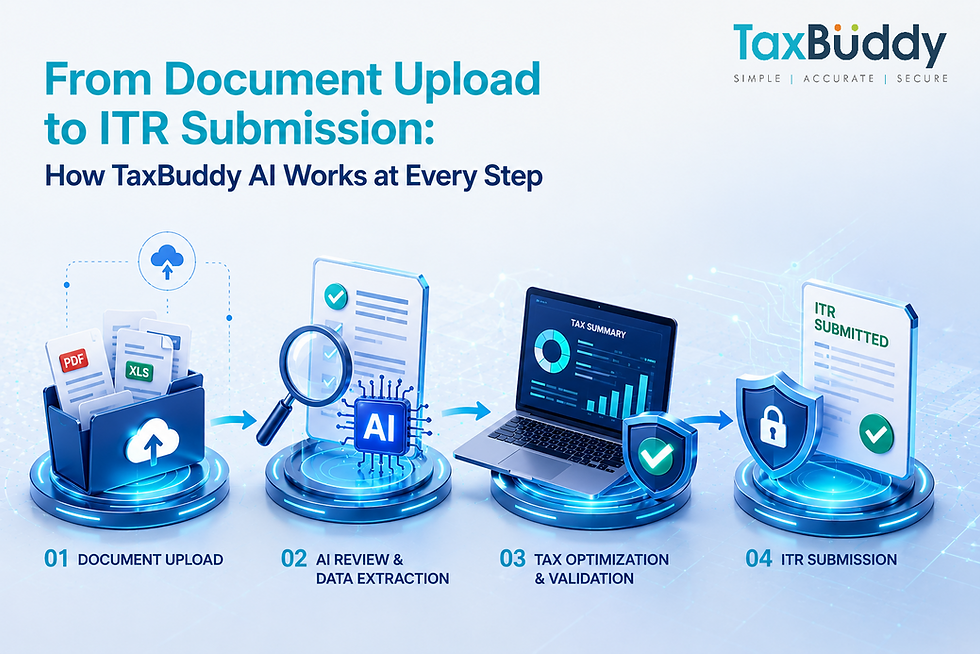
TaxBuddy focuses on prevention as much as resolution. Before filing, deduction claims are validated against available data to identify gaps early. Supporting documents are reviewed for completeness and accuracy. In cases where scrutiny notices are issued, TaxBuddy assists with structured responses, ensuring that explanations are clear, relevant, and supported by evidence. This approach reduces back-and-forth communication and helps bring scrutiny proceedings to a timely conclusion.
Document Management and Verification for High Deduction Claims
Effective document management is critical for high deduction cases. Investment proofs, insurance receipts, and donation certificates must be preserved in an organized manner. Digital storage allows quick retrieval during scrutiny and minimizes the risk of missing documents. Verification ensures that documents match the amounts claimed and comply with section-specific rules. Proper tagging and categorization of records make scrutiny responses more efficient and accurate.
Handling Section 143(2) Scrutiny Notices for Chapter VI-A
A notice under Section 143(2) indicates selection for detailed examination. The notice typically specifies the issues under review, including deduction claims. Responding involves submitting relevant documents, explanations, and reconciliations within prescribed timelines. Clear, factual replies reduce the likelihood of escalation to deeper assessment. Professional review before submission helps avoid incomplete or inconsistent responses that could prolong the process.
Reducing Penalty Risk Through Accurate Reporting and Compliance
Reducing penalty risk under the Income Tax Act largely depends on how accurately deductions and income are reported at the time of filing. Penalties are not imposed merely because deductions are high, but because claims are incorrect, excessive, or lack proper support. When reported figures do not align with available data or supporting documents, the tax department treats such discrepancies as potential misreporting, which increases exposure to penalties and interest.
Accurate reporting begins with a clear understanding of eligibility conditions under each deduction section. Every Chapter VI-A deduction has specific rules relating to limits, qualifying payments, and timing. Claims that exceed prescribed limits or ignore section-specific conditions are more likely to be questioned. Ensuring that deductions are claimed only under the correct tax regime and within allowable thresholds reduces the risk of disallowance during scrutiny.
Verifiable documentation plays a critical role in defending deduction claims. Investment proofs, insurance premium receipts, and donation certificates must clearly reflect the taxpayer’s PAN, payment date, and eligible amount. Documents that are incomplete, unclear, or inconsistent with the return often weaken the explanation during scrutiny. Maintaining organized records makes it easier to respond accurately and within deadlines if clarification is sought.
Regular review of AIS data is another key compliance measure. AIS reflects information reported by banks, insurers, and institutions, and the tax department relies heavily on this data for cross-verification. Even genuine deductions may attract scrutiny if they do not match AIS entries. Reviewing this information before filing allows discrepancies to be identified early, giving taxpayers the opportunity to correct errors or provide feedback where third-party reporting is inaccurate.
Avoiding aggressive or unrealistic claims also helps maintain compliance. Claiming deductions at maximum limits year after year without corresponding income growth, or claiming benefits that do not align with the taxpayer’s financial profile, increases scrutiny risk. A conservative and consistent approach to deductions, supported by actual financial activity, is more sustainable and defensible.
When discrepancies are identified after filing, timely corrective action can significantly reduce penalty exposure. Filing a revised return to correct errors, or providing clear explanations during assessment, demonstrates intent to comply rather than conceal. Early resolution often prevents escalation into penalty proceedings and limits the accumulation of interest.
Overall, compliance is strengthened through accuracy, consistency, and transparency. When deductions are reported correctly, supported by valid documentation, and aligned with available data, scrutiny proceedings are more likely to conclude without penalties, ensuring a smoother and more predictable tax assessment outcome.
Conclusion
High deductions under Chapter VI-A require careful reporting and strong documentation, especially in an environment driven by data matching and analytics. Scrutiny notices are increasingly focused on consistency, proportionality, and proof. A structured approach to filing and response management reduces uncertainty and compliance risk. For taxpayers seeking a smoother experience in handling deductions and scrutiny, downloading the TaxBuddy mobile app offers a simplified, secure, and hassle-free way to manage tax filing and notices.
FAQs
Q1. Does TaxBuddy offer both self-filing and expert-assisted plans for ITR filing, or only expert-assisted options?
TaxBuddy offers both self-filing and expert-assisted plans to suit different taxpayer needs. The self-filing option is designed for individuals with straightforward income and deduction profiles, where automated checks and guided steps are sufficient. For cases involving high Chapter VI-A deductions, multiple income sources, or scrutiny notices, the expert-assisted plan provides access to qualified tax professionals who review claims, validate documents, and manage responses to notices. This flexibility allows taxpayers to choose the level of support required without shifting platforms.
Q2. Which is the best site to file ITR?
The Income Tax Department’s official e-filing portal remains the primary and authoritative platform for filing income tax returns in India. However, many taxpayers prefer assisted platforms that simplify the process through structured workflows, pre-filled data, and built-in validation checks. Platforms like TaxBuddy integrate directly with the official portal while offering additional layers of accuracy checks, deduction reviews, and post-filing support, which are particularly useful when high deductions or scrutiny risks are involved.
Q3. Where to file an income tax return?
Income tax returns are filed on the Income Tax Department’s e-filing portal. Taxpayers can file directly on the portal or use authorized platforms that act as intermediaries while submitting returns to the same government system. Assisted platforms streamline data entry, document uploads, and compliance tracking, reducing the likelihood of errors that could later trigger scrutiny.
Q4. Are Chapter VI-A deductions available under the new tax regime?
Most Chapter VI-A deductions are not available under the new tax regime. Popular deductions such as those under Sections 80C, 80D, and 80G apply only under the old tax regime. The new regime offers lower tax rates but removes most deductions, with limited exceptions linked to employer contributions in specific cases. Choosing the correct regime before claiming deductions is essential, as incorrect claims under the new regime often lead to adjustments and notices.
Q5. How does scrutiny differ from regular assessment?
Regular assessment is an automated process where returns are processed based on system checks and available data. Scrutiny, on the other hand, involves a detailed examination of specific aspects of the return, such as high deductions or income mismatches. During scrutiny, the tax department actively seeks explanations and supporting documents. The process is more interactive and time-bound, requiring clear responses to avoid adverse outcomes.
Q6. Can high deductions alone lead to penalties?
High deductions by themselves do not automatically result in penalties. Penalties generally arise when deductions are found to be incorrect, inflated, or unsupported by valid documents. If claims are genuine, properly reported, and backed by evidence, scrutiny may conclude without any penalty. Consistency with AIS data and timely responses play a crucial role in preventing adverse action.
Q7. How long does scrutiny under Section 143(2) usually take?
The duration of scrutiny under Section 143(2) varies depending on the complexity of the case and the quality of responses submitted. Some cases conclude within a few months, while others may extend longer if multiple clarifications are required. Prompt submission of complete documents and clear explanations helps shorten the process and avoid repeated queries.
Q8. Is it mandatory to submit physical documents during scrutiny?
Most scrutiny proceedings are conducted electronically through the income tax portal. Notices, responses, and document submissions are handled online, eliminating the need for physical visits or paper submissions in most cases. Digital uploads of investment proofs, insurance receipts, and donation certificates are generally sufficient, provided they are clear and complete.
Q9. Can past returns be scrutinized for Chapter VI-A deductions?
Yes, past returns can be selected for scrutiny within the time limits prescribed under the Income Tax Act. If high deductions were claimed in earlier years and later data indicates discrepancies, those returns may be examined. Maintaining proper records for past years is important, as scrutiny may require explanations or documents even after filing is completed.
Q10. What happens if a deduction claim is disallowed?
If a deduction claim is disallowed, the amount is added back to taxable income. This may result in additional tax liability along with applicable interest. In cases where the disallowance is due to misreporting or false claims, penalties may also be initiated. Accurate reporting and proper documentation reduce the risk of such outcomes.
Q11. How can AIS errors be corrected before scrutiny?
AIS allows taxpayers to provide feedback on incorrect, duplicated, or incomplete information reported by third parties. Submitting feedback helps align records before filing or during assessment. Correcting AIS discrepancies early ensures that deduction claims match available data, reducing the likelihood of automated flags and scrutiny notices.
Q12. Does professional assistance reduce scrutiny stress?
Professional assistance helps manage scrutiny in a structured and timely manner. Expert review ensures that responses are accurate, relevant, and supported by appropriate documents. This reduces uncertainty, avoids procedural mistakes, and helps bring scrutiny proceedings to a smoother conclusion, especially in cases involving high Chapter VI-A deductions.




Comments