

Tax Year in Income Tax: Meaning, Changes and Impact from 2026

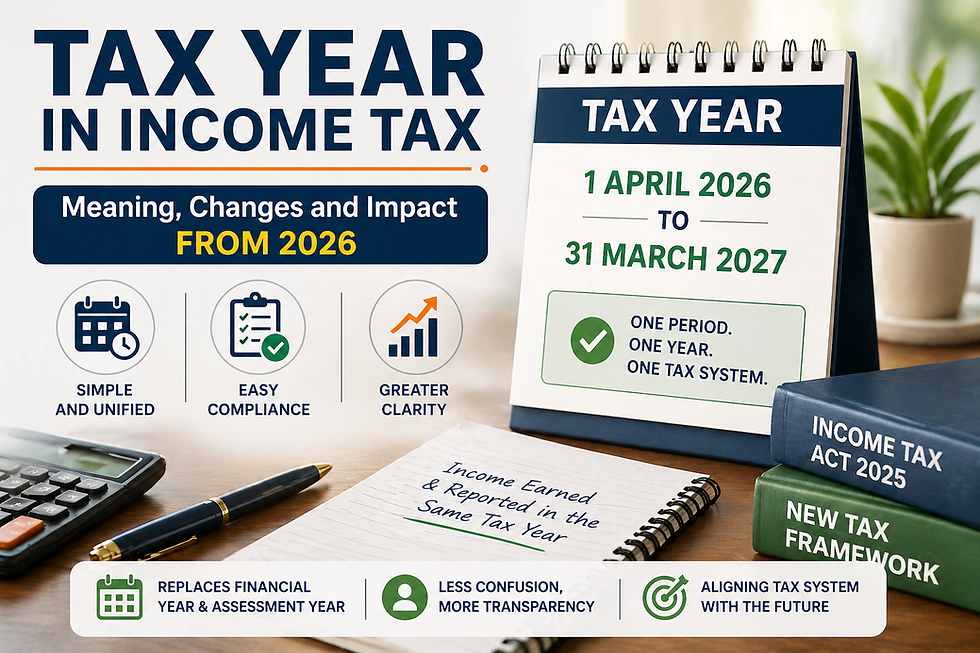
The Income Tax Act 2025 introduces a new approach to defining tax periods in India by replacing the earlier system of Financial Year and Assessment Year with a single concept known as the Tax Year. This change will come into effect from April 1, 2026, and will apply to income earned from that date onward.
Under the earlier framework, taxpayers were required to understand two separate timelines. The Financial Year referred to the period in which income was earned, while the Assessment Year referred to the period in which that income was reported and assessed. This dual system often created confusion, especially for individuals who were not familiar with tax terminology.
The new framework simplifies this process by introducing a single Tax Year, which represents the period in which income is both earned and reported. By combining these timelines, the new system removes the need to track multiple years for taxation purposes.
Table of Contents
Tax Year in Income Tax Overview
The Tax Year is a defined period under the Income Tax Act 2025 that represents the timeline during which income is earned and taxed. It replaces the earlier concepts of Financial Year and Assessment Year, providing a single, unified framework for taxation.
The Tax Year typically spans a period of twelve months, beginning on April 1 and ending on March 31 of the following year. During this period, taxpayers earn income and are required to report it under the same timeline, removing the separation between earning and assessment.
This unified approach simplifies compliance by eliminating the need to differentiate between two different years. Taxpayers can now relate their income, reporting, and tax obligations to a single period, making the overall process easier to understand.
The introduction of the Tax Year also supports a more streamlined tax administration system. Aligning timelines and reducing complexity, it helps improve accuracy in reporting and reduces the likelihood of errors during filing.
What Is a Tax Year
A Tax Year is the period defined under the Income Tax Act 2025 during which income is earned and taxed. It replaces the earlier system of having separate timelines for earning income and assessing it.
The Tax Year is a continuous 12-month period that begins on April 1 and ends on March 31 of the following year. All income earned within this period is reported and taxed within the same timeline.
This unified concept removes the need to distinguish between different years for different purposes. It allows taxpayers to relate their income, deductions, and tax obligations to a single period, making the system easier to understand and apply.
Why the Tax Year Concept Was Introduced
The earlier system required taxpayers to track both the Financial Year and the Assessment Year. This created confusion, especially for individuals who were not familiar with tax terminology.
The Tax Year concept has been introduced to simplify this structure. By combining the two timelines into one, the new framework reduces complexity and improves clarity.
The objective is to make tax compliance easier, reduce errors in filing, and improve understanding of tax obligations. It also supports a more streamlined approach to tax administration.
Tax Year vs Financial Year vs Assessment Year
Under the earlier system, three different terms were used to define tax timelines.
The Financial Year referred to the period during which income was earned. The Assessment Year referred to the period in which that income was reported and assessed. These two timelines were linked but separate.
The Tax Year replaces both these concepts with a single period. Income is earned and reported within the same timeframe, eliminating the need to manage two different years.
This change simplifies understanding and reduces the chances of confusion while filing tax returns.
Duration of the Tax Year
The Tax Year follows a standard duration of twelve months. It begins on April 1 and ends on March 31 of the next year.
This duration remains consistent for most taxpayers. All income earned during this period is included in the same Tax Year, and tax compliance is based on this single timeline.
A uniform duration ensures consistency across individuals, businesses, and other entities.
Special Cases: Short Tax Year for New Businesses
In certain situations, the Tax Year may be shorter than twelve months. This typically applies to new businesses or entities that are established during the year.
For such cases, the Tax Year begins from the date of commencement of the business and ends on March 31 of the same year. This results in a shorter period for the first year of operation.
After the initial year, the business will follow the standard twelve-month Tax Year cycle.
Applicability of the Tax Year Concept
The Tax Year concept will apply from April 1, 2026, onward. It will be relevant for all taxpayers, including individuals, businesses, and other entities.
For income earned before this date, the earlier system of Financial Year and Assessment Year will continue to apply. The new concept will only apply to income earned from the Tax Year 2026–27 onward.
How the Tax Year Simplifies Tax Filing
The introduction of the Tax Year simplifies tax filing by removing the need to manage two different timelines.
Taxpayers no longer need to determine which Assessment Year corresponds to a particular Financial Year. Instead, they can focus on a single period for both earning and reporting income.
This reduces confusion, minimises errors, and makes the filing process more straightforward. It also improves consistency in reporting and compliance.
Impact of Tax Year on Taxpayers
For individual taxpayers, the Tax Year makes it easier to understand tax obligations. Income, deductions, and tax liability are all linked to a single period.
This simplifies record-keeping and reduces the chances of mistakes while filing returns. It also improves clarity in understanding deadlines and compliance requirements.
Overall, the change is expected to make tax filing more user-friendly for individuals.
Impact on Businesses and Professionals
Businesses and professionals will benefit from a clearer and more streamlined system. The alignment of income and reporting within a single period simplifies accounting and compliance processes.
It reduces the need for adjustments between different timelines and makes financial planning more straightforward. Professionals handling tax compliance will also find it easier to manage filings and reporting.
Advantages of the Tax Year System
The Tax Year system offers several benefits:
Simplifies tax timelines by using a single period
Reduces confusion between different tax terms
Improves clarity in compliance requirements
Makes tax filing more straightforward
Aligns with modern and digital tax systems
These advantages contribute to a more efficient and user-friendly tax framework.
Key Points to Remember About Tax Year
The Tax Year replaces the Financial Year and Assessment Year
It follows a 12-month period from April 1 to March 31
It applies from April 1, 2026
It simplifies compliance and reporting
It may be shorter for new businesses in their first year
Understanding these key points helps taxpayers adapt to the new system effectively.
Conclusion
The introduction of the Tax Year under the Income Tax Act 2025 represents a major step toward simplifying tax compliance in India. By replacing multiple timelines with a single unified period, the new system improves clarity and reduces confusion.
The change is expected to make tax filing easier for individuals, businesses, and professionals. While the transition may require some adjustment, the long-term benefits of a simpler and more structured system are significant.
FAQs
Q1. What is a Tax Year in income tax?
A Tax Year is a single 12-month period, starting from April 1 and ending on March 31, during which income is earned and taxed under the new system. It replaces the earlier approach where income was earned in one year and assessed in another. This unified timeline helps taxpayers track income and reporting within the same period.
Q2. When will the Tax Year concept be implemented in India?
The Tax Year concept will apply from April 1, 2026. It will be used for all income earned from the Tax Year 2026–27 onward. For income earned before this date, the earlier system of Financial Year and Assessment Year will continue to apply.
Q3. How is the Tax Year different from the Financial Year?
The Financial Year referred only to the period in which income was earned. The Tax Year combines both earning and reporting of income into one timeline. This removes the need to link one year to another and simplifies the overall tax process.
Q4. What happens to the Assessment Year under the new system?
The Assessment Year concept is removed under the new system. Since income is both earned and reported within the same Tax Year, there is no need for a separate period for assessment.
Q5. Will the Tax Year always be 12 months?
In most cases, the Tax Year will be a full 12-month period from April to March. However, in specific situations such as newly established businesses, the first Tax Year may be shorter.
Q6. How does the Tax Year apply to new businesses?
For new businesses or entities formed during the year, the Tax Year will begin from the date of establishment and end on March 31 of that year. This results in a shorter initial Tax Year, after which the standard cycle applies.
Q7. Does the Tax Year apply to all types of taxpayers?
Yes, the Tax Year applies to individuals, businesses, professionals, and other entities. It creates a uniform timeline for all taxpayers, making compliance more consistent across different categories.
Q8. Will the Tax Year change tax rates or tax liability?
No, the introduction of the Tax Year does not change tax rates or the overall tax calculation. It only simplifies the timeline and structure of taxation without affecting the amount of tax payable.
Q9. How does the Tax Year simplify tax filing?
The Tax Year eliminates the need to match the Financial Year with the Assessment Year. Taxpayers only need to focus on one period, which reduces confusion and makes filing returns easier and more accurate.
Q10. What impact does the Tax Year have on record-keeping?
Record-keeping becomes simpler because all income, expenses, and deductions are tracked within a single period. This reduces the chances of errors and makes it easier to maintain accurate financial records.
Q11. Will businesses need to change their accounting systems?
Businesses may need to align their reporting and compliance processes with the Tax Year structure. However, since the Tax Year still follows the April to March cycle, the overall impact on accounting systems is expected to be limited.
Q12. How does the Tax Year benefit individual taxpayers?
Individual taxpayers benefit from improved clarity and reduced complexity. They no longer need to understand multiple tax timelines, making it easier to plan, calculate, and file taxes correctly.
Q13. Does the Tax Year reduce errors in tax filing?
Yes, by removing multiple timelines and simplifying the structure, the Tax Year reduces the chances of mistakes in selecting the correct year for reporting income and filing returns.
Q14. Is the Tax Year aligned with global tax practices?
Many tax systems globally use a single reporting period. The introduction of the Tax Year brings India’s system closer to such practices, making it more straightforward and easier to understand.
Q15. What should taxpayers do to prepare for the Tax Year system?
Taxpayers should understand how the new timeline works, ensure their records are maintained according to the April to March cycle, and update their knowledge of compliance requirements. Being aware of the change will help in adapting smoothly to the new system.


