

When Switching Tax Regimes Mid-Career Creates Long-Term Tax Inefficiency
- PRITI SIRDESHMUKH

- Feb 5
- 9 min read
Switching between the old and new tax regimes under Section 115BAC may appear harmless for salaried individuals, especially when income levels rise or deductions seem limited. However, mid-career regime changes often disrupt long-term tax planning built around consistent investments, housing decisions, and family-related deductions. As careers progress, deductions typically increase, not decline. Frequent regime switching during this phase can reduce the effectiveness of compounding, weaken retirement planning, and create mismatches between tax-saving habits and applicable benefits. Understanding how regime flexibility interacts with long-term financial behaviour is critical to avoiding hidden tax inefficiencies later in life.
Table of Contents
Understanding Tax Regime Choices Under Section 115BAC
Section 115BAC of the Income Tax Act introduced an alternative tax structure for individuals and HUFs, commonly referred to as the new tax regime. This regime was designed to simplify taxation by offering lower slab rates while removing most exemptions and deductions available under the old regime. From FY 2023–24 onwards, the new tax regime became the default option, although salaried individuals without business income retain the flexibility to choose between the two regimes every year while filing their income tax return.
The choice under Section 115BAC is not permanent for salaried taxpayers, but the impact of switching regimes repeatedly is often underestimated. While the law allows annual selection, the financial decisions that support each regime, such as investments and long-term commitments, are not easily reversible.
Key Differences Between Old and New Tax Regimes
The old tax regime follows higher slab rates but allows a wide range of deductions and exemptions, including those under Section 80C, 80D, HRA, LTA, and home loan interest on self-occupied property. This structure rewards disciplined long-term financial planning and is especially beneficial when deductions grow over time.
The new tax regime offers lower slab rates and a higher rebate threshold but restricts most deductions and exemptions. Only limited benefits, such as the standard deduction and employer contribution to NPS are permitted. While the reduced rates can lower tax liability for individuals with minimal deductions, the absence of deduction-linked incentives significantly alters long-term tax outcomes.
Is the New Tax Regime Suitable for Mid-Career Salaried Professionals?
The suitability of the new tax regime for mid-career salaried professionals depends largely on the level and trajectory of deductions. Early in a career, when financial commitments are limited, the new regime may result in higher take-home pay. However, mid-career professionals typically experience rising deductions due to housing loans, insurance premiums, children’s education, and retirement planning.
At this stage, continuing with the new regime often leads to foregone tax benefits that would otherwise grow annually. While the new regime may appear simpler, simplicity alone does not translate into efficiency once deduction eligibility expands.
How Switching Tax Regimes Mid-Career Impacts Long-Term Tax Planning
Mid-career regime switching disrupts consistency in tax planning. Financial strategies such as systematic investments, provident fund contributions, and insurance planning rely on continuity. Switching to the new regime often leads to reduced or paused investments because the immediate tax incentive disappears.
When individuals later attempt to switch back to the old regime, rebuilding deduction capacity becomes difficult. Missed years of investment also reduce the power of compounding, resulting in a higher cumulative tax burden over the remaining working years.
How Deduction-Based Planning Works in the Old Tax Regime
Under the old tax regime, deductions are designed to encourage long-term financial discipline. Contributions under Section 80C, health insurance premiums under Section 80D, and housing loan interest deductions directly reduce taxable income. Over time, these deductions naturally increase as income rises and financial responsibilities expand.
This structure aligns tax savings with wealth creation and risk management. Consistent participation ensures that tax planning evolves alongside life stages rather than resetting every year.
Why the New Tax Regime Often Looks Attractive in Early Career Stages
In the early years of employment, deductions are usually limited. Salaried individuals may not have housing loans, significant insurance coverage, or long-term investments. In such cases, the lower slab rates of the new regime can result in immediate tax savings and higher monthly cash flow.
This early advantage, however, is often mistaken for a permanent benefit. As income and responsibilities grow, the absence of deductions begins to outweigh the benefit of lower rates, particularly when investment discipline has already weakened.
Mid-Career Tax Inefficiency Explained Through Practical Scenarios
A salaried professional earning ₹20 lakh annually may initially benefit from the new regime when deductions are low. However, once deductions cross ₹4–5 lakh due to home loans, insurance, and retirement contributions, the old regime generally becomes more tax-efficient.
If the individual continues under the new regime during this phase, the annual tax outgo increases gradually. Over a decade or more, this difference compounds into a significant lifetime tax inefficiency, often without being immediately visible.
Impact of Job Changes and TDS Mismatch During Regime Switching
Job changes during the financial year add another layer of complexity. If different tax regimes are declared to different employers, TDS calculations may not align with the final regime selected at the time of filing. This can result in shortfalls, interest liabilities, or unexpected tax demands.
Frequent regime switching combined with employment changes increases the likelihood of mismatches, especially when Form 12B disclosures are incomplete or delayed.
Long-Term Effect of Regime Switching on Retirement and Wealth Creation
Retirement planning depends heavily on consistency. Reduced contributions to provident funds, NPS, and long-term investments during mid-career years weaken retirement corpus growth. Even if tax savings appear marginally higher in the short term, the opportunity cost of reduced compounding can lower retirement wealth significantly.
Over a 15–20 year horizon, inconsistent regime selection can reduce overall wealth by a meaningful margin, affecting post-retirement financial security.
How Consistent Tax Regime Selection Improves Financial Stability
Consistent tax regime selection plays a significant role in building long-term financial stability, especially for salaried individuals in the middle phase of their careers. When a tax regime is chosen based on long-term income trends, expected deductions, and evolving life-stage responsibilities, financial planning becomes more structured and predictable. This approach allows tax planning to support broader financial goals rather than reacting to short-term changes in take-home pay.
A stable tax regime encourages disciplined investment behaviour. Contributions to provident funds, insurance policies, retirement schemes, and other long-term instruments are more likely to continue uninterrupted when the underlying tax benefits remain predictable year after year. This consistency strengthens the compounding effect of long-term investments, which is a key driver of wealth creation and retirement readiness.
Insurance and risk management planning also benefit from regime stability. Health insurance premiums, life cover, and disability policies are typically increased as income and family responsibilities grow. A consistent regime ensures these protections are aligned with available tax deductions, making it easier to maintain adequate coverage without frequent reassessment of tax impact.
From a compliance perspective, consistency reduces complexity. Declaring the same tax regime to employers across years simplifies TDS calculations and lowers the risk of mismatches between salary income, deductions, and tax deducted at source. This results in fewer surprises at the time of filing and reduces the likelihood of interest liabilities or corrective filings.
Consistent regime selection also improves financial visibility. When deductions, savings, and tax liability follow a predictable pattern, individuals can plan cash flows more effectively. Budgeting for investments, EMIs, and insurance premiums becomes easier, allowing financial decisions to be made with greater confidence and less uncertainty.
For mid-career salaried individuals, deductions tend to rise steadily due to home ownership, education expenses, insurance needs, and retirement planning. In such cases, remaining consistent with a regime that supports these deductions often delivers better outcomes than frequently switching regimes in pursuit of marginal short-term tax savings. Over time, this consistency translates into stronger financial stability, improved wealth accumulation, and smoother tax compliance.
How TaxBuddy Helps Evaluate Taxorm 16 Regime Decisions Accurately
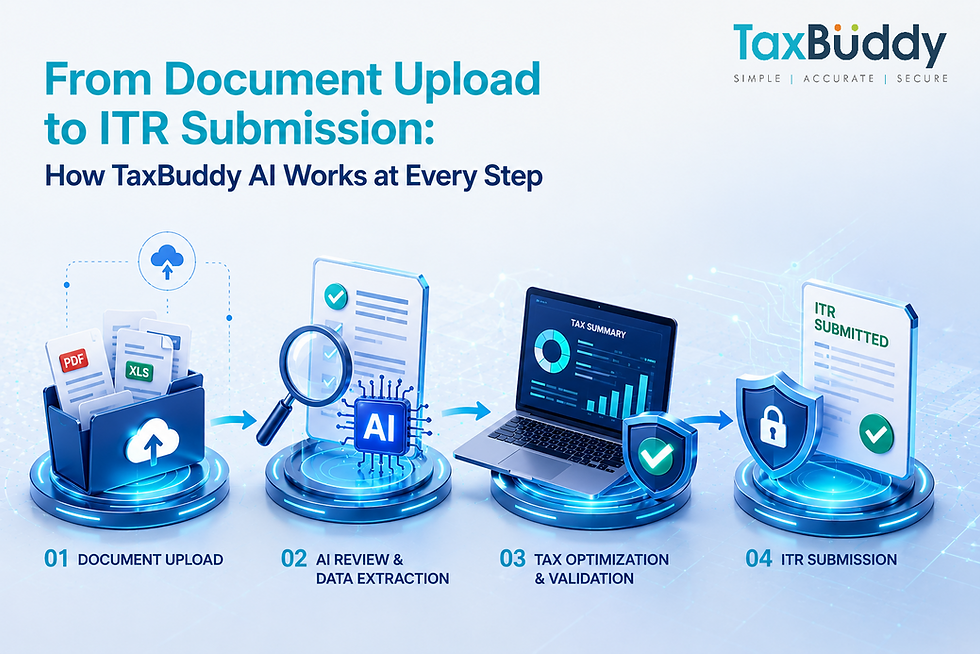
TaxBuddy simplifies regime evaluation by comparing old and new tax regimes using actual income, deductions, and future planning inputs. Automated calculations, error checks, and expert-assisted guidance help ensure that regime selection supports long-term financial efficiency rather than short-term convenience.
Conclusion
Switching tax regimes mid-career may appear harmless, but it often results in higher lifetime tax costs and weaker long-term financial outcomes. A stable, well-evaluated regime choice aligned with evolving deductions and life-stage needs provides better tax efficiency and financial clarity. For anyone looking for assistance in tax filing and regime selection, it is recommended to download the TaxBuddy mobile app for a simplified, secure, and hassle-free experience.
FAQs
Q. Does TaxBuddy offer both self-filing and expert-assisted plans for ITR filing, or only expert-assisted options?
TaxBuddy offers both self-filing and expert-assisted ITR filing plans. The self-filing option is suitable for individuals with straightforward income structures who are comfortable filing on their own using guided tools and system validations. The expert-assisted option is designed for taxpayers with higher incomes, multiple income sources, or tax planning concerns, where a qualified tax expert reviews the return, verifies deductions, and ensures accurate regime selection before submission.
Q. Which is the best site to file ITR?
The best site to file an income tax return depends on the level of guidance required. The official Income Tax Department e-filing portal is suitable for users who are confident about tax rules and return filing. Authorised platforms like TaxBuddy are often preferred by taxpayers who want simplified filing, automated checks, regime comparison, and access to expert assistance, especially for salaried professionals navigating regime choices.
Q. Where to file an income tax return?
An income tax return can be filed online through the Income Tax Department’s e-filing portal or through authorised tax-filing platforms integrated with the government system. Platforms such as TaxBuddy provide an alternative filing route with structured workflows, error detection, and support for both self-filing and assisted filing, while still submitting returns directly to the tax department.
Q. Can salaried individuals switch tax regimes every year?
Yes, salaried individuals who do not have business or professional income are allowed to choose between the old and new tax regimes every financial year. The selection is made at the time of filing the income tax return. This flexibility exists under Section 115BAC, but frequent switching may affect long-term tax planning and investment discipline.
Q. Does switching tax regimes cancel past investments?
Switching tax regimes does not cancel or invalidate past investments. However, the ability to claim tax deductions on those investments depends on the regime chosen. Under the new tax regime, most deductions, such as those under Section 80C and 80D, are not allowed, even though the investments themselves continue to remain valid and financially beneficial.
Q. Is the new tax regime better for high-income earners?
The new tax regime may be beneficial for high-income earners who have minimal deductions and exemptions. However, high-income individuals often accumulate significant deductions through housing loans, insurance, retirement contributions, and family-related expenses. In such cases, the old tax regime may result in a lower overall tax liability despite higher slab rates.
Q. Does the new tax regime allow a standard deduction?
Yes, the new tax regime allows a standard deduction for salaried individuals. However, apart from the standard deduction and limited benefits such as employer contributions to NPS, the most common deductions and exemptions available under the old tax regime are not permitted.
Q. Can frequent regime switching increase tax liability?
Yes, frequent switching between tax regimes can increase long-term tax liability. While short-term savings may appear attractive, inconsistent regime selection often leads to reduced investment continuity, loss of deduction benefits over time, and weaker compounding of long-term savings, ultimately resulting in higher cumulative taxes.
Q. How does job switching affect tax regime choice?
Job switching during a financial year can complicate tax regime selection. If different regimes are declared to different employers, TDS may be deducted inconsistently. Unless prior salary details and regime choices are properly disclosed to the new employer, this can result in TDS shortfalls and additional tax payable at the time of filing the return.
Q. Is Form 10-IEA mandatory for regime selection?
Form 10-IEA is required when a taxpayer opts out of the default new tax regime while filing the income tax return. For salaried individuals, this form is submitted electronically along with the return to formally confirm the choice of the old tax regime for that financial year.
Q. Does regime switching affect retirement planning?
Yes, regime switching can impact retirement planning. Reduced or inconsistent contributions to long-term instruments such as provident funds, NPS, and other retirement-oriented investments may weaken the growth of the retirement corpus. Over time, this can significantly affect post-retirement financial stability.
Q. Can TaxBuddy help with regime comparison before filing?
Yes, TaxBuddy helps taxpayers compare the old and new tax regimes based on actual income, deductions, and future planning considerations. Its tools and expert support assist in identifying the most tax-efficient option for the year, while also factoring in long-term financial implications before the return is filed.




Comments