

Which Communities Are Eligible to Form an HUF?

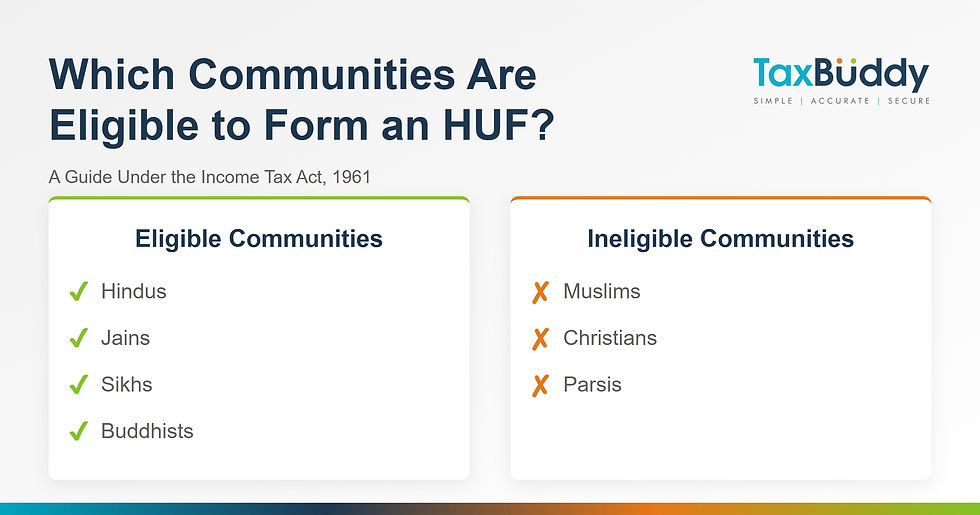
A Hindu Undivided Family (HUF) is recognised as a separate taxable entity under the Income Tax Act, 1961. However, not every individual or community can form an HUF. Indian tax law permits only specific religious communities that follow the concept of a joint family under Hindu law. These include Hindus, Jains, Sikhs, and Buddhists. The eligibility arises from traditional joint family structures where members share a common ancestor and property. Communities such as Muslims, Christians, and Parsis cannot create an HUF because their personal laws do not recognize this structure.
Table of Contents
What Is a Hindu Undivided Family (HUF)?
A Hindu Undivided Family (HUF) is a distinct legal and tax entity recognised under the Income Tax Act, 1961. It represents a family unit that consists of individuals descended from a common ancestor and includes their spouses and unmarried daughters. The concept originates from traditional Hindu law, where families jointly own property and share income derived from that property.
For taxation purposes, an HUF is treated separately from its members. This means the HUF can have its own Permanent Account Number (PAN), bank account, assets, investments, and sources of income. The income generated by the HUF is taxed independently of the personal income of its members.
The senior-most member of the family typically acts as the Karta, who manages the financial and legal affairs of the HUF. However, courts and tax authorities now recognise that even a female member can act as the Karta if she is the senior-most coparcener.
Because it is treated as a separate taxpayer, forming an HUF can provide certain tax planning opportunities where income and assets are managed collectively.
Which Communities Are Eligible to Form an HUF?
Under Indian tax law, only specific communities can form a Hindu Undivided Family. These communities include Hindus, Jains, Sikhs, and Buddhists.
The eligibility is based on the recognition of the joint family system under Hindu law. Members of these communities traditionally follow a family structure where property and income may belong to the entire family rather than individual members.
Even though Jains, Sikhs, and Buddhists are separate religions, courts and tax authorities recognise that their family structures historically evolved from Hindu law traditions. As a result, the Income Tax Act allows individuals from these communities to create an HUF.
Communities such as Muslims, Christians, and Parsis cannot form an HUF because their personal laws do not recognise a joint family system that operates in the same way as Hindu law. Since the HUF structure is tied to the concept of ancestral family property, it applies only to communities where this legal framework exists.
Legal Basis for HUF Under the Income Tax Act, 1961
The Income Tax Act, 1961 provides legal recognition to a Hindu Undivided Family by including it in the definition of a “person.” Section 2(31) of the Act recognises an HUF as a separate entity capable of earning income and paying taxes independently.
Because the law treats an HUF as a separate taxpayer, it must follow the same compliance requirements as individuals. This includes obtaining a PAN, maintaining financial records, filing income tax returns, and paying taxes where applicable.
The eligibility of certain communities to form an HUF stems from the interpretation of Hindu law by courts and tax authorities. Judicial rulings have clarified that Jains, Sikhs, and Buddhists can also create HUFs because their family structures historically follow similar principles of joint ownership and lineage.
Importantly, recent Finance Acts have not changed the eligibility criteria for forming an HUF. The rules governing HUF formation and recognition continue to remain consistent under the existing provisions of the Income Tax Act.
Religious Communities Allowed to Form an HUF
Four religious communities are eligible to create a Hindu Undivided Family under Indian tax law:
Hindus
Members of the Hindu religion form the majority of HUFs in India. Hindu families traditionally follow the concept of joint family ownership of property.
Jains
Although Jainism is a separate religion, the joint family structure within Jain communities closely resembles that of Hindu families. Because of this historical link, tax laws recognize their eligibility to form an HUF.
Sikhs
Sikh families may also create HUFs. Courts have acknowledged that Sikh personal law historically developed from Hindu legal traditions in relation to family property and inheritance.
Buddhists
Buddhist families are also permitted to form an HUF. Like other communities listed above, their family systems historically derive from the Hindu legal framework regarding joint family structures.
These communities are recognized under tax law because their family systems support the concept of collective ownership and lineage-based property rights.
Communities That Cannot Form an HUF in India
Certain religious communities are not eligible to form an HUF because their personal laws do not recognize the joint family property system.
Muslims
Muslim personal law follows a different inheritance structure where property is distributed among heirs rather than being held jointly by the family.
Christians
Christian family law also focuses on individual property ownership and inheritance rights rather than collective family ownership.
Parsis
Parsi personal law similarly does not recognize a joint family property system similar to the HUF structure.
Since the HUF concept is rooted in Hindu law principles, individuals belonging exclusively to these communities cannot legally create an HUF for tax purposes.
Why Only Certain Communities Can Create an HUF
The HUF structure is not simply a tax arrangement. It is derived from ancient Hindu legal traditions related to family ownership of property and lineage.
In a traditional joint family, property is owned collectively by family members who share a common ancestor. Income generated from that property belongs to the family as a whole rather than individual members.
Because this structure exists only in specific religious and cultural legal systems, tax laws restrict HUF formation to communities that follow these traditions.
Allowing individuals outside these systems to form HUFs would contradict the legal basis of the structure and could lead to misuse of tax provisions.
Key Conditions for Forming an HUF
Creating a valid HUF requires certain basic conditions to be fulfilled.
Presence of a family unit
An HUF cannot exist with only one person. There must be at least two members who share a common ancestor.
Common lineage
All members must be lineal descendants of the same family ancestor.
Existence of coparceners
Coparceners are family members who have a right in ancestral property. Traditionally these included male descendants, but modern laws now recognize daughters as coparceners as well.
A Karta to manage affairs
The senior-most member of the family typically acts as the Karta who manages financial and legal matters.
Family property or assets
While an HUF may start with a small initial contribution or gift, it typically operates through property or assets belonging to the family.
How an HUF Is Created in Practice
Forming an HUF is relatively simple compared to registering many other business or legal entities.
First, a declaration deed is prepared stating the formation of the HUF. This document includes details such as the name of the HUF, the Karta, and the members of the family.
Next, the HUF applies for a PAN card. Since the HUF is treated as a separate taxpayer, obtaining a PAN is essential for tax compliance.
Once the PAN is issued, a bank account can be opened in the name of the HUF. The family may then transfer assets or income sources to the HUF.
Unlike companies or partnerships, HUF formation does not require registration with a specific government authority. The legal recognition arises from family structure and tax compliance procedures.
Documents Required to Form an HUF
Several documents are typically required while establishing an HUF and completing financial procedures.
HUF declaration deed
This document formally declares the creation of the HUF and lists the Karta and members.
PAN card of the HUF
A separate PAN must be obtained for the HUF to file tax returns and conduct financial transactions.
Karta identity proof
Documents such as PAN, Aadhaar, or passport of the Karta are required for compliance.
Address proof
The address proof of the Karta or the HUF may be required for banking purposes.
PAN details of members
Banks and financial institutions may request PAN details of the coparceners.
Cancelled cheque
A cancelled cheque is usually required when opening a bank account.
Opening a Bank Account for an HUF
Once the HUF obtains its PAN, a bank account can be opened in the name of the HUF. This account is used for managing income, investments, and expenses belonging to the family entity.
Most banks require a declaration deed confirming the creation of the HUF. The Karta must provide identity and address proof along with the HUF PAN.
Financial institutions may also require details of coparceners and a cancelled cheque to complete the process.
For investment purposes such as trading or demat accounts, additional documentation may be required depending on the broker or institution involved.
Taxation Rules for HUF Under the Income Tax Act
An HUF is taxed similarly to an individual taxpayer under the Income Tax Act. The income earned by the HUF is calculated separately from the personal income of its members.
Common sources of HUF income include rental income from family property, income from investments, business income, and capital gains.
The HUF can also claim certain deductions available under the Income Tax Act where applicable. However, specific benefits such as the rebate under Section 87A may not apply in the same way as they do for individual taxpayers.
Because an HUF files its own tax return, maintaining proper financial records and documentation is important for compliance.
Platforms such as TaxBuddy help families manage these processes by simplifying PAN applications, tax calculations, and return filing for HUF entities.
Recent Updates on HUF Eligibility and Tax Rules
Recent updates in tax regulations have primarily focused on tax slabs and rebate changes rather than altering the eligibility rules for HUF formation.
As of the financial year 2025–26, there have been no major changes to the communities eligible to form an HUF. The rules continue to allow Hindus, Jains, Sikhs, and Buddhists to create an HUF under the Income Tax Act.
The official income tax portal continues to confirm the existing structure of HUF taxation without introducing new eligibility restrictions.
This stability allows families using HUF structures for asset management and tax planning to continue following established compliance procedures.
Common Mistakes While Creating an HUF
Many families make procedural mistakes while creating or managing an HUF.
One common mistake is transferring personal income directly into the HUF without following proper legal methods. Income must originate from HUF assets or investments.
Another mistake is failing to maintain clear documentation of assets transferred to the HUF. This may create confusion during tax assessments.
Some families also assume that a single individual can create an HUF, which is not correct. At least two members with a common ancestor are required.
Improper management of bank accounts or mixing personal and HUF finances may also lead to compliance issues.
Maintaining separate records and following proper tax filing procedures can prevent these problems.
How Platforms Like TaxBuddy Help With HUF Tax Compliance
Managing an HUF requires proper documentation, accurate tax calculations, and timely return filing. For many families, handling these requirements without professional assistance can become complicated.
Digital tax platforms such as TaxBuddy simplify these processes by offering guided tax filing, document management, and expert review services. Families can use such platforms to ensure that HUF income is reported correctly and tax returns are filed in compliance with applicable laws.
These tools also help track deductions, maintain records, and provide assistance in responding to tax notices if required. This reduces the chances of errors and ensures smoother tax compliance.
Conclusion
The Hindu Undivided Family structure remains an important concept in Indian tax law. However, eligibility to form an HUF is limited to Hindus, Jains, Sikhs, and Buddhists because their personal laws recognise joint family ownership and lineage-based property rights. Understanding these eligibility rules, formation procedures, and taxation requirements is essential before creating an HUF.
For anyone looking for assistance in tax filing or managing HUF compliance, it is highly recommended to download the TaxBuddy mobile app for a simplified, secure, and hassle-free experience.
FAQs
Q1. Which religious communities can legally form a Hindu Undivided Family (HUF)?
Under Indian tax law, only Hindus, Jains, Sikhs, and Buddhists are allowed to form a Hindu Undivided Family. These communities follow family systems that historically recognize joint ownership of property and lineage-based inheritance. Because the HUF concept originates from Hindu law principles, only individuals belonging to these communities can create an HUF entity for tax purposes.
Q2. Can Jains, Sikhs, and Buddhists form an HUF even though they are not Hindus?
Yes, Jains, Sikhs, and Buddhists are eligible to form an HUF even though they are separate religions. Courts and tax authorities recognize that these communities historically followed legal traditions similar to Hindu joint family systems. As a result, the Income Tax Act permits members of these communities to create and operate an HUF.
Q3. Can Muslims form an HUF in India?
No, Muslims cannot form an HUF. Muslim personal law follows a different inheritance system where property is distributed among heirs rather than held collectively by a joint family. Because the HUF structure depends on the concept of joint family ownership under Hindu law, it does not apply to Muslim families.
Q4. Are Christians allowed to create an HUF for tax purposes?
Christians cannot form an HUF because their personal law does not recognize the joint family property system required for the HUF structure. Property ownership and inheritance under Christian law are treated individually rather than as a collective family entity.
Q5. Can Parsis form a Hindu Undivided Family?
Parsis are not eligible to create an HUF. Similar to other non-Hindu communities, Parsi personal law does not recognize the joint family structure that forms the basis of the HUF concept under Indian tax law.
Q6. Can a person from an eligible community create an HUF alone?
No, a single individual cannot create an HUF. The structure requires a family unit with members descended from a common ancestor. Typically, an HUF consists of the Karta and other family members such as spouse, children, and lineal descendants.
Q7. Who becomes the Karta of an HUF?
The Karta is the person who manages the financial and legal affairs of the HUF. Traditionally, the senior-most male member acted as the Karta. However, legal developments now allow the senior-most female coparcener to serve as the Karta if she is the eldest member of the family.
Q8. Can a mixed-religion family form an HUF?
An HUF can generally be formed only when the family belongs to communities eligible under Hindu law. If family members belong to different religions, eligibility may depend on whether the family legally follows Hindu law traditions. In most cases, if the family does not follow Hindu personal law, forming an HUF may not be permitted.
Q9. Is an HUF treated as a separate taxpayer under the Income Tax Act?
Yes, an HUF is recognized as a separate taxable entity under the Income Tax Act, 1961. It must obtain its own PAN, maintain financial records, and file income tax returns separately from the individual members of the family.
Q10. Can a non-resident family create an HUF?
Yes, a non-resident HUF can exist. The residential status of the HUF generally depends on where the control and management of the HUF are exercised. If the Karta manages the HUF from India, it may be treated as resident for tax purposes.
Q11. Is there any recent change in the rules for communities eligible to form an HUF?
There have been no major changes in recent years regarding eligibility to form an HUF. As of the latest tax regulations for financial year 2025–26, the same communities—Hindus, Jains, Sikhs, and Buddhists—continue to remain eligible to create a Hindu Undivided Family.
Q12. What is the main benefit of forming an HUF for tax purposes?
One of the main advantages of forming an HUF is that it is treated as a separate taxpayer. This allows families to manage income and assets under a separate tax entity, which may help in structured tax planning when handled properly and in compliance with income tax rules.


