

Interest Calculation When Advance Tax Is Adjusted with Refund

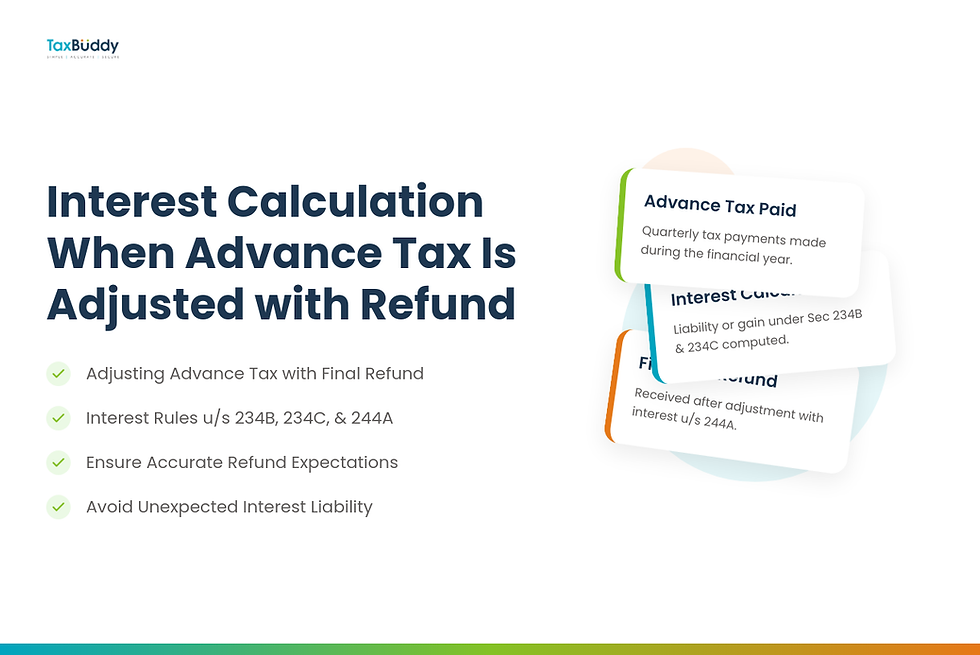
Interest calculation becomes important when advance tax paid during the year is later adjusted against the final tax refund. The Income Tax Act uses specific rules under Sections 234B, 234C, and 244A to compute interest depending on whether the taxpayer paid excess advance tax, paid it late, or paid less than the required amount. Understanding these adjustments helps avoid unexpected interest liability and ensures accurate refund expectations. Many salaried taxpayers use platforms like TaxBuddy for automated tax computation, advance tax tracking, and refund estimation to avoid miscalculations.
Table of Contents
Interest Calculation Under Section 234B for Shortfall in Advance Tax
Interest Calculation Under Section 234C for Deferment of Advance Tax
Refund Interest Under Section 244A: Eligibility and Computation
Examples: How Interest Changes When Advance Tax Is Adjusted with Refund
How TaxBuddy Helps with Advance Tax and Refund Interest Computation
Common Errors When Calculating Advance Tax and Refund Interest
Final Considerations Before Claiming Refund Adjusted Against Advance Tax
Conclusion
FAQs
How Advance Tax and Refund Adjustments Work
Advance tax is paid in instalments across the financial year when the estimated tax liability exceeds the prescribed threshold. Once the return is filed, the final tax computation determines whether the taxpayer has paid more or less than required. If excess advance tax is paid, the amount becomes refundable. If the tax paid is lower than the assessed liability, the department calculates interest for the shortfall or late payment. The adjustment between advance tax and refund follows predefined rules under the Income Tax Act, ensuring that interest is fair to both the taxpayer and the department. This mechanism applies to both salaried and non-salaried taxpayers.
Interest Calculation Under Section 234B for Shortfall in Advance Tax
Section 234B applies when at least 90 per cent of the total tax liability is not paid before the end of the financial year. Interest is calculated at the prescribed monthly rate on the unpaid amount from 1 April of the assessment year until the date of actual payment. The computation does not consider the date on which the refund is issued; instead, it focuses only on the shortfall and the delay in clearing the final liability. When advance tax is partially paid but insufficient, Section 234B interest increases based on the remaining unpaid amount. This interest directly reduces the final refund amount.
Interest Calculation Under Section 234C for Deferment of Advance Tax
Section 234C deals with delays or shortfalls in instalments of advance tax. Interest applies even when the total advance tax paid by year-end is sufficient, but individual instalments fall short of the required percentages. Each instalment has a specific due date and a minimum payable portion of the total estimated tax. Any shortfall attracts interest at a monthly rate from the due date until the instalment is paid. Refund adjustments do not affect this computation, as the law is concerned with the timeliness of payments rather than the outcome. When refunds are later issued for excess payments, they do not erase the 234C interest already applicable.
Refund Interest Under Section 244A: Eligibility and Computation
Section 244A provides interest to taxpayers when excess tax has been paid. This applies when advance tax, TDS, or self-assessment tax exceeds the final tax liability. Interest begins from 1 April of the assessment year or from the date of payment, depending on the type of tax paid, and continues until the refund is issued. The rate is fixed and applies only to the refundable portion. If refund processing is delayed beyond the statutory timeline, the interest component increases. This ensures that taxpayers are compensated for the time their excess money remains with the department.
Impact of Excess Advance Tax on Refund Interest
When the advance tax exceeds the final liability, the extra amount is refundable. Refund interest under Section 244A becomes payable on this excess. A higher surplus increases the base amount for interest, leading to a larger refund. However, refund interest depends on the timing of payments—earlier payments gain interest for a longer period. Excess advance tax eliminates exposure to Sections 234B and 234C and increases 244A interest. Thus, paying advance tax on time, even if slightly higher than required, may result in a more favourable refund outcome.
Impact of Advance Tax Shortfall on Final Refund
A shortfall in advance tax triggers interest under Sections 234B and 234C. These interest amounts reduce the final refund because they are adjusted against the refundable balance. Even if TDS or late self-assessment tax payments later create a refund situation, the shortfall interest is still levied. Once interest is deducted, the remaining amount becomes the final refundable figure. This is why calculating advance tax correctly is essential. Shortfalls create unnecessary deductions that reduce refund value and delay refund timelines.
Examples: How Interest Changes When Advance Tax Is Adjusted with Refund
Consider a case where the advance tax paid during the year exceeds the final tax liability. In this situation, the refund will include the extra tax plus interest from 1 April of the assessment year until refund issuance. In a different scenario, if a taxpayer pays less advance tax, interest under Sections 234B and 234C is calculated and subtracted from the refundable balance. A late self-assessment payment may create a refund only after clearing the total interest-adjusted liability. These examples illustrate how timing and accuracy of advance tax payments directly influence the final refund and interest outcomes.
Advance Tax and Refund Rules for Salaried Taxpayers
Salaried individuals generally rely on TDS for tax compliance. However, advance tax becomes necessary when income from other sources increases their overall tax liability beyond the minimum threshold. If advance tax is not paid despite having additional income, interest provisions apply. Refunds for salaried individuals often arise when TDS exceeds the final liability. In such cases, refund interest applies in the usual manner. Since many salaried taxpayers receive refunds due to higher TDS deductions, understanding refund interest rules helps in accurate tax planning.
How TaxBuddy Helps with Advance Tax and Refund Interest Computation
TaxBuddy provides automated tax estimations that factor in salary, investments, TDS, and additional income to project accurate advance tax liabilities. This reduces errors that often lead to interest penalties. The platform also calculates expected refund interest and highlights the impact of early or delayed tax payments. By analysing income patterns, TaxBuddy helps taxpayers avoid shortfall interest and claim refunds more efficiently. Its automated computation ensures that both shortfall and refund interest are correctly reflected before filing the return.
Common Errors When Calculating Advance Tax and Refund Interest
One common mistake is underestimating taxable income by excluding investment gains or interest income. Another recurring error involves ignoring the instalment percentages required under Section 234C. Many taxpayers incorrectly assume that refunds automatically erase interest liability, which is not the case. Errors also arise when refund interest is calculated from the date of return filing rather than as per statutory rules. Misinterpretation of TDS credits often leads to incorrect advance tax calculations. Automated systems like TaxBuddy minimise these errors through accurate and consistent calculations.
Final Considerations Before Claiming a Refund Adjusted Against the Advance Tax
Before filing a return, taxpayers should recheck advance tax payments, ensure proper TDS reconciliation, and verify that no shortfall exists. Reviewing Form 26AS and AIS helps confirm that the correct credits are reflected. If excess tax has been paid, taxpayers should ensure accurate refund computation along with applicable interest. For those with complex income streams, automated platforms reduce the risk of inaccuracies. A clear understanding of both shortfall and refund interest helps prevent disputes and ensures smooth refund processing.
Conclusion
Accurate advance tax payments reduce interest liabilities and ensure that any refund due includes the correct interest under Section 244A. Understanding how these computations work helps taxpayers avoid unnecessary charges and anticipate their final refund value. For anyone looking for assistance in tax filing, it is highly recommended to download the TaxBuddy mobile app for a simplified, secure, and hassle-free experience.
FAQs
Q1. Does TaxBuddy offer both self-filing and expert-assisted plans for ITR filing, or only expert-assisted options? TaxBuddy provides both options so that different types of taxpayers can choose what suits their needs. The self-filing system is designed for individuals with straightforward income, where the platform’s automated checks, document scanning, and AI-supported guidance help complete the return quickly. For those with multiple income sources, capital gains, business income, rental complications, or notice-related concerns, the expert-assisted plan assigns a qualified tax professional who reviews every detail, verifies deductions, matches TDS, and ensures error-free filing. Both formats are supported by the same secure and compliant backend, offering flexibility without compromising accuracy.
Q2. Which is the best site to file ITR? The “best” site depends on the complexity of income and the level of assistance required. While the income tax department’s official portal is the default filing platform, many taxpayers prefer platforms that simplify calculations, reduce manual data entry, and help prevent errors. Platforms like TaxBuddy offer automated tax checks, interest calculations, TDS reconciliation, and expert review, making the filing process smoother. The platform’s accuracy-focused workflows and post-filing support make it a reliable choice for those who want a seamless experience without navigating complicated tax terms.
Q3. Where to file an income tax return? An income tax return can be filed on the government’s official portal or through recognised private platforms. The income tax portal is suitable for those who understand tax rules and can complete the forms independently. Users who want guided assistance, automatic error detection, and personalised help often choose platforms such as TaxBuddy. These platforms simplify data upload, track refund progress, and ensure that tax rules are applied accurately, which makes the process more convenient for salaried individuals, freelancers, and business taxpayers.
Q4. How is interest under Section 234B calculated? Section 234B applies when the advance tax of at least 90 per cent of the total tax liability is not paid before the financial year ends. Interest is calculated at the prescribed monthly rate on the unpaid tax amount, starting from 1 April of the assessment year until the date the shortfall is fully paid. The calculation considers only the unpaid amount and the period of delay; refund issuance does not change the interest already charged. Any interest computed under this section is adjusted against the final refund, if applicable.
Q5. How is interest under Section 234C calculated? Section 234C deals with delays or deficiencies in advance tax instalments. The law specifies due dates along with mandatory percentages of tax to be paid for each instalment. When the amount paid falls short or is paid after the due date, interest applies for the period between the deadline and the actual date of payment. This interest applies even if the taxpayer ultimately pays sufficient tax by year-end. Refunds issued later do not cancel or reduce 234C interest, as the computation strictly follows instalment timelines.
Q6. Who is required to pay advance tax? Any taxpayer whose estimated tax liability exceeds the threshold after adjusting TDS is required to pay advance tax. This includes salaried individuals with additional income from rent, capital gains, or interest, and also self-employed professionals and business owners whose income is not subject to TDS. Advance tax ensures that taxes are paid throughout the year rather than in a single payment, aligning with the “pay-as-you-earn” principle. Failure to pay results in interest under Sections 234B and 234C.
Q7. What happens if excess advance tax is paid? Excess advance tax creates a refund once the return is processed. The taxpayer becomes eligible for refund interest under Section 244A from 1 April of the assessment year or from the date of tax payment, depending on the type of tax paid. This interest compensates for the department holding the taxpayer’s funds longer than necessary. The final refund includes both the excess tax and the interest component, unless any pending demands or adjustments exist.
Q8. Is refund interest taxable? Yes. Refund interest received from the income tax department under Section 244A is taxable as income. It falls under the head “Income from Other Sources” and must be reported in the return for the year in which it is received. The department typically includes the interest amount in the refund order, and it appears in AIS or Form 26AS, making it easier to identify and disclose accurately.
Q9. How to check refund and interest details on the income tax portal? Refund and interest details can be accessed through the dashboard of the income tax portal after logging in. The “Refund Status” section displays the refund amount, payment date, and any associated interest. More detailed tax credit information, including refund interest, is available in Form 26AS, while AIS provides additional transaction-level details. These documents help verify whether the refund and interest have been correctly processed.
Q10. How long does the IT department take to process refund interest? Refund interest is automatically computed during the processing of returns under Section 143(1). Once the return is processed, the refund amount—including interest—is released through the department’s banking partner. Processing time varies based on the volume of filings and verification of details. In most cases, returns filed accurately and electronically are processed faster, leading to quicker refunds.
Q11. Can advance tax be adjusted in the next financial year? Advance tax belongs exclusively to the financial year for which it is paid. It cannot be carried forward or applied to tax liabilities of a future year. If excess advance tax is paid, the refund is issued for that year along with interest. If the advance tax is short, the taxpayer must pay the balance along with applicable interest. The adjustment mechanism remains confined to the same fiscal period.
Q12. How does TaxBuddy help in advance tax and refund interest calculations? TaxBuddy’s system evaluates salary income, investment gains, interest earnings, and business receipts to provide an accurate projection of tax liability. It computes advance tax instalments, checks for shortfalls, and estimates potential refund interest with precision. The platform reduces the risk of errors that often lead to interest penalties or delayed refunds. By automating calculations and offering expert guidance, TaxBuddy ensures that taxpayers fulfil advance tax requirements correctly and receive refunds without discrepancies.


