

Building White‑Label ITR Filing for Fintechs Using TaxBuddy’s APIs and SDKs
- Ankita Murkute

- 20 hours ago
- 7 min read
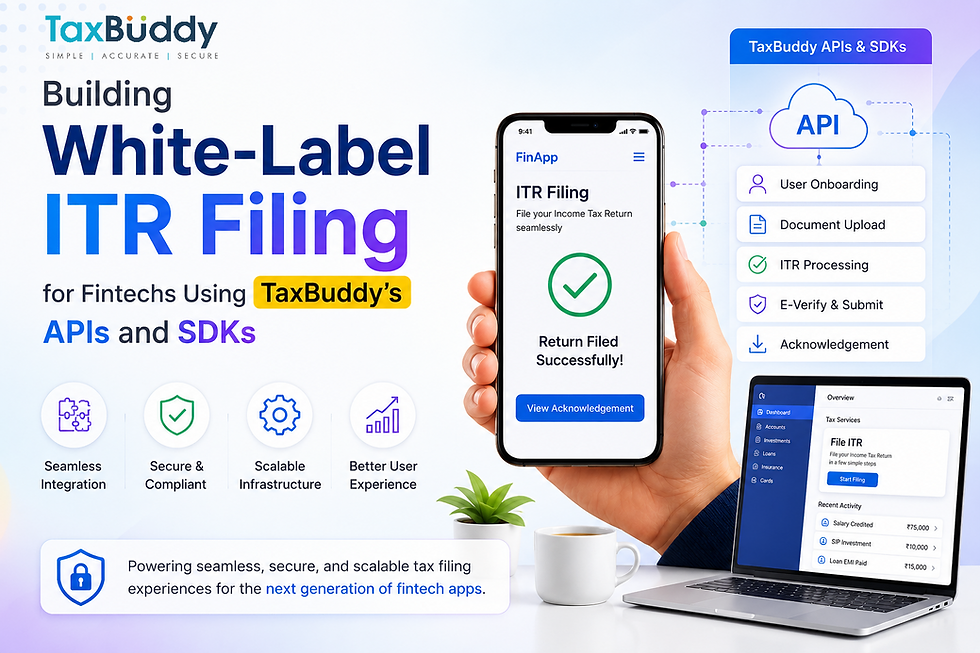
Fintech apps have become central to how users manage money today. From investing and savings to lending and salary-linked services, financial activity now happens continuously inside digital ecosystems.
But when tax season arrives, many users still move into fragmented filing journeys involving external portals, scattered documents, and disconnected workflows.
This growing gap between financial activity and tax filing is why white-label ITR filing infrastructure is becoming increasingly important for fintech ecosystems in India.
Table of Contents
Why Fintech Apps Are Expanding Beyond Financial Transactions
The first phase of fintech growth focused on accessibility.
Platforms competed on onboarding speed, payment convenience, investment access, clean UI experiences, and digital-first financial journeys. This dramatically improved financial participation across India.
But the next phase is increasingly about ecosystem depth.
Users now expect fintech apps to support broader financial workflows including:
Financial planning
Tax awareness
Reporting visibility
Filing readiness
Financial wellness
Long-term money management
This shift is behavioural as much as technological.
Modern users do not see taxation as a completely separate administrative activity anymore. They increasingly expect financial platforms to help reduce operational stress around compliance and reporting as well.
This is creating strong demand for embedded and branded filing experiences.
The Operational Gap Between Fintech Activity and Tax Filing
One of the biggest structural problems in digital finance today is the disconnect between financial activity and financial reporting.
Users may spend an entire year:
Investing
Trading
Receiving salary
Earning gig income
Managing loans
Exploring deductions
Building wealth
through fintech ecosystems.
But when filing season arrives, they often begin coordinating tax workflows manually and retrospectively.
This creates operational fatigue.
Users suddenly search for:
Capital gains visibility
AIS reconciliation
Deduction planning
Filing applicability
Tax-saving opportunities
Refund estimation
Documentation support
Most of these workflows still happen outside the app where financial activity originally took place.
That separation weakens continuity.
White-label tax filing infrastructure helps fintech ecosystems reduce this fragmentation by bringing filing journeys closer to the broader financial experience itself.
Why Branded Tax Filing Experiences Are Becoming Important
Fintech ecosystems care deeply about user continuity and trust.
When users leave the app during filing season and enter unfamiliar external environments, the experience often feels disconnected. The fintech platform loses engagement during a high-intent financial moment.
This is where branded tax filing experiences become strategically important.
A white-label filing experience allows fintech platforms to maintain:
Brand continuity
Familiar user journeys
Consistent app experience
Higher user trust
Better financial engagement
Stronger ecosystem relevance
The value here is not simply visual branding.
It is behavioural continuity.
Users are more comfortable completing financially sensitive activities inside ecosystems they already trust and interact with regularly.
What White-Label ITR Filing Means for Fintech Ecosystems
White-label ITR filing allows fintech apps to offer embedded tax filing services under their own branding while backend infrastructure, compliance workflows, and filing operations are powered by a specialist infrastructure partner like TaxBuddy.
This allows fintech platforms to offer:
ITR filing
Tax planning
Filing readiness journeys
Deduction discovery
Expert-assisted filing
Refund tracking
Filing support workflows
without building tax infrastructure internally from scratch.
The fintech platform controls the front-end experience.
The infrastructure partner manages the filing engine, workflow coordination, compliance support, operational scaling, and backend tax logic.
This creates a much smoother ecosystem experience for users.
APIs vs SDKs: Choosing the Right Integration Layer
Fintech ecosystems often evaluate both APIs and SDKs while planning embedded filing infrastructure.
The right approach depends on the type of experience the platform wants to create.
A white-label API integration typically supports:
Backend workflow coordination
Reporting systems
Authentication flows
Notifications
Filing status visibility
Platform-level flexibility
A white-label SDK integration helps platforms embed smoother in-app experiences directly into mobile or web environments.
SDK-led journeys are especially useful for:
Mobile-first fintech apps
Faster deployment
Consistent UI experience
Native app continuity
Guided filing workflows
Many fintech ecosystems eventually combine both approaches to create stronger operational continuity.
The important factor is that the filing journey should feel naturally embedded into the fintech experience rather than appearing like an attached external utility.
Why Embedded Filing Improves User Continuity
Embedded filing significantly improves ecosystem continuity because users no longer feel forced into disconnected operational workflows during filing season.
Instead of manually coordinating filing across multiple systems, users can access:
Filing workflows
Planning journeys
Tax visibility
Filing readiness
Support experiences
inside the same ecosystem where financial activity already happens.
This improves:
User confidence
Engagement depth
Filing participation
Operational simplicity
Long-term retention
Fintech apps increasingly understand that users evaluate ecosystems most strongly during moments of confusion, uncertainty, or financial stress.
Tax filing is one of those moments.
How Tax Planning Creates Stronger Financial Engagement
Tax planning is gradually becoming one of the strongest engagement layers inside fintech ecosystems.
Users exploring:
Tax-saving opportunities
Investment-linked deductions
Capital gains impact
Refund expectations
Long-term financial structuring
are often highly engaged financially.
This creates opportunities for fintech platforms to improve customer profiling and contextual engagement across broader financial journeys.
For example, users actively interacting with tax planning workflows may also become relevant for:
Wealth products
Investment journeys
Insurance offerings
Goal-based planning
Long-term savings products
This makes tax planning strategically valuable far beyond compliance alone.
The Importance of Operationally Scalable Tax Infrastructure
India’s filing environment operates at an enormous seasonal scale.
During filing season, fintech ecosystems may experience significant spikes in user engagement around:
Filing queries
Deduction planning
AIS mismatches
Capital gains visibility
Documentation support
Refund expectations
Filing deadlines
This requires infrastructure that supports not only technical integration but also operational continuity.
The challenge is not simply enabling tax filing.
The challenge is enabling filing readiness, support coordination, workflow visibility, and user continuity at scale.
This is where mature white-label fintech infrastructure becomes especially important.
Why Mobile-First Filing Journeys Matter
Most fintech ecosystems in India are mobile-first.
Users expect filing journeys to feel:
Fast
Guided
Simple
Native to the app
Low-friction
Operationally clear
This is why white-label SDK environments are becoming increasingly important.
A strong mobile-first filing journey should support:
Secure authentication
Smooth onboarding
Guided filing flows
Easy document upload
Filing progress visibility
Assisted support access
The objective is not to make filing look technical.
The objective is to reduce operational anxiety around tax workflows.
How TaxBuddy’s White-Label APIs and SDKs Support Fintech Apps
TaxBuddy’s white-label infrastructure is designed specifically to help fintech ecosystems launch branded filing experiences without building complex tax infrastructure internally.
The ecosystem support includes:
White-label ITR filing workflows
Embedded tax planning journeys
API-ready infrastructure
SDK-led mobile experiences
Secure token-based SSO
Real-time workflow validation
Filing coordination visibility
Compliance-ready operational support
The infrastructure allows fintech platforms to maintain their own branding and ecosystem continuity while TaxBuddy powers the backend filing workflows, filing logic, and operational coordination.
The trust layer also matters significantly.
TaxBuddy’s 17K+ Google reviews and strong ecosystem credibility help reinforce confidence across embedded filing journeys.
Operational visibility is equally important.
TaxBuddy’s partner dashboard transparency and workflow visibility help fintech ecosystems manage filing continuity more effectively during high-engagement filing periods.
The Role of Financial Awareness and Filing Education
Many users delay tax filing because they lack confidence around taxation rather than willingness.
They often remain unsure about:
Which ITR form applies
Whether deductions are correctly considered
How capital gains work
What income requires disclosure
How refunds are calculated
This is why education has become operationally important for fintech ecosystems.
TaxBuddy supports partners through:
Tax awareness campaigns
Filing-readiness initiatives
Financial wellness programs
Tax education webinars
User engagement support
Seasonal filing awareness communication
These initiatives help ecosystems improve financial clarity while reducing user hesitation during filing season.
The Future of White-Label Fintech Infrastructure in India
The next phase of fintech evolution in India will likely focus less on isolated utilities and more on connected financial ecosystems.
Users increasingly expect apps to support:
Financial planning
Reporting continuity
Filing readiness
Tax visibility
Financial wellness
Long-term financial coordination
White-label fintech solutions are emerging directly from this behavioural shift.
As ecosystems continue evolving, embedded and branded filing journeys will likely become a major ecosystem layer for improving retention, trust, financial engagement, and operational continuity.
Conclusion
Fintech ecosystems in India are gradually moving beyond transaction-focused infrastructure into broader financial coordination environments. As user expectations evolve, platforms increasingly need to support not only financial activity, but also the reporting and compliance responsibilities connected to it.
White-label ITR filing infrastructure helps bridge this gap by allowing fintech apps to offer branded filing journeys directly inside their ecosystem.
TaxBuddy’s APIs and SDKs stand out because they support not just filing workflows, but also operational continuity, tax planning engagement, filing readiness, financial awareness initiatives, and scalable ecosystem coordination. As fintech ecosystems continue evolving, platforms that simplify both financial participation and financial understanding will likely build stronger long-term user trust and engagement.
FAQs
Q1. What is white-label ITR filing?
White-label ITR filing allows fintech platforms to offer tax filing services under their own branding while backend infrastructure is powered by a specialist filing provider.
Q2. What is a white-label API for tax filing?
A white-label API helps fintech ecosystems integrate filing workflows, authentication systems, reporting journeys, and filing coordination into their own platform.
Q3. What is a white-label SDK?
A white-label SDK allows fintech apps to embed tax filing journeys directly into mobile or web applications while maintaining consistent branding and smoother UX continuity.
Q4. Why are fintech apps adopting white-label tax filing in India?
Fintech apps are adopting white-label filing to improve user continuity, strengthen financial engagement, reduce operational fragmentation, and support broader financial wellness journeys.
Q5. How does embedded filing improve user retention?
Embedded filing keeps users engaged during financially important moments such as filing season, tax planning, refund tracking, and year-end financial reviews.
Q6. What is the difference between APIs and SDKs for filing infrastructure?
APIs provide backend integration flexibility, while SDKs support smoother in-app experiences and mobile-first filing journeys.
Q7. How does TaxBuddy support branded filing experiences?
TaxBuddy supports fintech ecosystems through white-label APIs, SDK-led filing workflows, secure SSO environments, operational coordination, and filing-readiness infrastructure.
Q8. Can white-label filing include tax planning workflows?
Yes. Embedded filing ecosystems can support tax planning, deduction discovery, refund estimation, filing readiness, and expert-assisted filing journeys.
Q9. How long does integration typically take?
Webview-based integrations can generally go live within 3–5 days, while deeper API-led or SDK-led integrations usually take around 2–3 weeks depending on customisation scope.
Q10. Why is operational continuity important in tax filing journeys?
Users strongly associate filing stress with overall financial experience. Smooth continuity improves trust, engagement, and ecosystem retention.
Q11. Does TaxBuddy support partner engagement initiatives?
Yes. TaxBuddy supports fintech ecosystems through tax awareness campaigns, webinars, financial wellness programs, filing-season communication support, and user engagement initiatives.
Q12. What is the future of white-label fintech solutions in India?
The future is moving toward embedded financial ecosystems where planning, reporting, filing, and financial wellness operate with stronger continuity inside trusted digital platforms.


Comments