

What Happens When Financial Decisions and Tax Outcomes Stay Disconnected?
- Pritish Sahoo

- 12 hours ago
- 7 min read
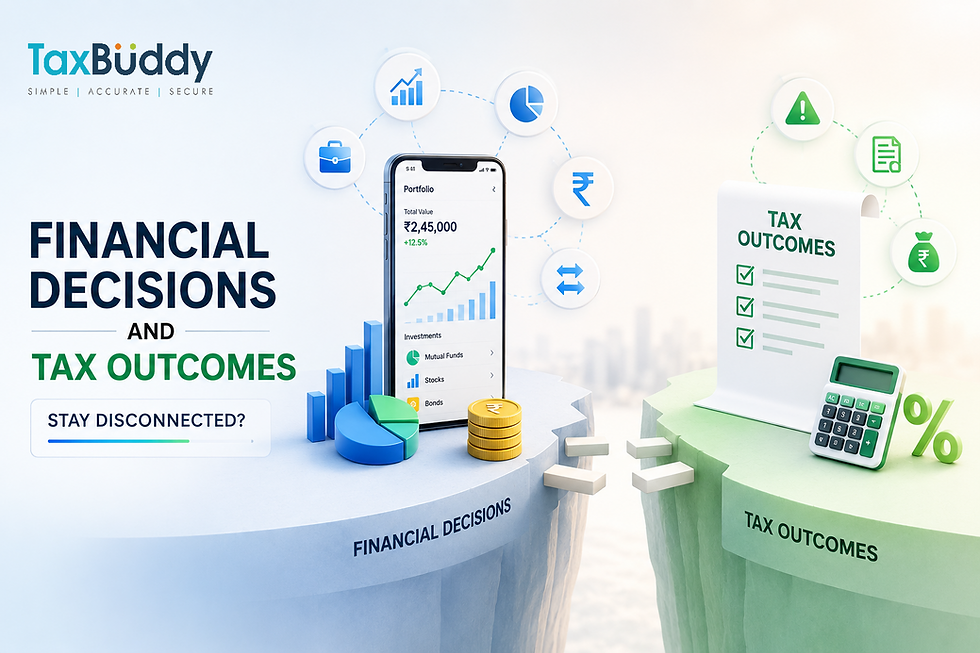
Most financial decisions today happen instantly. Users invest through apps, redeem funds digitally, shift portfolios, trade actively, or move money between products within minutes. But the tax impact of these decisions is usually understood much later, often only during filing season.
This creates a major disconnect in modern finance.
A transaction that looks profitable in real time may later create unexpected reporting complexity, additional tax liability, or lower retained profitability once the broader financial impact becomes visible. The issue is not that users make poor financial decisions. The issue is that financial activity and tax understanding often operate separately from each other.
This gap is becoming more visible as users become more financially active across investments, trading, lending, and wealth products. It is also one reason financial ecosystems like Jio Financial Services are increasingly bringing TaxBuddy-powered tax planning and filing experiences closer to broader financial workflows.
Table of Contents
Why Most Financial Decisions Are Made Without Tax Visibility
How Short-Term Financial Decisions Create Long-Term Reporting Complexity
Why Tax Outcomes Influence Wealth Creation More Than Most Users Realise
How TaxBuddy Helps Reduce the Gap Between Financial Activity and Tax Understanding
Why Financial Ecosystems Are Moving Toward Integrated Tax Visibility
Why Most Financial Decisions Are Made Without Tax Visibility
Most financial behaviour today is driven by speed and accessibility. Users invest through apps, switch funds instantly, trade actively, or move money across products with very little friction. The decision-making process is usually influenced by market trends, expected returns, liquidity needs, or short-term financial goals.
Tax consequences rarely enter the picture at the same moment. For most users, taxation remains something evaluated afterward rather than during the decision itself. This creates a disconnect where financial activity grows rapidly while tax understanding develops much later. By the time users begin thinking about reporting obligations or realised tax impact, the underlying transactions have already accumulated across multiple systems.
The result is that many financial decisions are made with incomplete visibility into their eventual financial consequences.
The Hidden Cost of Delayed Tax Awareness
Delayed tax awareness creates costs that are often invisible initially.
These costs are not always limited to higher tax liability. In many cases, the larger impact appears through:
reduced retained profitability
operational stress
reporting confusion
inefficient financial planning
A user may feel financially successful throughout the year, only to discover later that:
realised gains triggered higher taxes
transactions created unexpected reporting obligations
documentation was incomplete
profitability was lower than expected after compliance impact
The delay between financial activity and tax understanding makes these outcomes harder to anticipate early. Over time, this weakens financial clarity because users evaluate performance in real time but understand consequences only retrospectively.
How Short-Term Financial Decisions Create Long-Term Reporting Complexity
Short-term financial actions often create long-term operational consequences.
A user may redeem investments, rebalance portfolios, trade frequently, or switch products for entirely rational financial reasons in the moment. But every additional transaction creates another reporting dependency later.
This complexity compounds over time.
What initially feels like:
quick portfolio adjustments
opportunistic trades
temporary reallocations
eventually becomes:
multiple statements
reconciliation work
capital gains tracking
classification challenges
compliance coordination
The issue is not that users are making wrong decisions. The problem is that the long-term reporting burden remains disconnected from the short-term decision-making process itself.
Why Profitability Often Looks Different After Taxes
Many users measure profitability using visible returns alone. But retained outcomes often tell a different story.
Two individuals may generate similar gains during the year while ending up with very different post-tax outcomes depending on:
transaction frequency
gain timing
holding structures
reporting treatment
tax efficiency
This difference becomes more noticeable as financial activity becomes more sophisticated. High portfolio movement may create stronger visible returns but also increase taxable events. Similarly, poorly timed redemptions or frequent churn may reduce long-term retained value despite strong market performance.
This is gradually changing how financially aware users evaluate investment success. Profitability is no longer only about growth. It increasingly involves understanding how efficiently gains are retained after taxation and reporting impact are considered.
The Operational Stress Created by Financial-Tax Disconnects
One of the biggest consequences of disconnected financial and tax workflows is operational fatigue. Modern users interact with finance continuously throughout the year, but compliance still operates like a separate annual reconstruction exercise. Filing season often becomes stressful because users must suddenly:
locate documents
organise records
reconcile statements
interpret transactions
understand reporting treatment
across fragmented systems.
The stress is not always caused by taxation itself. It often comes from trying to rebuild financial context after months of disconnected activity. This creates an experience where finance feels highly digital during transactions but surprisingly manual during compliance.
How Fragmented Financial Activity Weakens Financial Clarity
Financial fragmentation weakens visibility into overall financial health. Most users today participate across multiple ecosystems simultaneously. Salary may flow through one platform, investments through another, lending through another, and trading through separate apps entirely.
Each platform may work efficiently individually, but the user’s broader financial position often
remains fragmented. As a result, users struggle to clearly understand:
actual taxable income
realised profitability
consolidated liabilities
overall financial efficiency
without manually combining information from multiple sources. The larger problem is not lack of financial data. It is the lack of financial continuity between systems that already hold important parts of the user’s financial story.
Why Tax Outcomes Influence Wealth Creation More Than Most Users Realise
Long-term wealth creation depends not only on generating returns but also on retaining them efficiently. Tax outcomes directly influence this process.
Frequent taxable events, inefficient portfolio churn, poor timing of gain realisation, or lack of planning can gradually reduce compounding efficiency over time. Many users underestimate how significantly these small inefficiencies affect long-term retained wealth.
This is especially important for financially active users because:
reporting complexity increases with activity
taxable events become more frequent
financial coordination becomes harder
Over longer time horizons, tax efficiency often becomes just as important as investment performance itself.
How TaxBuddy Helps Reduce the Gap Between Financial Activity and Tax Understanding
TaxBuddy helps reduce the disconnect between what users do financially and how they later understand or report those activities.
Instead of treating income tax filing as an isolated yearly task, TaxBuddy-powered workflows help ecosystems like Jio Financial Services bring filing visibility, planning support, and financial interpretation closer to ongoing financial activity.
This changes the user experience significantly. Users no longer need to completely reconstruct financial behaviour separately during filing season because tax visibility becomes more integrated into broader financial workflows already happening inside the ecosystem.
The value is not only operational convenience. It improves financial understanding over time.
Why Financial Ecosystems Are Moving Toward Integrated Tax Visibility
Financial ecosystems increasingly recognise that users do not think about finance in isolated categories anymore.
From the user’s perspective:
investing
borrowing
saving
tax filing
wealth creation
are interconnected parts of one financial life.
As a result, ecosystems are moving toward integrated tax visibility because taxation naturally sits across multiple financial activities already happening inside the platform.
The goal is no longer limited to enabling transactions. Platforms increasingly want to reduce the fragmentation between financial behaviour and financial interpretation itself.
This shift is becoming an important evolution in digital finance because users increasingly expect ecosystems to help them stay financially organised, not just financially active.
The Future of Financial Decision-Making in Digital Finance
The future of financial decision-making will likely become far more outcome-aware than it is today.
Users are gradually moving beyond evaluating:
returns alone
transaction convenience
product accessibility
and beginning to focus more on:
retained profitability
financial coordination
tax efficiency
long-term financial clarity
This will likely push financial ecosystems toward deeper integration between financial activity and compliance visibility.
Platforms like Jio Financial Services are already moving in this direction by bringing TaxBuddy-powered tax planning and filing experiences closer to everyday financial workflows.
The next generation of digital finance may ultimately be defined not only by how easily users can make financial decisions, but by how clearly they can understand the long-term consequences of those decisions afterward.
Conclusion
Modern finance made financial activity faster, simpler, and more accessible. But the tax consequences of those activities still remain disconnected for many users until much later. This creates a gap between financial behaviour and financial understanding, where users actively invest, trade, borrow, or build wealth without fully seeing how those decisions eventually affect reporting, profitability, and compliance outcomes.
As financial participation becomes more sophisticated, this disconnect becomes harder to manage manually. Users increasingly want better visibility into how financial decisions translate into real retained outcomes over time. This is one reason financial ecosystems like Jio Financial Services are integrating TaxBuddy-powered tax planning and filing experiences closer to broader financial workflows.
The future of digital finance may increasingly depend on reducing the distance between financial activity and financial clarity itself.
FAQs
Q1. Why do financial decisions often stay disconnected from tax outcomes?
Most financial decisions are made around returns, liquidity, or convenience in real time, while tax implications are usually evaluated much later during filing or reporting periods. This creates a disconnect between financial activity and financial understanding.
Q2. How can delayed tax awareness affect users financially?
Delayed tax awareness can lead to:
lower retained profitability
unexpected tax liability
reporting confusion
operational stress during filing season
because users often understand the compliance impact only after transactions have already accumulated.
Q3. Why does financial activity create reporting complexity over time?
Every investment, redemption, trade, loan product, or interest income stream creates additional reporting and documentation requirements. As financial participation grows, these layers become increasingly difficult to manage manually across disconnected systems.
Q4. Why can profitability look different after taxes?
Visible portfolio returns do not always reflect actual retained outcomes. Transaction frequency, gain timing, tax treatment, and reporting structures can significantly change post-tax profitability.
Q5. Why does the filing season become stressful for many users?
Users often need to retrospectively organise financial behaviour spread across multiple platforms, statements, and records. The stress usually comes from fragmented financial information rather than taxation alone.
Q6. How does fragmented financial activity weaken financial clarity?
When investments, salary, lending, trading, and savings activity exist across separate ecosystems, users struggle to maintain a clear understanding of:
taxable income
realised gains
liabilities
overall financial efficiency
without manually consolidating information.
Q7. Why are tax outcomes important for long-term wealth creation?
Long-term wealth creation depends not only on generating returns but also on retaining them efficiently. Frequent taxable events and poor financial coordination can gradually reduce compounding efficiency over time.
Q8. How does TaxBuddy help reduce the disconnect between finance and taxation?
TaxBuddy helps ecosystems like Jio Financial Services bring tax planning, filing visibility, and financial interpretation closer to ongoing financial workflows instead of treating filing as a separate yearly process.
Q9. Why are financial ecosystems moving toward integrated tax visibility?
Financial ecosystems increasingly recognise that users view investing, borrowing, saving, and filing as connected parts of one financial life rather than separate activities. Integrated tax visibility helps reduce fragmentation between these journeys.
Q10. How is digital finance evolving beyond transactions?
Digital finance is gradually shifting from simply enabling transactions toward helping users better understand, coordinate, and manage the long-term financial consequences of those transactions.



Comments