

From Document Upload to ITR Submission: How TaxBuddy AI Works at Every Step

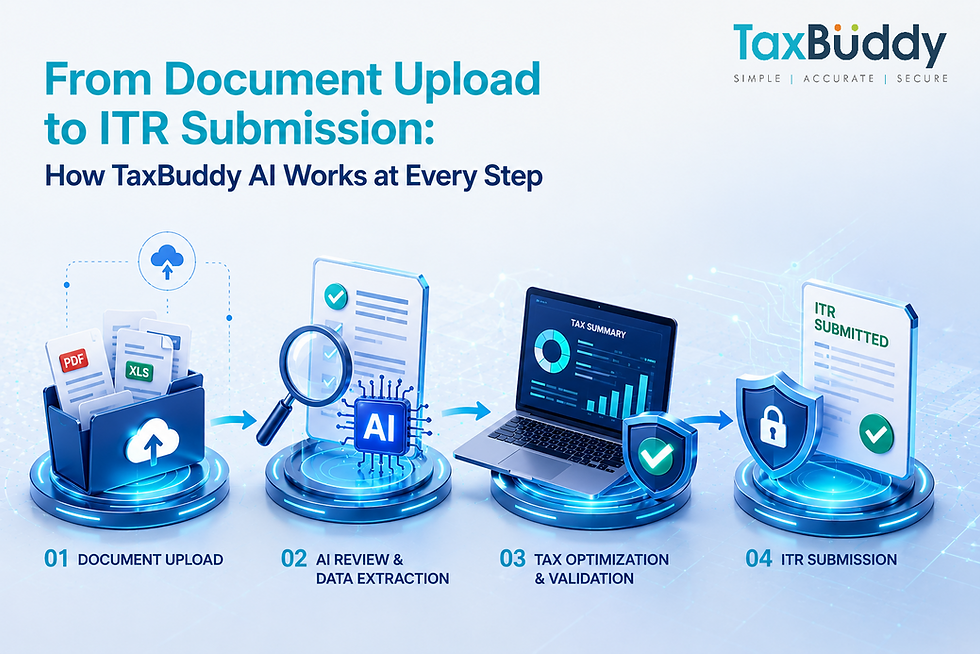
Income tax filing has changed dramatically over the past few years. What was once a paper-heavy process involving multiple forms, manual calculations, and repeated visits to a tax consultant has gradually become a digital experience. Today, taxpayers receive Form 16 electronically, banks issue interest certificates online, brokers provide downloadable capital gains statements, and much of this information is already available with the Income Tax Department through documents such as Form 26AS and the Annual Information Statement (AIS).
Alongside this digital transformation, Artificial Intelligence has become an increasingly popular tool during tax season. Many taxpayers now use AI to understand tax rules, compare tax regimes, estimate refunds, and even prepare their Income Tax Returns. While general AI assistants have made tax information easier to access, filing an Income Tax Return still involves much more than asking questions. Every return must accurately reflect a taxpayer's income, deductions, tax credits, and reporting obligations before it is submitted to the Income Tax Department.
This is where TaxBuddy AI has been designed to make a meaningful difference. Instead of functioning as a general conversational assistant, it supports taxpayers throughout the entire filing journey—from uploading documents to submitting the final Income Tax Return. By combining intelligent automation with structured tax workflows and expert assistance where required, TaxBuddy AI helps reduce manual effort while making the filing process simpler, faster, and more accurate.
Understanding how this journey works helps taxpayers appreciate why purpose-built AI delivers a very different experience from using a general AI chatbot.
Table of Contents
Why Tax Filing Needs More Than Document Uploads
Many taxpayers assume that filing an Income Tax Return is simply a matter of uploading Form 16 and submitting the numbers that appear on the document. While Form 16 is an important part of the filing process, it rarely represents the complete financial picture.
A taxpayer may also earn interest from savings accounts and fixed deposits, receive dividend income, sell mutual funds or shares, switch employers during the financial year, earn rental income, or have other taxable receipts that need to be reported. At the same time, the Income Tax Department already receives financial information from employers, banks, brokers, mutual funds, and other reporting entities.
Preparing an accurate return, therefore, requires consolidating information from multiple sources, verifying that government records match the taxpayer's documents, applying the latest tax provisions, and ensuring that no mandatory disclosure has been overlooked.
A purpose-built AI system must therefore support every stage of this process rather than focusing on just one part of it.
Step 1: Uploading Your Tax Documents
Every filing journey begins with collecting the necessary information.
Instead of manually entering figures from multiple documents, taxpayers simply upload the relevant tax documents and provide their PAN details. Depending on the individual's financial profile, these documents may include Form 16, capital gains statements, interest certificates, investment proofs, or other supporting records.
Rather than asking taxpayers to understand where every figure belongs, TaxBuddy AI begins organising the available information so that the filing journey starts with structured financial data instead of scattered documents.
This significantly reduces one of the most time-consuming aspects of manual tax filing.
Step 2: Understanding and Organising Your Financial Information
Collecting documents is only the first step. The real challenge lies in understanding how they fit together.
Different financial institutions report different aspects of a taxpayer's income. Employers report salary and TDS, banks report interest income, brokers provide investment transactions, while the government records consolidate much of this information through AIS and Form 26AS.
TaxBuddy AI helps organise this information into a structured filing workflow. Instead of requiring taxpayers to manually interpret every document, the platform guides them through their financial information in a way that mirrors the actual filing process.
This reduces confusion while ensuring that taxpayers have a clearer understanding of what will eventually appear in their Income Tax Return.
Step 3: Selecting the Right Filing Path
One of the earliest decisions during tax filing is determining the appropriate filing journey.
Some taxpayers have straightforward salary income and can comfortably complete their return through a guided self-filing experience. Others may have capital gains, business income, foreign assets, ESOPs, or multiple sources of income that require additional review.
Rather than offering a one-size-fits-all approach, TaxBuddy AI allows taxpayers to choose the filing path that best matches the complexity of their financial situation.
This flexibility enables taxpayers to receive the right level of support without making the process unnecessarily complicated.
Step 4: Validating Income and Tax Details
Accuracy is one of the most important aspects of tax compliance.
Before a return is prepared, income reported across various documents must be reviewed carefully to minimise inconsistencies. This includes salary information, tax deducted at source, investment income, and other financial details that contribute to the final computation.
Instead of expecting taxpayers to manually compare multiple records, TaxBuddy AI guides them through this validation process as part of the filing workflow.
The objective is not only to prepare an Income Tax Return but to prepare one that accurately reflects the taxpayer's financial information.
Step 5: Reviewing Deductions and Tax Liability
Once income has been organised, taxpayers need to understand how deductions and exemptions affect their final tax liability.
This stage often creates confusion because eligibility depends on individual circumstances rather than broad tax rules. Home loan benefits, insurance deductions, retirement contributions, and other tax-saving provisions require careful consideration before they are claimed.
TaxBuddy AI helps taxpayers review these aspects within the filing journey, making it easier to understand how their taxable income has been computed before moving to the next stage.
Instead of treating deductions as an afterthought, the platform incorporates them into the overall tax computation process.
Step 6: Preparing Your Income Tax Return
Once the necessary information has been organised and reviewed, the return itself begins to take shape.
Unlike general AI chatbots that generate answers one prompt at a time, TaxBuddy AI follows a structured workflow that mirrors the format required for filing with the Income Tax Department.
Taxpayers are guided through each stage of return preparation while maintaining visibility into the information being reported. This makes the filing journey more intuitive because every step builds naturally upon the previous one.
The focus remains on helping taxpayers complete their return accurately rather than requiring them to assemble the filing process themselves.
Step 7: Expert Review for Complex Cases
Artificial Intelligence can simplify many routine aspects of tax filing, but some financial situations still require professional judgment.
Business income, foreign assets, ESOPs, capital gains, multiple employers, and certain deduction claims often involve tax interpretations that extend beyond automated processing.
Recognising this, TaxBuddy AI complements its automated workflows with expert-assisted filing.
Taxpayers whose financial situations are more complex can have experienced tax professionals review their returns before submission, combining the speed of automation with the confidence of expert oversight.
Step 8: Filing and Post-Filing Support
Submitting the Income Tax Return is an important milestone, but it is not always the end of the taxpayer's journey.
After filing, taxpayers may wish to track processing, understand refund status, respond to routine queries, or seek assistance regarding their filed return.
TaxBuddy AI continues to support taxpayers beyond submission, making the filing journey feel complete rather than ending abruptly after the return has been uploaded.
This continuity is an important part of building taxpayer confidence, particularly for individuals filing their returns for the first time.
Why an End-to-End Filing Journey Matters
Many AI tools can answer tax questions.
Some can explain deductions.
Others can perform calculations.
Very few are designed around the complete filing lifecycle.
The real value of TaxBuddy AI lies not in any single feature, but in the way every stage connects seamlessly—from document upload and financial organisation to tax computation, expert review, filing, and post-filing support.
Instead of leaving taxpayers to manage multiple tools, documents, and conversations, the platform provides one guided journey that reflects the actual way an Income Tax Return is prepared.
For taxpayers, this means less manual work, fewer opportunities for error, and a filing experience that is considerably more organised than assembling the process independently.
Conclusion
Artificial Intelligence is transforming tax filing by making information easier to access and reducing the manual effort involved in preparing returns. Yet filing an Income Tax Return remains a structured compliance exercise that requires much more than simply answering tax-related questions.
TaxBuddy AI has been designed to support taxpayers through every stage of this journey. From document upload and financial organisation to return preparation, expert review, filing, and post-filing support, it combines intelligent automation with tax-specific workflows built for Indian taxpayers.
As AI continues to reshape personal finance, the greatest value will come from platforms that do more than explain tax rules. They will help taxpayers complete the entire filing journey with greater confidence, greater accuracy, and significantly less effort.
FAQs
Q1. What documents do I need to upload to TaxBuddy AI?
Depending on your financial profile, you may upload Form 16, capital gains statements, bank interest certificates, investment proofs, and other relevant tax documents.
Q2. Does TaxBuddy AI support salaried taxpayers only?
No. TaxBuddy AI also supports taxpayers with capital gains, business income, foreign income, rental income, ESOPs, and other complex financial situations.
Q3. Can TaxBuddy AI help me choose the correct ITR form?
Yes. TaxBuddy AI guides taxpayers through the filing journey based on their financial profile and applicable filing requirements.
Q4. Does TaxBuddy AI verify my tax information?
The platform helps organise and validate information as part of its structured filing workflow before preparing the return.
Q5. Can I get expert assistance if my return is complicated?
Yes. TaxBuddy AI offers expert-assisted filing for taxpayers with more complex tax situations.
Q6. Does TaxBuddy AI help after my ITR is filed?
Yes. The platform also supports taxpayers with post-filing assistance, including guidance after submission.
Q7. Is TaxBuddy AI suitable for first-time taxpayers?
Absolutely. The guided workflow is designed to simplify filing even for individuals who are filing their Income Tax Return for the first time.
Q8. How is TaxBuddy AI different from a general AI chatbot?
Unlike general AI assistants that answer tax questions, TaxBuddy AI is built specifically for Indian income tax filing and supports taxpayers throughout the complete filing journey—from document upload to ITR submission.


