

GST Input Tax Credit Reversal: How TaxBuddy Identifies When ITC Must Be Reversed
- Rashmita Choudhary

- Jan 20
- 9 min read
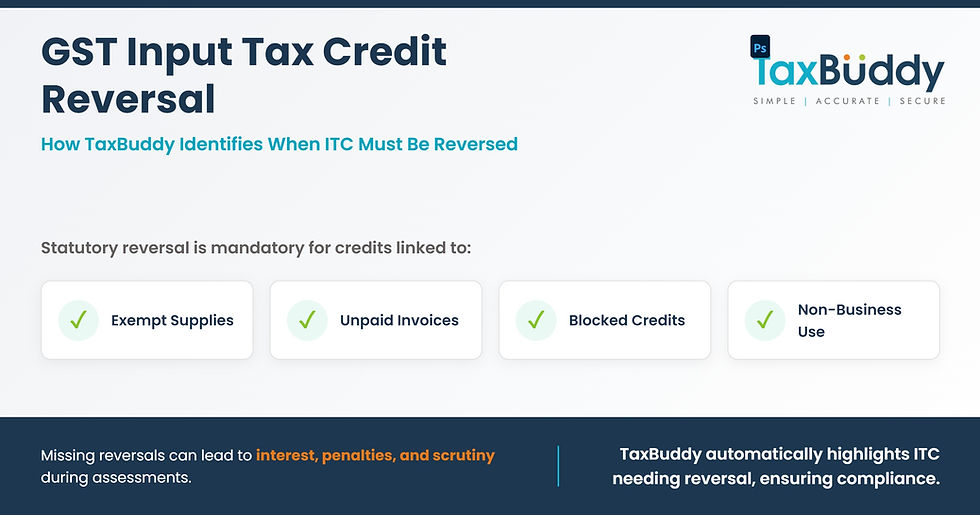
GST Input Tax Credit reversal is not optional. It is a statutory requirement under the CGST Act whenever credits are linked to exempt supplies, unpaid invoices, blocked credits, or non-business use. Missing a reversal can lead to interest, penalties, and scrutiny during assessments. With frequent changes such as new exemptions and compliance checks driven by GSTR-2B data, identifying reversal situations manually has become complex. During routine GST filing, platforms like TaxBuddy simplify this process by tracking transactional data, matching it with return filings, and highlighting ITC that must be reversed before errors escalate into notices or financial exposure.
Table of Contents
Reporting ITC Reversal in GSTR-3B and GSTR-9
What Is GST Input Tax Credit Reversal
GST Input Tax Credit reversal refers to the process of adding back previously claimed ITC to the tax liability when that credit no longer satisfies the conditions laid down under the CGST Act. ITC is allowed only when goods or services are used for taxable business supplies and all compliance conditions are met. When this link breaks due to exemptions, non-payment, personal use, or statutory restrictions, the credit must be reversed. This mechanism ensures that GST credit remains consumption-based and is not used to offset tax where the law does not permit it.
When ITC Reversal Is Mandatory Under GST Law
ITC reversal becomes mandatory in clearly defined situations under the GST law. These include non-payment to suppliers within the prescribed timeline, use of inputs for exempt or non-business purposes, blocked credits, and changes in taxability of outward supplies. The law treats reversal as a compliance correction, not a penalty. Failure to reverse eligible amounts on time results in interest liability and may trigger scrutiny during audits or return assessments.
ITC Reversal for Exempt Supplies and Non-Business Use
When inputs or input services are used partly for taxable supplies and partly for exempt supplies or non-business purposes, ITC cannot be fully retained. GST requires proportionate reversal of common credit in such cases. Exempt supplies include nil-rated, fully exempt, and non-GST supplies. Non-business use covers personal consumption or activities outside the scope of business. This reversal is calculated periodically to reflect the actual usage pattern during the tax period.
ITC Reversal for Non-Payment to Suppliers Within 180 Days
If payment to a supplier is not made within 180 days from the invoice date, the ITC claimed on that invoice must be reversed. This rule applies even when the supplier has correctly reported the transaction and tax has been paid to the government. Once payment is eventually made, the reversed ITC can be reclaimed. Interest applies for the period between availing the credit and reversing it, making timely vendor payments critical for GST compliance.
Blocked Credits Under Section 17(5) and Their Impact
Certain categories of ITC are permanently blocked under Section 17(5), regardless of business use. These include credits on motor vehicles for personal transport, food and beverages, club memberships, employee-related benefits, and goods lost or destroyed. If such credits are mistakenly claimed, they must be reversed immediately. Blocked credits often surface during departmental audits, making early identification essential to avoid disputes and penalties.
ITC Reversal When Goods or Services Become Exempt
When outward supplies transition from taxable to exempt, ITC related to stock, semi-finished goods, finished goods, and capital goods held on the effective date must be reversed. This is a one-time adjustment and applies even if the exemption is introduced through a notification. Capital goods reversal is based on the remaining useful life. Rate reductions do not trigger reversal as long as the supply remains taxable.
How ITC Reversal Is Calculated Under Rule 42 and Rule 43
Rule 42 governs reversal for inputs and input services used for both taxable and exempt supplies. The formula apportions common credit based on the ratio of exempt turnover to total turnover, with an additional deemed non-business portion. Rule 43 applies to capital goods and spreads ITC over a five-year period. Reversal is calculated based on the remaining months of use. Accurate computation requires structured data and consistent turnover tracking.
Reporting ITC Reversal in GSTR-3B and GSTR-9
ITC reversals are reported in Table 4(B) of GSTR-3B and reduce the net eligible credit for the tax period. Annual disclosures are consolidated in GSTR-9. Certain events, such as exemption-based reversals, also require filing Form GST ITC-03. Incorrect or delayed reporting can create mismatches with GSTR-2B data, often leading to system-generated notices.
Common Errors Businesses Make in ITC Reversal
Many businesses miss reversals due to manual tracking, incomplete invoice data, or misunderstanding exemption rules. Common errors include ignoring 180-day payment reversals, not adjusting for exempt turnover, claiming blocked credits, and failing to reverse ITC during exemption changes. These mistakes usually come to light during audits or departmental reconciliations, by which time interest liability has already accumulated.
How TaxBuddy Identifies ITC That Must Be Reversed
TaxBuddy identifies ITC reversal requirements through a layered, data-driven approach that mirrors how GST authorities validate credits, but does so proactively rather than retrospectively. Instead of relying on manual checks at month-end, the system continuously evaluates credit eligibility as transactional data flows in.
The first level of identification happens through automated reconciliation between GSTR-2B and GSTR-3B. Every inward supply reflected in GSTR-2B is matched against credits claimed in GSTR-3B. If ITC is claimed on invoices that are missing, duplicated, or restricted in GSTR-2B, the system flags those credits as potentially ineligible or reversible. This prevents situations where excess ITC is carried forward unknowingly.
Supplier payment timelines form the next layer of checks. TaxBuddy tracks invoice dates and payment status to identify credits that fall under the 180-day non-payment rule. When payment crosses the statutory timeline, the platform highlights the exact invoices linked to mandatory reversal, along with the period in which reversal must be reported. This avoids interest exposure caused by delayed reversals that are often missed in manual vendor tracking.
Exempt turnover analysis plays a critical role for businesses with mixed supplies. TaxBuddy monitors turnover classification and identifies when exempt, nil-rated, or non-GST supplies are present. Based on this data, the system automatically determines whether common ITC needs proportionate reversal under Rule 42. The exempt-to-total turnover ratio is computed internally, removing guesswork and ensuring consistency across tax periods.
For capital goods, TaxBuddy applies Rule 43 logic by tracking asset details, ITC availed, and the remaining useful life. If capital goods are shifted to exempt use, disposed of, or impacted by changes in taxability, the system calculates the exact reversal amount based on the unexpired portion of the 60-month period. This eliminates complex manual calculations that are prone to error.
The platform also checks for blocked credits under Section 17(5). Credits linked to restricted categories such as personal-use assets or employee-related expenses are flagged early, allowing correction before returns are filed. This is particularly useful during audits, where blocked credits are a common point of dispute.
All identified reversals are mapped directly to the relevant reporting tables in GSTR-3B and annual disclosures in GSTR-9. Instead of treating reversal as a post-filing correction, TaxBuddy integrates it into the filing workflow itself. This ensures that reversals are not only identified accurately but also reported in the correct period, reducing the risk of mismatches, notices, and interest liability.
By combining reconciliation, rule-based logic, and continuous monitoring, TaxBuddy transforms ITC reversal from a reactive compliance task into a controlled, predictable process.
Why Automated ITC Reconciliation Matters for GST Compliance
GST compliance is no longer driven by manual checks or post-filing reviews. The GST system today operates on continuous data matching, with inputs flowing from supplier filings, e-invoices, and system-generated statements like GSTR-2B. Automated ITC reconciliation plays a critical role in aligning business records with this data-driven framework and reducing compliance risk at every stage of the return lifecycle.
One of the biggest advantages of automation is early identification of ineligible ITC. Instead of discovering errors during audits or departmental scrutiny, automated reconciliation highlights mismatches, blocked credits, unpaid invoices, and exempt supply adjustments before GSTR-3B is filed. This proactive correction helps businesses avoid interest costs that accumulate silently when reversals are delayed.
Accuracy also improves significantly with automation. Manual reconciliations are prone to errors due to volume, timing differences, and frequent rule changes. Automated systems apply GST rules consistently across periods, ensuring that reversals under Rule 42, Rule 43, Section 17(5), and the 180-day payment condition are computed correctly every time. This consistency strengthens the credibility of returns and reduces the chances of queries during assessments.
Another key benefit lies in handling regulatory changes. GST law evolves frequently through notifications, exemptions, clarifications, and system updates. Automated reconciliation tools are designed to adapt to these changes without requiring businesses to redesign internal spreadsheets or workflows. This reduces dependency on ad-hoc manual fixes and lowers compliance fatigue, especially for businesses with mixed supplies or high transaction volumes.
Automation also improves audit readiness. With structured reconciliation reports, clear reversal logic, and system-backed calculations, businesses are better positioned to respond to notices or audits. Documentation becomes easier to maintain, traceable, and defensible, which is crucial in an environment where GST authorities rely heavily on data analytics.
Platforms like TaxBuddy integrate automated ITC reconciliation directly with return filing. By continuously comparing GSTR-2B with GSTR-3B and applying rule-based checks, such systems reduce manual intervention while improving compliance accuracy. In a GST regime built on data matching and automated scrutiny, reconciliation is no longer optional. It is a foundational control for sustainable, low-risk compliance.
Conclusion
GST Input Tax Credit reversal is a compliance safeguard designed to keep credits aligned with taxable business activity. With increasing reliance on data matching and system-driven checks, early identification of reversal events has become essential. Platforms like TaxBuddy simplify this process by combining reconciliation, rule-based logic, and timely alerts. For businesses seeking structured GST compliance support, downloading the TaxBuddy mobile app offers a simplified, secure, and hassle-free experience.
FAQs
Q1. Does TaxBuddy offer both self-filing and expert-assisted plans for ITR filing, or only expert-assisted options?
TaxBuddy offers both self-filing and expert-assisted plans. The self-filing option is built for taxpayers who prefer a guided, automated experience with system checks and validations. The expert-assisted option is designed for cases involving complexity, reconciliations, or compliance risks, where a tax professional reviews data, resolves issues, and completes filing. This flexibility allows taxpayers and businesses to choose the level of support that suits their needs.
Q2. Which is the best site to file ITR?
The Income Tax Department’s e-filing portal is the official platform for filing income tax returns in India. However, many taxpayers opt for private compliance platforms that offer structured workflows, automated data reading, and error detection. These platforms help reduce manual mistakes, especially in cases involving multiple income sources, deductions, or reconciliation with AIS and TIS data.
Q3. Where to file an income tax return?
Income tax returns can be filed directly on the Income Tax Department’s e-filing portal or through authorised online platforms that integrate with the government system. These platforms submit returns to the department on behalf of the taxpayer while providing additional checks, summaries, and compliance assistance during the filing process.
Q4. When is ITC reversal mandatory under GST?
ITC reversal becomes mandatory when credits are linked to exempt supplies, non-business use, blocked credits under Section 17(5), or invoices that remain unpaid beyond 180 days. Reversal is also required when outward supplies become fully exempt or when capital goods are no longer used for taxable supplies. These situations are defined under the CGST Act and related rules to ensure ITC is used only for eligible taxable activities.
Q5. Is ITC reversal required for GST rate reductions?
ITC reversal is not required when GST rates are reduced, but the supply remains taxable. Reversal applies only when a supply becomes fully exempt or moves outside the scope of GST. As long as output tax continues to be payable, previously availed ITC remains eligible.
Q6. How is ITC reversed for exempt supplies?
When inputs or services are used for both taxable and exempt supplies, GST requires proportionate reversal of the common credit. This is calculated using the formula prescribed under Rule 42, based on the ratio of exempt turnover to total turnover. The reversal ensures that only the portion of ITC attributable to taxable supplies is retained.
Q7. What happens if ITC reversal is delayed?
Delayed ITC reversal attracts interest from the date the credit was wrongly availed until the date of reversal. Prolonged delays may also result in notices during assessments, audits, or return scrutiny. While reversal itself is a correction mechanism, non-compliance increases financial exposure through interest and potential penalties.
Q8. How is ITC reversal handled for capital goods?
ITC on capital goods is reversed based on their remaining useful life, calculated over a maximum period of 60 months. If capital goods start being used for exempt supplies or are disposed of, the proportionate ITC corresponding to the unexpired period must be reversed as per Rule 43. This method ensures a fair allocation of credit over time.
Q9. Where is ITC reversal reported in GST returns?
ITC reversals are disclosed in Table 4(B) of GSTR-3B for the relevant tax period. Annual consolidation of such reversals is reflected in GSTR-9. In specific situations, such as when supplies become exempt, Form GST ITC-03 is also required to report stock and capital goods reversals.
Q10. Can reversed ITC be reclaimed later?
ITC reversed due to non-payment to suppliers can be reclaimed once payment is made, subject to conditions under GST law. However, ITC reversed due to exemptions or blocked credits cannot be reclaimed. Reclaim eligibility depends entirely on the reason for reversal.
Q11. How does TaxBuddy help with ITC reversal compliance?
TaxBuddy assists by reconciling GSTR-2B with GSTR-3B, monitoring payment timelines, identifying exempt turnover, and flagging ineligible or reversible credits. Automated checks reduce reliance on manual tracking and help ensure reversals are made accurately before return filing.
Q12. Does ITC reversal apply to mixed supplies?
Yes, ITC reversal applies when inputs or services are used for a mix of taxable and exempt supplies. In such cases, GST law mandates proportionate reversal of common credit to ensure ITC is claimed only to the extent it relates to taxable outward supplies.


Comments