

Why Tax Planning Cannot Be Done at the Time of ITR Filing
- CA Pratik Bharda

- Feb 11
- 9 min read
Tax planning is a year-long exercise governed by timelines set under the Income Tax Act, 1961. Most tax-saving opportunities, including deductions, exemptions, advance tax payments, and capital gain reinvestments, must be completed before the financial year ends. Once the year closes, income becomes final and irreversible. Income tax return filing is designed only to report past transactions, not to restructure them. Attempting tax planning at the time of ITR filing often results in missed deductions, interest liabilities, and increased scrutiny. Platforms like TaxBuddy focus on helping taxpayers plan early rather than react late.
Table of Contents
What Tax Planning Actually Means Under Income Tax Law
Tax planning refers to legally arranging income, investments, expenses, and transactions during a financial year to reduce overall tax liability in compliance with the Income Tax Act, 1961. It involves choosing the correct tax regime, making eligible investments, timing income and capital gains, paying advance tax where applicable, and ensuring documentation is in place before statutory deadlines. Tax planning is preventive in nature and works only when actions are taken before income crystallises. Once the financial year ends, the scope of planning narrows significantly, as the law does not permit retroactive restructuring of income or investments.
Why Tax Planning Cannot Be Done at the Time of ITR Filing
Income tax return filing is a disclosure mechanism, not a planning exercise. By the time the return is filed, the financial year has already ended, and income has been finalised. The law does not allow taxpayers to introduce new investments, claim fresh deductions, or alter tax positions after this stage. ITR filing only permits accurate reporting of what has already occurred. Any attempt to “plan” at this stage usually results in disallowed claims, interest liabilities, or increased scrutiny, rather than tax savings.
Deductions That Expire Before the ITR Filing Window
Most deductions under Chapter VI-A must be backed by actual payments or investments made before March 31 of the financial year. Popular deductions such as Section 80C investments, health insurance under Section 80D, and interest benefits linked to eligible payments lapse once the year closes. During ITR filing, these deductions can only be reported if they were already executed within the prescribed timeline. Filing a return without prior action automatically results in permanent loss of these benefits.
Advance Tax Compliance Cannot Be Fixed During Return Filing
Advance tax obligations arise when the estimated tax liability exceeds the prescribed threshold. The law requires advance tax to be paid in instalments during the financial year itself. Once the year ends, the unpaid advance tax attracts mandatory interest. This liability cannot be corrected or avoided at the time of filing the return. Paying tax during ITR filing only settles the principal amount; interest for delay remains payable and cannot be waived through return filing.
Capital Gains Reinvestment Deadlines vs ITR Deadlines
Capital gains exemptions are governed by strict reinvestment timelines that begin from the date of transfer of the asset, not from the return filing date. Whether it involves specified bonds or reinvestment in eligible assets, the law allows exemptions only if investments are completed within defined periods. These windows usually close months before the ITR filing deadline. Once missed, no exemption can be claimed, even if the return is filed correctly.
ITR Forms Are Designed for Reporting, Not Planning
Income tax return forms are structured to capture income details, tax payments, deductions already claimed, and supporting disclosures. They do not provide any mechanism to create new eligibility or modify tax outcomes. The design of ITR forms reinforces the principle that tax planning must precede filing. The system validates existing data but does not permit new tax-saving decisions at the reporting stage.
Revised Returns Do Not Replace Tax Planning
Revised returns exist to correct mistakes such as incorrect income reporting, missed disclosures, or data mismatches. They do not allow taxpayers to introduce new investments, claim fresh deductions, or alter tax positions that were never legally available. Treating revised returns as a tax planning tool often results in rejection of claims and further compliance issues.
Missed Loss Set-Offs and Carry Forward Due to Late Action
Certain losses can be carried forward only if the return is filed within the due date. Filing late permanently blocks the ability to adjust those losses against future income. This is a common consequence of year-end or post-year tax planning. Once the filing deadline passes, the law does not permit revival of these benefits, regardless of the taxpayer’s intent.
Increased Scrutiny for Post-Filing Adjustments
Post-filing changes, rectifications, and aggressive claims attract higher scrutiny under the faceless assessment framework. Authorities increasingly examine late claims, inconsistent disclosures, and after-the-fact corrections. What could have been avoided through early planning often turns into compliance stress, notices, and prolonged correspondence.
How Early Tax Planning Reduces Errors and Notices
Early tax planning brings structure and visibility to a taxpayer’s financial activity across the entire financial year. When income streams are tracked regularly instead of being reviewed at the end, discrepancies between salary income, professional receipts, interest income, and capital gains are identified early. This prevents common reporting errors such as missing bank interest, unreported freelance income, or incorrect classification of income under the wrong head.
Planning in advance also ensures deductions and exemptions are claimed only when they are genuinely eligible. Health insurance premiums, tax-saving investments, home loan interest, and other eligible payments can be timed correctly within the financial year. This avoids situations where deductions are claimed without valid proof or after the eligibility window has closed, which is a frequent reason for disallowances and subsequent notices.
Advance tax planning plays a critical role in reducing compliance issues. Estimating tax liability periodically and paying advance tax in correct instalments minimises interest liabilities and prevents large tax outflows at the time of filing. Many automated notices arise not due to tax evasion but because of short payment or delayed payment of advance tax, which early planning effectively eliminates.
Regular reconciliation with tax credit statements, such as Form 26AS and AIS, further reduces the risk of mismatches. Early review helps identify missing TDS credits, incorrect PAN reporting by deductors, or duplicated entries. These issues can be resolved well before filing, ensuring that the return data matches the information available with the tax department and reducing the chances of automated system-generated notices.
Planned filing also leads to better documentation and record-keeping. When documents are organised throughout the year, the likelihood of errors in data entry, incorrect figures, or missed disclosures reduces significantly. This results in smoother return processing, quicker refund issuance, and minimal follow-up communication from tax authorities.
Overall, early tax planning transforms compliance from a reactive exercise into a controlled and predictable process. It lowers the probability of errors, reduces dependence on revisions and rectifications, and significantly decreases exposure to notices and assessments, making the entire tax filing experience more efficient and stress-free.
Role of Digital Platforms in Year-Round Tax Planning
Tax compliance has evolved from a once-a-year activity into a continuous process that spans the entire financial year. Income today is earned from multiple sources, tax rules differ across regimes, and compliance timelines are spread throughout the year. In this environment, relying on last-minute calculations during ITR filing increases the risk of errors, missed benefits, and interest liabilities. Digital platforms address this gap by enabling ongoing visibility and control over tax-related data.
A key advantage of digital tax platforms is real-time income tracking. Salaries, freelance receipts, interest income, capital gains, and tax deductions can be monitored as they accrue, rather than reconstructed at year-end. This helps taxpayers understand their evolving tax liability early and adjust financial decisions accordingly. Continuous tracking also reduces dependence on manual records and eliminates discrepancies during return preparation.
Another important role played by digital platforms is deadline management. Advance tax due dates, investment cut-offs for deductions, capital gains reinvestment windows, and return filing deadlines are spread across the year. Automated reminders ensure that critical timelines are not missed, preventing interest underpayment and loss of eligibility for deductions or exemptions. This shifts compliance from reactive correction to proactive action.
Digital platforms also simplify reconciliation of tax credits by integrating data from sources such as Form 26AS and AIS. Early reconciliation helps identify mismatches related to TDS, advance tax, or self-assessment tax well before filing. Addressing these issues in advance reduces the likelihood of processing delays, demands, or notices after filing.
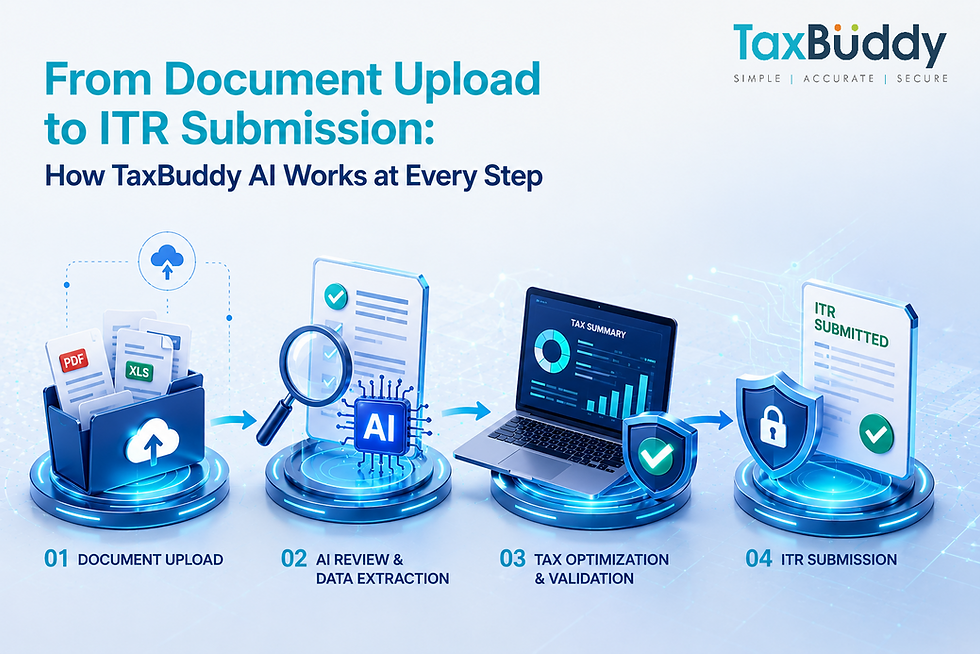
Return preparation becomes significantly smoother when year-round data is already organised. Instead of rushing to compile information during the filing window, taxpayers can focus on verification and accuracy. This leads to cleaner filings, faster processing, and fewer revisions. Platforms like TaxBuddy combine tracking, reminders, reconciliation, and filing support into a single workflow, making tax compliance more structured and predictable.
Overall, digital platforms transform tax planning from a stressful, last-minute exercise into an ongoing financial discipline. By supporting early action, accurate reporting, and timely compliance, they reduce errors, minimise scrutiny, and help taxpayers remain aligned with the law throughout the year rather than only at the time of filing.
Conclusion
Tax planning is effective only when it is integrated into financial decisions throughout the year. Once the return filing stage begins, the scope is limited to reporting and compliance. Early planning ensures lawful tax savings, avoids penalties, and minimises scrutiny. For taxpayers seeking structured support across the entire tax cycle, it is advisable to download the TaxBuddy mobile app for a simplified, secure, and hassle-free experience.
FAQs
Q1. Why is tax planning considered a year-long activity?
Tax planning depends on actions such as investments, insurance payments, advance tax instalments, and capital gains reinvestments that must be completed within the financial year. The Income Tax Act, 1961, does not allow these actions to be performed retrospectively. Once the year ends, income and eligibility conditions are fixed, making planning after that point ineffective.
Q2. Can tax liability be reduced during ITR filing?
ITR filing does not allow reduction of tax liability through new decisions. It only allows reporting of income, deductions, and taxes that already exist. Any attempt to reduce tax during filing without prior action usually results in disallowed claims or additional scrutiny.
Q3. Are deductions like Section 80C and 80D allowed during ITR filing?
Deductions under Sections such as 80C and 80D are allowed only if the eligible investment or payment was made before March 31 of the financial year. During ITR filing, these deductions can only be reported, not created. Payments made after the year ends are not eligible.
Q4. Is the advance tax payment adjustable at the time of return filing?
Advance tax must be paid in prescribed instalments during the financial year. Paying tax at the time of ITR filing only settles the remaining tax payable but does not remove interest liability for delayed or missed advance tax. Interest under applicable provisions remains mandatory.
Q5. Can capital gains exemptions be claimed during ITR filing?
Capital gains exemptions depend on reinvestment within specific timelines from the date of asset transfer. These timelines usually expire well before the ITR filing date. If reinvestment is not completed within the allowed period, the exemption cannot be claimed while filing the return.
Q6. Do ITR forms allow changes to the income structure?
ITR forms are designed for disclosure, not restructuring. They capture income earned, deductions already availed, and taxes paid. They do not provide any mechanism to alter income classification, change transaction timing, or introduce new tax-saving measures.
Q7. Is filing a revised return a substitute for tax planning?
A revised return is meant to correct errors such as incorrect income figures, missed disclosures, or reporting mistakes. It cannot be used to claim new deductions, introduce fresh investments, or restructure tax positions that were never eligible in the first place.
Q8. What happens if loss carry-forward conditions are missed?
Certain losses can be carried forward only if the return is filed within the due date. If the return is filed late, the right to carry forward those losses lapses permanently. This benefit cannot be restored through revised or belated returns.
Q9. Does late tax planning increase the chances of tax notices?
Yes, post-filing claims, corrections, and aggressive adjustments attract higher scrutiny under automated and faceless assessment systems. Late planning often results in mismatches, interest demands, or compliance notices that could have been avoided with timely action.
Q10. How does early tax planning reduce filing errors?
Early planning ensures income is tracked correctly, deductions are executed on time, and tax payments align with statutory requirements. This reduces mismatches with tax credit statements, avoids interest and penalties, and leads to smoother return processing.
Q11. Is tax planning different under the old and new tax regimes?
Yes, the availability of deductions and exemptions differs significantly between the two regimes. Tax planning must be aligned with the chosen regime before the financial year ends. Switching regimes at filing time does not allow retroactive benefit planning.
Q12. How can digital platforms support year-round tax planning?
Digital platforms help taxpayers monitor income, track deductions, receive deadline reminders, reconcile tax credits, and prepare returns in advance. Solutions like TaxBuddy enable proactive compliance by integrating planning and filing into a continuous process rather than a last-minute task.




Comments