

GSTR-3B Filing Made Easy: How TaxBuddy Calculates Your Net GST Payable
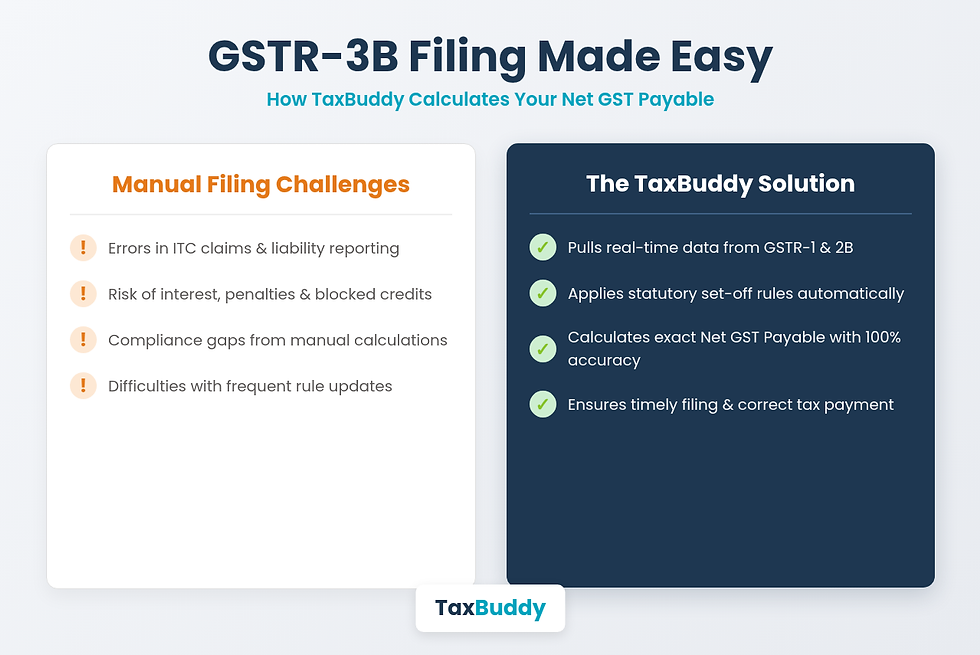
GSTR-3B is the most critical GST return because it determines the actual tax paid to the government. Errors in ITC claims, liability reporting, or set-off orders can lead to interest, penalties, and blocked credits. With frequent rule updates, auto-populated data from GSTR-1 and GSTR-2B, and strict filing timelines, manual calculations often create compliance gaps. Automated platforms like TaxBuddy bridge this gap by pulling real-time GST data, applying statutory set-off rules, and calculating the exact net GST payable with accuracy. This ensures timely filing, correct tax payment, and reduced reconciliation issues for businesses of all sizes.
Table of Contents
What Is GSTR-3B and Why It Matters for GST Compliance
GSTR-3B is a summary return under the GST law that determines the actual tax paid to the government for a tax period. It captures total outward supplies, eligible input tax credit, reverse charge liabilities, and the final net GST payable. Unlike detailed returns, GSTR-3B directly impacts cash outflow because tax must be paid at the time of filing. Any error in reporting or ITC utilisation can lead to interest, late fees, or future notices. For this reason, GSTR-3B acts as the backbone of GST compliance and serves as the primary reference for tax payments, refunds, and departmental reconciliation.
Key Components of GSTR-3B That Affect Net GST Payable
Net GST payable is influenced by a few critical tables within GSTR-3B. Table 3.1 reports outward supplies, including taxable supplies, zero-rated supplies, exempt supplies, and reverse charge liabilities. Table 4 determines the eligible and ineligible input tax credit based on GSTR-2B. Table 6 calculates tax payment through ITC and cash ledgers. Any misreporting in these sections directly changes the final liability, making accuracy across these components essential for compliant filing.
How Net GST Payable Is Calculated in GSTR-3B
Net GST payable is calculated by first determining the total GST liability on outward supplies and reverse charge transactions. From this liability, eligible ITC is reduced as per GST utilisation rules. The balance amount, after ITC adjustment, becomes payable in cash. This calculation is not flexible and must strictly follow statutory rules. Incorrect offsets or excess ITC claims can result in blocked credits or interest demands later.
ITC Utilisation Rules Applied While Calculating GST Payable
Input tax credit utilisation follows a prescribed order. IGST credit must be used first against IGST liability, followed by CGST and SGST. CGST credit can be used against CGST and IGST, but not SGST. SGST credit can be used against SGST and IGST, but not CGST. Cross-utilisation between CGST and SGST is not permitted. These rules are mandatory and often misapplied during manual calculations, leading to incorrect tax payments.
GSTR-3B Filing Process and Data Auto-Population
The filing process starts with selecting the tax period on the GST portal and opening GSTR-3B. Liability details are auto-populated from GSTR-1, while ITC data flows from GSTR-2B. Taxpayers must verify these figures, make necessary adjustments, offset liabilities using ITC and cash ledgers, generate challans if required, and submit the return using DSC or OTP. Since auto-populated data is now system-locked, careful validation before filing has become more important than ever.
Due Dates, Late Fees, and Interest Under GSTR-3B
Monthly filers are required to file GSTR-3B by the 20th of the following month. QRMP taxpayers file quarterly, with due dates falling on the 22nd or 24th, depending on state category. Late filing attracts a fee of ₹50 per day, reduced to ₹20 per day for NIL returns, subject to turnover-based caps. Interest at 18 per cent per annum applies on delayed tax payments. These charges apply automatically and cannot be waived through rectification.
Common Errors in Manual GSTR-3B Calculations
Manual filing often leads to mismatches between GSTR-1, GSTR-2B, and the books of accounts. Common errors include excess ITC claims, incorrect reverse charge reporting, wrong ITC utilisation order, missed ineligible credits, and incorrect cash offset. These mistakes may not be visible immediately but often surface during audits, refunds, or departmental data matching, resulting in compliance risk.
How TaxBuddy Calculates Net GST Payable Step by Step
TaxBuddy automates GSTR-3B computation by directly integrating with GST data sources. It pulls outward liability from GSTR-1, ITC data from GSTR-2B, and ledger balances from the GST portal. The system validates eligibility, applies statutory ITC utilisation rules, highlights reversals required under GST law, and computes the exact cash payable. This structured approach removes guesswork and ensures consistency across returns.
Mismatch Detection Between GSTR-1, GSTR-2B, and Books
One of the biggest compliance risks arises from mismatches across returns and accounting records. TaxBuddy identifies differences between sales reported in GSTR-1, ITC reflected in GSTR-2B, and internal books. These mismatches are flagged before filing, allowing corrective action within the same tax period. This proactive reconciliation reduces the chances of notices, blocked credits, or interest liabilities.
Recent GSTR-3B Updates and Compliance Changes
Recent updates have tightened compliance requirements. Auto-populated liabilities are now locked, limiting manual changes. Filing of returns beyond three years has been restricted, and system-based validations have increased. These changes make accuracy at the time of filing non-negotiable and increase reliance on automated, rule-based computation systems.
Who Should File GSTR-3B Monthly vs Quarterly
The frequency of GSTR-3B filing depends on a taxpayer’s aggregate turnover and the scheme opted under GST. Businesses with an aggregate turnover exceeding ₹5 crore in the preceding financial year are mandatorily required to file GSTR-3B every month. For these taxpayers, tax liability is discharged every month, and both compliance and reconciliation activities are spread evenly across the year. This structure suits businesses with regular transactions, stable cash flows, and in-house accounting systems capable of handling frequent reporting.
Taxpayers with aggregate turnover up to ₹5 crore have the option to opt for the Quarterly Return Monthly Payment (QRMP) scheme. Under this scheme, GSTR-3B is filed once every quarter instead of monthly. However, tax payment is still required on a monthly basis through Form PMT-06 for the first two months of the quarter. The actual tax liability is finally adjusted at the time of filing the quarterly GSTR-3B. This allows smaller businesses to reduce the frequency of return filing while continuing to meet payment obligations.
The choice between monthly and quarterly filing has a direct impact on cash flow management. Monthly filers pay tax based on actual liability each month, which provides better visibility and avoids large outflows at quarter-end. QRMP taxpayers, on the other hand, often make estimated payments in the first two months, which may result in excess or short payments that are adjusted later. For businesses with fluctuating turnover, this estimation can sometimes create temporary cash flow strain.
Compliance workload is another important factor. Monthly filing requires frequent reconciliation between GSTR-1, GSTR-2B, and the books of accounts, along with timely ITC verification. Quarterly filing reduces the number of returns but increases the need for careful tracking of transactions throughout the quarter to avoid errors during final filing. Businesses with limited accounting resources often prefer QRMP to reduce routine compliance pressure.
Reconciliation frequency also differs between the two options. Monthly filers reconcile data every month, which helps in early detection of mismatches and quicker corrections. QRMP taxpayers may face a higher reconciliation load at the end of the quarter, as three months of data must be reviewed together. This makes disciplined record-keeping essential under the quarterly scheme.
Selecting the right filing frequency requires evaluating turnover trends, transaction volume, cash flow stability, and internal compliance capability. A well-informed choice helps reduce interest exposure, improve working capital efficiency, and maintain consistent GST compliance without unnecessary operational stress.
Why Automated GST Filing Reduces Compliance Risk
Automated GST filing significantly reduces compliance risk by removing the most common source of errors in return filing, which is manual intervention. When calculations are done manually, mistakes often occur in liability reporting, input tax credit eligibility, utilisation order, and cash offset. Automation applies statutory GST rules uniformly every time, ensuring that tax liabilities and credits are calculated strictly as per law, without subjective interpretation or oversight.
As GST compliance becomes increasingly data-driven, authorities rely heavily on system-based matching across GSTR-1, GSTR-2B, GSTR-3B, e-way bills, and financial records. Automated filing tools continuously reconcile these data points and highlight mismatches before returns are submitted. This early detection prevents incorrect filings that may otherwise trigger interest, credit reversals, or scrutiny notices at a later stage.
Timeliness is another critical factor in GST compliance. Automated platforms track due dates, filing status, and payment requirements, reducing the risk of missed deadlines. Late fees and interest apply automatically under GST, leaving little scope for correction once timelines are breached. Automation ensures that filings are prepared and submitted on time, even during high-volume or complex reporting periods.
Automated systems also improve transparency and audit readiness. Each adjustment, reversal, or override is recorded with a clear trail, making it easier to explain figures during departmental verification or audits. This structured documentation supports consistent reporting across tax periods and reduces dependency on individual knowledge or memory.
By simplifying return preparation and reducing repetitive compliance tasks, automation allows businesses to allocate time and resources to core operations rather than return mechanics. As GST regulations continue to evolve and system controls tighten, automated filing provides a reliable framework for maintaining compliance with minimal risk and greater confidence.
Conclusion
GSTR-3B filing directly impacts tax payments, ITC availability, and overall GST compliance. With strict utilisation rules, auto-populated data, and higher scrutiny, accuracy has become critical. Digital platforms simplify this complexity by ensuring correct calculations and timely filing. For anyone looking for assistance in tax filing, downloading the TaxBuddy mobile app offers a simplified, secure, and hassle-free experience.
FAQs
Q1. Does TaxBuddy offer both self-filing and expert-assisted plans for ITR filing, or only expert-assisted options?
TaxBuddy offers both self-filing and expert-assisted plans to suit different compliance needs. The self-filing option is designed for straightforward cases where automation, data prefill, and system checks are sufficient. The expert-assisted plan is suitable for taxpayers dealing with multiple income heads, GST-linked income, corrections, or compliance risks, where a qualified professional reviews the data before filing. This flexibility allows users to choose the level of support required without overpaying for unnecessary services.
Q2. Which is the best site to file ITR?
The Income Tax Department’s official portal remains the primary platform for filing income tax returns. However, many taxpayers prefer platforms that offer structured guidance, automated checks, and support during errors or notices. Platforms like TaxBuddy provide a more user-friendly interface, automated data import from AIS and Form 26AS, and optional expert review, making them suitable for individuals and businesses seeking accuracy and ease.
Q3. Where to file an income tax return?
Income tax returns can be filed directly on the official income tax e-filing portal or through authorised platforms that assist with return preparation and submission. These platforms act as intermediaries, helping taxpayers organise data, apply correct tax rules, and file returns accurately while still submitting them through the government system.
Q4. Is GSTR-3B mandatory even for NIL turnover?
Yes, GSTR-3B must be filed even if there are no sales, purchases, or tax liabilities during the tax period. In such cases, a NIL return is required. Non-filing of NIL GSTR-3B attracts late fees and may lead to compliance blocks on future filings, making timely submission important even during inactive periods.
Q5. Can GSTR-3B be revised after filing?
GSTR-3B cannot be revised once filed. Any errors or omissions must be corrected in subsequent returns as per GST rules. This makes accuracy at the time of filing critical, especially for ITC claims and liability reporting, since incorrect figures may trigger interest, reversals, or notices later.
Q6. What happens if the ITC claimed in GSTR-3B is not reflected in GSTR-2B?
ITC not reflected in GSTR-2B is generally considered ineligible unless specific conditions are met. Claiming such ITC can lead to reversal, interest liability, and possible scrutiny from the department. Matching GSTR-3B ITC claims with GSTR-2B data is therefore essential to avoid future disputes.
Q7. Is interest applicable if tax is paid late but the return is filed on time?
Yes, interest is applicable on delayed tax payment even if the GSTR-3B return is filed within the due date. Interest is calculated at 18 per cent per annum from the due date until the date of payment. Filing the return without paying tax does not stop interest from accruing.
Q8. Can QRMP taxpayers change to monthly filing later?
Yes, taxpayers under the QRMP scheme can switch to monthly filing if their turnover crosses the prescribed threshold or if they choose to opt out of the scheme. The change must be made within the timelines notified on the GST portal, usually before the start of the relevant quarter.
Q9. Are reverse charge liabilities mandatory to report in GSTR-3B?
Yes, reverse charge liabilities must be reported and paid in GSTR-3B. These liabilities arise when the recipient is liable to pay GST instead of the supplier. Failure to report reverse charge transactions can result in interest, penalties, and mismatches during audits or departmental verification.
Q10. Does automated filing eliminate GST notices completely?
Automated filing significantly reduces errors related to calculations, data mismatches, and compliance gaps. However, it does not eliminate the possibility of GST notices entirely, as scrutiny can also arise from supplier non-compliance, sector-based audits, or policy-level checks. Automation helps in early detection and correction, reducing overall risk.
Q11. How does the ITC utilisation order affect cash flow?
Incorrect ITC utilisation increases cash payment requirements even when sufficient credit is available. Following the statutory utilisation order ensures maximum credit usage before cash outflow. Errors in this order can block credits temporarily and strain working capital, especially for businesses with high GST turnover.
Q12. Is professional review useful even with automated tools?
Professional review remains valuable in cases involving complex transactions, past-period corrections, reversals, or notices. While automation handles calculations and validations, expert review adds a layer of judgment and interpretation, helping ensure compliance with evolving GST rules and reducing long-term litigation risk.


