

How SMB Lending Platforms can Accelerate Growth with Tax Filing Solutions

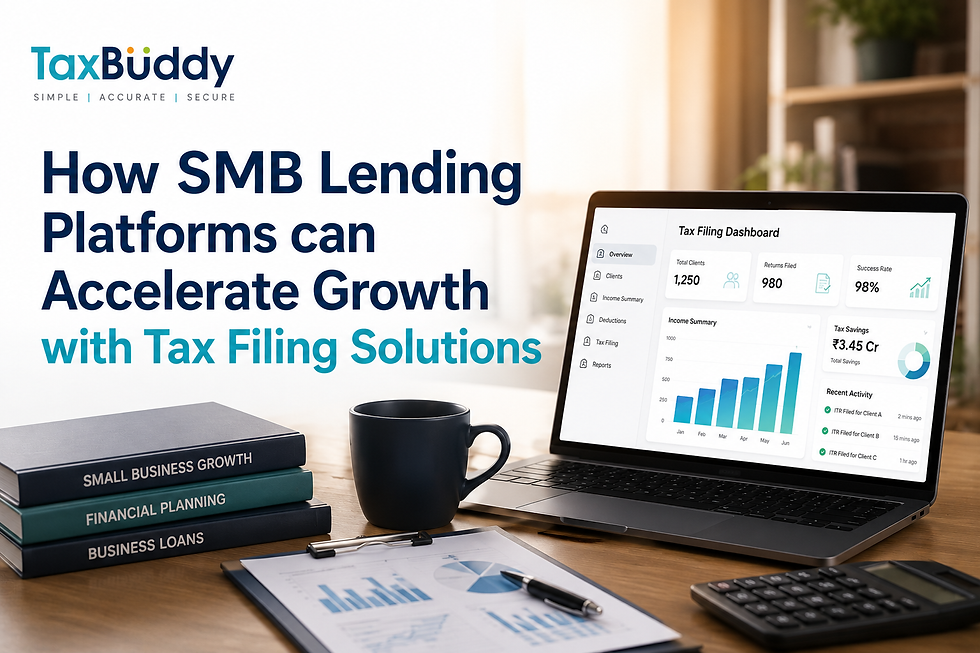
With the central government granting API access to tax portals, AI-focused automation tools have found their way into the financial ecosystem to simplify compliance and filing. In addition, data from the Press Bureau of India reveals that approximately 9.19 Crore Income Tax Returns (ITRs) have been filed during FY 2024-25 demonstrating an increase in the number of taxpayers across the country.
GST-registered taxpayers are a huge part of this pie, running small and medium businesses and contributing to India’s GDP. In this scenario, embedded tax filing in SMB lending platforms can revolutionise how business owners access value and convenience while fulfilling their credit needs.
TaxBuddy provides an API‑first, secure income tax filing solution that seamlessly integrates into lending platforms. Partners like Rupeeflo, WorkiFi, BizBrolly, Hyten, and Inops have already used it to improve customer experience, stickiness, and trust. To know more about the challenges faced by SMB lending platforms and how embedded tax filing can help tackle them, read on.
Table of Contents
Why Tax Season Presents a Challenge for SMB Lenders and Customers
Once users get a business loan from an SMB lender, they leave the platform only to return when changing loan terms, refinancing, or getting the interest certificate for tax deduction purposes. This low engagement post disbursal is one of the reasons why business lenders consider adding a tax-filing integration.
This feature also helps an SMB lender go from being a utility platform to a quarterly financial hub, especially when tax planning features form a part of embedded finance. For most business owners, tax filing means reconciling GST returns, tracking business expenses, and navigating complex presumptive tax regimes.
By embedding AI-driven and expert-driven tax filing directly into their app, SMB platforms transform this journey into an experience where borrowers feel supported. This ensures peace of mind and prevents them from going to a competitor.
When a borrower leaves a lending app to file taxes on a third-party portal, they may be drawn to the credit products of competitors and never return. By keeping the tax-filing journey inside your app, SMB lenders protect customers from being poached.
Business owners are also often overwhelmed by the sheer number of platforms they must use for GST, payroll, and banking. Every time they have to log into a new system, there is a risk of fatigue, which can lead to low loyalty. Offering a unified interface for both credit and tax-filing offers an efficient solution.
TaxBuddy’s embedded tax filing for SMB platforms automates the entire tax lifecycle – from data capture and validation to form creation and e-filing. Once the user uploads the required documents, such as TDS and AIS, the integrated solution facilitates auto-import of data from these uploaded documents securely. Thus, an SMB lender adding on tax services is laying a foundation for scalable growth.
What is Embedded Tax Filing?
Embedded tax filing refers to the integration of the entire tax workflow, right from preparation to submission, all within an SMB lending platform. It consolidates the entire process into a unified experience, and users don’t need to rely on external platforms for filing their tax returns.
At its core, an embedded filing solution like that of TaxBuddy’s leverages modern APIs to offer intuitive, white-labelled user interfaces. Once the user logs in with their PAN and uploads the required documents, the integrated solution verifies and maps the data to the relevant tax forms without needing manual intervention.
With built-in error-checking and real-time validation, issues such as data mismatches, missing fields, or numerical errors in tax forms are automatically detected. This further ensures that submissions comply with tax regulations, helping customers reduce chances of human errors.
One differentiating factor that sets embedded tax filing apart is its capability to adapt to the evolving regulatory landscape. Whenever there is a new tax law updated by the Income Tax Department, it gets automatically integrated into the system. This way, the SMB lending platform is safeguarded against compliance risks.
Embedded tax filing transforms a traditionally cumbersome task into a streamlined, proactive activity within the lending portal. By providing the entirety of the tax filing experience to customers, platforms can offer a differentiated journey to customers within a single financial hub.
How Embedded Tax Filing Accelerates Growth for SMB Lenders
Offering tax filing attracts compliance-conscious business owners to an SMB lending platform. In this way, TaxBuddy’s embedded tax filing for SMB platforms is much more than just an automation tool. Here’s how it becomes a strategic move:
Reduces Attrition and Improves Borrower Retention
Once business owners are in the ecosystem for tax wellness, SMB lending platforms have a captive audience for lending products. In a crowded market, lenders who only offer credit are viewed as utilities and those who offer value-added compliance services are viewed as partners. Providing a white-labelled, secure tax-filing journey positions your brand as an advocate for an SMB's growth.
Builds Trust in Customers
Customer satisfaction is also pivotal to growth, and embedded tax filing helps achieve that. A smooth, integrated tax process is a strong differentiator for SMBs. This is simply because it eliminates the frustration of using multiple external platforms or confusing manual steps. Instead, customers experience a unified process where their tax filings are handled seamlessly as part of the overall platform experience. This consistent and trust-building interaction fosters long-term customer loyalty in a market where repeat business is critical.
Helps Tap into Better Opportunities
With the embedded finance business expanding at a 45% CAGR in India, it comes as no surprise that this is the future of digital finance. TaxBuddy’s embedded tax filing solution not only simplifies compliance for SMBs but also transforms it into a strategic driver for operational excellence and better growth. It helps small and medium businesses position themselves for long-term success in an ever-changing marketplace. This drives higher user engagement, reduces borrower churn, and builds brand loyalty.
Technical Considerations of an Embedded Tax Filing Solution
Understanding the integration models and technical nuances is crucial for any SMB lending platform planning to integrate the embedded solution. TaxBuddy’s tax filing solution has been specifically engineered to fit seamlessly into any platform’s ecosystem with several integration pathways. Each of these pathways caters to different operational requirements and technical architectures.
Businesses can choose from Webview or fully API-led integrations. The API-first integration model, one of the most popular approaches, is ideal for those platforms looking for full automation. In this case, lending systems interact directly with TaxBuddy’s backend via secure API calls. This can take up to 3 weeks, depending on the platform’s bandwidth and other requirements.
Another option is to opt for a Webview integration that can be implemented within 3 to 5 days. In this case, TaxBuddy offers white-labelled user interface components that can be embedded into the existing interface matching every design element of the host platform.
As a registered e-Return Intermediary, TaxBuddy weaves security into every layer of the integration. Its information security management system has been certified according to ISO/IEC 27001 by TÜV SÜD.
TaxBuddy adopts robust encryption methods, such as Single Sign On authentication, to ensure data stays secure and safe. By aligning integration strategies with technical and operational goals, SMB lending platforms can ensure a smooth adoption of the embedded tax filing solution. In addition to tax-filing, SMB lenders can add tax planning and portfolio analysis services to help business owners plan the right investments, forecast post-tax gains, and take the right decisions to minimise their tax liability.
Conclusion
Around 60% of Indian consumers are interested in embedded financing, and TaxBuddy helps achieve that effortlessly. It transforms tax compliance from cumbersome manual effort into a frictionless experience. As SME lenders do not need to spend time, resources, and effort into building a tax logic from scratch, they gain the benefits of customer engagement, retention, and trust effortlessly. The scalability of this embedded solution also ensures that the platform continues to serve greater numbers, even as the customer base grows.
Ultimately, embracing an embedded tax filing solution means investing in a future where the platform is better positioned for growth and a superior customer experience. Contact TaxBuddy for a personalised demo and discover how this solution can help enhance efficiency, reduce costs, and drive growth.
Frequently Asked Questions
1. What is embedded tax filing, and how does TaxBuddy implement it?
Embedded tax filing integrates the entire tax lifecycle, from checking filing readiness to submitting the form to the Income Tax Department, directly into the workflow of the existing platform. With TaxBuddy’s solution, users can complete the entire filing process within the same ecosystem and don’t need to log into external sites or rely on manual processes.
2. How does integrating TaxBuddy’s solution reduce manual errors?
TaxBuddy’s embedded tax filing for SMB lending platforms brings AI-driven intelligence to reconciliation and filing processes. By importing data automatically from uploaded documents and flagging discrepancies, the system reduces human error, minimises manual rework, and decreases the turnaround time taken from capturing data to submitting the filing.
3. What security measures does TaxBuddy put in place to protect sensitive user data?
TaxBuddy employs robust encryption, tokenises sensitive information, and uses strict role-based access control. Its Security Management System has been certified ISO/IEC 27001 by TÜV SÜD.
4. How quickly can an SMB lending platform integrate TaxBuddy’s tax filing solution?
Integration timelines can vary based on the chosen model. For an API-first integration, it typically takes 2–3 weeks. Webview integrations can go live within 3–5 days. TaxBuddy’s technical team works closely with the business to ensure a smooth and rapid implementation.
5. What kind of support and documentation does TaxBuddy offer during tax-filing integration?
TaxBuddy offers end-to-end support throughout the tax-filing integration process, from planning to go-live. The complete integration typically takes around two to three weeks from project initiation.
In Week 1, TaxBuddy works closely with the partner’s product and technology teams to finalise the integration scope, user journey, APIs, and required interfaces.
In Week 2 or 3, TaxBuddy leads the development phase with ongoing coordination for requirement clarifications. Both teams then conduct UAT testing together before moving to go-live.
From the partner’s side, only two key inputs are required: SSO API details for seamless authentication and design inputs such as Figma files, design templates, or brand palette to ensure the journey matches the app’s look and feel.
6. How does embedded tax filing in SMB lending platforms help improve customer satisfaction and retention?
By automating and integrating tax compliance into the existing SMB lending platform, TaxBuddy reduces the friction often associated with business owners manually filing tax returns. Customers get to experience reliable, error-free services, increasing their loyalty towards the brand.
7. What measurable benefits can SMB lending platforms expect when using TaxBuddy’s solution?
By keeping the borrower within the app for their annual tax filing needs, lenders avoid losing customers to competitors. Lenders also position themselves for growth by going from a single-service platform to a financial hub. Other gains include higher customer retention, satisfaction, loyalty, and opportunities to cross-sell.
8. How do SMB lenders get started with TaxBuddy’s embedded tax filing solution?
To integrate the embedded filing solution, the SMB lending platform can reach out to TaxBuddy. Request a demo to see how TaxBuddy’s solution works and choose an integration path. Next, our team will outline an integration roadmap tailored to meet the platform’s demands.
9. How does TaxBuddy’s embedded tax filing solution improve borrower experience?
TaxBuddy’s embedded solution transforms a high-stress task into a simple journey. Borrowers can access business loan interest certificates and upload all tax-filing documents directly within the SMB lending app. This eliminates the need to switch between different platforms. By providing AI-assisted workflows and expert support, SMB owners can stay compliant. This integrated approach allows borrowers to maximise their tax savings with minimal effort.
10. Does the SME lending platform have access to the borrower's personal tax data?
No. TaxBuddy operates on a privacy-first model. While the filing journey happens within the lending app, the sensitive tax data remains strictly encrypted. TaxBuddy’s secure, token-based SSO, real-time authentication validation, and secure compute environments all follow IT Act rules, data minimisation policies, and continuous monitoring. The infrastructure is PCI-aware, audit-ready, and designed for BFSI-grade compliance.
11. Why should a lender use TaxBuddy's API instead of building an internal tax tool?
Building a proprietary tax-filing feature not only requires constant maintenance to stay compliant but also costs time, effort, and CAPEX in the product development phase. TaxBuddy’s API-first infrastructure assumes all regulatory risk and automatically updates tax logic and slabs. This allows lenders to deploy a plug-and-play solution in as little as 3 days.


