

When an App Manages Loans, Investments, and Payments, Should It Also Handle ITR Filing and Tax Compliance?

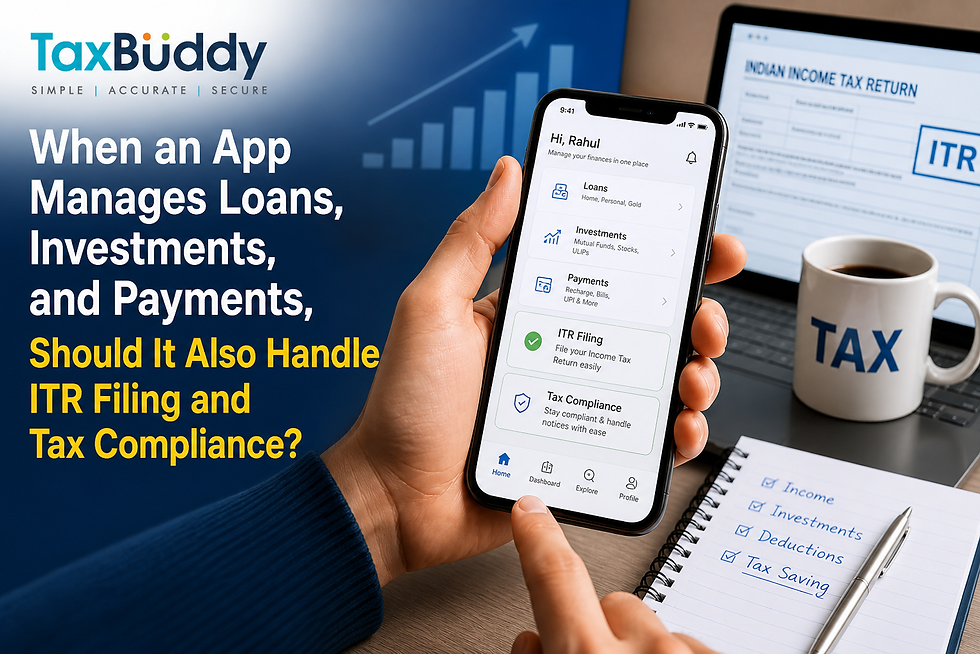
Financial apps today are no longer limited to handling transactions. They have evolved into platforms where users manage loans, track investments, make payments, and take key financial decisions on a regular basis.
As these platforms become more central to a user’s financial life, expectations have started to shift. Users are no longer looking at these apps as isolated tools. They expect them to support their financial journey in a more connected and complete way.
This shift is already visible in platforms like Jio Financial Services, where multiple financial services are brought together into a single experience.
However, there is still a noticeable gap.
While users actively manage income, expenses, and investments within these apps, tax-related activities such as planning, ITR filing, and handling notices are often managed separately. This creates a disconnect between financial decisions and their tax impact.
The question then becomes more relevant than ever.
If an app already helps users manage their money, should it also help them manage their taxes?
As financial platforms move towards becoming more complete ecosystems, the answer is increasingly leaning in one direction.
Yes, they should.
Table of Contents
The Expanding Role of Financial Apps
Financial apps have steadily moved beyond their original purpose of enabling transactions.
What started with payments has expanded into lending, investments, and insurance. Today, users rely on these platforms not just to execute financial actions, but to manage their overall financial lives.
This shift is not just about adding more services. It reflects a deeper change in how users interact with money.
Instead of using multiple tools for different needs, users now prefer a single platform where they can:
access credit when required
monitor and grow investments
manage day-to-day expenses
evaluate financial decisions
This transformation is visible in platforms like Jio Financial Services, where multiple financial services are integrated into one app experience.
As a result, these apps are no longer seen as utilities. They are becoming decision-making environments.
Users expect them to not only execute actions, but also support choices.
This is where the next layer naturally comes into consideration.
Where the Current Experience Breaks for Users
Despite this evolution, the user journey is still incomplete.
Users may manage most of their financial activity within a single app, but when it comes to taxes, the experience breaks.
They are required to:
switch to separate platforms for tax planning
file returns through different systems
seek external help for handling notices
This interruption creates friction.
Financial decisions and tax outcomes are closely linked, but they are handled in isolation. Users are forced to connect these pieces themselves, often without full clarity.
This leads to practical challenges:
decisions are made without understanding tax implications
tax planning happens late in the cycle
the filing process feels disconnected from earlier financial activity
More importantly, it changes how users perceive the platform.
Even if the app supports most financial needs, it is not seen as complete. There is still a dependency on external tools for something critical.
For platforms aiming to build deeper relationships, this gap becomes difficult to ignore.
Why Tax Is No Longer Separate From Financial Decisions
Tax is not just a compliance requirement. It is closely tied to almost every financial decision a user makes.
Whether someone is:
choosing an investment
planning expenses
deciding between financial products
tax implications play a role.
For example:
investment decisions are often influenced by tax-saving benefits
income structure impacts overall tax liability
timing of financial actions can affect tax outcomes
When tax is handled separately, these connections are lost.
Users may make decisions first and think about tax later, which limits their ability to optimise outcomes.
This is why tax can no longer be treated as an independent activity. It needs to be part of the same flow where financial decisions are being made. For financial apps, this creates a strong case for integration.
If they are already influencing decisions, they are also in a position to support the tax implications of those decisions.
Should Financial Apps Handle Tax Compliance?
At first glance, integrating tax compliance into financial apps may seem like an extension too far.
Tax involves:
regulatory complexity
structured workflows
multiple user scenarios
It is not as straightforward as payments or investments.
However, the question is not whether tax is complex.
The question is whether users should continue handling it separately.
From a user perspective, the answer is increasingly clear.
Managing finances and managing taxes are part of the same journey. Separating them creates friction, reduces clarity, and increases effort.
From a platform perspective, the answer is equally strong.
Tax periods are some of the most important engagement windows. Users are actively reviewing their finances, making decisions, and taking action.
If platforms do not support this phase, they lose relevance at a critical moment.
This is why the answer is gradually shifting towards integration.
Financial apps should handle tax compliance, not by turning into tax experts themselves, but by enabling the experience within their ecosystem.
Why Tax Planning Naturally Fits Into Financial Apps
Among all tax-related services, planning is the most natural starting point for financial apps.
It happens before filing and directly influences financial decisions.
When users engage with tax planning, they are actively trying to understand:
how much tax they might pay
which options can reduce liability
how their current decisions impact outcomes
This makes planning a high-intent interaction.
For platforms, it creates an opportunity to engage users early, when they are still open to taking action.
It also enables more meaningful interactions.
When users explore tax-saving opportunities, they are often looking for ways to optimise their finances. This allows platforms to:
guide users towards relevant financial choices
introduce suitable products at the right time
build stronger, more contextual engagement
Unlike filing, which is deadline-driven, planning creates a longer engagement window.
This is why it becomes the entry point for most platforms looking to integrate tax services.
Once planning is in place, extending into filing and other areas becomes a natural progression.
How ITR Filing Completes the Financial Journey
Once users move through tax planning, the next step is execution, and this is where ITR filing becomes critical.
Planning helps users understand what to do. Filing is where they actually act on those decisions.
In most current journeys, this transition is broken.
Users may:
evaluate their tax position within one platform
explore deductions or savings strategies
decide on a course of action
But when it is time to file, they are required to leave the platform and complete the process elsewhere. This introduces unnecessary friction.
The moment users switch platforms:
context is lost
effort increases
drop-off risk rises
Many users delay filing or make errors simply because the process feels disconnected from what they have already done.
When ITR filing is integrated within the same app, this gap is removed.
The journey becomes continuous.
Users can:
move directly from planning to filing
carry forward their decisions into execution
complete the process without restarting
A well-designed filing experience further simplifies this by breaking down complex tax forms into guided steps.
Instead of requiring users to understand tax structures in depth, the platform:
asks structured questions
organises inputs logically
reduces the chances of errors
This is where financial apps shift from being informative to being outcome-driven.
Planning creates intent. Filing ensures completion.
The Need for Including Tax Notice Management
Tax compliance does not always end with filing. For many users, the most challenging part begins after filing, when notices are received.
Tax notices introduce uncertainty because they are:
often technical in language
unexpected in timing
unclear in required action
A user receiving a notice may not immediately know:
whether it is serious
what triggered it
how to respond
This leads to anxiety and, in most cases, forces users to seek help outside the platform.
From a platform perspective, this is a missed opportunity. Even if the app supports planning and filing, it loses relevance during the most sensitive stage of the user journey.
Including notice management changes the nature of the relationship. Instead of being a tool used for transactions and filing, the platform becomes a support system during critical situations.
This allows platforms to:
guide users through responses in a structured way
reduce confusion around compliance requirements
provide access to expert help when needed
More importantly, it builds trust. Users are more likely to rely on a platform that supports them not just during routine tasks, but also when things become complex.
This is why notice management is gradually emerging as the next important layer in tax integration.
What Changes When Tax Moves Inside the App
When tax services are brought into financial apps, the impact is not limited to functionality. It changes how users think and behave.
Traditionally, users treat financial decisions and tax compliance as separate activities.
They:
make financial decisions during the year
think about taxes only at the time of filing
This separation often leads to suboptimal outcomes.
When tax is integrated into the same platform, this gap closes.
Users begin to see:
how their decisions impact tax outcomes
how early planning can improve results
how different financial choices connect with each other
This leads to a more informed approach.
Behaviourally, users start to:
engage earlier in the financial cycle
plan proactively instead of reacting
rely on a single platform for multiple needs
The experience also becomes significantly smoother.
Instead of switching between tools, users can:
review finances
evaluate tax impact
complete filing
within the same environment.
Over time, this creates a stronger relationship between the user and the platform.
The app is no longer just a utility. It becomes a central hub for managing both financial decisions and compliance.
The Business Case for Financial Platforms
From a platform perspective, integrating tax services is not just about improving user experience. It has a direct impact on business outcomes.
Tax periods are among the highest-intent moments in the financial lifecycle.
During this time, users are actively:
reviewing income and expenses
evaluating investments
making decisions about savings
This level of engagement is significantly higher than regular usage patterns.
If platforms can capture this engagement within their ecosystem, they benefit in multiple ways.
First, engagement increases. Users spend more time within the app, interacting with features beyond routine transactions.
Second, retention improves. When users rely on a platform for critical tasks like tax filing, they are less likely to switch.
Third, it creates opportunities for meaningful interaction. Tax planning, in particular, reveals user intent.
For example:
users exploring deductions may be looking to invest
users comparing tax regimes may need guidance
users planning early may be more financially engaged
This allows platforms to:
personalise recommendations
introduce relevant products at the right time
move from generic communication to contextual engagement
This makes monetisation more aligned with user needs rather than being intrusive.
Ultimately, tax integration helps platforms move closer to owning the full financial journey.
How Platforms Can Introduce Tax Without Complexity
A common concern for financial platforms is that tax integration adds operational and technical complexity.
Tax compliance involves:
regulatory requirements
multiple user scenarios
structured workflows
However, this complexity can be managed with the right approach.
Platforms do not need to build everything internally.
Instead, they can adopt a phased strategy:
begin with tax planning to drive early engagement
introduce guided ITR filing workflows
gradually expand into advanced areas like notice management
The key is to keep the user experience simple.
Users should not feel like they are interacting with a complex tax system. The process should feel intuitive and structured.
This is where infrastructure partners like TaxBuddy play an important role.
They enable platforms to integrate tax capabilities by providing:
pre-built modules for tax planning and filing
guided workflows that simplify compliance
expert-assisted support when required
In addition to product capabilities, they also support engagement through:
awareness campaigns during tax periods
educational initiatives such as webinars
structured communication to drive adoption
This allows platforms to focus on user experience while managing compliance effectively.
The Role of Engagement and User Education
Even the most well-designed features will not deliver value unless users actively use them.
Tax-related actions are often delayed because users:
perceive them as complex
are unsure how to begin
postpone them until deadlines
This makes engagement a critical part of the strategy.
Platforms need to actively guide users through the journey.
This includes:
sending timely reminders aligned with tax timelines
simplifying communication to reduce hesitation
providing educational content that explains concepts clearly
Engagement is not just about prompting action. It is about building confidence.
When users understand what needs to be done, they are more likely to act.
Support from partners like TaxBuddy strengthens this layer through:
tax awareness campaigns
free educational webinars
structured engagement initiatives
These efforts help:
increase adoption of tax features
reduce dependency on external tools
ensure timely completion of tasks
Engagement transforms tax from a passive feature into an active part of the user journey.
The Future: One Platform for Financial Decisions and Compliance
Financial platforms are moving towards a unified model where different aspects of financial management are connected.
The goal is to create a seamless experience where users can:
manage money
make financial decisions
handle compliance
within the same environment.
This shift is already visible in platforms like Jio Financial Services, where multiple services are integrated into one ecosystem.
Tax planning and filing are becoming natural extensions of this model.
The next phase will focus on:
expanding into notice management
strengthening advisory capabilities
improving user engagement
In this model, users no longer need to switch platforms for related tasks.
Managing finances and managing taxes become part of the same journey.
FAQs
Q1. Should financial apps handle ITR filing and tax compliance?
Yes, and increasingly, they are expected to.
Financial apps are no longer limited to transactions. Users already depend on them for managing loans, investments, and day-to-day financial decisions. Since tax is directly linked to all of these activities, keeping it separate creates unnecessary friction.
When tax compliance is integrated into the same platform, users benefit from a smoother experience. They do not need to switch between tools or restart processes. More importantly, they can connect their financial decisions with their tax outcomes in a more meaningful way.
For platforms, this integration helps them stay relevant during critical financial moments. It allows them to move from being a utility to becoming a more complete financial partner.
Q2. Why is tax planning important within financial apps?
Tax planning plays a crucial role because it influences decisions before they are finalised.
Most users traditionally think about taxes only at the time of filing. By then, there is limited scope to optimise outcomes. Integrating tax planning within financial apps shifts this behaviour.
Users can evaluate:
how their investments impact tax liability
which regime suits their financial situation
how to structure their finances more efficiently
This early-stage interaction helps users make better decisions. For platforms, it creates an opportunity to engage users when they are actively thinking about their finances, rather than only during compliance.
Q3. How does ITR filing improve the overall user journey?
ITR filing completes the journey that starts with financial planning.
Without integration, users have to leave the app to file their returns, which interrupts the flow. They often need to re-enter details or revisit decisions, making the process feel repetitive and time-consuming.
When filing is integrated:
the transition from planning to execution becomes seamless
users can complete the process in one place
the likelihood of errors reduces due to guided workflows
This continuity improves both user experience and completion rates. It ensures that users follow through on their planning rather than stopping midway.
Q4. What role does tax notice management play in financial apps?
Tax notice management addresses one of the most stressful parts of the compliance journey.
Receiving a tax notice can be confusing. Users may not understand:
why the notice was issued
what it means for them
how urgently they need to respond
Without support, they often turn to external advisors.
When financial apps include notice management, they extend their role beyond routine tasks. They help users handle complex situations with clarity and structure.
This builds trust. Users are more likely to rely on a platform that supports them not only during planning and filing, but also when issues arise.
Q5. How does tax integration impact user behaviour?
Tax integration changes how users approach their financial decisions.
Instead of treating tax as a once-a-year obligation, users begin to:
engage with their finances earlier
think about tax impact while making decisions
plan more proactively
This leads to more consistent interaction with the platform.
Over time, users become more comfortable managing both finances and compliance in one place. This increases reliance on the platform and strengthens the overall relationship.
Q6. What benefits do platforms gain from integrating tax services?
The benefits go beyond user convenience.
First, engagement increases. Tax cycles bring users back to the app with high intent, creating opportunities for deeper interaction.
Second, retention improves. When users rely on a platform for critical tasks like tax filing, they are less likely to switch.
Third, platforms gain better insight into user intent. Tax-related interactions reflect what users are trying to achieve financially, which helps in delivering more relevant experiences.
Overall, integration strengthens the platform’s position as a long-term financial partner.
Q7. How can platforms use tax planning for better customer engagement?
Tax planning is a strong signal of user intent.
When users explore deductions, compare regimes, or evaluate savings strategies, they are actively thinking about improving their financial outcomes.
Platforms can use this to:
personalise communication
introduce relevant financial products
guide users towards better decisions
This makes engagement more contextual. Instead of pushing generic offerings, platforms can align with what the user is already trying to achieve.
Q8. Does integrating tax features increase complexity for users?
Not if it is designed correctly.
While tax itself can be complex, the user experience does not have to be.
Modern financial apps simplify this through:
guided workflows
structured inputs
step-by-step processes
This reduces the need for users to understand technical details.
The goal is to make the process intuitive, so users can complete tasks confidently without feeling overwhelmed.
Q9. How do infrastructure providers support tax integration?
Infrastructure providers make integration practical and scalable.
Instead of building tax systems internally, platforms can use ready-to-integrate solutions that handle:
tax planning workflows
ITR filing processes
compliance requirements
expert-assisted support
Providers like TaxBuddy also support engagement through:
awareness campaigns
educational initiatives such as webinars
structured communication
This allows platforms to launch faster while maintaining a strong user experience.
Q10. Why is user engagement important for tax features?
Availability alone does not ensure usage.
Tax-related actions are often delayed because users are unsure where to start or feel the process is complex.
Engagement helps bridge this gap.
Through reminders, simple communication, and educational content, platforms can:
guide users step-by-step
encourage timely action
reduce hesitation
This ensures that users not only have access to tax features, but actually use them.
Q11. How do webinars and awareness campaigns help platforms?
Webinars and awareness initiatives play a key role in building user confidence.
Taxes can feel complicated, especially for users who are not familiar with the process. Educational sessions simplify concepts and provide clarity.
These initiatives help:
reduce confusion
encourage early engagement
increase adoption of tax features
For platforms, they act as a bridge between product availability and actual usage.
Q12. What does the future of financial apps look like?
Financial apps are moving towards becoming complete ecosystems.
In the future, users will expect to:
manage finances
make decisions
handle compliance
within the same platform.
Tax planning, filing, and support will become standard features rather than add-ons.
This shift will reduce fragmentation and create a more connected experience, where financial decisions and tax outcomes are aligned within a single journey.


