

Presumptive Taxation vs Expense-Based Planning for Professionals
- Rashmita Choudhary

- Feb 5
- 8 min read
Presumptive taxation and expense-based planning are two distinct tax computation methods available to professionals under the Income Tax Act, 1961. Presumptive taxation under Section 44ADA simplifies compliance by taxing 50 per cent of gross receipts as income, while expense-based planning allows actual business expenses to be deducted under regular provisions. The choice directly impacts tax liability, compliance burden, and audit exposure. Understanding how both methods work, who they apply to, and when each approach is beneficial helps professionals optimise taxes while staying compliant with evolving rules for FY 2025–26.
Table of Contents
What Is Presumptive Taxation Under Section 44ADA
Presumptive taxation under Section 44ADA of the Income Tax Act, 1961, is a simplified tax computation method designed specifically for professionals. Instead of calculating taxable income after deducting actual expenses, the law presumes that 50 per cent of gross receipts represent taxable profit. This deemed profit is taxed according to the applicable income tax slab rates.
Under this scheme, professionals are not required to maintain detailed books of accounts or undergo tax audits, provided the prescribed turnover limits are met. The scheme significantly reduces compliance effort and is commonly used by consultants, freelancers, and small professional practices with limited overhead costs.
Who Is Eligible for Presumptive Taxation for Professionals
Presumptive taxation under Section 44ADA is available to resident professionals engaged in specified professions such as legal, medical, engineering, architectural, accountancy, technical consultancy, interior decoration, and other notified professions.
Eligibility is subject to a gross receipts limit of ₹75 lakh in a financial year, provided cash receipts do not exceed five per cent of total receipts. Non-resident professionals and those earning income through commission or agency arrangements are not eligible. If receipts exceed the threshold, income must be computed under regular provisions.
What Is Expense-Based Planning Under Regular Provisions
Expense-based planning refers to computing professional income under the regular provisions of the Income Tax Act, primarily Sections 28 to 44. Under this method, taxable income is calculated by deducting actual business expenses from gross professional receipts.
Allowable deductions may include office rent, staff salaries, professional software costs, depreciation on equipment, travel expenses, and other costs incurred wholly and exclusively for professional purposes. This method provides flexibility and is generally preferred by professionals with significant operational expenses.
Key Differences Between Presumptive Taxation and Expense-Based Planning
The most significant difference lies in how income is determined. Presumptive taxation fixes taxable income at 50 per cent of receipts, whereas expense-based planning taxes only the actual profit after expenses.
Presumptive taxation offers ease of compliance with minimal documentation, while expense-based planning requires systematic bookkeeping and, in some cases, tax audit compliance. Advance tax obligations also differ, with presumptive taxation allowing a single payment instead of quarterly instalments.
Is Presumptive Taxation Allowed in the New Tax Regime
Presumptive taxation under Section 44ADA is allowed under both the old and new tax regimes. However, while the computation of business income remains unchanged, the final tax liability differs due to slab rates and deduction availability.
Under the new tax regime, most deductions under Chapter VI-A are not available, but lower slab rates may still make presumptive taxation attractive for professionals with limited deductions. The regime choice should be evaluated separately after determining professional income.
How Expense-Based Planning Works in the Old Tax Regime
Expense-based planning is often more effective under the old tax regime because it allows both business expense deductions and additional personal deductions, such as those under Sections 80C, 80D, and interest on housing loans, subject to eligibility.
Professionals opting for this method must maintain proper books of accounts and may be required to undergo a tax audit if turnover or profit thresholds are breached. Despite higher compliance, the old regime can significantly reduce tax liability when expenses and deductions are substantial.
Compliance, Audit, and Record-Keeping Comparison
Presumptive taxation significantly reduces compliance requirements. No detailed books, vouchers, or audit reports are needed as long as income is declared at or above the presumptive rate.
Expense-based planning demands systematic record-keeping, supporting invoices, depreciation schedules, and bank reconciliations. Audit requirements may apply if turnover exceeds statutory limits or profits fall below prescribed percentages, increasing both compliance effort and professional costs.
Tax Impact Comparison Based on Expense Levels
When professional expenses are below 50 per cent of gross receipts, presumptive taxation generally results in lower tax liability and simpler compliance.
However, when expenses exceed 50 per cent, expense-based planning often leads to a lower taxable income. High-cost structures such as clinics, design studios, or firms with salaried staff and equipment investments typically benefit more from regular computation methods.
When Presumptive Taxation Is More Beneficial for Professionals
Presumptive taxation is most suitable for professionals with low overheads, predictable income, and minimal capital investment. Independent consultants, advisors, and freelancers working remotely often fall into this category.
It is also ideal for professionals seeking compliance simplicity, reduced interaction with audits, and faster return filing without maintaining detailed financial records.
When Expense-Based Planning Leads to Lower Tax Outgo
Expense-based planning becomes advantageous when operational costs are high or fluctuate significantly. Professionals running physical offices, employing staff, or using costly equipment can claim legitimate deductions that substantially reduce taxable income.
This method also allows depreciation benefits and flexibility in tax planning, particularly under the old tax regime.
Common Mistakes Professionals Make While Choosing a Tax Method
A common mistake is selecting presumptive taxation solely for convenience without comparing actual expense ratios. Another frequent error is ignoring the impact of tax regimes on overall liability.
Professionals also often overlook future restrictions when switching out of presumptive taxation after declaring lower profits, leading to compliance complications in subsequent years.
How TaxBuddy Simplifies the Choice Between Both Methods
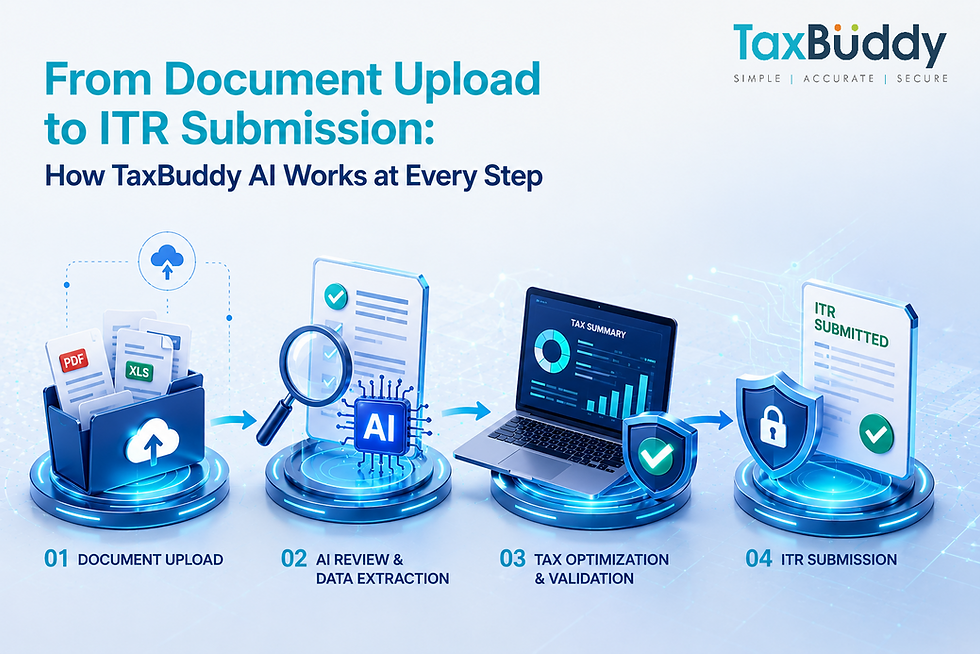
TaxBuddy simplifies the decision between presumptive taxation and expense-based planning by converting what is usually a confusing, manual comparison into a structured, data-driven process. Instead of relying on assumptions, the platform evaluates professional income using actual receipt patterns, expense behaviour, and applicable tax regime rules to arrive at the most tax-efficient outcome.
At the initial stage, TaxBuddy analyses gross receipts and checks eligibility for presumptive taxation under Section 44ADA, including turnover limits and cash receipt conditions. If the professional qualifies, the system automatically computes income under the presumptive method by applying the deemed profit rate. In parallel, it evaluates expense-based planning by factoring in reported business expenses, depreciation, and other allowable deductions under regular provisions. This side-by-side income simulation gives clear visibility into which method results in lower taxable income.
TaxBuddy also integrates tax regime selection into this comparison. Since the old and new tax regimes affect final tax liability differently, the platform recalculates tax payable under both regimes after determining business income. This helps professionals understand whether presumptive taxation remains beneficial once slab rates and deduction restrictions are applied, instead of making regime decisions in isolation.
Automated compliance checks further reduce risk. TaxBuddy verifies whether choosing a particular method triggers bookkeeping requirements, audit exposure, or restrictions on future years. Alerts are generated if declaring lower income under presumptive taxation may limit re-entry or increase scrutiny. This proactive approach prevents filing choices that may appear beneficial in the short term but create compliance issues later.
Once the optimal method is identified, TaxBuddy guides the professional through filing under the correct ITR form, ensuring accurate reporting of business income, advance tax, and regime selection. Built-in validations minimise data mismatches and calculation errors, significantly reducing the likelihood of notices or rework.
By combining eligibility checks, income simulations, regime comparison, and guided filing in a single workflow, TaxBuddy removes guesswork from tax planning decisions. Professionals are able to choose the method that aligns with their cost structure and compliance capacity while maintaining accuracy and peace of mind throughout the filing process.
Conclusion
Presumptive taxation and expense-based planning serve different professional profiles and cost structures. The right choice depends on expense levels, compliance capacity, and long-term tax efficiency rather than convenience alone. Evaluating both options before filing helps avoid excess tax and future scrutiny.
For anyone looking for assistance in tax filing, it is highly recommended to download the TaxBuddy mobile app for a simplified, secure, and hassle-free experience.
FAQs
Q. Does TaxBuddy offer both self-filing and expert-assisted plans for ITR filing, or only expert-assisted options?
TaxBuddy offers both self-filing and expert-assisted ITR filing plans. The self-filing option is suitable for professionals with straightforward income and a clear understanding of tax rules, while the expert-assisted plan is designed for cases involving higher income, complex deductions, regime selection, or compliance risks. This flexibility allows professionals to choose the level of support based on their individual tax situation rather than being locked into a single approach.
Q. Which is the best site to file ITR?
The best site to file an income tax return is one that ensures accurate computation, built-in compliance checks, and timely support. For professionals, this becomes even more important due to choices between presumptive taxation, expense-based planning, and tax regimes. Platforms that offer automated validations, clear comparisons, and expert guidance help reduce errors and improve filing confidence.
Q. Where to file an income tax return?
Income tax returns can be filed online through the official income tax e-filing portal or through authorised private e-filing platforms. While the government portal provides basic filing functionality, authorised platforms often offer additional features such as error detection, tax comparisons, reminders, and guided workflows, which are particularly useful for professionals managing business income.
Q. Can professionals claim expenses under Section 44ADA?
No, professionals opting for presumptive taxation under Section 44ADA cannot separately claim business expenses. The law presumes that 50 per cent of gross receipts represent taxable profit after accounting for all expenses. Once this option is chosen, deductions for rent, salaries, depreciation, or other professional costs are deemed to be included and cannot be claimed again.
Q. What happens if professional receipts exceed ₹75 lakh?
If gross professional receipts exceed ₹75 lakh in a financial year, the professional cannot use Section 44ADA. In such cases, income must be computed under regular provisions, requiring the maintenance of proper books of accounts. Depending on turnover and profit levels, a tax audit may also become mandatory, increasing compliance responsibilities.
Q. Is advance tax mandatory under presumptive taxation?
Yes, advance tax is applicable even under presumptive taxation. However, unlike regular taxpayers who must pay advance tax in quarterly instalments, professionals opting for Section 44ADA are allowed to pay the entire advance tax in a single instalment by the prescribed due date. Missing this deadline can attract interest under the Income Tax Act.
Q. Does expense-based planning always require a tax audit?
Expense-based planning does not automatically trigger a tax audit. A tax audit becomes mandatory only when turnover or profit conditions specified under the law are breached. Professionals with receipts below audit thresholds and reasonable profit margins may not require an audit, provided books of accounts are properly maintained and income is correctly reported.
Q. Can depreciation be claimed under regular provisions?
Yes, depreciation on eligible assets such as computers, medical equipment, furniture, or office infrastructure can be claimed when income is computed under regular provisions. Depreciation reduces taxable income and is often a key benefit of expense-based planning, particularly for professionals who have made significant capital investments in their practice.
Q. Can a professional switch between the two methods every year?
Professionals can switch between presumptive taxation and expense-based planning. However, if income is declared below the presumptive rate, books of accounts must be maintained, and re-entry into presumptive taxation may be restricted for a specified period. Therefore, switching should be done after careful evaluation rather than on a year-to-year convenience basis.
Q. Is presumptive taxation suitable for freelancers?
Presumptive taxation is generally suitable for freelancers who have low operating costs, minimal asset investment, and stable income patterns. Freelancers working independently without significant overheads often find Section 44ADA beneficial due to simplified compliance and predictable tax liability.
Q. Does the tax regime choice affect professional income computation?
The choice between the old and new tax regimes does not change how professional income is computed. However, it directly impacts the final tax payable due to differences in slab rates and deduction availability. Professionals should first compute business income correctly and then evaluate which regime results in lower overall tax liability.
Q. How does TaxBuddy help professionals avoid filing errors?
TaxBuddy reduces filing errors through automated validations, income comparisons, regime analysis, and guided workflows. The platform checks eligibility conditions, flags compliance risks, and ensures the correct ITR form is selected. This structured approach helps professionals file accurate returns while minimising the risk of notices or rework.




Comments