

How to Report Professional Tax Deduction in ITR
- Asharam Swain

- Dec 8, 2025
- 8 min read
Professional tax is a small but important deduction that can reduce your taxable income. Whether it’s automatically deducted from your salary or paid directly by self-employed individuals, it qualifies for a deduction under Section 16(ia) of the Income Tax Act, 1961. Reporting it correctly in your ITR ensures your taxable income is computed accurately and helps avoid discrepancies during assessment. Understanding where and how to claim it depends on your income type and the ITR form you use.
Table of Contents
Understanding Professional Tax Deduction under Section 16(ia)
Professional tax, also known as employment tax, is a state-level levy imposed on individuals earning income through salaries or practising a profession such as law, medicine, accountancy, or consultancy. Under Section 16(ia) of the Income Tax Act, salaried individuals are eligible to claim a deduction for the professional tax paid during the financial year. This deduction directly reduces the taxable income, ensuring that employees are not taxed twice on the same amount. It applies only when the tax has actually been paid to the respective state government and is reflected in the salary slip or Form 16 issued by the employer.
How to Report Professional Tax Deduction in ITR
Professional tax is typically deducted by the employer from the employee’s monthly salary and deposited with the state government. The total amount paid during the year appears in Form 16 under the “Allowances and Deductions” section. While filing the Income Tax Return (ITR), this amount should be reported under the “Deductions under Section 16” field in the salary schedule. It’s important to verify the figure in Form 16 and ensure it matches the salary slip records to avoid mismatches during e-verification or processing by the Income Tax Department.
Step-by-Step Process to Claim Professional Tax Deduction
Check your salary slips or Form 16 for the total professional tax amount deducted during the year.
Log in to the income tax e-filing portal and select the appropriate ITR form (usually ITR-1 or ITR-2 for salaried individuals).
Navigate to the “Income from Salary” section.
Enter the total gross salary and other allowances as reflected in Form 16.
In the “Deductions under Section 16” section, enter the professional tax amount paid during the year.
Verify the details and submit the return after completing e-verification.
Keep a copy of your salary slips and Form 16 as supporting proof in case of any future query or scrutiny.
Required Documents and Proof of Payment
To claim a professional tax deduction, employees should retain specific documents that confirm the tax was deducted and paid to the state government. The main documents include:
Salary slips showing monthly professional tax deduction.
Form 16 from the employer indicating the total professional tax paid.
Payment receipt, if paid directly (for self-employed individuals). Employers are responsible for deducting and depositing this tax, but self-employed professionals must ensure timely payment themselves to claim the deduction.
Is Professional Tax Deduction Allowed in the New Tax Regime?
The new tax regime under Section 115BAC was introduced with the intention of simplifying the tax structure by offering lower tax rates in exchange for foregoing most exemptions and deductions. One of the important deductions that becomes unavailable under this regime is the professional tax deduction. Professional tax, which is levied by state governments on salaried individuals and certain professionals, is normally allowed as a deduction under Section 16(ia) when calculating taxable salary. However, this benefit applies only when a taxpayer chooses the old tax regime.
Under the new regime, the tax slabs are lower but come with the condition that commonly claimed deductions, such as standard deduction, HRA exemption, LTA exemption, and professional tax deduction, cannot be claimed. This means that salaried individuals who pay professional tax through their employer will not be able to reduce their taxable income by this amount if they opt for the new regime.
Choosing between the old and new regimes, therefore, requires a comparison of total tax liability under both systems. Employees with higher deductions—like professional tax, insurance premiums, NPS contributions, home loan interest, and 80C investments—often find the old regime more beneficial. On the other hand, individuals with fewer deductions or simple income structures may benefit more from the lower tax rates of the new regime.
Since the choice can significantly affect taxable income, taxpayers should evaluate their expected deductions at the start of every financial year and select the regime that results in the lowest tax outflow. Employers typically allow employees to declare their chosen regime for TDS purposes, and the final selection can be made while filing the Income Tax Return.
Common Errors While Reporting Professional Tax in ITR
Taxpayers often make small but costly mistakes while reporting professional tax deductions. Some of the common ones include entering the gross monthly deduction instead of the total annual amount, skipping the deduction altogether, or reporting a mismatch between Form 16 and salary slips. Errors like these can trigger mismatch notices or delay refund processing. It’s advisable to verify Form 16 carefully and ensure all deductions, including professional tax, are correctly reflected before submission.
Recent Updates and CBDT Notifications
Recent updates and clarifications issued by the Central Board of Direct Taxes (CBDT) continue to reinforce the correct treatment of professional tax under Section 16(ia) of the Income Tax Act. Although professional tax is a state-level levy and each state has the authority to decide slabs, payment timelines, and compliance rules, the deduction for professional tax in income tax calculations is governed uniformly across the country through Section 16(ia). This ensures consistency in how salaried taxpayers report this deduction, regardless of the state in which they work.
CBDT’s recent notifications focus on improving accuracy in reporting, especially because many taxpayers overlook the professional tax component while claiming deductions. Employers often deduct professional tax every month and reflect it in Form 16, but mismatches arise when employees fail to cross-check these entries while filing their Income Tax Returns (ITRs). To address this issue, CBDT has advised both employers and taxpayers to ensure that the deduction shown in Form 16 matches the amount paid during the financial year. Accurate reporting also helps avoid unnecessary system-generated notices linked to mismatches in Form 16, AIS, or the taxpayer’s ITR.
As of FY 2025-26, there have been no revisions to the maximum deduction available for professional tax under Section 16(ia). The upper limit remains capped at ₹2,500 per year, a ceiling defined by the Constitution and uniformly applicable across all states where professional tax is charged. This means taxpayers can claim the exact amount of professional tax paid during the year, subject to the maximum limit, without any additional restrictions or conditions.
For salaried individuals, understanding these updates is helpful not only for accurate tax reporting but also for ensuring that the correct deduction is reflected in their taxable income. Proper reconciliation between salary slips, Form 16, and ITR forms ensures smooth processing of returns and minimises the chances of queries or adjustments from the Income Tax Department.
How TaxBuddy Simplifies Professional Tax Reporting
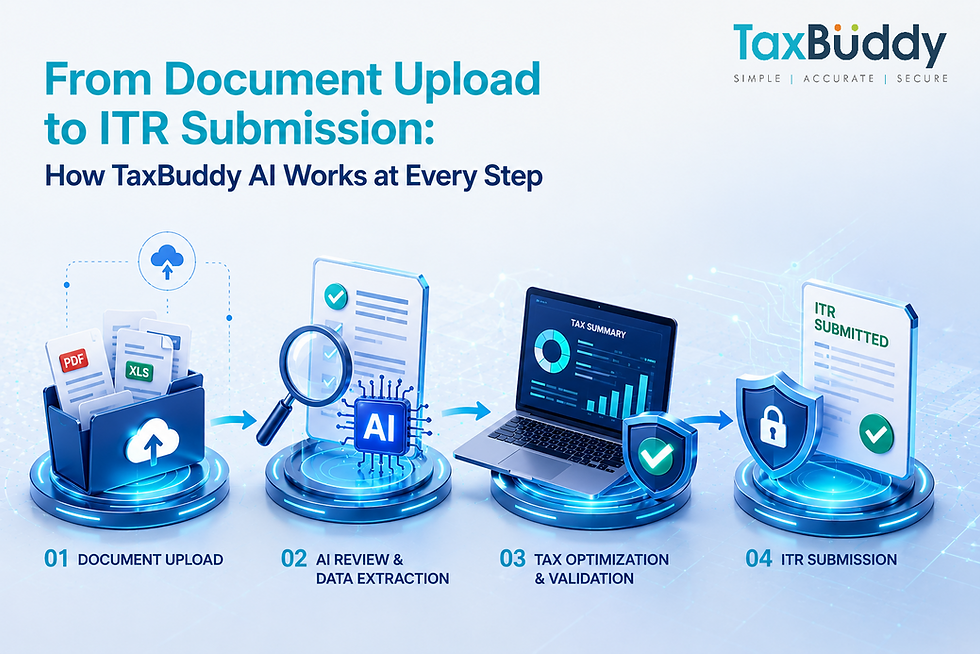
TaxBuddy’s intelligent filing system automatically extracts salary and deduction data from Form 16, identifies professional tax amounts, and correctly places them under Section 16(ia) in the ITR. The platform’s AI-driven validation ensures there are no mismatches or missed deductions. For complex cases or multiple income sources, TaxBuddy’s expert-assisted plans offer professional review to guarantee 100% compliance and maximum refund eligibility.
Conclusion
Professional tax deduction under Section 16(ia) provides small yet valuable relief for salaried taxpayers. It ensures that individuals paying state-level employment tax are not doubly taxed under the central income tax structure. For accurate computation, always verify Form 16 and ensure that the deduction is correctly claimed while filing your ITR. Using a trusted platform like TaxBuddy helps eliminate manual errors and guarantees a seamless, compliant, and stress-free filing experience.
For anyone looking for assistance in tax filing, it is highly recommended to download the TaxBuddy mobile app for a simplified, secure, and hassle-free experience.
FAQs
Q1. What is professional tax, and who pays it? Professional tax is a state-level tax imposed on income earned by individuals engaged in any profession, employment, or trade. Salaried employees have this tax deducted directly from their monthly salary by the employer, who then deposits it with the respective state government. Professionals such as doctors, lawyers, chartered accountants, and freelancers are also liable to pay professional tax, but they must pay it directly to the state authority through prescribed challans. The tax amount varies from state to state, and only those states that impose this tax require payment.
Q2. What is the maximum amount of professional tax deductible under Section 16(ia)? The Income Tax Act allows a maximum deduction of ₹2,500 per financial year for professional tax paid. Even though each state sets its own slab rates, the deduction limit under Section 16(ia) cannot exceed ₹2,500. Salaried employees can claim the exact amount deducted by their employer, while self-employed individuals can claim the amount they pay directly, subject to the ceiling.
Q3. Can self-employed individuals claim a professional tax deduction? Yes, self-employed individuals such as freelancers, traders, independent consultants, or professionals can claim professional tax as a deduction. They must pay the tax themselves to the state government and retain payment challans or receipts. During income tax filing, the paid amount is eligible for deduction under Section 16(ia), reducing the taxable income.
Q4. Is professional tax applicable in all states of India? No, professional tax is not applicable in every state. Some states, such as Maharashtra, Karnataka, Tamil Nadu, West Bengal, Gujarat, Andhra Pradesh, and Telangana, levy this tax. Others, including Delhi, Haryana, Uttar Pradesh, and Rajasthan, do not impose professional tax. Taxpayers must check the rules in their respective states to understand their liability.
Q5. Can professional tax be claimed under the new tax regime? No, professional tax cannot be claimed as a deduction under the new tax regime (Section 115BAC). The new tax regime offers lower tax rates but disallows most exemptions and deductions, including those under Section 16. Taxpayers who want to avail professional tax benefits must opt for the old tax regime.
Q6. Where is the professional tax deduction shown in Form 16? Professional tax appears in Form 16 under Part B, specifically in the section titled “Deductions under Section 16.” It is commonly listed as “Tax on Employment” or “Professional Tax.” The amount shown here is the same amount deducted by the employer during the financial year and is claimable as a deduction in the salary computation.
Q7. Is there a deadline for paying professional tax to claim the deduction? Yes, professional tax must be paid within the same financial year to be eligible for deduction. Self-employed individuals must pay it before the due dates prescribed by their state. Late payment may attract interest or penalties under state laws, and the deduction may not be permitted if the payment falls outside the eligible period.
Q8. What happens if the employer fails to deposit professional tax? If an employer deducts professional tax from an employee’s salary but fails to deposit it with the state government, the employer becomes liable for penalties and interest. However, employees can still claim the deduction in their ITR as long as the amount appears in Form 16 or salary slips, since the tax was already borne by them.
Q9. How can taxpayers verify professional tax payment? Employees can verify professional tax payments by checking their monthly salary slips, which show the deduction clearly. For self-employed individuals, payment challans or digital receipts issued by the state professional tax portal serve as proof. These documents should be retained for tax filing and compliance purposes.
Q10. Does professional tax impact TDS calculations? Yes, professional tax reduces the taxable salary on which TDS is computed. Since it is deducted before calculating taxable income, the total amount subject to TDS becomes slightly lower. As a result, the monthly TDS deducted by the employer also decreases proportionately.
Q11. What are the penalties for not paying professional tax on time? Penalties vary by state but typically include late fees and monthly interest. For example, states like Maharashtra impose a penalty for delayed registration, late filing of returns, and non-payment. Interest accumulates until the tax is paid in full. Consistent non-compliance can also attract higher penalties or prosecution under state laws.
Q12. How does TaxBuddy help with professional tax reporting? TaxBuddy’s AI-based platform automatically identifies professional tax amounts from salary slips, Form 16, and financial records. It applies the deduction under the correct section, ensures there are no mismatches with AIS or Form 26AS, and helps taxpayers avoid missed claims or incorrect reporting. For self-employed individuals, TaxBuddy guides users on allowable deductions and integrates professional tax payments seamlessly into the final return computation.




Comments