

Refund Processed But Amount Is Incorrect: Steps to Rectify

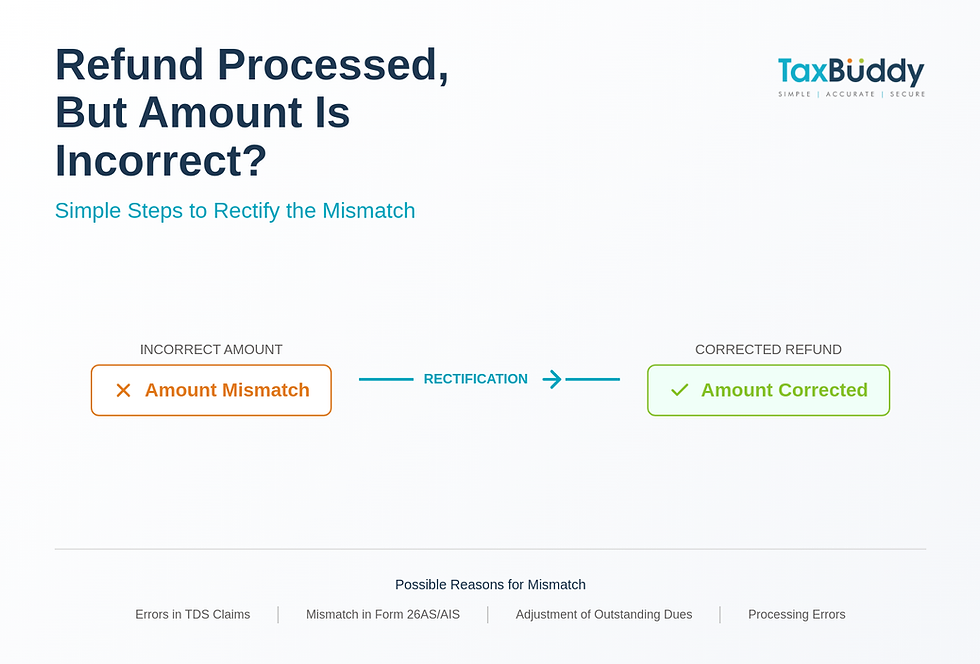
Refund mismatches occur when the amount credited by the Income Tax Department does not align with the refund shown in the processed ITR. This usually happens due to errors in TDS claims, mismatches in Form 26AS or AIS, adjustments against outstanding dues, or mistakes in computation made during processing under Section 143(1). The issue can be corrected through a structured rectification process on the Income Tax Portal, ensuring the correct refund is reissued. Platforms like TaxBuddy simplify this by reviewing mismatches, identifying the cause, and guiding taxpayers through rectification to help recover the correct refund amount quickly.
Table of Contents
Common Reasons for Incorrect Refund Amount Under Income Tax Rules
How to Read Intimation Under Section 143(1) for Refund Mismatch
Steps to Rectify Incorrect Refund Credited by Income Tax Department
Revised Return vs Rectification: Which One Fixes Refund Errors?
Latest CBDT Updates on Refund Corrections and Processing Delays
How TaxBuddy Helps with Refund Rectification and Error-Free Filing
Understanding Why Income Tax Refund Amounts Go Wrong
Refund discrepancies usually appear when the figures processed by the Income Tax Department differ from the numbers filed in the ITR. The processing system under Section 143(1) compares the reported income, deductions, TDS entries, taxes paid, and bank details with the information available in Form 26AS, AIS, and internal databases. Even a small mismatch triggers adjustment during automated processing, which results in a refund that is either lower or higher than expected. These variations often stem from automated corrections, data mismatches, or adjustments against outstanding dues carried from earlier years.
Common Reasons for Incorrect Refund Amount Under Income Tax Rules
Refund errors generally arise from a few predictable triggers. Unmatched TDS or TCS entries between the ITR and Form 26AS is the most common reason. Mathematical mistakes in tax calculation or missed entries also cause refund adjustments. Sometimes, the department adjusts refunds against outstanding demands from previous years after issuing a notification to the taxpayer. Discrepancies in income reporting, duplicate claims, or incorrect entries in AIS also lead to reworked refunds. Technical delays or errors in bank validation may cause partial or failed credits, adding to confusion for taxpayers.
How to Read Intimation Under Section 143(1) for Refund Mismatch
The intimation under Section 143(1) is the key to understanding why the refund credited differs from the expected amount. It contains a detailed comparison between the income, deductions, and tax liabilities as filed and as processed. Differences in TDS claims, exemption limits, arithmetic calculations, or previous unpaid dues are highlighted under the “Adjusted Total Income” or “Adjusted Refund” sections. This intimation shows the final tax computation used to determine the refund. Reading each item carefully helps trace the exact reason for mismatch and ensures the correct action—either rectification or revision—is taken.
Steps to Rectify Incorrect Refund Credited by Income Tax Department
Rectifying a wrong refund begins by reviewing the 143(1) intimation. Once the discrepancy is identified, the next step is to compare entries in Form 26AS and AIS with the ITR. If the mismatch is caused by an error in processing, the solution is to file a rectification request under Section 154. If the mistake originated due to incorrect filing, a revised return under Section 139(5) is more appropriate. After filing the rectification or revised return, the case moves into departmental processing, which usually results in reissuance of the corrected refund once the issue is resolved.
How to File Rectification Request Under Section 154
Rectification under Section 154 is designed to correct mistakes that are apparent from the record, such as miscalculated tax, incorrect TDS credit, or a wrongly processed refund. The request is filed through the Income Tax Portal by selecting the relevant assessment year and choosing the “Rectification” option. Supporting documents such as Form 26AS screenshots, bank validation proofs, or AIS extracts can be uploaded to strengthen the claim. The department reviews the request and issues a rectification order within the statutory timeline. If the rectification results in an increased refund, the revised amount is credited to the validated bank account.
Revised Return vs Rectification: Which One Fixes Refund Errors?
Rectification corrects errors made during departmental processing, while a revised return corrects mistakes made while filing the original ITR. If the error stems from incorrect reporting—like wrong income entries, missed deductions, or inaccurate bank details—a revised return under Section 139(5) is the right approach. When the figures in the ITR are correct but the department processes them incorrectly, rectification under Section 154 solves the issue. Choosing the right method ensures faster correction and avoids unnecessary delays.
Checking Refund Status After Filing Rectification
The refund status can be tracked on both the Income Tax Portal and the refund status tracker managed by the refund banker. After submitting a rectification request, the system regularly updates the progress, showing whether the request is under review, completed, or whether a new order has been passed. If the rectification leads to an updated refund, the revised amount is credited once the order is processed. Keeping an eye on the status helps ensure timely follow-up, especially if further clarification or bank detail validation is required.
Bank Account Validation Issues and Refund Failures
Refunds are credited only to validated bank accounts that are linked with PAN on the Income Tax Portal. If the account is not validated, inactive, or closed, refunds may fail or get delayed. Sometimes, only a partial refund gets credited due to system-level banking issues. Ensuring that the account is validated under “Profile” on the Income Tax Portal prevents refund credit failures. In cases where credit fails, updating bank details and filing a rectification request if needed generally resolves the issue.
Latest CBDT Updates on Refund Corrections and Processing Delays
As per recent updates, the Income Tax Department has intensified scrutiny for high-value refund claims flagged under system-based risk checks. Refunds involving mismatches, incorrect claims, or red-flagged entries undergo additional review, especially those involving TDS differences or unusual deductions. Legitimate claims continue to be cleared, and the CBDT has stated that most pending refunds will be processed within the current assessment cycle. New ITR forms and improved refund processing architecture are expected to simplify compliance from 2026 onwards.
How TaxBuddy Helps with Refund Rectification and Error-Free Filing
TaxBuddy assists taxpayers by identifying the root cause of refund mismatches through detailed review of Form 26AS, AIS, and processing intimations. The platform guides users through filing rectification requests, revised returns, or updating bank details wherever required. With automated checks, expert oversight, and simplified workflows, TaxBuddy minimizes filing errors and helps taxpayers secure accurate refunds without navigating complex procedures alone. This blend of automation and expertise ensures smoother resolution of refund discrepancies.
Conclusion
A mismatched tax refund is common and often arises due to small errors or automated adjustments during processing. Understanding the reason behind the discrepancy and choosing the correct method—rectification or revised return—ensures the refund is corrected without delay. Keeping bank details validated, reviewing Form 26AS regularly, and tracking refund status help avoid future issues. For anyone looking for assistance in tax filing, it is highly recommended to download the TaxBuddy mobile app for a simplified, secure, and hassle-free experience.
FAQs
Does TaxBuddy offer both self-filing and expert-assisted plans for ITR filing, or only expert-assisted options? TaxBuddy provides both self-filing and expert-assisted options so taxpayers can choose based on the complexity of their income sources. The self-filing system is powered by an AI-driven interface that automatically reads Form 16, pre-fills data, checks for inconsistencies, and highlights potential mismatches. This helps salaried taxpayers or individuals with straightforward cases file returns with confidence. For more complex profiles—such as those involving rental income, capital gains, foreign income, business income, or refund-related issues—the expert-assisted plan assigns a trained tax professional who reviews the documents, ensures accurate reporting, and handles queries related to refund mismatches, notices, or rectification.
Which is the best site to file ITR? The official Income Tax Portal is the primary platform for filing returns, but many taxpayers prefer using guided filing platforms for convenience and accuracy. Platforms like TaxBuddy reduce the risk of errors by performing data checks, validating TDS entries with Form 26AS and AIS, and ensuring that deductions, exemptions, and tax reliefs are correctly applied. This becomes especially useful when resolving refund mismatches or handling rectification requests. The best platform is the one that ensures error-free filing, offers technical support, and minimizes the chances of processing issues.
Where to file an income tax return? Income tax returns can be filed directly on the Income Tax Department’s e-Filing portal or through trusted tax-filing platforms that simplify the process. The department’s portal is suitable for those who prefer completely manual filing. For users seeking guidance or automated assistance, online filing platforms provide structured workflows, document uploads, and data validations that help prevent refund discrepancies or errors in computation.
What is the first step when the refund amount received is incorrect? The first step is reviewing the intimation issued under Section 143(1). This document shows the department’s final calculation of total income, deductions allowed, tax liability, interest applicable, and refund determined. Any adjustment made—such as corrections in TDS mismatch, arithmetic recalculation, or set-off against past demands—appears in this summary. Understanding this intimation helps identify whether the discrepancy arose from a filing mistake or a processing issue.
How to file a rectification request under Section 154 for refund mismatch? A rectification request is filed online on the Income Tax Portal. After selecting the relevant assessment year, choose the “Rectification” option and specify whether the correction relates to tax credit mismatch, incorrect computation, or refund error. Upload supporting documents such as Form 26AS, AIS screenshots, or corrected bank account details. The system forwards the request to the assessing officer for review. Section 154 applies only to mistakes apparent from the record, such as wrong tax calculation, missed TDS credit, or system-based errors in refund computation.
Can a revised return fix refund calculation issues? A revised return under Section 139(5) is useful when the mistake originated in the ITR itself—such as incorrect income entry, missed deductions, or wrong tax credits. In such cases, the department processes the revised return and recalculates the refund. However, if the data submitted was correct and the discrepancy occurred due to departmental processing, rectification under Section 154 is more effective. Understanding whether the error lies in filing or processing helps determine which option is appropriate.
How long does the Income Tax Department take to process rectification requests? The department generally processes rectification requests within six months from the end of the month in which the application was filed. However, in practice, processing may occur sooner, especially when the mistake is straightforward and supported by clear documentation. Cases flagged under risk management, mismatches in high-value transactions, or those requiring AO verification may take longer. Tracking the status regularly helps ensure timely follow-ups.
What if TDS mismatch is causing an incorrect refund? TDS mismatches occur when the deductor fails to deposit TDS on time, incorrectly reports PAN details, or records an incorrect amount in the TDS statement. The first step is verifying entries in Form 26AS and AIS. If the deductor has made an error, a correction request must be raised with them. If the mismatch is due to departmental processing, a rectification request under Section 154 helps correct the refund. Ensuring that TDS entries match the department’s records is essential to avoid refund deductions.
Can an outstanding tax demand reduce the refund amount? Yes, the department can legally adjust the refund against any outstanding demand from previous assessment years. Before doing so, it sends a notice informing the taxpayer of the proposed adjustment. If the outstanding demand is incorrect, the taxpayer must respond immediately through the portal and request correction. If the demand is valid, the refund will be reduced by the amount owed, and the balance will be credited.
What if incorrect bank details were submitted in the ITR? If the bank account provided in the ITR is incorrect or not validated, the refund may fail or get credited to a non-operational account. Updating bank details on the Income Tax Portal under the profile section and completing validation resolves the issue. If the refund has already been processed but failed due to incorrect details, the taxpayer should update the account and file a rectification request so the department can reissue the refund.
How to track the status of rectification or corrected refund? Refund status can be tracked on both the Income Tax Portal and the refund banker’s tracking system. The portal shows whether the rectification is under review, accepted, or completed. Once processed, the banker’s page displays whether the refund has been initiated, credited, or failed. This dual-tracking approach provides complete visibility into the progress of the correction.
Are refund mismatches common under the new processing system? Refund mismatches have become more frequent due to the automated, data-driven processing system that compares ITR entries with multiple data sources such as Form 26AS, AIS, and TIS. Even minor inconsistencies—like rounding differences, delayed TDS updates, or errors by the deductor—trigger adjustments. This makes it important to verify all data before filing and review AIS and 26AS carefully to avoid errors that lead to incorrect refunds.


