

Risk Management Income Tax Notice: How TaxBuddy Interprets and Responds Safely
- Rashmita Choudhary

- Dec 24, 2025
- 8 min read

Risk management for income tax notices depends on accurate interpretation, timely action, and a safe response strategy that reduces exposure to penalties and further scrutiny. Income tax notices often arise from mismatches in TDS, incorrect reporting, wrong PAN details, or discrepancies in bank information. Understanding the issue raised and replying with precise documentation helps avoid escalation. TaxBuddy simplifies this process by reviewing the notice, identifying risks, guiding documentation, and ensuring compliant submission under the Income Tax Act, 1961.
Table of Contents
How Risk Management Works for an Income Tax Notice
Risk management for income tax notices revolves around identifying risk triggers, interpreting the notice accurately, and responding with precise documentation. Every income tax notice carries a defined purpose—ranging from simple data mismatches to scrutiny-level verification. Effective management begins with assessing the notice section, understanding the discrepancy highlighted, and mapping it to income records, bank statements, tax deductions, and financial disclosures. This process helps prevent errors like incorrect explanations, missing attachments, or inconsistent data. Modern tax platforms such as TaxBuddy streamline this by reviewing notices, verifying source data, and guiding safer replies that comply with the Income Tax Act, 1961.
Key Reasons Income Tax Notices Are Issued
Income tax notices generally arise from specific mismatches or irregularities in reported information. Common triggers include: • Variations between AIS/TIS data and reported income • TDS credits claimed higher than those reflected in Form 26AS • Incorrect PAN details submitted by employers or banks • Unreported capital gains, interest income, or foreign assets • Filing under the wrong ITR form • Computational errors, missing schedules, or defective returns under Section 139(9) • High-value transactions inconsistent with declared income These issues often appear minor but require careful interpretation, as overlooking even small discrepancies can lead to penalties or reassessment proceedings.
How TaxBuddy Interprets Income Tax Notices Safely
TaxBuddy follows a structured interpretation model that reviews the notice section, underlying discrepancy, and required corrective action. The platform examines PAN details, tax credits, salary information, capital gains entries, and bank-reported data to identify the root cause of the issue. Experts evaluate whether the notice stems from an automatic mismatch (such as under Section 143(1)) or from detailed examination (like Section 143(2)). This assessment ensures each response is legally aligned and supported with factual data. TaxBuddy also guides users through document requirements, disclosure corrections, and secure online submission procedures, creating a safe, compliant, and timely response framework.
Risk Management Income Tax Notice: Safe Response Strategy
A safe response strategy prioritises accuracy, clarity, and compliance. The Income Tax Department expects replies backed by verifiable information rather than assumptions or speculative explanations. The risk management approach involves: • Verifying AIS, TIS, and Form 26AS against the notice issue • Reviewing salary slips, investment proofs, capital gains statements, and bank data • Identifying missing information or incorrect disclosures • Preparing a concise, factual reply linked to supporting documents • Ensuring the response aligns with the specific section of the Act cited in the notice • Submitting the explanation within deadlines to avoid escalation TaxBuddy streamlines each step, reducing the possibility of errors that may otherwise create deeper scrutiny or reassessment risks.
Documentation Required for a Safe and Complete Reply
Supporting documents vary depending on the nature of the notice. Key documents may include: • Form 16, salary slips, and employer TDS data • Form 26AS, AIS, and TIS for cross-verification • Capital gains statements from brokers or investment platforms • Bank account statements for financial flow mapping • Proofs of deductions under Chapter VI-A • Rent agreements, interest certificates, home loan statements • Revised computation sheets or corrected returns where required Providing clear, authenticated copies helps establish accuracy and lowers the risk of further queries. TaxBuddy helps identify gaps and assemble complete documentation to support a strong response.
How TaxBuddy Manages Online Submission and Deadlines
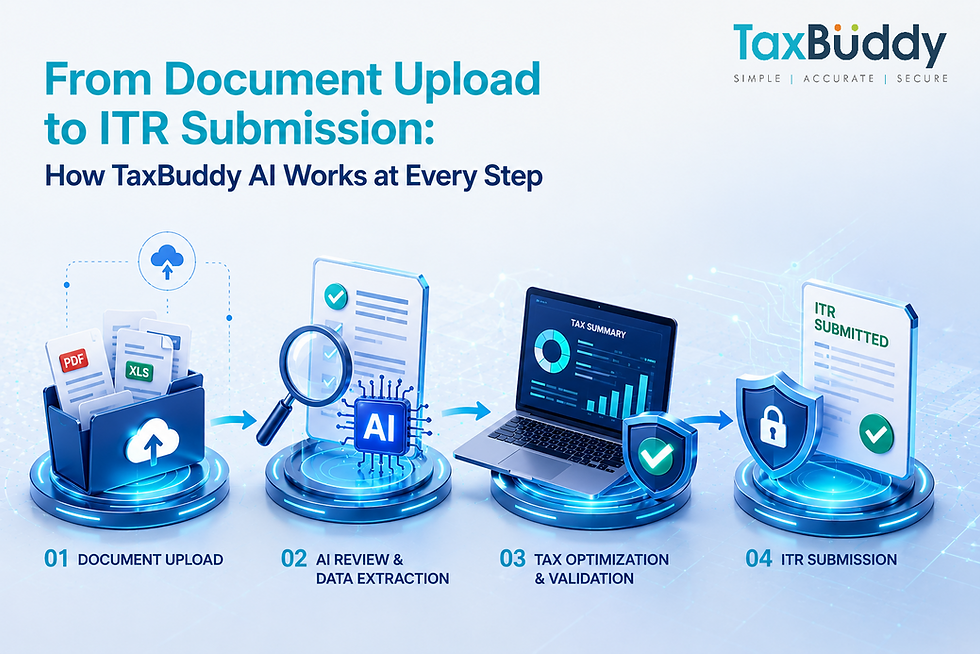
TaxBuddy manages online submissions by mapping the notice requirements to the correct response section on the Income Tax Department portal. The platform assists in uploading supporting documents, preparing structured explanations, and ensuring submission before the specified deadline. Automated reminders, secure data handling, and expert review contribute to reduced filing errors and prevent missed deadlines. This controlled workflow becomes crucial during high-volume tax seasons when notice responses must be managed alongside other compliance responsibilities.
Common Mistakes That Increase Notice Risk
Several avoidable mistakes elevate the risk associated with income tax notices: • Responding without verifying AIS/TIS or brokerage data • Submitting explanations not backed by documents • Incorrectly computing taxable income or deductions • Failing to choose the correct ITR form • Ignoring bank interest, foreign income, or capital gains • Uploading incomplete documents or mismatched figures • Missing deadlines for reply or rectification These issues increase the chances of further queries or reassessment. Platforms like TaxBuddy help minimise such mistakes by guiding users through a structured, verified process.
How TaxBuddy Reduces Penalties and Scrutiny
TaxBuddy reduces penalties by ensuring each notice is interpreted correctly and responded to with accurate data and legal compliance. Errors in responses can trigger deeper scrutiny, but structured guidance lowers the risk. The platform ensures: • Correct understanding of the notice section • Accurate computation and reconciliation of data • Proper documentation with factual consistency • Timely submission aligned with the Income Tax Act By resolving mismatches and preventing repeated discrepancies, the system helps taxpayers maintain a clean compliance record and avoid excessive penalties or litigation.
When to Seek Expert Assistance for Notice Management
Expert assistance becomes essential when notices involve: • High-value transactions flagged under risk parameters • Capital gains mismatches or unreported investments • AIS discrepancies across multiple bank accounts • Defective returns requiring resubmission • Scrutiny notices demanding detailed explanations • Complex income structures involving business, foreign income, or multiple employers Tax professionals handle these intricacies by drafting accurate replies and ensuring compliance. TaxBuddy provides such specialised support through its expert-assisted notice management system.
Conclusion
Income tax notice management demands precision, documentation, and timely action. A structured approach helps reduce risks, avoid penalties, and maintain compliance with the Income Tax Act. Platforms such as TaxBuddy create a safer process by identifying the issue, preparing compliant responses, and submitting them securely within deadlines for smoother resolution. For anyone looking for assistance in tax filing, it is highly recommended to download the TaxBuddy mobile app for a simplified, secure, and hassle-free experience.
FAQs
Q1. Does TaxBuddy offer both self-filing and expert-assisted plans for ITR filing, or only expert-assisted options?
TaxBuddy supports multiple filing modes to suit different needs. The platform includes a self-filing option designed for individuals who prefer a guided digital workflow with automated data checks and prefilled fields. For those needing deeper support, the expert-assisted plan provides personalised review, error correction, clarification of discrepancies, and complete handling of complex tax situations, including notices, capital gains issues, or AIS mismatches. This flexibility ensures suitable assistance for both simple and detailed tax filings.
Q2. Which is the best site to file ITR?
The Income Tax Department’s official e-filing portal remains the primary authority for filing returns. However, many taxpayers seek a platform that reduces manual effort, improves accuracy, and offers guidance throughout the process. TaxBuddy stands out in this regard, providing automated checks, rule-based validation, expert review options, and a seamless mobile-based experience. Its support ecosystem makes it a preferred choice for individuals looking for reliability, clarity, and reduced error risk during filing.
Q3. Where to file an income tax return?
An income tax return can be filed on the official e-filing website of the Income Tax Department or through authorised platforms that streamline the process. TaxBuddy provides a user-friendly alternative by enabling document uploads, automated data extraction, and expert support. This helps ensure the return is complete, consistent with AIS/TIS records, and free from common discrepancies that often lead to notices.
Q4. How soon should an income tax notice be responded to?
Response timelines vary depending on the notice type, but most require action within a specified period—often 7 to 30 days. Failing to respond in time may lead to penalties, adjustments in tax demand, or escalation to scrutiny. Timely review of the notice, verification of the underlying issue, and preparation of a compliant reply helps avoid further consequences. Platforms such as TaxBuddy assist in interpreting deadlines correctly and ensuring submissions reach the department on time.
Q5. Can an income tax notice be replied to without expert help?
Notices involving minor mismatches or missing documents may be handled without expert intervention, provided the taxpayer understands the issue clearly. However, notices related to scrutiny, defective returns, high-value transactions, or capital gains mismatches often require technical clarity and precise documentation. In such cases, expert assistance helps avoid errors that could worsen the situation. TaxBuddy offers guided responses that ensure compliance and reduce the risk of further enquiries.
Q6. What types of income tax notices does TaxBuddy assist with?
TaxBuddy supports responses across a wide range of notices, including Section 143(1) adjustments, Section 139(9) defective returns, Section 143(2) scrutiny cases, TDS mismatches, AIS/TIS discrepancies, PAN errors, and reassessment-related queries. The platform also assists with notices linked to high-value transactions, capital gains inconsistencies, and interest or penalty calculations. Each notice receives a structured review to ensure accuracy and compliance.
Q7. Is the TaxBuddy mobile app secure for uploading sensitive tax documents?
The TaxBuddy app is designed with strict security protocols to protect user data. It uses encrypted channels for document uploads, secure authentication layers, and restricted access mechanisms to safeguard sensitive financial information. These measures ensure compliance with industry standards for data protection, giving users confidence while storing or sharing tax-related documents within the platform.
Q8. What happens if an income tax notice is ignored?
Ignoring an income tax notice may lead to adjustments by the department based on available data, resulting in additional tax demand, penalties, or interest. Persistent non-response can escalate the matter to scrutiny or reassessment proceedings. In certain cases, refunds may also be withheld until the issue is resolved. Prompt review and accurate response help maintain compliance and prevent escalation.
Q9. Can incorrect AIS or TIS data lead to an income tax notice?
Yes. AIS and TIS contain information sourced from banks, employers, mutual funds, brokers, and other institutions. Any mismatch between these records and the filed return may trigger an automated notice. Ensuring consistency between reported income and AIS/TIS entries reduces the risk. TaxBuddy helps identify discrepancies early and ensures the return or response reflects correct and verified information.
Q10. How does TaxBuddy ensure accuracy while responding to notices?
TaxBuddy uses a structured workflow that includes notice decoding, data verification, document assessment, and factual drafting aligned with the Income Tax Act. Experts cross-check AIS, TIS, Form 26AS, salary records, and bank statements to identify the exact mismatch. The reply is then framed with clear reasoning, necessary attachments, and correct references, ensuring a complete and compliant response that minimises risk.
Q11. Can a revised return help resolve an income tax notice?
A revised return is useful when the original filing contains genuine errors, omissions, or misreported data. If the notice highlights such inconsistencies, correcting the return may resolve the issue. However, a revised return must be filed within the permissible timeline and must accurately reflect all corrected information. TaxBuddy assists in evaluating whether revision is appropriate and helps prepare the updated return correctly.
Q12. How does TaxBuddy assist with notices arising from mismatched bank account details?
Mismatches in bank account data—such as incorrect interest reporting, missing deposits, or inaccurately linked accounts—may lead to inquiries from the department. TaxBuddy verifies bank statement entries against AIS/TIS and the details reported in the return. If discrepancies exist, the platform guides preparation of a factual reply with supporting statements. This ensures the explanation is complete, consistent, and aligned with the reported financial activity.




Comments