

RSU vs ESOP Taxation in India: Important Differences For Employees

Updated: Jun 17

Equity compensation has become an integral part of salary packages in startups and established companies. Yet many employees remain unsure how RSUs and ESOPs are taxed in India. Understanding important facts that differentiate RSU vs ESOP can help one make informed decisions to build long-term wealth.
Although both involve company shares, the tax rules differ depending on when the shares vest, when the employee exercises the option, and when the shares are sold. This makes it important to understand not just the benefit itself, but also the tax treatment at each stage.
For employees, this is not just a technical issue. It affects cash flow, tax planning, and the choice of when to sell shares or exercise options. The amount must be reported correctly in salary records and in the income tax return to ensure compliance with IT regulations.
To know more about the difference between ESOP and RSU, how tax is calculated, and how employees can report these transactions in their income tax return, read on.
Table of Contents
RSU vs ESOP: Know What They Mean
Before delving into finer details, understanding what they stand for and imply is crucial. The RSU full form is the Restricted Stock Unit, which is a form of incentive an employer can provide to its employees. The employer promises to deliver a fixed number of shares to the employee after a vesting period, provided the required conditions are met. The employee does not pay an exercise price for RSUs. Also called the strike price, it is the fixed cost that one agrees to pay for each share.
Likewise, the ESOP full form is Employee Stock Option Plan. It gives an employee the right to buy company shares on a future date at a predetermined price once the vesting period is over. In this option, the employee does not immediately receive shares on grant; instead, the right becomes usable after the vesting period ends.
Unlike an RSU, ESOPs require the employee to actively exercise the option and pay the exercise price before the shares are allotted. Knowing the difference between RSU and ESOP is important because it affects both the tax timing and the amount of tax payable.
ESOP vs RSU: A Quick Glance at Differences
RSUs are generally easier to understand because it means the employee receives shares free of cost after vesting. ESOPs offer more flexibility because the employee can decide when to exercise the right to buy, depending on the market value of the share and their own financial situation.
See the table below to learn more about ESOPs vs RSUs.
Factor | RSU | ESOP |
Employee payment | Employee receives shares without payment | Employee pays exercise price |
First tax event | At vesting | On exercising |
Taxable value at first stage | Full fair market value | Fair market value minus exercise price |
Employee control over timing | Low | High |
Typically used by | Established companies | Startups and growth-stage companies |
How RSU Taxation Works
RSUs are taxed at the time of vesting. The fair market value of the shares on the vesting date is treated as a taxable perquisite and included under salary income. This means the employee may have a tax liability even before selling the shares.
For example, if 1,000 RSUs vest when the fair market value is ₹500 per share, the taxable salary value is ₹5 Lakh. When the employee sells the shares at a later date, capital gains tax applies. The gain is calculated by comparing the sale price with the fair market value on the vesting date. This becomes the cost base for capital gains purposes.
The tax can arise first, while the money from the actual sale may come later. This two-stage structure is why RSUs are often described as simple but not necessarily easy from a cash-flow point of view.
How ESOP Taxation Works
When comparing RSU vs ESOP, know that ESOPs are taxed when the employee exercises the option and receives the shares. The taxable perquisite is the difference between the fair market value on the exercise date and the exercise price paid by the employee.
For example, if the fair market value is ₹500 per share and the exercise price is ₹100 per share, the taxable perquisite is ₹400 per share. If 1,000 options are exercised, the taxable amount becomes ₹4 Lakh.
This amount is taxed as salary income. Once an individual sells his shares, capital gains tax applies to the difference between the fair market and sale price value on the exercise date.
There is an important point to note when comparing the taxation of ESOPs/RSUs, meaning ESOP taxation also happens in two stages, just like RSUs. However, in this case, the first taxable event comes later because the employee has to exercise the option first. That gives the employee some control over timing, which can be useful for tax planning.
RSU vs ESOP: Tax Rates and Capital Gains
The salary or perquisite portion of both RSUs and ESOPs is taxed at the employee’s applicable income tax slab. That means the first-stage tax depends on the employee’s total taxable income for the year, not merely on the value of the shares.
The capital gains portion is taxed separately after the shares are sold. The rate depends on the type of shares and the holding period. In the case of listed shares, STCG or short-term capital gains are taxed at 20%, while long-term capital gains are taxed at 12.5% with an exemption up to ₹1.25 Lakh.
For those shares not listed on stock exchange, long-term capital gains are taxed at 20%. Since the tax rules depend on both holding period and listing status, employees should check the exact nature of their shares before computing tax. The classification of the share is important, because the tax liability can differ depending on whether the shares are listed or unlisted.
Practical Examples to Understand What ESOPs/RSUs Mean
Here’s a simple example to compare Restricted Stock Units vs ESOPs. Let’s say an employee receives 1,000 RSUs and 1,000 ESOPs. For the RSUs, the fair market value on vesting is ₹500 per share, and the shares are later sold at ₹700 per share.
For the ESOPs, the exercise price is ₹100 per share, the fair market value on exercise is ₹500 per share, and the shares are later sold at ₹700 per share.
RSU example
At vesting, the taxable amount is:
1,000 × ₹500 = ₹5,00,000
This ₹5 Lakh is taxed as salary income at the employee’s slab rate. Later, when the shares are sold at ₹700 each, the total sale value becomes ₹7,00,000.
The capital gain is: ₹7,00,000 - ₹5,00,000 = ₹2,00,000
This gain is taxed under the applicable capital gains rules.
ESOP example
At exercise, the taxable perquisite is:
(₹500 - ₹100) × 1,000 = ₹4,00,000
This amount is taxed as salary income. Later, when the shares are sold at ₹700 each, the total sale value is ₹7,00,000.
The capital gain is again: ₹7,00,000 - ₹5,00,000 = ₹2,00,000
This example shows that when compared to ESOPs, RSU's first-stage taxable amount is higher. It is because the ESOP allows the employee to deduct the exercise price from the taxable perquisite.
How to Report ESOPs and RSUs in an ITR
The Income Tax Department’s ITR-2 form includes separate sections for salary and capital gains. Schedule 3.2 and Schedule 3.4 respectively. This matters because RSU and ESOP income usually has to be reported in both places. Most employees opting for these stock options from employers will use ITR-2, unless they also have business income, in which case ITR-3 may be required.
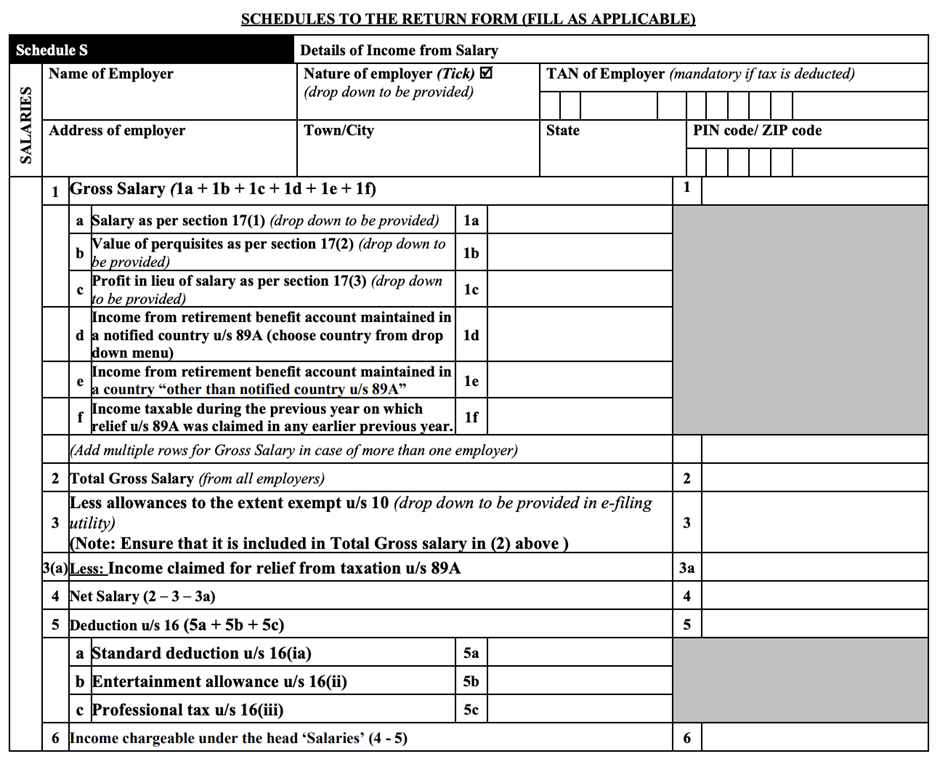
The perquisite value from ESOPs/RSUs should be reported under Schedule Salary. The profit from the sale of shares should be reported under Schedule Capital Gains. ITR-2 is the form used by individual taxpayers and HUFs for this type of reporting.
Employees should keep Form 16, grant letters, vesting or exercise statements, and sale transaction records ready before filing. If the employer has already deducted tax at source on the perquisite value, the figure should match the salary breakup and the tax credit available in the return.
How to Find the ITR-2 Form on the Income Tax Portal
Here’s a quick step-by-step process for locating the form on the portal.
Visit the official website at https://www.incometax.gov.in/iec/foportal/.
Log in using your PAN details and password
Select the e-File menu and opt for ‘Income Tax Returns’
Choose the relevant year and select the required status
Select the appropriate form, which is ITR-2 in this case
Click on the option ‘Let’s Get Started’ and provide a valid reason for filing
Choose relevant schedules applicable based on your income source
Start by filling in the personal details and verifying the given data
Choose a specific tax regime and fill in all the relevant details
Make sure to complete Schedule S and Schedule CG along with other relevant sections
Opt for the verification step and review your return for errors, if any
Pay any self-assessment tax if it is due, and submit your ITR
SCHEDULE SALARY IN ITR-2 FORM
This section requires taxpayers to enter income from pension or salary. Remember to provide the breakup of all salary components, which you can get from Form 16.
SCHEDULE Capital Gains in ITR-2 FORM
This section is essential to report gains or losses from the sale or transfer of capital assets. Depending on the type of asset, this schedule is split into 4 sub-sections:
Schedule STCG (Short-term Capital Gains)

● Schedule 112A (Long-term Capital Gains from listed equity shares)

● Schedule 115AD (Ideal for non-resident FPIs/FIIs)

● Schedule VDA (Gains generated from the transfer of Virtual Digital Assets)

RSU vs ESOP: Which One Is Better?
While both these options are ways companies grant equity to employees, knowing the difference between ESOP and RSU is essential. RSUs are less dependent on the employee’s decision to exercise, which makes them more predictable.
On the other hand, ESOPs are more flexible because the employee decides when to exercise. They can also offer greater upside if the company performs well over time. However, they also involve more market risk and cash outflow.
RSU vs ESOP: How Should Employees Plan?
RSU taxation can create a cash-flow issue because tax arises when the shares vest, even if the employee has not sold them yet. Employees should therefore plan whether they need to sell part of the vested shares to meet their tax liability.
ESOPs give more room for planning because the employee chooses when to exercise. This allows the employee to delay exercise if the market conditions are not favourable or if the personal tax bracket is likely to be higher in that year.
However, ESOPs also involve a cash outflow at exercise because the employee must pay the exercise price in addition to the tax on the perquisite value. So, even though the taxable perquisite may be smaller than in the RSU case, the immediate cash requirement can still be significant.
A simple record of grant date, vesting date, exercise date, fair market value, and sale date can make income tax filing much easier. This is especially useful where there are multiple vesting dates or repeated exercises.
That is why many employees think RSUs as simpler and ESOPs as more flexible. Simpler does not always mean easier, and flexible does not always mean cheaper. The right choice depends on the employee’s risk appetite, liquidity, and confidence in the company’s future.
RSU vs ESOP: Common Mistakes to Avoid
A common mistake is assuming tax is due only when the shares are sold. In reality, the first tax event occurs earlier, at vesting for RSUs and at exercise for ESOPs. Another mistake is using the wrong cost of acquisition for capital gains.
For RSUs, the cost is the fair market value on vesting. For ESOPs, the cost is the fair market value on exercise. A third mistake is selecting the wrong return form or leaving out part of the income. Employees sometimes also forget to keep share documents and contract notes, which makes filing harder. A complete paper trail can save time and reduce errors.
For employees, the key is to understand the vesting date, exercise date, sale date, and taxable value at each stage. This simple approach can help avoid tax surprises and make filing smoother.
FAQ
Are RSUs taxable in India?
Yes. RSUs are taxed when they vest, and the later sale of shares is taxed as capital gains.
Are ESOPs taxed twice?
Yes. ESOPs are taxed first at exercise as a perquisite and again when the shares are sold and
capital gains are reported.
Which ITR form should one use for RSU or ESOP income?
Choose the ITR-2 form that includes Schedule Salary and Schedule Capital Gains. If the taxpayer also has business income, ITR-3 may be needed.
Does one need to pay tax if they do not sell the shares immediately?
Yes. The first tax event is vesting for RSUs and exercise for ESOPs.
What is RSU meaning in salary package?
RSU means a promise from your employer to provide you with actual shares of the company stock, ideally at zero cost.
What is the main tax difference between RSUs and ESOPs?
The first tax event is the main difference. RSUs are taxed on vesting, while ESOPs are taxed on exercise.
Can the cost of acquisition be the amount paid for ESOPs?
No. For capital gains, the cost is generally the fair market value on the exercise date, not merely the exercise price paid.
What do you mean by stock options for private companies?
They are a form of equity compensation offered by startups and established companies, helping employees purchase company stocks at a set price.
How do the vesting schedules and tax implications of startup equity options differ from traditional private equity stock options?
Both differ significantly, as startups focus on early-stage growth using tax-incentivised structures. However, private equity firms incorporate performance-driven structures primarily focused on maximising financial returns.


