

Understanding the Role of Bookkeeping in Avoiding Income Tax and GST Notices
- Tejaswi Bodke

- Mar 12
- 9 min read
Bookkeeping plays a crucial role in preventing Income Tax and GST notices by ensuring accurate, consistent, and timely financial records. When books of accounts align with filed returns and government-reported data such as AIS, Form 26AS, TIS, and GSTR-2B, the risk of automated scrutiny reduces significantly. Most tax notices arise from mismatches, unreported income, incorrect ITC claims, or incomplete disclosures. Proper bookkeeping creates a defensible audit trail, supports deductions and exemptions, and ensures compliance under the Income Tax Act, 1961 and GST laws. In an environment of increasing digital scrutiny, disciplined record-keeping is no longer optional but essential.
Table of Contents
Why Bookkeeping Is Critical to Avoid Income Tax and GST Notices
Bookkeeping forms the foundation of tax compliance. Every income entry, expense voucher, bank transaction, invoice, and tax payment recorded in books directly impacts what is reported in Income Tax Returns and GST filings. When books are incomplete or inconsistent, returns may not match the data already available with the tax authorities through AIS, Form 26AS, TIS, or GST portals.
Most Income Tax and GST notices are triggered due to mismatches, under-reporting, excess ITC claims, unexplained cash deposits, or incorrect disclosures. Proper bookkeeping ensures that:
Income is fully reported.
Deductions and exemptions are supported by documents.
GST turnover matches reported sales.
ITC claims match supplier filings in GSTR-2B.
Bank interest and TDS entries align with Form 26AS and AIS.
Accurate records act as evidence during scrutiny and significantly reduce the probability of automated or manual notices.
Bookkeeping Requirements Under the Income Tax Act, 1961
Under Section 44AA of the Income Tax Act, certain businesses and professionals are required to maintain prescribed books of accounts. The objective is to enable proper computation of taxable income.
Professionals such as doctors, lawyers, architects, accountants, and consultants must maintain books if their gross receipts exceed the prescribed threshold. Businesses must maintain books if income or turnover crosses specified limits.
Typical books required include:
Cash book
Ledger
Journal (if following the mercantile system)
Bills and receipts
Expense vouchers
Inventory records
These records must generally be preserved for six years from the end of the relevant assessment year. Failure to maintain books can lead to penalties and may result in presumptions of under-reporting during scrutiny proceedings.
How Proper Bookkeeping Prevents Income Tax Notices Under Section 143(1) and 143(3)
Section 143(1) involves preliminary processing of returns through automated systems. Returns are compared with data available in AIS, TIS, and Form 26AS. If discrepancies are found, an intimation is issued.
Section 143(3) refers to a detailed scrutiny assessment, where supporting documents may be demanded.
Proper bookkeeping helps by:
Ensuring reported income matches AIS data.
Avoiding a mismatch in TDS credits.
Supporting deduction claims with invoices and proofs.
Justifying high expenses or capital transactions.
When books are reconciled before filing the return, the chances of receiving an intimation under Section 143(1) reduce significantly. In case of scrutiny under Section 143(3), detailed and organised books provide a clear audit trail.
GST Compliance and the Role of Bookkeeping in Avoiding GST Notices
GST law requires the maintenance of detailed records under Section 35 and Rule 56. Businesses must maintain:
Tax invoices
Purchase registers
Sales registers
Input tax credit records
Stock registers
Electronic records with digital authentication
Improper maintenance often leads to ITC mismatches, turnover discrepancies, or late filing penalties. GST notices are commonly triggered due to differences between GSTR-1, GSTR-3B, and GSTR-2B.
Systematic bookkeeping ensures that reported turnover, tax liability, and ITC claims are consistent across returns.
Monthly GST Reconciliation: GSTR-1, GSTR-3B and GSTR-2B Matching
Monthly reconciliation is essential to avoid GST notices.
GSTR-1 reports outward supplies. GSTR-3B reports the summary tax liability and ITC claims. GSTR-2B reflects eligible ITC based on supplier filings.
Reconciliation ensures:
Sales reported in GSTR-1 match liability in GSTR-3B.
ITC claimed in GSTR-3B matches GSTR-2B.
Missing supplier invoices are identified early.
Reversals under Rule 37 are handled correctly.
Without reconciliation, businesses may claim excess ITC or under-report output tax, leading to notices and interest demands.
Section 44AA and Mandatory Books of Accounts for Businesses and Professionals
Section 44AA of the Income Tax Act 1961 lays down the requirement for maintaining books of accounts for certain businesses and specified professionals. The purpose of this provision is to ensure that income declared in the return is properly supported by documentary evidence and structured financial records. It creates a compliance foundation for accurate tax computation and verification during assessment proceedings.
Under Section 44AA(1), specified professionals such as doctors, lawyers, chartered accountants, architects, engineers, technical consultants, interior decorators, and other notified professions must maintain prescribed books of accounts if their gross receipts exceed the prescribed threshold. These professionals are required to maintain records such as cash books, journals, ledgers, bills issued, bills received, and other supporting documents that enable the computation of taxable income. The intention is to ensure transparency in professional receipts and expense claims.
For businesses, Section 44AA(2) applies where income exceeds the basic exemption limit or turnover crosses the prescribed limits. Even where specific books are not prescribed in detail, businesses must maintain sufficient records to enable proper determination of profit or loss. This includes sales registers, purchase registers, bank statements, expense vouchers, inventory records, and reconciliation statements. Proper documentation ensures that revenue recognition, expense classification, and tax calculations remain defensible.
Many small businesses opt for presumptive taxation under Section 44AD or Section 44ADA, where income is declared at a fixed percentage of turnover or gross receipts. While these schemes reduce the burden of maintaining detailed books in certain situations, maintaining basic transaction records remains advisable. In practice, bank deposits, digital payments, and cash inflows still require explanation if questioned during scrutiny. If adequate records are not available to justify deposits, withdrawals, or expenses, tax authorities may treat unexplained amounts as income and make additions accordingly.
Increased data integration between GST returns, TDS statements, and income tax filings has also made record maintenance more critical. Mismatches between turnover declared under GST and income reported in the income tax return can trigger notices. Structured monthly or periodic bookkeeping helps align reporting across different statutory platforms and reduces compliance risk.
Maintaining structured records also strengthens financial discipline within the business. Clear documentation supports accurate advance tax computation, reduces the risk of penalties or interest, and improves readiness for tax audits under Section 44AB when applicable. For professionals and businesses aiming to scale operations, seek funding, or expand banking relationships, consistent record maintenance enhances credibility.
Ultimately, Section 44AA is not merely a statutory requirement; it serves as a compliance safeguard. Organised books of accounts improve transparency, protect against adverse additions during assessment, and create a reliable financial base for long-term business growth.
Bank Accounts in ITR: Disclosure, Validation and Mismatch Risks
Income Tax Returns require disclosure of all active bank accounts held during the financial year. Details such as account number, IFSC, and bank name must be accurately reported.
AIS captures bank interest, high-value transactions, and TDS entries. If a bank account is not disclosed or interest income is omitted, automated notices may be issued.
Pre-validating bank accounts on the e-Filing portal ensures smooth refund processing and reduces compliance risks.
How to Fill Bank Details in ITR-1 to Avoid Notices
To avoid mismatches:
Disclose all active bank accounts.
Cross-check interest income with Form 26AS and AIS.
Select one account for a refund credit.
Ensure IFSC and account number are accurate.
Verify pre-filled details before submission.
Minor errors in bank details may delay refunds or trigger clarification notices.
What If Bank Account Validation Fails on the e-Filing Portal?
Bank validation may fail due to:
PAN not linked with bank account.
Name mismatch between PAN and bank records.
Incorrect mobile number or email linkage.
Non-integrated bank status.
Re-validation should be attempted after correcting details. In some cases, updating KYC with the bank may be required. Proper documentation prevents refund delays and compliance issues.
Common Bookkeeping Mistakes That Trigger Income Tax and GST Notices
Several avoidable errors increase scrutiny risk:
Not reconciling AIS before filing ITR.
Claiming excess GST ITC.
Ignoring bank interest income.
Reporting turnover inconsistently between GST and Income Tax.
Poor documentation of cash transactions.
Not maintaining serially numbered invoices.
Missing TDS reconciliation.
Such errors are easily identified by automated systems. Structured bookkeeping reduces these risks significantly.
CBDT Scrutiny Guidelines for AY 2025-26 and the Need for Evidence-Based Records
Recent scrutiny guidelines emphasise data-driven and evidence-based selection of returns. High-value transactions, mismatch in reported income, and unusual deductions are flagged automatically.
In this environment, documentary evidence becomes critical. Books of accounts must support:
Deduction claims
Exemptions
Business expenses
Capital gains computations
Cash deposits
Proper record maintenance strengthens defense during assessment proceedings.
How Digital Tools and TaxBuddy Simplify Bookkeeping and Compliance
Digital compliance platforms help align financial records with tax filings. Automated reconciliation tools compare ITR data with AIS, Form 26AS, and GST records before submission.
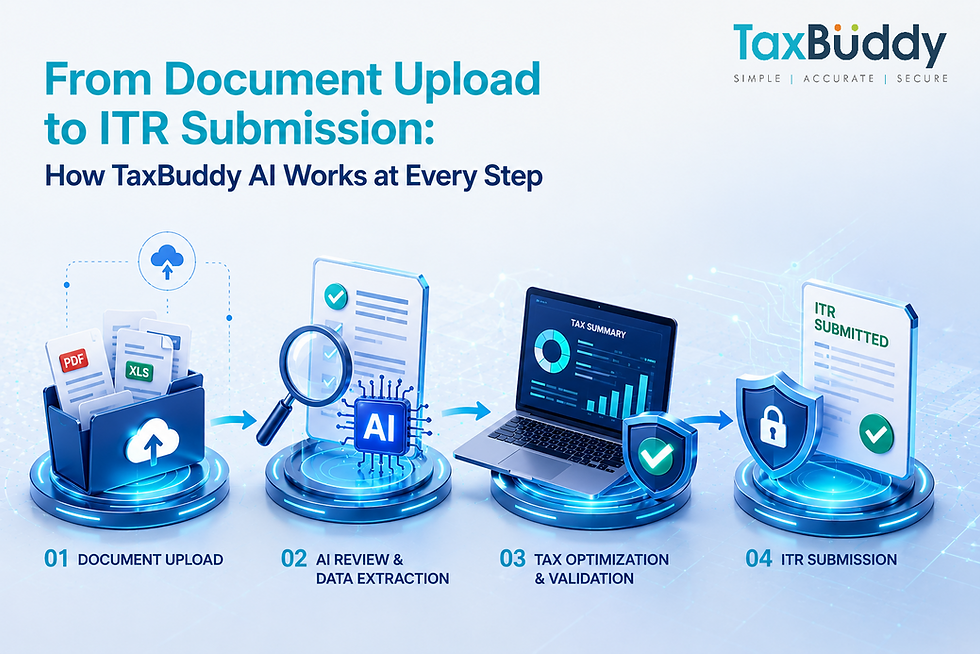
TaxBuddy integrates validation checks, guided filing workflows, and mismatch detection to reduce notice risks. Pre-filing reviews and structured documentation improve accuracy and transparency.
Technology-driven bookkeeping combined with systematic reconciliation helps businesses and professionals maintain compliance with reduced manual errors.
Conclusion
Bookkeeping is not merely an accounting exercise but a compliance safeguard. Accurate records ensure alignment between reported income, GST filings, bank transactions, and government data systems. As scrutiny becomes increasingly automated and data-driven, structured bookkeeping reduces mismatch risks and strengthens defence in case of notices.
For anyone looking for assistance in maintaining compliance and filing returns accurately, it is advisable to download the TaxBuddy mobile app for a simplified, secure, and hassle-free experience.
FAQs
Q1. What is the role of bookkeeping in avoiding Income Tax notices?
Bookkeeping ensures that all income, expenses, deductions, and tax credits are accurately recorded and reported in the Income Tax Return. When financial records match data available in AIS, Form 26AS, and TIS, the chances of receiving notices under Section 143(1) for mismatches reduce significantly. Proper books also help justify deductions and business expenses during scrutiny under Section 143(3).
Q2. How does improper bookkeeping lead to GST notices?
Improper bookkeeping often results in mismatches between GSTR-1, GSTR-3B, and GSTR-2B. Excess ITC claims, under-reporting of output tax, or inconsistent turnover reporting can trigger GST notices. If purchase records are not aligned with supplier filings, ITC may be denied, and interest or penalties may be imposed.
Q3. Which books of accounts are mandatory under Section 44AA?
Businesses and specified professionals are required to maintain books such as cash book, ledger, journal (if following mercantile system), bills, receipts, and expense vouchers. These records must enable proper computation of taxable income and must generally be preserved for six years from the end of the relevant assessment year.
Q4. Can small businesses receive Income Tax notices due to bookkeeping errors?
Yes. Even small businesses may be selected for scrutiny if turnover reported under GST does not match Income Tax returns, or if unexplained cash deposits, high expenses, or discrepancies appear in AIS. Automated systems identify inconsistencies regardless of business size.
Q5. How does AIS reconciliation help prevent notices?
AIS captures interest income, TDS, securities transactions, high-value purchases, and other financial data. Reconciling books with AIS before filing the return ensures that all income is properly disclosed and reduces the risk of mismatch-based intimation.
Q6. Is monthly GST reconciliation necessary to avoid notices?
Monthly reconciliation of GSTR-1, GSTR-3B, and GSTR-2B is strongly recommended. It ensures that outward supplies, tax liabilities, and ITC claims are consistent across returns. Regular reconciliation prevents the accumulation of errors that may later trigger departmental action.
Q7. How long should books of accounts be retained to defend against notices?
Books of accounts should generally be retained for at least six years from the end of the relevant assessment year. If any assessment or appeal proceedings are ongoing, records may need to be preserved longer to support claims and explanations.
Q8. What common bookkeeping mistakes trigger Income Tax scrutiny?
Common mistakes include not reporting bank interest, failing to reconcile TDS credits, claiming unsupported deductions, ignoring AIS data, and mismatching turnover between GST and Income Tax returns. Poor documentation of cash transactions also raises red flags.
Q9. How do mismatches between GST and Income Tax returns trigger notices?
If sales turnover declared in GST returns differs from the turnover reported in Income Tax returns, automated systems may flag the discrepancy. Authorities may then issue notices seeking an explanation for the variation.
Q10. Does presumptive taxation eliminate the need for bookkeeping?
Presumptive taxation simplifies income computation but does not eliminate the importance of maintaining basic transaction records. In case of scrutiny or cash deposit verification, supporting documentation may still be required.
Q11. Why is proper bank account disclosure important in ITR?
All active bank accounts must be disclosed in the Income Tax Return. Failure to disclose accounts or interest income reflected in AIS can lead to automated notices and refund delays. Accurate reporting ensures transparency and smoother processing.
Q12. How do digital bookkeeping tools reduce notice risks?
Digital tools help automate reconciliation between books, AIS, Form 26AS, and GST returns. Built-in validation checks identify mismatches before filing, reducing human error and strengthening compliance. Early detection of discrepancies significantly lowers the risk of Income Tax and GST notices.




Comments