

Who Are Coparceners in an HUF and What Rights They Have

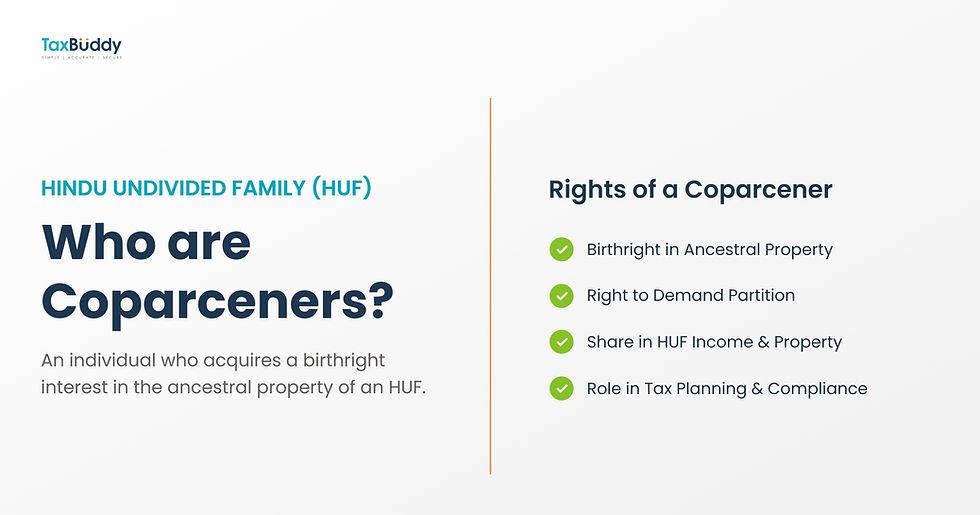
Coparceners in a Hindu Undivided Family (HUF) are individuals who acquire a birthright interest in ancestral property within the family structure recognised under Hindu law. These members, typically lineal descendants up to four generations from a common ancestor, hold specific legal and financial rights related to HUF assets and income. Their role is important not only in property ownership but also in tax planning because the Income Tax Act treats an HUF as a separate taxable entity. Understanding who qualifies as a coparcener and what rights they possess helps families manage ancestral property, income distribution, and tax compliance more effectively.
A coparcener in a Hindu Undivided Family is a person who acquires a direct ownership interest in ancestral HUF property by birth and has the legal right to demand partition, claim a share in family assets and income, and participate in important family decisions. Sons and daughters within four generations of a common ancestor qualify as coparceners, with daughters gaining equal status after the Hindu Succession (Amendment) Act, 2005. These rights influence both property ownership and tax planning because the HUF is recognized as a separate taxable entity under the Income Tax Act.
Table of Contents
Understanding Coparceners in an HUF
A Hindu Undivided Family (HUF) is a legal structure recognized under Hindu law and the Income Tax Act, 1961. It consists of members of a family who share ancestral property and income. Within this structure, coparceners are a special category of members who possess specific ownership and decision-making rights in HUF property.
Coparceners acquire an interest in ancestral property by birth. This means they do not need a will, transfer, or gift to gain ownership rights in HUF assets. Their share exists automatically because of their lineage within the family. The concept of coparcenary is central to the functioning of an HUF because only coparceners can demand partition of family property and influence major decisions related to HUF assets.
In addition to property rights, coparceners also indirectly benefit from the tax treatment of HUF income. Since the HUF is treated as a separate taxpayer under the Income Tax Act, income generated from HUF assets is taxed in the HUF’s hands rather than the individual coparceners. This structure often helps families manage income distribution and tax planning more efficiently.
Who Qualifies as Coparceners in a Hindu Undivided Family
Coparceners are lineal descendants within four generations from a common ancestor in a Hindu Undivided Family. Traditionally, this included only male descendants. However, legal reforms have expanded the definition significantly.
Today, the following individuals typically qualify as coparceners:
Sons of the family
Daughters of the family
Grandsons and granddaughters
Great-grandsons and great-granddaughters within four generations
The Hindu Succession (Amendment) Act, 2005 granted daughters the same coparcenary rights as sons. This change established that daughters have equal rights in ancestral property, regardless of their marital status.
However, not every member of an HUF is a coparcener. For example, spouses and other relatives may be members of the HUF but do not have coparcenary rights. These members cannot demand partition or claim ownership by birth in ancestral property.
Understanding this distinction is important when determining who can participate in property decisions and who can exercise legal rights within the HUF structure.
Difference Between Coparceners and Members of an HUF
An HUF includes two categories of individuals: members and coparceners. While both belong to the family unit, their legal rights and roles differ significantly.
Members of an HUF include all individuals who are part of the family structure, such as spouses and other relatives connected through marriage or lineage. They may benefit from HUF income and assets, but do not have ownership rights in ancestral property by birth.
Coparceners, on the other hand, have stronger legal rights because they acquire ownership interest in HUF property automatically at birth. This gives them the authority to participate in important decisions regarding family property.
The main differences include:
Coparceners have a birthright in ancestral property, whereas members do not.
Only coparceners can demand partition of HUF property.
Coparceners can influence decisions regarding sale or transfer of family assets.
These distinctions determine how property ownership and income distribution work within an HUF.
Rights of Coparceners in HUF Property and Income
Coparceners possess several legal rights in relation to HUF property and income. These rights arise from their status as joint owners of ancestral assets.
One of the most important rights is the right to share in the income generated from HUF property. Income from rental property, investments, or family businesses owned by the HUF belongs collectively to the family and benefits the coparceners.
Coparceners also have the right to participate in major family decisions involving property. While the Karta manages the day-to-day functioning of the HUF, important transactions involving HUF assets usually require the consent of coparceners.
Another key right is the ability to challenge decisions that may harm the interests of the HUF. If the Karta attempts to sell or transfer property without proper justification or family benefit, coparceners can legally question the decision.
These rights ensure that ancestral property remains protected and that family members maintain shared control over important assets.
Birthright and Ownership Rights of Coparceners in HUF
One of the defining features of coparcenary rights is the concept of birthright ownership. Unlike other forms of property ownership, coparceners automatically acquire their interest in ancestral property at the time of birth.
This means that a coparcener becomes a joint owner of HUF property from birth, even though the exact share may fluctuate depending on the number of coparceners in the family.
For example, if a new child is born into the family, the share of each coparcener may reduce proportionally because the property is jointly owned. Similarly, when a coparcener passes away, the share is redistributed among surviving coparceners according to applicable succession laws.
Birthright ownership ensures continuity of property ownership within the family and prevents unilateral control by any single individual.
Right to Demand Partition of HUF Property
One of the most powerful rights available to coparceners is the right to demand partition of HUF property. Partition refers to the division of ancestral property among coparceners so that each receives an individual share.
A coparcener can request partition at any time. Once a valid partition takes place, the HUF may cease to exist or may continue with the remaining members.
Partition typically involves the division of:
Immovable property such as land or buildings
Investments held in the name of the HUF
Business assets owned by the HUF
From a tax perspective, partition has important consequences. Once property is divided, each individual coparcener becomes responsible for reporting income from the assets received. The HUF may also stop filing returns if it no longer holds any joint assets.
Equal Coparcenary Rights of Daughters After the 2005 Amendment
The Hindu Succession (Amendment) Act, 2005 introduced a significant change in coparcenary rights by granting daughters equal rights in ancestral property.
Before this amendment, only sons were recognised as coparceners. Daughters were considered members of the family but did not possess ownership rights in HUF property.
After the amendment:
Daughters became coparceners by birth
They gained the same rights and responsibilities as sons
They can demand partition of HUF property
They can inherit ancestral property equally
This legal reform strengthened gender equality within the family property structure and ensured that daughters receive the same legal recognition as sons in matters of inheritance and property ownership.
Role of the Karta and How It Differs from Coparceners
The Karta is the head of the Hindu Undivided Family and manages the financial and administrative affairs of the HUF. Traditionally, the senior-most coparcener assumed the role of Karta, although legal developments now allow even daughters to become Karta under certain circumstances.
The responsibilities of the Karta include:
Managing HUF assets and investments
Representing the HUF in financial and legal matters
Operating bank accounts and conducting transactions
Filing income tax returns for the HUF
While the Karta has managerial authority, coparceners still hold ownership rights in the property. This means the Karta cannot arbitrarily sell or dispose of HUF property without legitimate reasons that benefit the family.
In simple terms, the Karta manages the HUF, while coparceners collectively own the property.
Tax Implications of Coparceners in HUF Under the Income Tax Act
The Income Tax Act, 1961, recognises an HUF as a separate taxable entity. This means the HUF must obtain its own PAN and file income tax returns independently from its members.
Income generated from HUF property, such as rental income, business income, or interest, is taxed in the hands of the HUF rather than individual coparceners.
This separation can create tax planning opportunities. For example:
The HUF can claim deductions independently under applicable provisions.
Income can be distributed within the family without increasing individual tax liability.
However, when assets are distributed after partition, the income generated from those assets becomes taxable in the individual hands of the respective coparceners.
Managing these tax aspects carefully helps families maintain compliance and optimise tax outcomes.
How HUF Income Is Distributed Among Coparceners
Income earned by the HUF does not automatically belong to individual coparceners. Instead, it belongs to the HUF entity itself until it is distributed or used for family purposes.
The Karta typically decides how HUF income is utilized. It may be used for family expenses, reinvestment, property maintenance, or other family needs.
If income is distributed among coparceners, the distribution must follow the ownership structure of the HUF. In most cases, income is reinvested or retained within the HUF to maintain the integrity of family assets.
Once partition occurs and assets are divided, each coparcener receives their share and becomes responsible for reporting income from those assets in their individual tax returns.
Impact of HUF Partition on Coparceners and Tax Filing
Partition of an HUF changes both property ownership and tax obligations.
When a partition takes place:
The HUF assets are divided among coparceners.
Each coparcener becomes the owner of their allocated share.
The HUF may cease to exist if all assets are divided.
From a tax perspective, the division of HUF property during partition generally does not trigger capital gains tax because the assets are merely redistributed among family members.
However, once the partition is completed, the income generated from those assets must be reported individually by each coparcener in their personal tax returns.
Proper documentation and compliance are necessary to ensure the partition is recognized for tax purposes.
Bank Accounts and Documentation for Coparceners in an HUF
HUFs often maintain separate bank accounts to manage family assets and income. These accounts are typically operated by the Karta on behalf of the family.
Opening an HUF bank account usually requires documentation such as:
HUF declaration or deed
PAN card of the HUF
PAN and identification documents of the Karta
Details of coparceners
Banks may also require a list of all coparceners and their identity documents to verify the structure of the HUF.
Coparceners themselves cannot independently operate the HUF bank account unless authorised by the Karta. However, their details are important for compliance and record keeping.
How Coparceners Benefit from HUF Tax Planning
The HUF structure can provide tax planning benefits for families that hold joint assets or businesses.
Since the HUF is treated as a separate taxpayer, it enjoys its own tax slab, deductions, and exemptions under the Income Tax Act. This allows families to distribute income across multiple entities rather than concentrating all income in one individual’s tax return.
For example, rental income or business income earned through HUF property can be taxed separately under the HUF, which may reduce the overall tax burden for the family.
Proper planning and compliance are necessary to ensure that HUF structures are used legitimately and effectively.
Managing HUF Tax Compliance and Filings with TaxBuddy
Managing the taxation and compliance requirements of an HUF can sometimes become complex. Separate PAN registration, documentation, income reporting, and tax return filing must all be handled accurately.
Digital tax platforms simplify these processes by providing structured guidance for HUF filings and compliance. Platforms like TaxBuddy help families manage income tax returns, track deductions, and ensure that HUF-related filings are completed correctly.
Such tools are particularly helpful when dealing with HUF partitions, income distribution, or documentation requirements related to coparceners.
Conclusion
Coparceners play a central role in the functioning of a Hindu Undivided Family because they possess ownership rights in ancestral property and the authority to demand partition or participate in family decisions. Their rights, including equal inheritance for daughters after the 2005 amendment, ensure that property ownership within the HUF remains structured and legally protected. At the same time, the recognition of an HUF as a separate taxable entity allows families to plan income distribution and tax compliance more efficiently.
For anyone managing HUF income or property distribution, proper tax filing and documentation are essential. For anyone looking for assistance in tax filing, it is highly recommended to download the TaxBuddy mobile app for a simplified, secure, and hassle-free experience.
FAQs
Q1. Who are coparceners in a Hindu Undivided Family (HUF)?
Coparceners in a Hindu Undivided Family are individuals who acquire a direct ownership interest in ancestral property by birth. They are typically lineal descendants within four generations from a common ancestor. This includes sons, daughters, grandsons, granddaughters, and further descendants within the prescribed lineage. Coparceners hold legal rights in HUF property and can participate in decisions related to family assets. Their rights arise automatically by birth and do not require any formal transfer or inheritance document.
Q2. How is a coparcener different from a member of an HUF?
A member of an HUF is anyone who belongs to the family unit, including spouses and other relatives connected through marriage or lineage. However, not every member has coparcenary rights. Coparceners have a birthright ownership interest in ancestral property, whereas members do not. Only coparceners can demand partition of HUF property and participate in decisions related to the ownership of ancestral assets.
Q3. Can daughters be coparceners in an HUF?
Yes, daughters are recognised as coparceners by birth under the Hindu Succession (Amendment) Act, 2005. This amendment granted daughters the same rights and responsibilities as sons in ancestral property. Daughters can claim an equal share in HUF property, demand partition, and participate in family decisions regarding property management. Their coparcenary rights remain valid regardless of marital status.
Q4. How many generations can qualify as coparceners in an HUF?
Coparceners generally include lineal descendants within four generations from a common ancestor. This usually includes the ancestor, children, grandchildren, and great-grandchildren. Each new generation born within this lineage automatically acquires a birthright interest in ancestral HUF property.
Q5. What rights do coparceners have in HUF property?
Coparceners possess several rights in relation to HUF property. These include the right to ownership by birth, the right to demand partition of ancestral property, the right to participate in major decisions regarding family assets, and the right to receive a share in HUF income. These rights ensure that ancestral property remains jointly owned and managed by eligible family members.
Q6. Can a coparcener demand partition of HUF property?
Yes, a coparcener has the legal right to demand partition of HUF property at any time. Partition refers to the division of ancestral assets among coparceners so that each receives an individual share. Once a valid partition occurs, the property is distributed among coparceners and the HUF structure may either dissolve or continue with remaining members.
Q7. Do coparceners automatically own ancestral property?
Yes, coparceners acquire ownership interest in ancestral property by birth. This means they do not need a will, transfer deed, or inheritance process to obtain rights in HUF property. However, the exact share of each coparcener may change depending on the number of coparceners in the family at a given time.
Q8. Can coparceners challenge decisions made by the Karta?
Coparceners have the right to question or challenge decisions made by the Karta if those decisions are not in the best interest of the HUF. For example, if the Karta attempts to sell or transfer family property without proper justification or family benefit, coparceners can legally object or seek judicial intervention.
Q9. What happens to coparceners’ rights after HUF partition?
After partition, the ancestral property is divided among coparceners and each individual becomes the owner of their allocated share. Once this division takes place, the joint ownership structure of the HUF changes. Each coparcener can independently manage, sell, or transfer the assets received after partition.
Q10. Can a coparcener become the Karta of an HUF?
Traditionally, the senior-most male coparcener acted as the Karta of an HUF. However, legal interpretations now allow the senior-most coparcener, including a daughter, to assume the role of Karta if circumstances permit. The Karta manages the financial and administrative affairs of the HUF on behalf of all coparceners.
Q11. Do spouses become coparceners in an HUF?
Spouses are considered members of the HUF but are not coparceners. For example, a wife becomes a member of her husband’s HUF after marriage, but she does not acquire coparcenary rights by birth. This means she cannot demand partition of ancestral property, although she may benefit from HUF income and family assets.
Q12. Why is understanding coparceners important for HUF property and financial planning?
Understanding the role of coparceners is important because it determines who has ownership rights in ancestral property and who can influence property decisions. These rights affect inheritance, partition, and management of family assets. Clear knowledge of coparcenary rights also helps families manage property disputes, maintain legal compliance, and structure HUF finances effectively.


