

Why Accounting Accuracy Reduces the Risk of Future Scrutiny and Adjustments
- CA Pratik Bharda

- Mar 12
- 8 min read

Accounting accuracy under the Income Tax Act 1961 directly reduces the risk of tax scrutiny, reassessment, penalties, and costly adjustments. When financial records align with bank statements, GST filings, AIS, and Form 26AS, the probability of automated selection for scrutiny decreases significantly. Errors in income reporting, TDS credit claims, depreciation, or expense deductions often trigger notices under Sections 143(1), 143(3), 142(1), or 148. Maintaining precise books, reconciled statements, and compliant documentation creates transparency, strengthens audit defence, and minimises financial exposure. Accurate accounting is not merely an administrative discipline; it is a strategic safeguard against prolonged litigation and regulatory stress.
Accounting accuracy reduces the risk of future scrutiny and adjustments because it ensures consistency between reported income, third-party data, and statutory disclosures, thereby preventing automated mismatch alerts, disallowances, reassessments, penalties, and interest liabilities under the Income Tax Act 1961.
Table of Contents
Why Accounting Accuracy Matters Under the Income Tax Act 1961
How Accounting Accuracy Prevents Scrutiny Under Section 143(3)
Role of AIS and Form 26AS Reconciliation in Reducing Tax Scrutiny Risk
How Errors Lead to Notices Under Sections 142(1), 148, and 131
Avoiding Costly Adjustments Under Section 154 and Section 271(1)(c)
Depreciation, Inventory Valuation, and Expense Claims: Why Precision Matters
How Bank KYC, PAN Linking, and Form 60/61 Accuracy Affect ITR Scrutiny
Accounting Accuracy and Audit Defence Before SEBI, RBI, and Tax Authorities
Internal Controls and Technology for Improving Accounting Accuracy
How TaxBuddy Supports AIS Reconciliation and Error-Free Tax Filing
Why Accounting Accuracy Matters Under the Income Tax Act 1961
The Income Tax Act 1961 operates on self-assessment supported by verifiable records. Every income entry, deduction claim, depreciation charge, and expense must be supported by books of account and documentation. When accounting records are accurate, they reflect true income and lawful claims, reducing the possibility of disputes during assessment.
Accounting accuracy ensures that figures declared in the return match supporting schedules, bank statements, GST returns, and statutory disclosures. Inaccurate bookkeeping, on the other hand, creates inconsistencies that are easily detected through automated data analytics systems used by the Income Tax Department. Precision in accounting therefore, becomes a compliance shield, preventing unnecessary scrutiny, reassessment, and financial stress.
How Accounting Accuracy Prevents Scrutiny Under Section 143(3)
Section 143(3) of the Income Tax Act, 1961 deals with detailed scrutiny assessment, where the Assessing Officer examines the return thoroughly to verify the correctness of income declared, deductions claimed, exemptions availed, and tax paid. Returns are typically selected for scrutiny based on risk-based parameters, data analytics, high-value transactions, or mismatches between the return and third-party information available with the department.
In today’s data-driven environment, the Income Tax Department cross-verifies information using AIS, Form 26AS, GST returns, TDS filings, bank reporting, and financial intelligence systems. Even small inconsistencies can create risk flags. When accounting records are inaccurate or reconciliations are incomplete, discrepancies become visible in automated systems, increasing the chances of selection for scrutiny under Section 143(3).
Accurate accounting plays a preventive role. When books of accounts are properly maintained and reconciled before filing the return, the information reported aligns seamlessly with statutory databases and third-party disclosures. This significantly reduces suspicion and risk categorisation.
Proper reconciliation before filing ensures that reported income matches AIS data. The Annual Information Statement reflects interest income, securities transactions, high-value purchases, dividends, and other financial transactions reported by banks, mutual funds, and institutions. If accounting records capture all such entries correctly and income is fully disclosed, there is no mismatch between AIS and the return.
TDS claims must match Form 26AS exactly. Over-claiming or under-reporting TDS creates immediate discrepancies. Accurate accounting ensures that TDS is booked correctly against relevant income heads, preventing automated flags triggered by incorrect credit claims.
Business turnover must match GST filings. The department compares turnover declared in income tax returns with outward supplies reported in GST returns, such as GSTR-1 and GSTR-3B. Any gap without a proper explanation may result in notice issuance. Regular reconciliation between accounting software and GST portal filings ensures consistency.
Bank interest, capital gains, dividend income, and other financial receipts must be fully disclosed. Financial institutions report these transactions directly to tax authorities. If accounting records omit or misclassify such income, scrutiny risk increases. Systematic tracking of bank statements, demat transactions, and investment records ensures accurate disclosure.
Accurate accounting also supports proper documentation. During scrutiny, officers may request ledger extracts, bank statements, invoices, contracts, and supporting calculations. When books are clean and updated regularly, responding to such notices becomes easier and faster.
Ultimately, accounting accuracy reduces red flags that typically trigger deeper examination. Consistency across books, GST returns, AIS, Form 26AS, and financial statements builds credibility. While scrutiny selection is risk-based and not entirely avoidable, disciplined accounting significantly lowers the probability of unnecessary examination under Section 143(3).
Role of AIS and Form 26AS Reconciliation in Reducing Tax Scrutiny Risk
The Annual Information Statement (AIS) captures high-value transactions, interest income, securities transactions, foreign remittances, and more. Form 26AS reflects TDS, TCS, and advance tax payments.
If accounting records are not reconciled with these statements before filing, discrepancies may arise. Common examples include:
Bank interest not reported
Capital gains reflected in AIS but omitted in ITR
TDS claimed but not appearing in Form 26AS
Reconciliation ensures that the income declared in the return is consistent with government-reported data. Platforms like TaxBuddy integrate AIS validation tools that allow pre-filing verification, reducing the risk of post-filing notices and adjustments.
Common Scrutiny Triggers Caused by Inaccurate Accounting
Certain errors commonly lead to scrutiny selection:
Underreporting of interest income
Mismatch in turnover between GST returns and ITR
Incorrect TDS credit claims
Inflated expense deductions without documentation
Sudden spikes in capital gains or losses without supporting records
Even minor mismatches can escalate into detailed assessment proceedings. Accurate bookkeeping and documentation eliminate these triggers at the source.
How Errors Lead to Notices Under Sections 142(1), 148, and 131
Section 142(1) empowers the department to seek clarification or documents. Section 148 allows reassessment where income has escaped assessment. Section 131 grants authority to summon individuals and call for evidence.
Accounting inaccuracies such as omitted income, unexplained credits, or unsupported expenses may lead to such notices. Reassessments can extend several years depending on statutory thresholds. Preventive accounting practices significantly reduce the likelihood of such proceedings.
Avoiding Costly Adjustments Under Section 154 and Section 271(1)(c)
Section 154 deals with rectification of mistakes apparent on record. Errors in return filing may result in adjustments that alter tax liability or reduce refunds.
Section 271(1)(c) provides for penalties in cases of concealment or inaccurate particulars. While genuine mistakes may be defensible, repeated discrepancies weaken credibility and increase exposure. Accurate accounting ensures correct depreciation claims, legitimate expense deductions, and transparent disclosures, reducing penalty risk.
Interest Implications Under Sections 234A, 234B, and 234C
Incorrect tax computation or underestimation of income can lead to interest liabilities:
Section 234A: Delay in filing return
Section 234B: Short payment of advance tax
Section 234C: Deferment of advance tax instalments
Interest is calculated at 1% per month and can accumulate quickly. Accurate accounting ensures proper tax estimation and timely payments, preventing avoidable interest burdens.
Depreciation, Inventory Valuation, and Expense Claims: Why Precision Matters
Depreciation under Section 32 must follow prescribed rates and asset classifications. Incorrect claims often result in disallowance during assessment.
Inventory valuation must comply with accepted accounting standards. Overvaluation or undervaluation distorts profits and invites scrutiny.
Expense claims under Section 37 must be wholly and exclusively for business purposes. Unsupported expenses frequently trigger queries. Maintaining structured ledgers and documentary proof ensures defensible positions during assessments.
How Bank KYC, PAN Linking, and Form 60/61 Accuracy Affect ITR Scrutiny
Bank accounts linked to PAN automatically feed data into AIS. Interest income, cash deposits, and financial transactions are reported to tax authorities.
Errors in PAN linkage, inaccurate Form 60/61 declarations, or mismatched KYC details may result in reporting inconsistencies. Such mismatches often prompt clarification notices. Accurate bank documentation, therefore, plays a direct role in minimising scrutiny exposure.
Accounting Accuracy and Audit Defence Before SEBI, RBI, and Tax Authorities
Regulators increasingly emphasise compliance, transparency, and internal controls. Entities regulated by SEBI or RBI face stricter disclosure norms.
Accurate ledgers, reconciled statements, and documented internal controls strengthen audit defence during regulatory inspections. Poor record maintenance, on the other hand, increases revision risk and reputational exposure.
Internal Controls and Technology for Improving Accounting Accuracy
Strong internal controls include:
Periodic reconciliation of bank accounts
Monthly AIS and GST comparison
Segregation of accounting duties
Documentation of supporting evidence
Automated accounting systems
Technology-driven tools reduce manual errors and create audit trails. Tax filing platforms with integrated validation systems help taxpayers reconcile discrepancies before submission, minimizing future adjustments.
How TaxBuddy Supports AIS Reconciliation and Error-Free Tax Filing
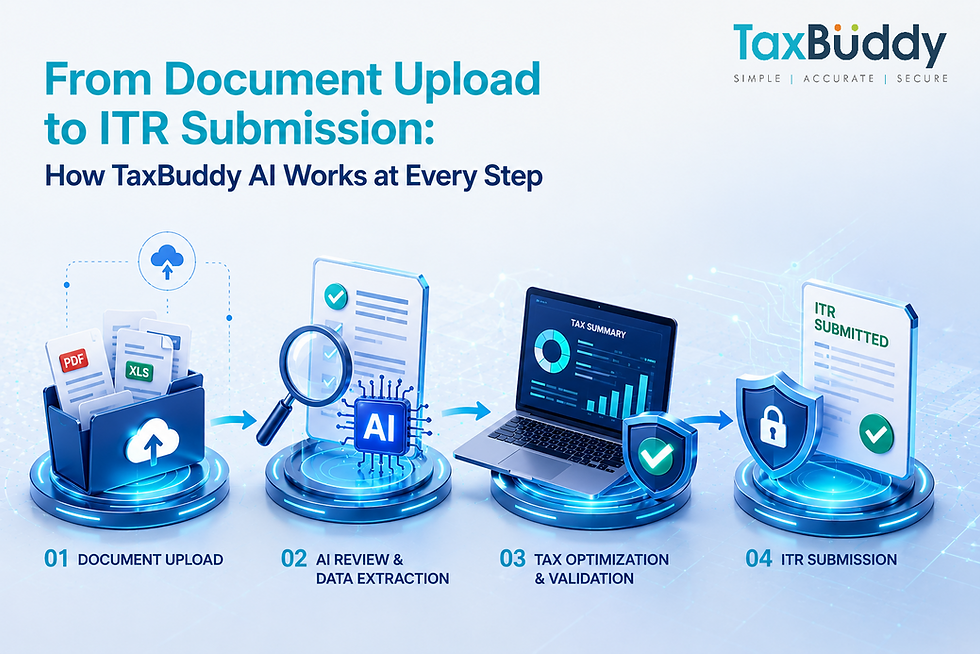
Accurate accounting must extend into the filing stage. Reconciliation tools, automated validations, and compliance alerts significantly reduce error rates.
TaxBuddy offers AIS comparison features, structured data validation, and guided filing processes that align reported income with statutory disclosures. These safeguards reduce mismatch notices, refund delays, and assessment complications while ensuring seamless compliance under the Income Tax Act 1961.
Conclusion
Accounting accuracy is a long-term risk management strategy rather than a routine bookkeeping task. When income, deductions, TDS credits, and financial disclosures are fully reconciled before filing, the probability of scrutiny, reassessment, penalties, and interest exposure reduces substantially. Proactive reconciliation supported by structured digital tools strengthens compliance and protects financial credibility. For anyone looking for structured support in reconciliation and tax filing, it is highly recommended to download the TaxBuddy mobile app for a simplified, secure, and hassle-free experience:
FAQs
Q1. Why does accounting accuracy reduce the risk of tax scrutiny?
Accounting accuracy ensures that income, deductions, TDS credits, and financial disclosures match third-party data reflected in AIS and Form 26AS. Since the Income Tax Department uses automated systems to identify mismatches, properly reconciled records significantly lower the chances of a return being selected for scrutiny or reassessment. Accurate books also demonstrate transparency and good faith compliance.
Q2. How does a mismatch between AIS and ITR trigger scrutiny?
The Annual Information Statement captures data from banks, financial institutions, stock exchanges, and other reporting entities. If income shown in AIS, such as interest or capital gains, is not reported in the Income Tax Return, automated systems flag the discrepancy. This may result in an adjustment under Section 143(1) or detailed scrutiny under Section 143(3).
Q3. Can minor accounting errors lead to major tax consequences?
Yes. Even small errors, such as omission of bank interest or incorrect TDS claims, can lead to return adjustments, refund reduction, or notices seeking clarification. Repeated inaccuracies may weaken credibility during future assessments and increase the risk of a detailed investigation.
Q4. What role does Form 26AS play in preventing tax adjustments?
Form 26AS reflects TDS, TCS, and advance tax payments linked to PAN. If the tax credit claimed on the return exceeds what appears in Form 26AS, the department may disallow the excess credit. Proper reconciliation before filing prevents such automatic adjustments and refund delays.
Q5. How does inaccurate bookkeeping lead to reassessment under Section 148?
If income escaping assessment is later detected through third-party reporting or data analytics, the department may initiate reassessment proceedings. Inaccurate bookkeeping increases the likelihood of unreported income being discovered during cross-verification, which may trigger the reopening of the assessment.
Q6. Why is depreciation accuracy important under tax laws?
Depreciation must be claimed strictly according to prescribed rates and asset classifications under Section 32. Incorrect classification or excess claim may be disallowed during assessment, increasing taxable income and potentially leading to interest liability.
Q7. How does incorrect expense reporting increase scrutiny risk?
Expenses claimed under Section 37 must be wholly and exclusively for business purposes. Unsupported or inflated expenses often raise red flags during assessment. Proper documentation and structured accounting reduce the likelihood of disallowance and penalty exposure.
Q8. Can bank KYC errors affect tax compliance?
Yes. Bank accounts linked with incorrect PAN or inaccurate KYC details may result in reporting inconsistencies in AIS. Unreported interest or financial transactions detected through banking data often lead to clarification notices from the department.
Q9. What interest liabilities arise from inaccurate accounting?
If income is underreported or advance tax is miscalculated due to inaccurate records, interest under Sections 234A, 234B, and 234C may apply. These provisions impose monthly interest, which can substantially increase overall tax liability.
Q10. Does maintaining accurate books eliminate the possibility of scrutiny completely?
No system guarantees zero scrutiny, as returns may still be selected randomly. However, accurate and reconciled records significantly reduce the probability of selection and strengthen defence during any review or assessment.
Q11. How can technology improve accounting accuracy before filing?
Automated reconciliation tools compare financial data with AIS and Form 26AS before submission. Such systems detect mismatches early, allowing corrections prior to filing and reducing the risk of post-filing notices or adjustments.
Q12. Why is documentation critical during tax assessments?
During scrutiny or inquiry proceedings, supporting documents validate income disclosures and deduction claims. Accurate accounting supported by invoices, bank statements, and ledgers ensures that reported figures withstand verification and reduces the risk of penalties or prolonged litigation.




Comments