

Why Last-Minute Tax Saving Leads to Defective or Revised Returns
- Rashmita Choudhary

- Feb 9
- 9 min read
Last-minute tax saving under the Income Tax Act, 1961 often creates more problems than benefits. Rushed investments, hurried document collection, and incomplete verification lead to incorrect claims, mismatches with Form 26AS and AIS, and missing disclosures. These errors frequently result in defective returns under Section 139(9) or force taxpayers to revise their returns under Section 139(5). Filing close to the deadline increases the risk of notices, refund delays, and compliance issues. A planned approach to tax filing significantly reduces these risks and ensures accurate reporting without unnecessary revisions.
Table of Contents
Common Mistakes Caused by Last-Minute Tax Saving
Last-minute tax saving often leads to avoidable reporting errors because decisions are taken in haste rather than through verification. One of the most frequent mistakes is incorrect or unsupported deduction claims under Section 80C and Section 80D. Investments are made close to the deadline, but proof submission is either incomplete or does not match Form 16 or AIS data.
Another common issue is omission of small income components such as bank interest, dividends, or freelance receipts. These figures are auto-captured in AIS, but rushed filers often miss reconciling them with the return. Bank account details are also entered incorrectly, especially when refunds are expected urgently, leading to refund failures or defective notices. Incorrect ITR form selection is another outcome of last-minute filing, particularly among freelancers and professionals.
How Last-Minute Tax Saving Triggers Defective Returns Under Section 139(9)
A return becomes defective when mandatory disclosures or validations are missing, and last-minute tax saving significantly increases this risk. Incomplete schedules, mismatch between reported income and TDS details, or missing audit reports under Section 44AB commonly trigger Section 139(9) notices.
Rushed filing often results in incorrect reporting of capital gains, foreign assets, or business income schedules. When the Income Tax Department identifies these gaps, a defective notice is issued with a limited time window for correction. Failure to respond within the prescribed period causes the return to be treated as invalid, leading to loss of deductions, carry-forward benefits, and refund eligibility.
Why Last-Minute Tax Saving Often Requires Revised Returns Under Section 139(5)
When errors are discovered after filing, a revised return under Section 139(5) becomes necessary. Last-minute tax saving increases the likelihood of post-filing realisation of mistakes such as missed income, incorrect deduction amounts, or wrong ITR form selection.
Although revised returns allow correction, they still involve additional compliance effort. Any extra tax liability identified must be paid along with applicable interest. In cases where the original return was belated, revision may not restore certain benefits like loss carry-forward. The need for revision is often not due to complexity, but due to insufficient time spent on reconciliation before filing.
Key Differences Between Defective Returns and Revised Returns
A defective return arises when the original filing itself is incomplete or non-compliant, whereas a revised return is filed voluntarily to correct mistakes discovered later. Defective returns are flagged by the department and require rectification within a prescribed timeline, failing which the return is treated as not filed.
Revised returns, on the other hand, replace the original return entirely and must be filed within the statutory deadline or before assessment completion. While defective returns carry the risk of invalidation, revised returns mainly involve interest or additional tax outflow. Both situations, however, are frequently linked to last-minute tax saving and rushed filing behaviour.
Impact of Last-Minute Tax Saving on Refunds, Penalties, and Compliance
Last-minute errors directly affect refund processing. Incorrect bank details, mismatched TDS claims, or pending defective notices can delay refunds for months. Interest under Sections 234A, 234B, and 234C may also apply where tax payments are short or delayed due to incorrect calculations.
In more serious cases, unresolved defects can lead to a best judgment assessment under Section 144. With enhanced AIS tracking covering bank transactions, digital payments, and investment data, inaccuracies caused by hurried filing increase the risk of scrutiny and compliance follow-ups.
How Early Tax Planning Prevents Defective or Revised Returns
Early tax planning plays a critical role in preventing defective or revised returns by shifting tax compliance from a reactive activity to a well-organised process spread across the financial year. When planning begins early, taxpayers have adequate time to identify all sources of income, including salary components, interest from savings accounts and fixed deposits, dividends, capital gains, and any freelance or professional receipts. This allows complete income reconciliation with Form 26AS and AIS well before the return is filed, reducing the risk of mismatches that commonly trigger notices.
With sufficient time in hand, deduction claims can be verified properly instead of being made in a hurry. Investments under Section 80C, medical insurance premiums under Section 80D, and other eligible deductions can be aligned with actual payments and supporting documents. This ensures that the claimed amounts match employer records, bank statements, and third-party reports reflected in AIS. As a result, incorrect or unsupported deductions that often lead to defective returns are avoided.
Early planning also helps in selecting the correct ITR form. Many filing errors occur because taxpayers choose an inappropriate form close to the deadline without fully understanding their income profile. When income heads are reviewed in advance, it becomes easier to determine whether salary income, business or professional income, capital gains, or foreign income require a specific ITR form. Correct form selection reduces validation failures and eliminates the need for revisions later.
Another important advantage of advance planning is accurate disclosure of income under the correct heads. Capital gains, interest income, and other taxable receipts are often misclassified during rushed filing. When these items are tracked throughout the year, they can be reported correctly with proper computation and supporting details. This prevents discrepancies that may otherwise result in defective return notices or assessment queries.
Bank account verification is another area where early planning makes a significant difference. Refund delays frequently arise due to incorrect or unvalidated bank details entered during last-minute filing. By verifying bank accounts in advance and ensuring they are pre-validated on the income tax portal, refund processing becomes smoother and the risk of defective notices related to bank details is eliminated.
Document management also becomes more efficient with early tax planning. Instead of collecting proofs at the last moment, documents such as investment statements, insurance receipts, interest certificates, and capital gain workings can be organised gradually. This structured approach reduces the chances of missing schedules, incomplete disclosures, or incorrect annexures in the return.
Overall, early tax planning ensures that tax saving and return filing are treated as part of an ongoing compliance process rather than a deadline-driven activity. By allowing time for verification, reconciliation, and validation, it significantly lowers the likelihood of defective returns under Section 139(9) or the need to file revised returns under Section 139(5).
Role of Technology Platforms in Avoiding Last-Minute Filing Errors
Technology-driven tax platforms have become essential in reducing the risks associated with last-minute tax filing. One of their biggest advantages is automated data integration. By directly fetching income details from AIS and Form 26AS, these platforms ensure that all reported income sources such as salary, interest, dividends, and TDS are captured accurately. This eliminates the common issue of missed or partially reported income that often arises when filing is done in a hurry.
Real-time validation is another critical feature. As return details are entered, the system continuously checks for mismatches between declared income, deductions, and tax credits. Errors related to excess deduction claims, incorrect tax calculations, or inconsistencies with government records are flagged immediately, allowing corrections before submission rather than after a notice is issued.
Technology platforms also simplify deduction planning. Instead of allowing users to randomly enter last-minute investment figures, these systems guide taxpayers on deduction eligibility based on their income profile and tax regime selection. This reduces incorrect claims under provisions such as Section 80C or Section 80D and prevents rejection due to missing or invalid supporting information.
Document management plays a key role in preventing defective returns. Digital platforms securely store salary slips, investment proofs, interest certificates, and other supporting documents in one place. This ensures that disclosures are complete and easily verifiable, even when filing spans multiple sessions. It also reduces dependency on physical documents that are often misplaced during deadline pressure.
Another important benefit is guided ITR selection. Many last-minute errors occur because taxpayers choose the wrong return form due to confusion or lack of time. Technology platforms assess income sources and automatically recommend the appropriate ITR form, reducing the risk of filing errors that later require revision.
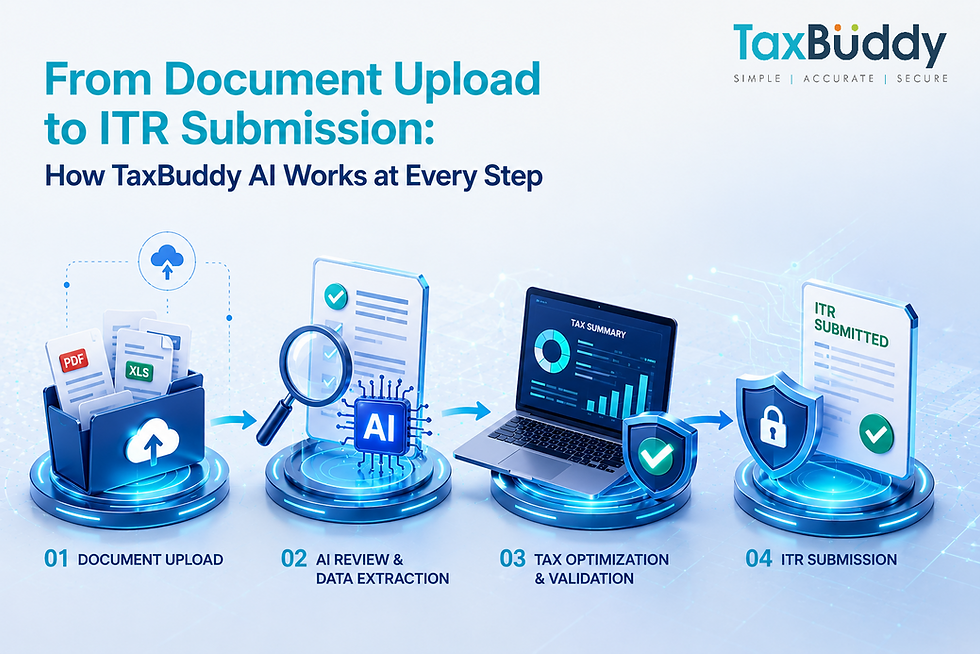
Platforms such as TaxBuddy further reduce deadline-driven mistakes by combining automation with structured workflows. Built-in checks, reminders, and review layers ensure that filing is not treated as a one-day task but as a managed process spread over time. This approach helps taxpayers complete accurate filings well before deadlines, even in cases involving multiple income streams or complex disclosures.
Overall, technology platforms shift tax filing from a reactive, last-minute activity to a proactive and controlled process. By automating data capture, validating entries in real time, and guiding users step by step, they significantly reduce the chances of defective returns, revisions, refund delays, and compliance notices.
Conclusion
Last-minute tax saving often creates compliance challenges instead of delivering benefits. Rushed decisions increase the risk of defective returns, revisions, refund delays, and notices. Early planning, accurate reconciliation, and the use of reliable digital platforms help avoid these outcomes and ensure smooth tax filing. For anyone looking for assistance in tax filing, it is highly recommended to download the TaxBuddy mobile app for a simplified, secure, and hassle-free experience.
FAQs
Q. Why does last-minute tax saving increase the risk of filing errors?
Last-minute tax saving compresses multiple decisions into a short time frame. Investments are made hurriedly, income reconciliation is skipped, and deduction proofs are not cross-verified with Form 16, Form 26AS, or AIS. This increases the likelihood of incorrect claims, missed income disclosures, and data mismatches, all of which lead to filing errors.
Q. What types of mistakes are most common during last-minute tax filing?
Common mistakes include incorrect deduction amounts under Section 80C or 80D, omission of bank interest or dividend income, wrong bank account details, selection of an incorrect ITR form, and mismatch between reported income and TDS data. These errors often surface only after filing, triggering notices or revisions.
Q. How does last-minute tax saving result in defective returns under Section 139(9)?
A defective return is triggered when mandatory information is missing or inconsistent. Last-minute filing often leads to incomplete schedules, missing audit reports, incorrect income classification, or invalid bank details. When such deficiencies are detected, the Income Tax Department issues a Section 139(9) notice asking for correction within a limited period.
Q. What happens if a defective return notice is ignored or not corrected on time?
If a defective return is not corrected within the prescribed time, the return is treated as invalid, meaning it is considered as not filed at all. This can result in loss of deductions, inability to carry forward losses, delayed or denied refunds, and exposure to penalties and interest.
Q. Why do taxpayers often need to file revised returns after last-minute tax saving?
Revised returns become necessary when errors or omissions are discovered after filing. Last-minute tax saving increases the chance of missing income, overstating deductions, or using the wrong ITR form. Once these issues are identified, a revised return under Section 139(5) is required to correct the original filing.
Q. Is there a penalty for filing a revised return under Section 139(5)?
There is no direct penalty for filing a revised return within the permitted timeline. However, if the revision results in additional tax liability, the taxpayer must pay the extra tax along with applicable interest. Filing multiple revisions may also increase scrutiny risk.
Q. How do defective returns and revised returns differ in practical terms?
Defective returns arise due to non-compliance or missing information in the original filing and are flagged by the department. Revised returns are voluntary corrections made by the taxpayer after identifying mistakes. While defective returns carry the risk of invalidation, revised returns mainly involve interest or additional tax payment.
Q. Can last-minute tax saving affect income tax refunds?
Yes, last-minute errors frequently delay refunds. Incorrect bank details, unvalidated accounts, TDS mismatches, or pending defective notices can stall refund processing until issues are resolved, sometimes extending delays by several months.
Q. How does AIS tracking increase the impact of last-minute filing errors?
AIS captures detailed financial data including interest income, dividends, digital transactions, and investments. When last-minute filers fail to reconcile this data with their return, mismatches are easily detected by the system, increasing the likelihood of notices, defective returns, or revision requirements.
Q. How does early tax planning reduce the risk of defective or revised returns?
Early tax planning allows sufficient time for income reconciliation, deduction verification, correct ITR selection, and document validation. It shifts tax saving from a reactive task to a structured process, significantly reducing the chances of errors, notices, and post-filing corrections.
Q. Can technology platforms help avoid last-minute tax filing mistakes?
Yes, technology platforms that auto-fetch AIS and Form 26AS data, validate deductions, and flag inconsistencies before submission help prevent last-minute errors. These systems reduce manual mistakes and provide clarity well before deadlines.
Q. Why is last-minute tax saving considered a compliance risk rather than a benefit?
While last-minute tax saving may appear convenient, it often compromises accuracy and compliance. The resulting defective returns, revisions, refund delays, and notices create additional effort and financial exposure, making it a high-risk approach compared to planned and timely tax filing.




Comments