

Why Many Businesses Outsource TDS Return Filing After First-Year Compliance Issues

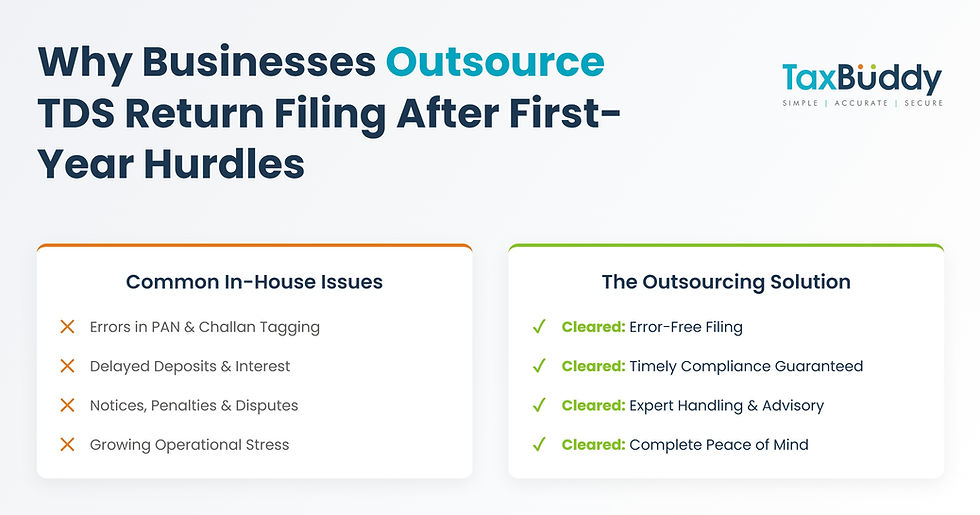
TDS return filing often looks manageable in the first year, but real issues surface once transactions increase, deductors multiply, and quarterly compliance begins to overlap. Errors in PAN mapping, challan tagging, delayed deposits, and incorrect reporting under multiple TDS sections quickly trigger notices, penalties, and vendor disputes. These early compliance gaps create long-term operational stress for growing businesses. As scrutiny tightens and digital reconciliation becomes non-negotiable, many businesses reassess whether in-house handling is sustainable. This shift explains why outsourcing TDS return filing becomes a strategic decision rather than a cost-driven one after first-year compliance challenges.
Table of Contents
Common TDS Return Filing Errors Seen After Initial Compliance
Why In-House TDS Filing Becomes Unsustainable as Businesses Grow
Role of Technology and Automation in Outsourced TDS Management
Why MSMEs and Growing Companies Prefer End-to-End TDS Solutions
When Businesses Should Shift From In-House to Outsourced TDS Filing
Why First-Year TDS Compliance Fails for Many Businesses
In the first year, TDS compliance is usually handled with limited exposure to real-world complexity. Businesses often deal with fewer vendors, fewer deductees, and lower transaction volumes, which creates a false sense of control. As operations expand, multiple TDS sections start applying simultaneously, quarterly timelines overlap, and reconciliation becomes unavoidable. Most businesses underestimate how closely TDS is linked with return filing, vendor documentation, and system-level validations. The absence of structured processes in the first year leads to gaps that surface only when the Income Tax Department’s systems begin cross-verifying data.
Common TDS Return Filing Errors Seen After Initial Compliance
After initial compliance, errors typically arise from incorrect PAN details, wrong challan mapping, short deductions, or missed deductions altogether. Many businesses also struggle with incorrect section selection under the Income Tax Act, especially when vendor nature or payment type changes. Delays in depositing TDS or filing quarterly returns further compound these issues. Once statements are processed, even small mistakes reflect in Form 26AS and trigger correction filings, notices, or vendor disputes.
Cost of TDS Non-Compliance Beyond Monetary Penalties
While late fees and interest are the most visible consequences of TDS non-compliance, the real impact on a business is far deeper and more disruptive. These indirect costs often build silently over time and end up causing far more damage than the financial penalties imposed by the tax department.
One of the earliest effects is the breakdown of trust with vendors and service providers. When TDS returns are delayed, filed incorrectly, or not reconciled properly, vendors do not see the expected TDS credit in their Form 26AS or AIS. This creates immediate friction, as vendors follow up repeatedly for corrections, revised filings, or challan details. In many cases, payments get delayed, relationships get strained, and negotiations become difficult, especially with long-term or high-value vendors who rely on timely TDS credit for their own tax compliance.
Employees are another group directly affected by TDS lapses. Errors in salary TDS calculations or delays in filing returns can lead to incorrect or incomplete Form 16. When employees attempt to file their income tax returns and discover mismatches, the burden often comes back to the employer. HR and finance teams then have to deal with escalations, clarification requests, and pressure to issue revised Form 16s. This not only affects employee confidence in payroll systems but also damages the organisation’s internal credibility.
From an operational standpoint, TDS non-compliance consumes an enormous amount of internal time and resources. Finance teams end up spending hours responding to notices, tracking old challans, coordinating with deductees, filing correction statements, and following up on defaults raised in the TRACES portal. What should have been a routine monthly compliance turns into a reactive exercise, pulling attention away from core financial planning, reporting, and business growth activities.
Repeated lapses in TDS compliance also have long-term consequences on a business’s compliance profile. The income tax department tracks historical behaviour, and frequent defaults, mismatches, or corrections increase the likelihood of closer scrutiny. This can translate into more frequent notices under sections like 139(9) or 143(1), higher chances of scrutiny selection, and stricter evaluation during assessments. Once a business is seen as non-compliant, even minor errors tend to attract disproportionate attention.
There is also a cascading effect on year-end income tax return filing. Incorrect or unreconciled TDS data directly impacts the accuracy of the final return. Businesses may end up paying additional tax upfront to avoid disputes, only to chase refunds later. In some cases, legitimate expenses get questioned simply because the underlying TDS trail is weak or inconsistent.
Over time, these indirect costs add up significantly. Lost productivity, damaged stakeholder relationships, repeated compliance work, and heightened scrutiny collectively outweigh the actual monetary penalties of interest and late fees. TDS non-compliance, therefore, is not just a technical lapse—it becomes a systemic risk that affects financial efficiency, operational stability, and long-term compliance confidence.
Why In-House TDS Filing Becomes Unsustainable as Businesses Grow
As businesses grow, the nature of TDS compliance changes completely. What starts as a manageable, periodic task slowly turns into a continuous, high-risk process that demands daily attention and specialised knowledge.
With higher transaction volumes, TDS is no longer limited to monthly challans or quarterly returns. Every payment—vendor fees, professional charges, rent, commissions, interest, or contractor payouts—needs real-time applicability checks, correct section mapping, accurate rate application, and timely deduction. Missing even a single transaction can lead to short deduction, interest liability, or future mismatches in Form 26AS and AIS.
In-house teams usually struggle to keep up with frequent regulatory updates. TDS rates, threshold limits, section interpretations, and reporting formats change regularly through circulars, notifications, and budget amendments. Without a dedicated compliance expert tracking these changes, businesses risk applying outdated rules, which later surface as notices or defaults during processing.
Data reconciliation becomes another major pressure point as scale increases. Payments flow through multiple systems—bank statements, ERP, accounting software, payroll tools, and vendor portals. Aligning these datasets with TDS registers, challans, and returns requires strong process discipline. In manual or semi-automated setups, this reconciliation is time-consuming and error-prone, especially when corrections or revisions are required.
Correction cycles further expose the limits of in-house handling. Errors in PAN, section codes, challan tagging, or amount mapping trigger the need for correction statements. Each correction has dependencies, approval stages, and follow-ups, often spanning weeks. Internal teams juggling multiple responsibilities find it difficult to close these loops efficiently, leading to pending defaults and unresolved credits for deductees.
Staff dependency and turnover add another layer of risk. TDS knowledge often sits with one or two individuals rather than being system-driven. When key staff leave, go on leave, or shift roles, continuity breaks. New team members require time to understand past filings, legacy errors, and department expectations, increasing the chances of repeated mistakes.
Manual workflows also do not scale well. Spreadsheet-based tracking, manual challan uploads, offline validations, and ad-hoc checks may work at low volumes, but they collapse under scale. As the number of deductees and transactions rises, manual processes increase compliance fatigue and reduce visibility into real-time status.
Over time, what initially looked like a cost-effective in-house approach starts consuming disproportionate management bandwidth. Finance teams spend more time firefighting notices, chasing corrections, and answering vendor queries about missing TDS credits instead of focusing on cash flow planning, forecasting, and business growth.
At scale, TDS compliance is no longer just a filing task—it becomes a continuous risk-management function. Without automation, centralized data control, and dedicated expertise, in-house TDS filing becomes unsustainable and exposes growing businesses to operational stress, financial leakage, and regulatory exposure.
How Outsourcing TDS Return Filing Reduces Compliance Risk
Outsourcing introduces structured processes, expert oversight, and accountability into TDS compliance. Professionals ensure accurate deductions, timely deposits, and correct reporting across all quarters. Regular reconciliations with TRACES, Form 26AS, and internal records significantly reduce error rates. This proactive approach helps businesses stay compliant throughout the year rather than reacting to issues after notices are issued.
Role of Technology and Automation in Outsourced TDS Management
Modern outsourced TDS solutions rely heavily on automation to eliminate manual errors. Automated validations flag PAN mismatches, incorrect challans, and short deductions before returns are filed. System-driven reminders ensure deadlines are not missed, while dashboards provide real-time visibility into compliance status. Technology transforms TDS from a reactive task into a controlled, predictable process.
How Accurate TDS Filing Impacts Vendor Trust and Cash Flow
Accurate and timely TDS reporting directly affects vendor confidence. When credits reflect correctly in Form 26AS, vendors can file their returns smoothly without follow-ups or disputes. This improves business relationships and prevents payment hold-ups caused by reconciliation issues. Consistent accuracy also positions the business as a reliable counterparty in long-term vendor arrangements.
TDS Compliance and Its Link With Bank Reviews and Funding
Banks and financial institutions increasingly review tax compliance records during loan assessments and account reviews. Irregular TDS filings, frequent corrections, or outstanding defaults raise red flags during due diligence. Clean and consistent TDS compliance strengthens financial credibility and supports smoother funding, credit renewals, and account-related approvals.
Why MSMEs and Growing Companies Prefer End-to-End TDS Solutions
MSMEs often operate with lean teams and limited compliance bandwidth. End-to-end TDS solutions combine deduction review, filing, reconciliation, correction handling, and reporting into a single workflow. This reduces dependency on multiple advisors and internal follow-ups. For growing businesses, such solutions offer scalability without increasing internal complexity.
How Platforms Like TaxBuddy Simplify Ongoing TDS Compliance
Platforms like TaxBuddy integrate technology with expert review to simplify TDS compliance throughout the year. Automated validations, structured workflows, and timely review reduce filing errors and follow-ups. Businesses benefit from a centralized system that connects TDS compliance with overall tax filing, improving consistency and visibility.
When Businesses Should Shift From In-House to Outsourced TDS Filing
The right time to outsource is when TDS filings start requiring frequent corrections, deadlines are narrowly met, or internal teams spend more time fixing errors than managing compliance. Growth in vendor count, salary restructuring, or increased scrutiny are also strong indicators. Early transition helps prevent compounding compliance risks and restores operational focus.
Conclusion
TDS compliance challenges after the first year highlight how interconnected tax reporting, vendor management, and regulatory systems truly are. Outsourcing TDS return filing allows businesses to reduce risk, improve accuracy, and maintain credibility as operations scale. For businesses seeking structured and reliable tax compliance support, downloading the TaxBuddy mobile app offers a simplified, secure, and hassle-free way to manage ongoing tax obligations.
FAQs
Q1. Why do TDS compliance problems usually start after the first year?
In the first year, transaction volume is limited, and compliance appears manageable. As businesses grow, multiple vendors, employees, and payment types come into play, triggering different TDS sections and quarterly overlaps. Errors surface when reconciliations with TRACES, Form 26AS, and AIS begin, exposing gaps in early processes.
Q2. What are the most common TDS mistakes businesses make after initial compliance?
Frequent issues include incorrect PAN details, wrong challan mapping, short deduction, missed deductions, and incorrect section selection. Delays in depositing TDS and filing quarterly returns also lead to late fees, interest, and correction filings.
Q3. Are TDS penalties limited only to late fees and interest?
No. While late fees under Section 234E and interest are common, non-compliance also results in notices, correction cycles, loss of deductee trust, and increased scrutiny risk. These indirect costs often impact operations more than the penalties themselves.
Q4. How does incorrect TDS filing affect vendors and employees?
Incorrect filings delay credit reflection in Form 26AS, making it difficult for vendors and employees to file their own returns. This leads to disputes, repeated follow-ups, and strained professional relationships.
Q5. Why does in-house TDS filing become difficult as businesses scale?
Growing businesses require continuous tracking of deadlines, rule changes, and reconciliations. In-house teams often lack dedicated expertise and depend on manual processes, increasing error risk and consuming significant operational time.
Q6. How does outsourcing TDS return filing reduce compliance risk?
Outsourcing brings expert oversight, structured workflows, and regular reconciliations. Professionals ensure accurate deductions, timely filings, and quick corrections, reducing exposure to notices and penalties throughout the year.
Q7. What role does automation play in outsourced TDS management?
Automation validates PANs, challans, and deduction details before filing. It also tracks deadlines, flags discrepancies early, and reduces dependency on manual checks, significantly lowering error rates.
Q8. Can poor TDS compliance impact bank loans or funding approvals?
Yes. Banks and financial institutions review tax compliance records during due diligence. Frequent TDS defaults or corrections can raise red flags and delay or affect loan approvals and credit renewals.
Q9. Is outsourcing TDS useful only for large companies?
No. MSMEs and growing businesses benefit the most because outsourcing eliminates the need for specialised internal teams while ensuring compliance accuracy and scalability.
Q10. When should a business shift from in-house to outsourced TDS filing?
A shift is advisable when filings require frequent corrections, deadlines are narrowly met, vendor disputes increase, or internal teams spend excessive time on compliance instead of core operations.
Q11. Should TDS compliance be reviewed separately from income tax return filing?
TDS should always be reviewed alongside income tax returns. Mismatches between TDS data and income reporting often trigger notices, making integrated review essential.
Q12. How do platforms like TaxBuddy support ongoing TDS compliance?
Platforms like TaxBuddy combine automation with expert review to manage deductions, filings, reconciliations, and corrections in one system. This ensures consistency, visibility, and reduced compliance stress across the year.


