

Why the Default New Tax Regime Doesn’t Work for Many Salaried Employees
Updated: Feb 6
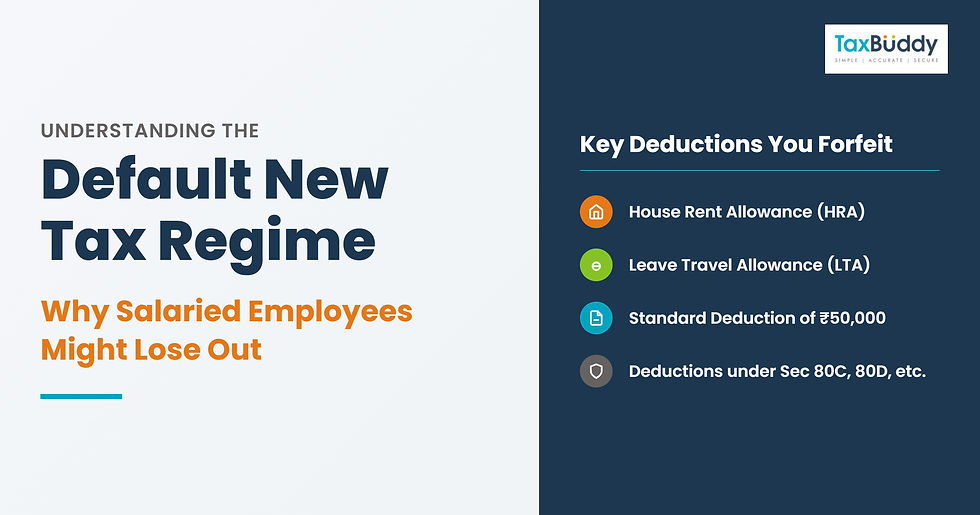
The new tax regime under Section 115BAC has been the default option for salaried employees since FY 2023–24. While it offers lower slab rates and a nearly tax-free income up to ₹12 lakh after rebate from FY 2025-2026, it removes most commonly used deductions. For salaried individuals with home loans, insurance, or long-term investments, the tax saved through deductions under the old regime often exceeds the benefit of lower slabs. As a result, many employees unknowingly pay higher tax despite the new regime appearing simpler and more attractive on paper.
Table of Contents
What Changed When the New Tax Regime Became the Default
From FY 2023–24, the new tax regime under Section 115BAC became the default option for salaried employees. Employers now deduct TDS assuming the new regime unless an employee explicitly opts for the old regime at the start of the year. This shift was intended to simplify tax compliance by offering lower slab rates and fewer exemptions. However, the default nature of the regime has led many employees to remain in it unintentionally, without evaluating whether it actually reduces their tax liability. The biggest change lies not in tax rates, but in the silent removal of long-standing deductions that salaried employees traditionally rely on.
How the New Tax Regime Calculates Tax for Salaried Employees
The new tax regime applies revised slab rates on gross taxable income after allowing only limited deductions. A standard deduction is permitted, and certain employer-linked benefits are allowed, but most personal and investment-related deductions are excluded. Tax is calculated purely on income slabs, without considering expenses such as rent, insurance premiums, loan repayments, or savings instruments. While this method benefits employees with minimal deductions, it often results in a higher tax outgo for those with structured financial commitments.
Which Deductions Are Not Allowed in the New Tax Regime
The new tax regime removes the most popular deductions that salaried employees routinely claim. These include Section 80C investments such as PF, PPF, ELSS, life insurance premiums, tuition fees, Section 80D medical insurance premiums, HRA exemption, LTA, and home loan interest on self-occupied property. The absence of these deductions significantly increases taxable income, especially for families managing housing, healthcare, and long-term savings simultaneously.
Is HRA Exemption Allowed in the New Tax Regime?
House Rent Allowance exemption is not available under the new tax regime. Even if rent is paid and HRA is reflected in the salary structure, the exemption cannot be claimed once the new regime is chosen. This directly impacts employees living in rented accommodation, particularly in metro cities where rent forms a large portion of monthly expenses.
How HRA Works in the Old Tax Regime
Under the old tax regime, the HRA exemption reduces taxable income based on actual rent paid, salary structure, and city of residence. For many salaried individuals, HRA alone can reduce taxable income by several lakhs annually. This benefit makes the old regime significantly more tax-efficient for employees living in rented homes, especially when combined with other deductions.
Is Home Loan Interest Allowed in the New Tax Regime?
Interest on home loans for self-occupied property under Section 24(b) is not allowed in the new tax regime. This means borrowers servicing housing loans cannot reduce their taxable income using interest payments, regardless of loan size or tenure. Only limited set-off rules apply for let-out property, making the benefit largely ineffective for typical salaried homeowners.
How Home Loan Deductions Work in the Old Tax Regime
The old tax regime allows deduction of home loan interest up to ₹2 lakh per year for self-occupied property, along with principal repayment under Section 80C. For salaried employees purchasing homes in early or mid-career stages, this deduction forms a critical component of tax planning and significantly lowers annual tax liability.
Is Section 80C Allowed in the New Tax Regime?
Section 80C deductions are not permitted under the new tax regime. Contributions to the provident fund, PPF, ELSS, insurance premiums, and tuition fees do not offer any tax relief once the new regime is selected. This discourages disciplined long-term savings and removes incentives that traditionally supported financial planning among salaried individuals.
How Section 80C Benefits Salaried Employees Under the Old Regime
Under the old regime, Section 80C allows deductions up to ₹1.5 lakh annually. Most salaried employees already invest through mandatory PF contributions, insurance, or child education expenses, making the deduction easy to utilise without additional effort. When combined with other deductions, Section 80C plays a major role in reducing effective tax rates.
Impact of Losing Section 80D and Medical Insurance Deductions
Medical insurance premiums under Section 80D are not allowed in the new tax regime. This impacts families covering parents, senior citizens, or dependent children. Healthcare expenses tend to rise with age, and removing this deduction increases tax liability precisely when financial protection is most needed.
Why Standard Deduction and NPS Benefits Are Not Enough
Although the standard deduction has been increased and employer contribution to NPS is allowed under the new regime, these benefits are limited in scope. For many salaried households, total deductions under the old regime often exceed ₹3–5 lakh annually. The marginal benefit offered under the new regime does not compensate for the cumulative loss of multiple deductions.
New Tax Regime vs Old Tax Regime for Middle-Income Salaried Employees
Middle-income salaried employees typically have housing loans, insurance cover, dependent family members, and systematic investments. For this group, the old tax regime often results in lower tax payable despite higher slab rates. The new regime tends to favour individuals with fewer financial commitments and minimal deductions, making it less suitable for traditional salaried households.
Break-Even Analysis: When Does the Old Tax Regime Become Better?
The old tax regime becomes more beneficial once total eligible deductions cross a certain threshold, often referred to as the break-even point. For higher income levels, the deduction requirement increases, but many salaried employees naturally meet this threshold through rent, loan interest, insurance, and retirement savings. Without calculating this break-even point, choosing the default regime can lead to unnecessary tax outflow.
Real-Life Salary Scenarios Where the New Tax Regime Fails
Employees earning between ₹12 lakh and ₹25 lakh with home loans, rented accommodation, or family insurance coverage often pay more tax under the new regime. Even though headline slab rates appear attractive, the removal of deductions shifts a larger portion of income into taxable brackets, reversing the expected benefit.
Effect of the New Tax Regime on Senior Citizens and Families
Senior citizens lose age-based basic exemption limits under the new regime. Families supporting elderly parents or dependent children also lose key deductions related to healthcare and education. The structure of the new regime does not account for family responsibilities, making it less equitable for households with dependents.
Can Salaried Employees Switch Back to the Old Tax Regime?
Salaried employees without business income can switch between the old and new tax regimes every financial year. Even if TDS is deducted under the new regime, the old regime can still be selected while filing the income tax return. This flexibility makes annual comparison essential before filing.
Common Mistakes Salaried Employees Make While Choosing the Default Regime
A common mistake is assuming lower slab rates automatically mean lower tax. Many employees also rely solely on payroll TDS without reviewing their final tax liability. Ignoring deductions already being incurred, such as rent or insurance, often leads to higher tax payments under the default regime.
How TaxBuddy Helps Compare Tax Regimes Before Filing
TaxBuddy enables salaried employees to compare tax liability under both regimes before filing. By capturing income details, deductions, and financial commitments, the platform helps identify the more beneficial option and ensures correct regime selection during return filing, even if TDS was deducted under the default regime.
Conclusion
The default new tax regime simplifies calculations but does not suit salaried employees with financial responsibilities and structured expenses. Evaluating both regimes before filing remains essential to avoid overpaying tax. For anyone looking for assistance in tax filing, it is advisable to download the TaxBuddy mobile app for a simplified, secure, and hassle-free experience.
FAQs
Q. Does TaxBuddy offer both self-filing and expert-assisted plans for ITR filing, or only expert-assisted options?
TaxBuddy offers both self-filing and expert-assisted ITR filing plans. The self-filing option is designed for individuals with straightforward income structures who want guided, step-by-step filing with automated checks. The expert-assisted option is suitable for salaried employees with multiple income components, regime comparisons, past-year corrections, or deduction-related complexities. This flexibility allows taxpayers to choose the level of support based on their financial situation rather than being restricted to a single filing model.
Q. Which is the best site to file ITR?
The best site to file an income tax return is one that ensures accuracy, correct tax regime selection, deduction validation, and compliance with current income tax rules. While the government portal allows direct filing, many salaried employees prefer platforms that provide automated calculations, error checks, and regime comparisons. Platforms like TaxBuddy help reduce filing mistakes by validating income details, deductions, and tax slabs before submission.
Q. Where to file an income tax return?
Income tax returns can be filed online either directly on the income tax department’s official portal or through authorised e-filing platforms. Authorised platforms offer additional assistance such as guided filing, tax regime comparison, deduction checks, and post-filing support. Choosing the right platform depends on the complexity of income and the level of guidance required during filing.
Q. Can salaried employees change the tax regime every year?
Yes, salaried employees who do not have business or professional income can switch between the old and new tax regimes every financial year. The regime choice is made at the time of filing the income tax return, regardless of which regime the employer used for TDS deduction. This annual flexibility makes it important to compare both regimes before filing rather than relying on the default option.
Q. Is Form 10-IEA required for salaried employees?
Form 10-IEA is required only for individuals who have business or professional income and wish to opt out of the new tax regime. Salaried employees without business income are not required to file Form 10-IEA. They can simply select the preferred tax regime while filing their income tax return.
Q. What happens if the employer deducted TDS under the wrong regime?
If the employer deducted TDS assuming the new tax regime but the old tax regime is more beneficial, the correct regime can still be selected while filing the return. Any excess tax deducted through TDS will be reflected as a refund in the final computation. This makes it essential to evaluate tax liability independently at the time of filing rather than relying only on payroll deductions.
Q. Is standard deduction available under both regimes?
Yes, the standard deduction is available under both the old and new tax regimes. However, the availability of standard deduction alone does not determine which regime is more beneficial. Other deductions such as HRA, Section 80C, Section 80D, and home loan interest play a much larger role in reducing taxable income under the old regime.
Q. Does the new tax regime suit first-time earners?
The new tax regime may suit first-time earners or early-career employees who have lower income levels and minimal deductions. Individuals who do not pay rent, do not have insurance coverage, or have not started long-term investments may find the lower slab rates beneficial. As income and financial responsibilities grow, the suitability of the new regime often reduces.
Q. Are senior citizens better off under the old tax regime?
In many cases, senior citizens are better off under the old tax regime. The old regime provides higher basic exemption limits for senior and super senior citizens and allows medical insurance deductions under Section 80D. These benefits are not available under the new regime, making the old regime more tax-efficient for retirees and elderly taxpayers.
Q. Can deductions be claimed later if the new regime was selected initially?
No, once the new tax regime is selected for a particular financial year, deductions that are not permitted under that regime cannot be claimed later for the same year. This applies even if supporting documents exist. The regime choice is final for that assessment year, which makes advance comparison and planning critical before filing.
Q. Is tax planning still relevant under the new regime?
Tax planning remains relevant under the new regime, but the available options are limited. Since most deductions and exemptions are removed, planning mainly revolves around salary structuring, employer contributions, and long-term financial decisions rather than tax-saving investments. Under the old regime, tax planning continues to play a much larger role due to the wider range of deductions.
Q. How does TaxBuddy help avoid regime-related filing errors?
TaxBuddy helps avoid regime-related filing errors by automatically comparing tax liability under both regimes based on actual income and deductions. The platform highlights the more beneficial option, validates deduction eligibility, and ensures the selected regime is applied correctly before submission. This reduces the risk of overpaying tax or missing eligible refunds due to incorrect regime selection.


