

How AIS Mismatches Are Creating Filing Problems for Investors
- Adv. Siddharth Sachan

- May 27
- 14 min read

Most investors expect the hardest part of tax filing to be understanding capital gains treatment or choosing between tax regimes. What they rarely anticipate is opening their Annual Information Statement and finding figures that do not match what they know their financial year to have looked like.
An AIS mismatch is not a minor inconvenience. It is a direct conflict between what the Income Tax Department has recorded about a taxpayer's financial activity and what the taxpayer believes that activity to be. For investors with multiple income streams, dividend receipts, mutual fund transactions, and interest income spread across several institutions, these conflicts can be numerous, confusing, and genuinely difficult to resolve within the filing window.
The problem is not that the AIS system is poorly conceived. The intent is sound. A consolidated view of financial activity, pre-populated and available to the taxpayer before filing, reduces dependence on scattered documents and creates a more complete compliance picture. The problem lies in the gap between how financial transactions are reported to the tax department and how investors actually understand and experience those transactions. That gap, when left unaddressed, turns a convenience tool into a source of filing anxiety.
Table of Contents
What the AIS Was Designed to Do and Where It Falls Short
The Annual Information Statement was introduced as an evolution of Form 26AS, designed to give taxpayers a far more comprehensive view of their financial footprint as seen by the tax department. Where Form 26AS was primarily focused on TDS and TCS credits, AIS extends to dividend income, interest income, mutual fund transactions, securities transactions, foreign remittances, and several other categories of financial activity.
The design logic is sensible. If the tax department already receives this information from banks, brokerages, mutual fund registrars, and other reporting entities, making it visible to the taxpayer before filing should create a more transparent and accurate compliance process. Taxpayers can verify what has been reported, identify omissions, and file with greater confidence.
In practice, the experience is considerably messier. The AIS aggregates data from multiple reporting sources, each of which operates on its own reporting timeline, uses its own transaction classification conventions, and submits data at different levels of granularity. When these varied data streams are consolidated into a single statement, inconsistencies emerge, not because any one source is necessarily wrong, but because the same underlying financial activity is being described from different vantage points simultaneously.
For a salaried individual with a straightforward income profile, AIS discrepancies are often minor and manageable. For an investor with actively managed portfolios, multiple mutual fund folios, dividend-yielding stocks, recurring deposits across banks, and perhaps some unlisted security transactions, the AIS can surface figures that require substantial cross-referencing before the investor can confidently proceed with filing.
Why Investor Financial Activity Is Particularly Prone to Reporting Gaps
The nature of investor financial activity makes AIS accuracy genuinely difficult to achieve. This is not a technology failure as much as a structural challenge created by the way investment transactions flow through reporting chains before reaching the tax department.
Consider how a mutual fund redemption is reported. The registrar and transfer agent submits transaction data to the tax department, but the timeline of that submission, the classification of the transaction, and the treatment of units purchased across different NAV dates can create entries in the AIS that look different from what the investor sees in their own consolidated account statement. When an investor redeems units from a scheme where they have made multiple SIP investments over several years, the capital gains calculation involves cost averaging logic that may not be reflected with precision in how the transaction appears in the AIS.
Dividend income presents a different challenge. Companies and mutual funds report dividend distributions to the tax department, but the investor receives dividends through their bank account or broker, often without a clear link between the reported figure and the individual receipt. When dividends from multiple holdings across different quarters are aggregated in the AIS, matching them to individual bank credits requires careful reconciliation that many investors find difficult to complete accurately.
Interest income from savings accounts, fixed deposits, and recurring deposits is similarly fragmented. Banks report interest income to the tax department, but accrual versus credit timing differences, partially withdrawn deposits, and interest on jointly held accounts can all create figures in the AIS that an investor cannot immediately reconcile with their own bank records.
Each of these scenarios is individually explainable. But for an investor managing a diversified portfolio, encountering several such discrepancies simultaneously during the filing window creates a genuine compliance challenge.
The Most Common AIS Mismatches Investors Encounter
While every investor's situation is different, certain categories of AIS mismatches appear consistently enough to be worth understanding before filing season begins.
Duplicate transaction reporting is one of the most frequently encountered issues. In some cases, the same transaction is reported by two different entities, such as both a broker and a depository, resulting in the same gain or income appearing twice in the AIS. An investor who does not catch this and files accordingly may overstate their income, leading to an inflated tax liability or a refund that the department later disputes.
Gross versus net reporting differences create another category of mismatch. Dividend income is sometimes reported at the gross distribution amount, while the investor has actually received a net amount after applicable withholding. The investor, comparing their AIS figure to bank credits, sees a number that does not match what they received and cannot immediately determine whether the AIS is wrong or their own records are incomplete.
Securities transaction values are sometimes recorded at a level of aggregation that makes individual trade-level reconciliation difficult. An investor who has executed multiple buy and sell transactions within a financial year may find that the AIS records these differently from what their broker's contract note or portfolio statement shows, particularly when the broker's platform uses a different settlement cycle reference for reporting purposes.
Unlisted share transactions and pre-IPO investments represent a category where AIS data is often sparse or absent entirely, not because the income is exempt but because reporting by private companies and intermediaries in this space is inconsistently applied. Investors in these instruments often find that their AIS does not reflect holdings or transactions that are genuinely taxable, creating a compliance gap they must address manually.
How Mismatches Create Downstream Filing Risk
An AIS mismatch does not stay contained within the AIS review step. Its consequences extend into the filing itself and can create compliance risk that surfaces well after the original return is submitted.
When an investor files income that differs materially from what the AIS reflects, the return is flagged for scrutiny. The investor then has to respond to a notice explaining the discrepancy, providing supporting documentation, and demonstrating that their filed figures are accurate. This process is time-consuming, stressful, and entirely avoidable if the reconciliation had been completed correctly at the time of filing.
Equally problematic is the opposite situation, where an investor takes the AIS figures at face value and files based on them without verifying accuracy. If the AIS has overstated income due to duplicate reporting, the investor ends up paying tax on income they did not receive. If it has understated income due to a missing transaction, the investor may file an incomplete return and face a demand notice later.
Neither outcome is acceptable, and both stem from the same underlying problem: investors are being asked to navigate a data reconciliation exercise without adequate tools to complete it accurately within the time available during the filing window. The AIS is designed to simplify compliance, but without a connected workflow that helps investors match AIS data to their own records, it adds a layer of complexity that many are not equipped to handle alone.
Why Reconciliation Becomes the Investor's Burden
The reconciliation challenge is significant because the investor sits at the intersection of multiple reporting systems that were not designed to speak to each other from the taxpayer's perspective.
Their broker has transaction records. Their mutual fund registrar has folio-level transaction statements. Their bank has credit records for dividends and interest. The tax department has aggregated reports submitted by each of these entities independently. The investor is expected to bring all of these together, identify where they diverge, determine which source is accurate, and file accordingly.
This is a meaningful operational task under any circumstances. During the filing window, when most investors are also managing work obligations and the general pressure of a deadline, it becomes significantly harder. Many investors resort to one of two equally problematic responses: they file based on AIS figures without verifying them, or they file based on their own records without addressing AIS discrepancies, and hope the gap does not attract notice scrutiny.
Neither response is sound compliance practice. But both are predictable outcomes of a system that generates the data investors need for reconciliation across five different platforms and expects them to consolidate it manually in a compressed timeframe.
The Behavioural Impact on Filing Confidence and Timeliness
AIS mismatches have a measurable effect on how investors approach the filing process, and not just in the year they first encounter the problem.
An investor who opens their AIS and immediately finds figures they cannot reconcile develops a fundamental uncertainty about what their correct tax liability is. They are no longer filing from a position of confidence. They are filing defensively, trying to navigate conflicting data while managing the risk of getting it wrong in either direction.
This uncertainty has two common behavioural consequences. The first is delay. Investors who are unsure about their AIS figures tend to push filing closer to or beyond the deadline, hoping the situation will become clearer with more time. Often it does not, and the delay itself creates additional risk in the form of late filing penalties and interest on outstanding liability.
The second is disengagement. Some investors, particularly those who have encountered notice scrutiny in the past due to AIS-related discrepancies, become reluctant to manage their own filing at all. They either outsource the entire process under time pressure to whoever is available, which increases cost and reduces accuracy, or they file incomplete returns and deal with the consequences later.
Both outcomes reflect a failure of the compliance experience rather than a failure of the investor. When the information environment around filing is difficult to navigate, the filing behaviour that results will reflect that difficulty.
How Integrated Tax Filing Changes the Reconciliation Experience
The core problem with AIS mismatches is not that they exist. Some level of discrepancy between a taxpayer's records and a consolidated government statement is structurally unavoidable given how reporting chains work. The problem is that investors currently have no integrated environment in which to identify, understand, and resolve these discrepancies before they affect the filed return.
Integrated tax filing addresses this by bringing the AIS review step inside the filing journey rather than leaving it as a separate, disconnected exercise the investor must complete on their own before approaching the filing process.
When AIS data is surfaced within a guided filing workflow, the investor can see exactly where their reported figures differ from what they have entered, understand the nature of the discrepancy, and make an informed decision about how to proceed. They can flag entries for feedback directly through the filing platform rather than navigating back to the government portal separately. They can see which discrepancies are likely reporting timing differences that will resolve, and which require active correction before the return can be filed accurately.
This is meaningfully different from simply telling an investor to check their AIS before filing. It means the reconciliation step is built into the filing experience, guided by logic that helps the investor interpret what they are seeing rather than requiring them to interpret it independently. Platforms offering integrated tax filing, whether through their own compliance infrastructure or through white-label solutions that embed this capability, are able to deliver this experience without the investor needing to understand the underlying complexity.
What AIS Auto Import Actually Solves for Investors
AIS auto import, when implemented within a filing workflow, changes the nature of the reconciliation task in a practical way. Instead of the investor manually transcribing figures from the AIS into a filing form and separately comparing them against their own records, the import brings AIS data directly into the filing environment where it can be reviewed, compared, and actioned in one place.
For investors with straightforward AIS data, this eliminates a significant portion of the manual work involved in filing. Income figures, TDS credits, and transaction summaries are already present in the form. The investor's role shifts from data entry to data verification, which is both faster and less error-prone.
For investors whose AIS contains discrepancies, auto import makes the discrepancy immediately visible within the filing interface rather than requiring the investor to hold two separate documents in mind and mentally reconcile them. The investor can see what the AIS says, what their own transaction records reflect, and where the two diverge, all within a single experience.
This is the practical value of AIS auto import as a feature within integrated tax filing: it does not eliminate AIS mismatches, but it substantially reduces the cognitive and operational burden of identifying and addressing them. The investor is no longer the integration layer between multiple data sources. The filing platform absorbs that integration function, and the investor is left with decisions rather than data-gathering tasks.
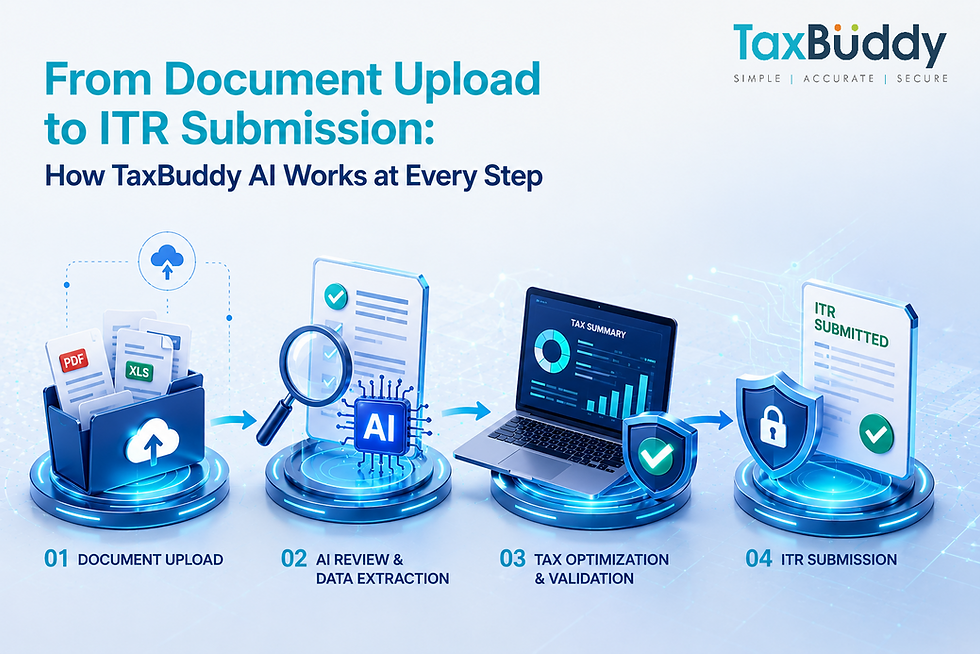
TaxBuddy's filing module includes AIS auto import as part of its guided filing workflow, which partner platforms can deploy under their own brand. The investor-facing experience remains within the platform they already use, while the reconciliation logic and compliance accuracy operate in the background.
The Broader Role of Connected Tax Workflows in Reducing Mismatch Stress
AIS reconciliation does not exist in isolation. It is one step in a broader filing journey that also involves capital gains calculation, deduction validation, regime comparison, and the final submission of the return. When these steps are fragmented across different tools and platforms, each transition between them introduces friction and increases the likelihood of error.
Connected tax workflows address this by treating the filing journey as a continuous process rather than a series of independent tasks. AIS review connects naturally into income reconciliation, which connects into deduction discovery, which feeds into the final tax computation and submission. At no point is the investor required to carry information manually from one environment to another or re-enter data that has already been captured earlier in the process.
For investment platforms and financial apps looking to embed this kind of experience for their users, the practical path is through white-label tax filing solutions that come with these workflows already built. The platform does not have to design the reconciliation logic, manage the AIS import mechanics, or handle the compliance accuracy requirements. These are handled by the underlying filing infrastructure. The platform's role is to surface the experience within its own product, under its own brand, in a way that feels native to the user rather than redirected.
Tax workflow APIs make this integration technically straightforward for platforms with existing digital infrastructure. The filing journey, including AIS import, guided reconciliation, deduction review, and return submission, can be embedded within a financial app or HRMS platform without requiring the partner to rebuild the compliance layer from scratch. What reaches the investor is a seamless, branded experience. What powers it is a compliance infrastructure designed specifically for accuracy and guided simplicity.
Conclusion
The AIS was introduced to make tax compliance more transparent and filing more accurate. For investors with straightforward financial profiles, it largely delivers on that intent. For those with diversified portfolios, multiple income streams, and transactions spread across several reporting entities, it has introduced a new category of complexity that the compliance ecosystem has not yet fully resolved.
The mismatch problem is not going away on its own. As more investor transactions become reportable events, as the range of instruments covered by AIS continues to expand, and as the tax department's ability to cross-reference filed returns with AIS data becomes more sophisticated, the cost of getting reconciliation wrong will only increase.
What needs to change is not the AIS itself, but the experience around it. Investors should not be expected to reconcile government-reported data with their own records using disconnected tools and manual effort during one of the most time-pressured periods of the financial year. Integrated tax filing, with AIS auto import and guided reconciliation built into the filing workflow, is the practical answer to that problem. It does not simplify what is genuinely complex. It makes sure the complexity is absorbed by the platform rather than handed entirely to the investor.
FAQs
Q1. What exactly is an AIS mismatch and why does it happen?
An AIS mismatch occurs when the financial figures in a taxpayer's Annual Information Statement differ from their own records. It happens because multiple entities, banks, brokers, mutual fund registrars, report the same or related transactions to the tax department independently, often with differences in timing, classification, or granularity that create apparent conflicts when aggregated.
Q2. Is an AIS mismatch always a sign that something is wrong?
Not necessarily. Many mismatches are the result of reporting timing differences, where a transaction falls in one financial year by one entity's accounting but appears differently in the AIS. Others reflect different levels of aggregation rather than factual errors. However, some mismatches do indicate genuine reporting errors that need to be addressed before filing.
Q3. What happens if an investor files without resolving AIS discrepancies?
If the filed return differs materially from the AIS, the return may be flagged for scrutiny. The investor would then need to respond to a notice and provide documentation supporting their filed figures. In cases where AIS overstates income and the investor files accordingly, they may pay more tax than necessary. If AIS understates income and the investor files a lower figure, they risk a demand notice later.
Q4. Which categories of investors are most affected by AIS mismatches?
Investors with multiple mutual fund folios, equity portfolios across more than one broker, dividend income from several holdings, fixed deposits across multiple banks, and any exposure to unlisted or pre-IPO securities tend to encounter AIS discrepancies most frequently. The more diverse the financial activity, the higher the likelihood that at least some reported figures will differ from the investor's own records.
Q5. How does AIS auto import help during the filing process?
AIS auto import brings the government's reported data directly into the filing interface, so the investor can compare it against their own transaction records within the same environment. It removes the need to manually transcribe figures from a separate portal and makes discrepancies immediately visible at the point where they need to be addressed, rather than requiring the investor to identify them independently before approaching the filing form.
Q6. Can an investor dispute figures in the AIS and how does that affect filing?
Yes. The AIS portal allows taxpayers to submit feedback flagging specific entries as incorrect, duplicate, or not relating to them. However, filing does not need to wait for that feedback to be resolved. Investors can file based on their actual correct figures and note the discrepancy, rather than adopting potentially incorrect AIS data simply because it is pre-populated.
Q7. Why do mutual fund capital gains figures in the AIS sometimes look different from the investor's own statement?
Mutual fund capital gains in the AIS are typically reported by the registrar at an aggregated level and may use FIFO or average cost conventions that differ from how the investor's own platform or broker calculates gains. Additionally, SIP investments made across different periods create a layered cost basis that may not be reflected with full granularity in the reported figures.
Q8. What is the difference between integrated tax filing and simply downloading the AIS and filing manually?
In manual filing, the investor downloads the AIS separately, compares it against their own records independently, decides how to handle discrepancies, and then enters figures into a filing form. In integrated tax filing, the AIS data is imported directly into the filing workflow, discrepancies are surfaced within the same guided interface, and the investor addresses them as part of a connected process rather than as a separate exercise completed before filing begins.
Q9. How do tax workflow APIs support this kind of integrated filing experience for platforms?
Tax workflow APIs allow financial platforms, investment apps, and HRMS systems to embed guided filing journeys within their own product environment without building the compliance infrastructure themselves. The AIS import, reconciliation logic, and filing workflow are handled by the underlying compliance engine. What the user sees is a native, branded experience within the platform they already use.
Q10. Should investors wait for AIS figures to be corrected before filing?
Not necessarily. AIS corrections submitted through the feedback mechanism can take time to reflect, and waiting for them to resolve may cause the investor to miss the filing deadline. The safer approach is to file based on accurate, verifiable figures from the investor's own records, note the AIS discrepancy in the relevant feedback channel, and retain supporting documentation in case it is needed later.
Q11. Does integrated tax filing eliminate the risk of notice scrutiny for investors?
It significantly reduces the risk by ensuring the investor files figures that are accurately reconciled with AIS data and well-supported by their own transaction records. However, no filing approach eliminates scrutiny risk entirely. What integrated filing does is ensure that when discrepancies exist, they are identified and addressed thoughtfully before submission rather than discovered after a notice has already been issued.
Q12. How does the AIS mismatch problem change as an investor's portfolio grows more complex?
It compounds. A larger, more diversified portfolio generates more reportable transactions across more institutions, each of which reports to the tax department through its own channel. The number of potential discrepancy points increases with portfolio complexity, making the reconciliation task proportionally more demanding. This is precisely why a guided, integrated filing approach becomes more valuable as an investor's financial life grows more sophisticated.




Comments