

Applying for Nil TDS Deduction on Passive Income

Updated: Apr 15
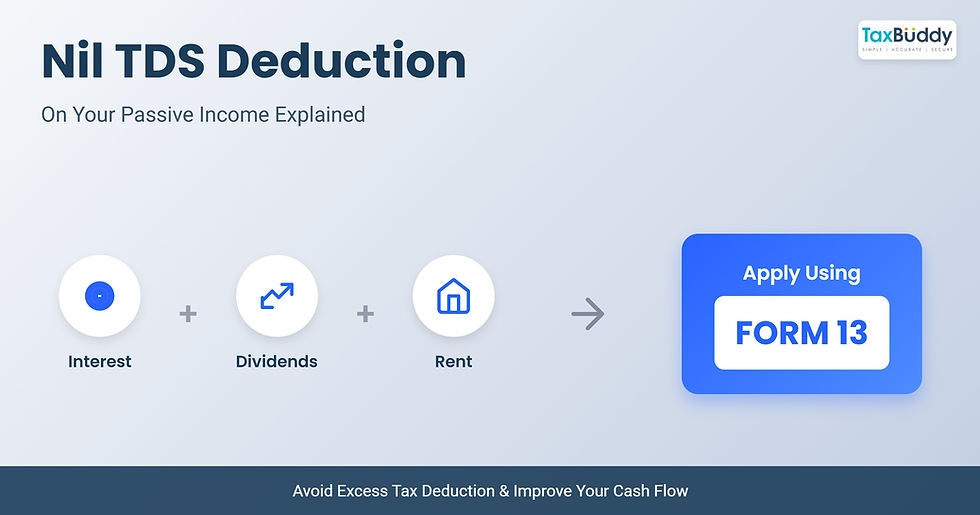
Applying for a nil TDS deduction certificate on passive income allows taxpayers to avoid unnecessary tax deduction when their actual tax liability is zero or very low. Under Section 197 of the Income-tax Act, 1961, Form 13 can be used to ensure that TDS on income such as interest, dividends, or rent is deducted at the correct rate instead of standard rates. Without this, banks and companies may deduct tax even when no tax is payable. Using this provision helps improve cash flow and reduces the need to claim refunds later.
Table of Contents
What is Nil TDS Deduction on Passive Income Under Section 197
Nil TDS deduction under Section 197 of the Income-tax Act, 1961, allows taxpayers to ensure that no tax is deducted at source when their actual tax liability for the financial year is zero. This provision is especially useful for passive income such as interest, dividends, and rent, where TDS is otherwise deducted at fixed rates. By obtaining a nil deduction certificate, taxpayers can avoid unnecessary tax deductions and receive their income in full without waiting for refunds.
What is Form 13 for Nil TDS on Passive Income
Form 13 is the application used to request a lower or nil TDS certificate under Section 197. It requires the taxpayer to submit income details, projected earnings, and supporting documents to demonstrate that the total tax liability is zero or lower than standard TDS rates. Once approved, the certificate instructs the payer to deduct tax at nil or reduced rates.
Types of Passive Income Eligible for Nil TDS Deduction
Passive income eligible for nil TDS includes interest from bank deposits, dividends from companies or mutual funds, and rental income from property. These income sources are typically subject to TDS under various sections, but taxpayers with low or no taxable income can apply for nil deduction.
TDS on Interest Income Under Section 194A Explained
Section 194A governs TDS on interest income, such as fixed deposits and savings accounts. TDS is deducted when interest exceeds the prescribed thresholds. However, this deduction does not consider deductions or total income, which may result in an excess tax deduction.
TDS on Dividend Income Under Section 194 Explained
Dividend income is taxable in the hands of the recipient, and companies deduct TDS once income crosses a specified threshold. The default deduction may exceed actual liability, especially for individuals with lower income levels.
TDS on Rent Under Section 194I Explained
Under Section 194I, TDS is deducted on rent payments exceeding the prescribed limit. The rate depends on the type of asset rented. For taxpayers with low taxable income, this deduction may be higher than the actual tax payable.
Eligibility Criteria to Apply for Nil TDS Deduction Using Form 13
Taxpayers can apply if their estimated total income results in zero tax liability after considering deductions, exemptions, and credits. Both residents and NRIs can apply, provided they can demonstrate their eligibility with proper documentation.
Is Nil TDS Deduction Allowed in the New Tax Regime
Under the new tax regime, deductions are limited, but nil TDS can still be requested if the total income remains below the taxable limit. The application must clearly establish that no tax is payable even under the simplified structure.
How Nil TDS Deduction Works in the Old Tax Regime
The old tax regime allows various deductions and exemptions that can reduce taxable income to zero. In such cases, Form 13 can be used to obtain a nil TDS certificate, ensuring no tax is deducted at source.
Form 15G and Form 15H vs Form 13 for Nil TDS
Form 15G and Form 15H are simpler alternatives for individuals with nil tax liability on interest income. They are submitted directly to banks without requiring approval from the Assessing Officer. Form 13, on the other hand, requires approval and can be used for multiple income sources, including rent and dividends.
Documents Required for Form 13 Application for Passive Income
The application requires PAN, income details for previous years, projected income for the current year, and supporting documents for deductions or exemptions. Additional documents such as Form 26AS and TDS certificates may also be required.
Step-by-Step Process to Apply for Nil TDS Certificate
The taxpayer logs in to the income tax portal, fills Form 13 with required details, uploads supporting documents, and submits the application. The Assessing Officer reviews the request and issues the certificate specifying nil TDS.
Timeline and Validity of Nil TDS Certificate
The approval process generally takes a few weeks, depending on verification. The certificate is usually valid for the relevant financial year or as specified by the tax authorities.
Common Mistakes While Applying for Nil TDS Deduction
Common mistakes include incorrect income estimation, incomplete documentation, and delayed application. These errors can result in rejection or delay, leading to continued TDS deduction.
Benefits of Nil TDS Deduction on Passive Income
Nil TDS helps avoid unnecessary tax deduction, improves cash flow, eliminates the need for refund claims, and ensures accurate tax compliance. It allows taxpayers to receive their full income without delay.
Difference Between Default TDS and Nil TDS Certificate
Default TDS is deducted at standard rates without considering the actual tax liability. A nil TDS certificate ensures that no tax is deducted when the taxpayer has zero liability, preventing excess deduction.
Role of Digital Platforms in Simplifying Form 13 and Tax Filing
Digital platforms have transformed the way taxpayers handle compliance, especially for processes like applying for Form 13 and managing TDS on passive income. Traditionally, these tasks required multiple steps, coordination with professionals, and manual tracking of documents and deadlines. Platforms like TaxBuddy bring all these elements together in a single streamlined system, making the process more structured and less time-consuming.
One of the key advantages is accurate income estimation. Taxpayers often struggle to calculate total income across different passive sources such as interest, dividends, and rent. Digital tools help organise this information, automatically compute projected income, and estimate tax liability. This is critical when applying for Form 13, as the approval depends on proving that the actual tax payable is lower than the default TDS.
Document preparation is another area where these platforms simplify the process. Applying for a nil or lower TDS certificate requires multiple supporting documents, including previous tax returns, income statements, and deduction proofs. Digital platforms guide users through these requirements, ensuring that all documents are complete, correctly formatted, and ready for submission. This reduces the chances of rejection due to incomplete or incorrect filings.
The filing process itself becomes easier through guided workflows. Instead of navigating technical portals independently, users are provided with step-by-step instructions to fill Form 13 accurately. This reduces errors and ensures that all required details, such as income projections and deductor information, are properly included in the application.
Tracking and follow-up are equally important. Once the application is submitted, taxpayers often face uncertainty about its status. Digital platforms provide real-time updates and notifications, helping users stay informed about approvals, queries, or additional requirements from the tax department. This improves transparency and reduces delays.
Another important benefit is integration with income tax return filing. After obtaining a nil or lower TDS certificate, taxpayers still need to report their income and complete the filing process. Platforms like TaxBuddy allow users to seamlessly move from the Form 13 application to ITR filing within the same system. This ensures consistency in data and reduces duplication of effort.
Accessibility also plays a major role. With mobile apps and web-based access, taxpayers can manage their tax matters from anywhere without needing physical visits or continuous follow-ups. This is particularly helpful for individuals with multiple income streams or those who are not familiar with complex tax procedures.
Overall, digital platforms bring efficiency, clarity, and reliability to tax compliance. They reduce manual work, minimise errors, and ensure that processes like Form 13 application and tax filing are handled smoothly, helping taxpayers focus on managing their finances rather than navigating complicated procedures.
Conclusion
Applying for nil TDS deduction on passive income is an effective way to ensure that tax deduction aligns with actual liability. It helps prevent excess deduction, improves liquidity, and simplifies compliance. Proper planning and timely application are essential for successful approval. Using digital platforms can further streamline the process and reduce errors. For anyone looking for assistance in tax filing, it is recommended to download the TaxBuddy mobile app for a simplified, secure, and hassle-free experience.
FAQs
Q1. What is nil TDS deduction on passive income, and when is it applicable?
Nil TDS deduction means no tax is deducted at source on passive income such as interest, dividends, or rent, when the taxpayer’s total income results in zero tax liability. It is applicable when, after considering deductions and exemptions, the taxable income falls below the basic exemption limit.
Q2. How does Form 13 help in getting nil TDS on passive income?
Form 13 is submitted under Section 197 to request a certificate from the Assessing Officer. Once approved, the certificate instructs banks, companies, or tenants not to deduct TDS on specified income sources, ensuring full payment without tax deduction.
Q3. Who is eligible to apply for nil TDS deduction using Form 13?
Any taxpayer, including residents and NRIs, can apply if their estimated total income for the financial year results in no tax payable. The applicant must provide proof through income projections and supporting documents.
Q4. Can nil TDS be applied to multiple passive income sources at once?
Yes, Form 13 allows taxpayers to include multiple income sources such as interest, dividends, and rent, in a single application. The certificate issued will specify the applicable rate for each income source.
Q5. What happens if nil TDS is not applied for on passive income?
If no certificate or declaration is submitted, TDS will be deducted at standard rates by banks or companies. The taxpayer will then need to file an income tax return to claim a refund of the excess deducted amount.
Q6. Is nil TDS deduction available for interest income from bank deposits?
Yes, if the total taxable income is below the exemption limit or fully offset by deductions, nil TDS can be requested through Form 13 or by submitting Form 15G or 15H, depending on eligibility.
Q7. Can dividend income qualify for nil TDS deduction?
Yes, dividend income can qualify if the taxpayer’s overall income results in zero tax liability. The taxpayer must apply through Form 13 to ensure companies do not deduct tax at source.
Q8. How long does it take to get a nil TDS certificate approved?
The approval process generally takes around 30 to 45 days, depending on the completeness of the application and verification by the Assessing Officer.
Q9. What is the validity period of a nil TDS certificate?
The certificate is usually valid for the financial year mentioned in the application. In some cases, it may be valid for a specific period or transaction as decided by the tax authorities.
Q10. Does nil TDS deduction mean no tax needs to be paid at all?
Nil TDS only ensures that tax is not deducted at source. The taxpayer must still calculate total income and confirm that no tax is payable while filing the income tax return.
Q11. Can Form 15G or Form 15H be used instead of Form 13 for nil TDS?
Yes, for interest income, eligible individuals can submit Form 15G or 15H directly to banks without requiring approval from the Assessing Officer. However, Form 13 is required for broader income types like rent and dividends.
Q12. How does nil TDS deduction improve financial planning?
Nil TDS ensures that taxpayers receive their full income without unnecessary deductions, improving cash flow and reducing the need to wait for refunds. This helps in better management of expenses and investments throughout the year.


