

Embedding TaxBuddy’s ITR Filing APIs and SDKs into Investment Platforms for Accurate Reporting

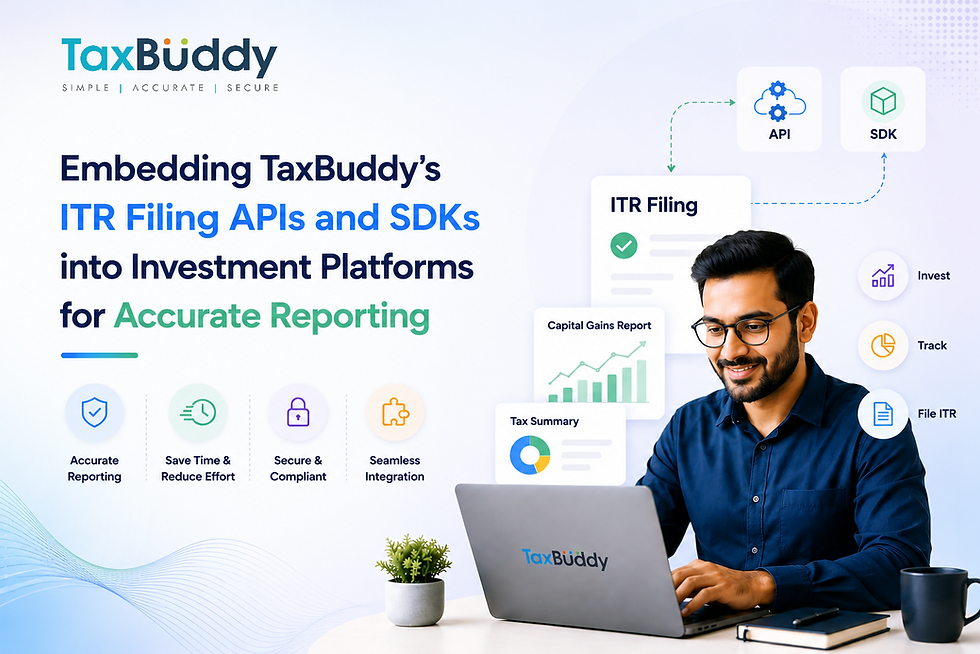
Technology platforms today are no longer operating independently. Financial ecosystems that once focused on solving only one use case are gradually becoming more connected through APIs, SDKs, and embedded infrastructure. Payment apps now support lending. Banking apps support investing. HR platforms support financial wellness. Across fintech, platforms are increasingly trying to reduce friction between connected financial activities instead of forcing users into disconnected journeys.
Investment platforms are now evolving in the same direction.
Modern investors can analyse markets, monitor portfolios, access advanced research, track performance, and execute transactions instantly through sophisticated investing ecosystems. But once filing season arrives, the experience often becomes fragmented. Investors suddenly shift from highly modern investment environments into separate workflows involving capital gains statements, tax planning, filing preparation, document collection, and ITR filing.
This is exactly why investment platforms are beginning to embed ITR filing APIs and SDK infrastructure into their ecosystems. The objective is not to turn investment apps into full tax compliance platforms. Investors will still review statements, verify capital gains reports, and attach supporting documents while filing returns. The larger shift is about making tax planning and ITR filing more accessible, connected, and operationally smoother for investors directly from the platforms they already use regularly.
Table of Contents
How Connected Financial Ecosystems Are Evolving
The fintech ecosystem is changing rapidly.
Earlier, most financial products focused on one core utility. Investing apps focused on trading. Banking apps focused on transactions. Payroll platforms focused on salaries. Users were expected to manage everything else separately.
But digital behaviour changed significantly.
People increasingly expect financial workflows to feel connected instead of fragmented across unrelated systems. They prefer ecosystems where related journeys operate more smoothly together through embedded infrastructure.
Today, users already experience:
Embedded lending inside fintech apps
In-app insurance journeys
Integrated wealth dashboards
Financial wellness tools inside HR platforms
Connected banking and investment experiences
ITR filing and tax planning are now gradually becoming part of this broader connected-finance evolution.
Why Investing and ITR Filing Traditionally Felt Disconnected
Investing activity and tax filing historically operated in completely separate environments.
An investor could spend an entire year inside modern investment platforms tracking portfolios, executing trades, analysing opportunities, and monitoring returns. But when tax season arrived, the same user usually shifted into completely different workflows involving:
Capital gains reports
Broker statements
Dividend disclosures
AIS reconciliation
Tax planning
Filing preparation
ITR filing
The investing journey felt modern. The filing journey often felt operationally disconnected. This gap became significantly more visible as retail investing participation increased across India.
The Operational Friction Investors Face During Filing Season
The challenge for most investors is not only tax filing itself. The larger issue is coordination.
Investors often struggle with questions such as:
Which gains need reporting?
Which ITR form applies?
How should capital gains statements be handled?
How should dividend income be disclosed?
What is the tax impact of transactions?
Which documents need to be attached or verified?
The operational friction increases significantly for users handling multiple investments, active trading activity, or multiple broker accounts. Most investors do not think about these layers while investing. The complexity becomes visible later during filing season when they begin coordinating reports, statements, and filing workflows manually.
Why Investment Platforms Are Adding Embedded ITR Filing
Investment platforms increasingly recognise that filing season directly affects investor experience. Users who feel disconnected during tax filing often associate that friction with the broader ecosystem experience itself.
This is one reason platforms are beginning to add embedded workflows around:
Tax planning
Filing readiness
ITR filing access
Filing guidance
Tax awareness
The goal is not to replace accountants or eliminate documentation requirements. The goal is making filing journeys more accessible and connected for investors who already spend the entire year inside investment ecosystems.
How ITR Filing APIs Improve Investor Experience
ITR filing APIs help platforms support connected filing workflows inside existing ecosystems. Instead of forcing investors to start filing preparation completely separately every year, platforms can now provide smoother access to:
Tax planning workflows
Filing journeys
Filing support
ITR preparation workflows
Reporting guidance
This improves continuity significantly. The investor no longer feels like they are shifting into an entirely unrelated environment during filing season. The experience becomes more structured and operationally smoother.
Why SDK-Based Filing Journeys Are Becoming Important
SDK infrastructure is becoming increasingly important because most investment activity today is mobile-first. Platforms want filing journeys to feel:
Embedded
Native to the app
Guided
Operationally smooth
Easy to access
An SDK-led filing journey helps investment ecosystems support filing workflows directly inside existing app environments instead of redirecting users through fragmented experiences. This becomes especially important during filing season when user attention and engagement are already high. The smoother the filing journey feels, the better the continuity for the investor.
How Tax Planning Is Becoming Part of Investing Workflows
Investors increasingly think beyond portfolio returns alone. Many users now actively evaluate:
Tax-saving opportunities
Exit timing impact
Post-tax profitability
Realised gains exposure
Tax-efficient investing behaviour
This is why tax planning is gradually becoming part of broader investing workflows. Platforms increasingly recognise that users want better understanding around the financial impact of investment decisions, not only portfolio performance visibility. This changes how investment ecosystems think about long-term engagement.
Why Platforms Want Better Filing Continuity
Investment platforms increasingly want to remain relevant during reporting and filing season instead of limiting engagement only to transactions and portfolio tracking. This is an important ecosystem shift. Platforms are gradually trying to support users during:
Filing preparation
Tax planning
Reporting coordination
ITR filing
Financial interpretation
This improves investor continuity because the platform remains useful during financially important moments instead of disappearing operationally once filing season begins.
The Role of Embedded Filing Infrastructure in Investor Retention
Most investment platforms traditionally focused on retention through:
Better research
Faster execution
Advanced analytics
Portfolio visibility
But financial continuity is now becoming equally important. A platform that helps investors navigate filing season more smoothly often becomes significantly more useful operationally. Embedded ITR filing infrastructure therefore becomes more than a utility layer. It becomes an engagement and retention layer.
How TaxBuddy Supports Investment Platforms Through APIs and SDKs
TaxBuddy’s infrastructure is designed specifically to help investment ecosystems support connected tax planning and ITR filing workflows more smoothly. The ecosystem support includes:
Embedded ITR filing APIs
Filing SDK infrastructure
Tax planning workflows
Filing-readiness journeys
Filing guidance support
Embedded filing continuity
The objective is not replacing reporting workflows or eliminating investor verification requirements. Investors will still review reports, reconcile statements, and attach supporting documents wherever required. The larger objective is helping platforms create smoother and more connected filing experiences during tax season. TaxBuddy also supports investor awareness through its free tax webinars.
These initiatives help simplify tax understanding for investors while improving filing confidence during reporting season. TaxBuddy’s 17K+ Google reviews also help reinforce trust during filing workflows where confidence and reporting clarity become highly important.
Why Investor Education and Tax Awareness Matter
Technology alone cannot eliminate filing confusion completely. Investor understanding still matters significantly. Questions around gains treatment, deductions, reporting interpretation, filing applicability, and ITR workflows continue creating uncertainty for many users.
This is why tax awareness and investor education are becoming increasingly important alongside embedded infrastructure.
Platforms increasingly understand that simplifying financial understanding is just as important as simplifying workflows themselves.
The Future of Connected Investment Ecosystems
Investment ecosystems are gradually moving toward more connected financial experiences. The shift is not about turning every investment platform into a complete tax compliance system. The shift is about reducing fragmentation between:
Investing activity
Tax planning
Filing preparation
ITR filing workflows
Financial interpretation
This reflects a broader trend across fintech ecosystems where platforms increasingly collaborate through APIs and SDK infrastructure to create smoother user journeys.
The next phase of investment platforms will likely focus not only on execution speed or analytics sophistication, but also on how effectively ecosystems simplify the operational side of investing after transactions themselves are complete.
Conclusion
Investment platforms have already transformed how people invest. The next evolution is improving what happens after investing activity itself, especially during filing season.
This is why embedded ITR filing APIs and SDK infrastructure are becoming increasingly relevant inside investment ecosystems. The objective is not eliminating reporting responsibilities or fully automating compliance workflows. Investors will still review capital gains statements, reconcile disclosures, and attach supporting documents wherever required.
The real value lies in creating more connected financial journeys where investing activity, tax planning, filing preparation, and ITR filing operate with stronger continuity. TaxBuddy supports this shift through embedded ITR filing APIs, SDK infrastructure, tax planning workflows, investor education initiatives, and filing-readiness support designed specifically for modern investment ecosystems.
FAQs
Q1. What are ITR filing APIs for investment platforms?
ITR filing APIs help investment ecosystems support connected filing workflows, tax planning, and filing readiness journeys inside their platform.
Q2. Why are investment platforms embedding ITR filing workflows?
Platforms increasingly want to reduce operational fragmentation between investing activity and filing season workflows.
Q3. What is an ITR filing SDK?
An ITR filing SDK helps platforms embed filing journeys directly inside mobile or web ecosystems for smoother user continuity.
Q4. Are investment platforms replacing capital gains reports completely?
No. Investors still need to review statements, verify disclosures, and attach supporting documents wherever required.
Q5. Why does the filing season create friction for investors?
Investors suddenly need to coordinate reporting interpretation, tax planning, filing preparation, and document management together.
Q6. How do embedded filing APIs improve investor experience?
They help create smoother continuity between investing activity and filing workflows without forcing users into disconnected experiences.
Q7. Why are SDK-led filing journeys becoming important?
Most investing activity is now mobile-first, so platforms want filing journeys to feel native and operationally smooth inside the app itself.
Q8. How does TaxBuddy support investment platforms?
TaxBuddy supports platforms through embedded ITR filing APIs, filing SDK infrastructure, tax planning workflows, and filing-readiness journeys.
Q9. What role do webinars and investor awareness initiatives play?
Free tax webinars and investor education initiatives help simplify tax understanding and improve filing confidence for investors.
Q10. Is the objective complete compliance automation?
No. The objective is smoother filing continuity and connected financial journeys, not eliminating reporting responsibilities entirely.
Q11. Why are investment platforms becoming more tax-aware?
Investors increasingly want better understanding around the financial and reporting impact of investment decisions.
Q12. What is the future of connected investment ecosystems?
Investment ecosystems are gradually moving toward connected experiences where investing, tax planning, filing preparation, and ITR filing operate more smoothly together.


