

GST Filing for Marketplace Sellers on Amazon, Flipkart, and Meesho
- PRITI SIRDESHMUKH

- Jan 20
- 8 min read
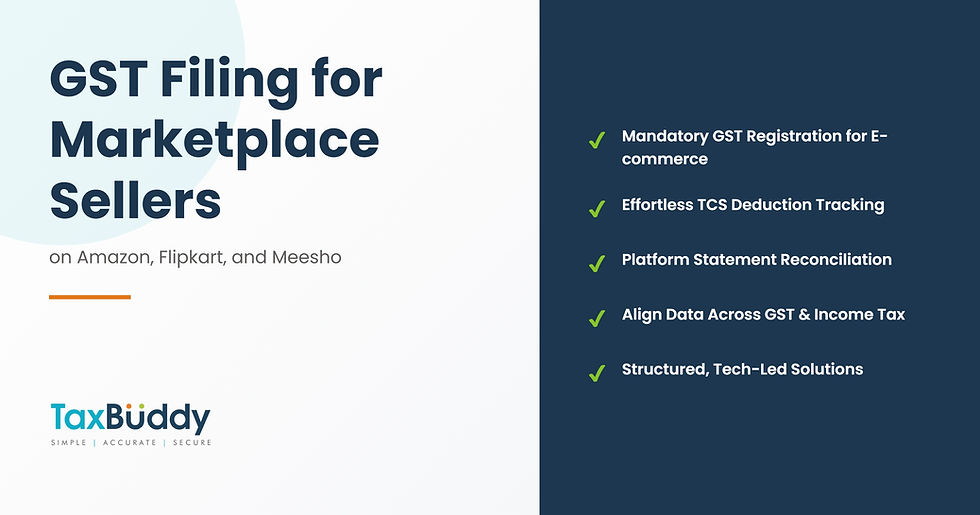
Marketplace sellers operating on Amazon, Flipkart, and Meesho face a distinct GST framework in India. GST registration is mandatory for most sellers, even at lower turnover levels, due to e-commerce provisions under the CGST Act. Alongside routine returns, sellers must track TCS deductions, reconcile platform statements, and align data across GST and income tax systems. With frequent rate updates and growing scrutiny, compliance has become more data-heavy than transactional. This complexity has pushed sellers to look for structured, technology-led solutions that can handle reporting accuracy without disrupting daily operations.
Table of Contents
GST Applicability for Marketplace Sellers in India
Selling through online marketplaces in India places sellers under a specific GST framework that differs from traditional offline businesses. Under the CGST Act, sellers supplying goods through e-commerce operators are treated as taxable persons regardless of their physical presence or business scale. The law views marketplaces as facilitators of supply, but the tax responsibility on outward supplies remains with the seller. This means GST applies from the very first sale for most marketplace sellers, even if turnover is low. Interstate supplies, pan-India customer reach, and platform-led logistics further strengthen GST applicability for online sellers.
Mandatory GST Registration Rules for Amazon, Flipkart, and Meesho Sellers
Marketplace sellers operating on Amazon and Flipkart are required to obtain GST registration under Section 24 of the CGST Act. This requirement applies irrespective of turnover because sales are made through an e-commerce operator. Registration is compulsory even below the ₹40 lakh threshold applicable to normal businesses.
Meesho follows a slightly different operational model for small sellers, allowing limited exemptions for intra-state supplies of exempt goods. However, once taxable goods are sold or platform-led logistics are used, GST registration becomes mandatory. Platform onboarding itself often requires a valid GSTIN, making registration a practical necessity.
Understanding TCS Deduction by E-commerce Platforms
E-commerce platforms are required to collect Tax Collected at Source on behalf of sellers. TCS is deducted at 1 per cent of the net taxable value of supplies, split equally between CGST and SGST for intra-state transactions. This amount is deposited by the platform and reported in GSTR-8.
For sellers, TCS is not an additional tax cost but a credit that can be claimed. However, claiming this credit depends entirely on accurate reconciliation between platform reports and GST returns. Any mismatch can lead to blocked credit or notices, making TCS tracking a critical compliance step.
GST Returns Required for Marketplace Sellers
Marketplace sellers are required to file multiple GST returns based on turnover and filing frequency. GSTR-1 captures outward supplies and must align with platform sales data. GSTR-3B summarises tax liability and payment. Sellers exceeding the specified turnover threshold must also file GSTR-9 as an annual return.
In addition, platforms file GSTR-8 for TCS reporting, which directly impacts the seller’s electronic cash ledger. Consistency across these returns is essential, as discrepancies are increasingly identified through automated checks.
Impact of 2025 GST Rate Changes on E-commerce Sellers
The 2025 GST reforms simplified tax slabs to fewer rate categories, affecting pricing, invoicing, and tax computation for online sellers. Certain categories saw rate rationalization, while luxury and special goods were placed in higher slabs.
For marketplace sellers, this change requires updates to product tax classification, invoice templates, and platform-level tax settings. Incorrect rate application can result in underpayment or excess tax collection, both of which carry compliance risks.
Common GST Reporting and Reconciliation Challenges
Marketplace sellers face challenges that are largely data-driven rather than transactional. High order volumes, frequent returns, cancellations, promotional discounts, and platform fees distort raw sales figures. These factors make GST reporting more complex than simple invoicing models.
Manual reconciliation becomes difficult when data is spread across multiple dashboards, GST returns, and bank records. Errors often arise not due to non-compliance, but due to fragmented data handling.
Why Marketplace Reports Often Do Not Match GST Returns
Differences between marketplace reports and GST returns usually stem from timing gaps, reverse logistics, fee adjustments, and tax deducted at source. Platform reports may reflect gross order value, while GST returns require net taxable value after adjustments.
Advertising charges, packaging fees, shipping recoveries, and refunds further complicate alignment. Without structured reconciliation, these differences can trigger system-generated GST notices.
Managing TDS under Section 194-O Alongside GST
Apart from GST-related deductions, marketplace sellers are also subject to TDS under Section 194-O of the Income Tax Act. Platforms deduct TDS at 1 per cent on gross sales and report it in Form 26AS and AIS.
This creates a parallel reconciliation requirement between GST data and income tax records. Sellers must ensure that turnover reported under GST aligns with income offered to tax, after adjusting for returns and platform charges.
How TaxBuddy Handles Complex GST and Marketplace Reports
TaxBuddy addresses marketplace complexity through integrated data processing rather than isolated return filing. Sales data, platform deductions, GST returns, and income tax records are mapped together to create a unified compliance view.
This approach reduces dependency on manual spreadsheets and ensures that GST, TDS, and income tax positions remain consistent across reporting systems.
Automated Reconciliation of TCS, TDS, and Input Tax Credit
Automation plays a critical role in reducing errors for marketplace sellers. TaxBuddy uses system-driven reconciliation to match TCS reported by platforms with GSTR-2A and GSTR-2B data. TDS credits are aligned with Form 26AS and AIS, ensuring no credit leakage.
Input tax credit is verified against supplier filings, minimising the risk of ineligible claims and future reversals.
Notice Risk Reduction and Ongoing GST Compliance Support
GST notices are increasingly data-based rather than complaint-driven. Mismatches, delayed filings, and inconsistent disclosures are common triggers. Continuous monitoring and timely corrections significantly reduce this risk.
TaxBuddy combines automation with expert oversight, allowing early identification of inconsistencies and structured responses where required. This proactive approach helps sellers remain compliant without constant firefighting.
Choosing the Right GST Filing Approach for Marketplace Businesses
Marketplace sellers operate in an environment where GST compliance is closely tied to data accuracy, reporting discipline, and regulatory awareness. Treating GST filing as a once-a-month activity often leads to gaps that surface later as mismatches, interest costs, or notices. For sellers dealing with daily orders, returns, logistics adjustments, and platform-led deductions, compliance works best when it is viewed as a continuous process that runs alongside business operations rather than after them.
High-volume sellers, especially those active on platforms like Amazon and Flipkart, generate large datasets every month. Manual tracking becomes inefficient at this scale. Automated systems help consolidate sales data, platform fees, TCS deductions, and GST liabilities in near real time. This reduces dependency on last-minute reconciliations and lowers the risk of missing credits or underreporting tax.
Growing sellers, including those expanding rapidly through Meesho, face a different challenge. Volumes may still be manageable, but frequent changes in pricing, product mix, and tax rates can introduce errors if filings are handled without review. Expert oversight helps identify incorrect classifications, missed adjustments, or inconsistencies between GST and income tax records before they compound over multiple periods.
A hybrid GST filing approach combines the strengths of both automation and professional review. Technology ensures speed, consistency, and data alignment across platforms, while expert involvement provides judgment on complex issues such as rate changes, reconciliation gaps, and notice responses. This model is particularly effective for sellers operating across multiple states or marketplaces, where compliance requirements overlap and errors can escalate quickly.
Choosing the right GST filing approach ultimately depends on business scale, transaction complexity, and growth plans. Sellers who invest early in structured systems and informed support are better positioned to maintain compliance, protect cash flow, and focus on scaling their marketplace operations with confidence.
Conclusion
GST compliance for marketplace sellers involves more than filing returns on time. It requires accurate data reconciliation, awareness of regulatory changes, and consistency across GST and income tax disclosures. Structured systems and informed support can significantly reduce compliance stress and financial risk. For sellers seeking a reliable way to manage these obligations, solutions that combine automation with expert review offer long-term clarity. For anyone looking for assistance in tax filing, it is highly recommended to download the TaxBuddy mobile app for a simplified, secure, and hassle-free experience.
FAQs
Q1. Does TaxBuddy offer both self-filing and expert-assisted plans for ITR filing, or only expert-assisted options?
TaxBuddy offers both self-filing and expert-assisted plans. The self-filing option is designed for sellers who are comfortable reviewing data themselves and want a guided, automated process that reads GST, TDS, and platform reports accurately. The expert-assisted plan is suitable for sellers with higher volumes, multi-platform sales, or reconciliation issues, where a tax professional reviews data, resolves mismatches, and handles end-to-end filing. This flexibility allows sellers to choose support based on business scale and complexity.
Q2. Which is the best site to file ITR?
The Income Tax Department’s e-filing portal is the official platform where all income tax returns are finally submitted. However, the effectiveness of filing depends on how accurately data is prepared before submission. Platforms like TaxBuddy help sellers compile income details, reconcile GST and TDS data, validate disclosures, and reduce errors before the return is filed on the government portal.
Q3. Where to file an income tax return?
Income tax returns are filed on the Income Tax Department’s e-filing portal. Taxpayers can file directly on the portal or use authorized platforms that assist with data preparation, reconciliation, and compliance checks while ensuring the final submission is completed on the official system.
Q4. Is GST mandatory for sellers on e-commerce platforms?
Yes. GST registration is mandatory for most sellers supplying goods through e-commerce platforms, regardless of turnover. This requirement applies due to specific provisions under the CGST Act for e-commerce operators. Even sellers below the normal exemption threshold are required to register when selling through platforms like Amazon or Flipkart.
Q5. What is TCS under GST for marketplace sellers?
TCS under GST refers to tax collected at source by e-commerce platforms on behalf of sellers. The platform deducts a prescribed percentage from taxable supplies and deposits it with the government. This amount reflects in the seller’s GST records and can be claimed as credit, provided the seller’s returns and platform data are correctly reconciled.
Q6. Which GST returns apply to marketplace sellers?
Marketplace sellers are generally required to file GSTR-1 for outward supplies and GSTR-3B for summary tax payment. Sellers crossing the prescribed turnover threshold must also file GSTR-9 as an annual return. These returns must align with platform-reported data to avoid discrepancies.
Q7. How do GST mismatches usually occur?
GST mismatches commonly arise due to differences in order timing, returns, cancellations, refunds, platform fees, and promotional adjustments. Platform reports often show gross values, while GST returns require net taxable figures. Without structured reconciliation, these differences can lead to incorrect reporting.
Q8. How does Section 194-O affect online sellers?
Section 194-O requires e-commerce platforms to deduct TDS on gross sales made by sellers. This TDS is reflected in income tax records such as Form 26AS and AIS. Sellers must reconcile this deduction with GST turnover and income disclosures to ensure consistency across tax filings.
Q9. Do GST rate changes affect existing sellers?
Yes. GST rate changes impact product classification, invoicing, pricing, and tax computation. Existing sellers must update tax settings on platforms and ensure invoices reflect the correct rates to prevent underpayment or excess tax collection.
Q10. Can GST notices be avoided with proper reconciliation?
While notices cannot be eliminated entirely, proper and regular reconciliation significantly reduces the risk. Most GST notices are system-generated due to data mismatches. Accurate alignment of returns, platform reports, and tax credits helps prevent such triggers.
Q11. Is automation necessary for multi-platform sellers?
Automation becomes essential as transaction volume increases and sales occur across multiple platforms. Manual tracking is prone to errors and delays. Automated systems help consolidate data, reconcile reports, and maintain consistency across GST and income tax records.
Q12. How does TaxBuddy support ongoing GST compliance?
TaxBuddy supports ongoing compliance through automated reconciliation of GST, TCS, and TDS data combined with expert review. This approach helps sellers maintain accurate filings, address discrepancies early, and stay compliant without continuous manual intervention.




Comments