

How Long Does Online Company Registration Take in India

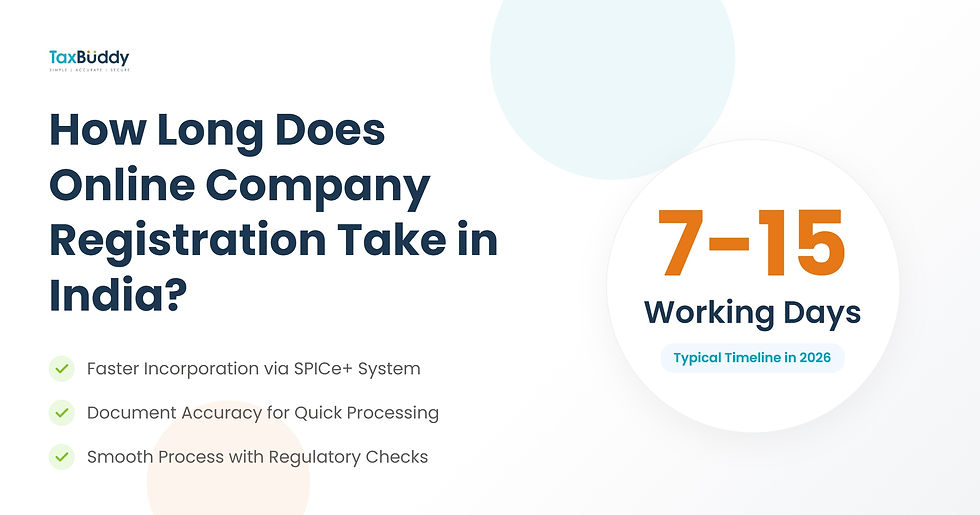
Online company registration in India has become significantly faster due to the MCA’s SPICe+ system, allowing businesses to incorporate within a few days if documents are ready. For most Private Limited Companies in 2026, the process typically takes between 7 to 15 working days. However, the actual timeline depends on approvals, document accuracy, and regulatory checks. Understanding each stage of registration helps avoid delays and ensures a smoother incorporation process for entrepreneurs and startups planning to start operations quickly.
Online company registration in India usually takes 7 to 15 working days for a Private Limited Company when all documents are correctly submitted, with faster approvals possible in 7–10 days and delays extending the process up to 2–4 weeks due to name rejections, incomplete documentation, or approval backlogs.
Table of Contents
Step-by-Step Timeline of Company Registration Process in India
Time Taken for SPICe+ Filing and Certificate of Incorporation
Common Delays in Online Company Registration and How to Avoid Them
Time Required to Open a Bank Account After Company Registration
Documents Required for Post-Registration Bank Account Opening
Latest Updates on Online Company Registration Process in India (2026)
How Digital Platforms Simplify Company Registration and Compliance
Online Company Registration in India Timeline Explained
Online company registration in India follows a structured process managed through the MCA’s SPICe+ portal. The timeline largely depends on how quickly documents are prepared and how smoothly approvals are granted. For most Private Limited Companies, the process is completed within 7 to 15 working days. Each stage, from obtaining identification numbers to receiving the Certificate of Incorporation, is interconnected. Any delay at one step can impact the overall timeline, making it important to understand how each stage works and how to prepare accordingly.
Step-by-Step Timeline of Company Registration Process in India
The company registration process is divided into clear stages, each with its own timeline:
Stage | Activity | Estimated Time |
Step 1 | DSC and DIN application | 1–2 days |
Step 2 | Name reservation (SPICe+ Part A) | 1–3 days |
Step 3 | SPICe+ Part B filing (MoA, AoA, details) | 2–5 days |
Step 4 | Certificate of Incorporation with PAN/TAN | Included in the above |
Total | Complete incorporation process | 7–15 days |
If all documents are correct and approvals are quick, the process can be completed in under 10 days.
Time Required for DSC and DIN Approval
The first step involves obtaining a Digital Signature Certificate (DSC) and Director Identification Number (DIN). These are mandatory for directors to sign documents electronically and be officially recognised.
This stage usually takes 1 to 2 working days if identity and address proofs are valid and properly submitted. Delays may occur if KYC documents are unclear or mismatched.
Name Approval Time Under SPICe+ Part A
Name approval is requested through SPICe+ Part A. The Registrar of Companies checks whether the proposed name is unique and complies with naming rules.
Approval typically takes 1 to 3 working days. If the name is too similar to an existing company or violates guidelines, it may be rejected. Resubmission can add another 2 to 3 days to the process.
Time Taken for SPICe+ Filing and Certificate of Incorporation
After name approval, SPICe+ Part B is filed along with the Memorandum of Association (MoA), Articles of Association (AoA), and other required details.
This stage takes around 2 to 5 working days for approval. Once approved, the Certificate of Incorporation is issued along with PAN and TAN, completing the legal formation of the company.
Total Time for Online Company Registration in India
In most cases, online company registration in India takes between 7 to 15 working days.
Fast-track cases: 7–10 days
Standard timeline: 10–15 days
Delayed cases: up to 2–4 weeks
The overall time depends on document readiness, approval speed, and whether corrections are required.
Factors Affecting Company Registration Time in India
Several factors can influence how quickly a company gets registered:
Accuracy of documents submitted
Availability and uniqueness of the company name
Workload at the Registrar of Companies
Completeness of KYC details
Whether additional registrations, like GST, are included
Being well-prepared can significantly reduce delays.
Common Delays in Online Company Registration and How to Avoid Them
Delays are common when basic checks are overlooked. Some frequent issues include:
Incorrect or incomplete documents
Name rejection due to similarity
Errors in SPICe+ form submission
Mismatch in director details
These can be avoided by double-checking all details before submission and choosing a unique company name.
Fast-Track Company Registration in India: Is It Possible
In certain cases, company registration can be completed within 24 to 48 hours. This is possible when:
All documents are ready and verified
The proposed name is approved without objections
There are no errors in the filing
While fast-track registration is possible, it is not guaranteed and depends on approval efficiency.
Time Required to Open a Bank Account After Company Registration
After receiving the Certificate of Incorporation, opening a current bank account is the next step. This usually takes 3 to 7 working days.
The timeline depends on the bank’s verification process and document submission. Some banks offer faster digital onboarding options.
Documents Required for Post-Registration Bank Account Opening
To open a company bank account, the following documents are generally required:
Document | Purpose |
Certificate of Incorporation | Proof of company existence |
PAN of the company | Tax identification |
MoA and AoA | Company structure and rules |
Board resolution | Authorisation for account opening |
Directors’ KYC documents | Identity verification |
Registered office proof | Address verification |
Submitting complete documents helps speed up the process.
Latest Updates on Online Company Registration Process in India (2026)
The SPICe+ system continues to streamline company registration by integrating multiple services into a single platform. PAN and TAN are issued along with incorporation, reducing additional steps.
As of 2026, there are no major changes in timelines, but improvements in digital processing have made approvals faster and more efficient.
How Digital Platforms Simplify Company Registration and Compliance
Digital tools have made company registration more accessible and efficient. From document preparation to compliance tracking, most processes can now be handled online.
Automation helps reduce manual errors, ensures faster submissions, and simplifies ongoing compliance requirements such as tax filings and regulatory reporting.
How TaxBuddy Supports Businesses After Company Registration
Once a company is incorporated, the focus quickly shifts from setup to ongoing compliance. This includes regular filings such as income tax returns, GST returns, TDS compliance, maintaining proper books of accounts, and responding to any notices issued by authorities. For many new businesses, especially startups and small enterprises, managing these requirements alongside daily operations can become challenging and time-consuming.
TaxBuddy provides structured support to help businesses handle these responsibilities in a more organised and simplified manner. Instead of dealing with multiple platforms, deadlines, and complex regulations separately, businesses can manage key compliance tasks through a streamlined system that brings everything into one place.
One of the key areas where support becomes important is income tax compliance. Businesses need to prepare accurate financial statements, calculate taxable income, and file returns within prescribed timelines. TaxBuddy helps ensure that filings are completed correctly, reducing the chances of errors that could lead to penalties or notices. This becomes especially useful for businesses that may not have an in-house finance team.
GST compliance is another critical requirement after company registration. Filing GSTR-1, GSTR-3B, and reconciling input tax credit can be complex if data is not properly maintained. TaxBuddy assists in tracking transactions, organising invoices, and ensuring that GST returns are filed accurately and on time. This helps businesses avoid late fees and maintain a clean compliance record.
Handling notices from the Income Tax Department or GST authorities is an area where many businesses face uncertainty. Even a small mismatch in reported data can trigger a notice. TaxBuddy guides in reviewing such notices, preparing responses, and ensuring that all required documentation is submitted correctly. This reduces stress and helps businesses respond confidently to compliance queries.
Another important aspect is maintaining proper documentation and records. From invoices and financial statements to compliance filings and acknowledgements, businesses need to keep everything organised for audits and future reference. TaxBuddy helps structure and manage these documents in a way that makes retrieval and tracking easier.
As businesses grow, compliance requirements also evolve. Additional filings, audits, and regulatory checks may become applicable. Having a system that adapts to these changes ensures that businesses do not miss important deadlines or requirements. TaxBuddy supports this transition by helping businesses stay updated and aligned with changing regulations.
Overall, managing compliance after company registration is not just about filing returns but about maintaining consistency, accuracy, and readiness for any regulatory checks. With the right support system in place, businesses can focus more on growth and operations while ensuring that their financial and tax responsibilities are handled efficiently.
Conclusion
Online company registration in India has become faster and more efficient with the SPICe+ system, allowing businesses to get started within a short time frame when documents are properly prepared. Understanding each stage and avoiding common mistakes can help reduce delays and ensure a smooth incorporation process.
For businesses that want to stay compliant after registration, choosing the right support system is equally important. For anyone looking for assistance in managing business compliance and tax filing, it is recommended to download the TaxBuddy mobile app for a simplified, secure, and hassle-free experience.
FAQs
Q1. How long does online company registration take in India?
Online company registration in India typically takes between 7 and 15 working days for a Private Limited Company. If all documents are accurate and approvals are smooth, the process can be completed in 7–10 days. However, delays in name approval or document verification can extend it up to 2–4 weeks.
Q2. What is the fastest time in which a company can be registered in India?
In ideal conditions, where documents are pre-verified and the proposed name is approved without objections, company registration can be completed within 24 to 48 hours. This fast-track scenario depends heavily on error-free filing and quick approvals from the Registrar of Companies.
Q3. Which stage of company registration takes the most time?
The SPICe+ Part B filing and approval stage usually takes the most time, around 2 to 5 working days. This is because the Registrar verifies all incorporation documents, including the MoA, AoA, and director details, before issuing the Certificate of Incorporation.
Q4. How long does it take to get DSC and DIN?
Obtaining a Digital Signature Certificate (DSC) and Director Identification Number (DIN) generally takes 1 to 2 working days. The timeline may increase if there are issues with identity proof, address proof, or document verification.
Q5. How much time does company name approval take in India?
Name approval through SPICe+ Part A usually takes 1 to 3 working days. If the name is rejected due to similarity or non-compliance with MCA guidelines, resubmission can add an additional 2 to 3 days.
Q6. What happens if the company name gets rejected?
If the proposed company name is rejected, a fresh name must be submitted through SPICe+ Part A. This does not require restarting the entire process, but can delay registration by a few days, depending on how quickly a new name is approved.
Q7. Are PAN and TAN issued along with the company registration?
Yes, PAN and TAN are automatically generated and issued along with the Certificate of Incorporation through the SPICe+ system. This eliminates the need for separate applications and reduces overall registration time.
Q8. Does applying for GST during incorporation increase the timeline?
Yes, if GST registration is applied along with company incorporation, it may add 2 to 3 additional working days to the overall process. However, it can be convenient as it avoids a separate application later.
Q9. How long does it take to open a bank account after company registration?
Opening a company bank account usually takes 3 to 7 working days after receiving the Certificate of Incorporation. The timeline depends on the bank’s internal verification process and the completeness of submitted documents.
Q10. What are the common reasons for delays in company registration?
Common reasons include incorrect or incomplete documents, a mismatch in KYC details, name rejection, errors in SPICe+ forms, and a heavy workload at the Registrar of Companies. Proper preparation can help avoid most of these delays.
Q11. Is the registration timeline different for OPC and Private Limited Company?
The process is similar for both a One Person Company (OPC) and a Private Limited Company. However, Private Limited Companies are often registered slightly faster due to more streamlined approvals and fewer restrictions.
Q12. Can company registration be done completely online in India?
Yes, the entire company registration process in India is conducted online through the MCA’s SPICe+ portal. From name reservation to incorporation and PAN/TAN issuance, all steps are completed digitally without the need for physical submissions.


