

How PF Withdrawal Timing Can Impact Your Tax Liability

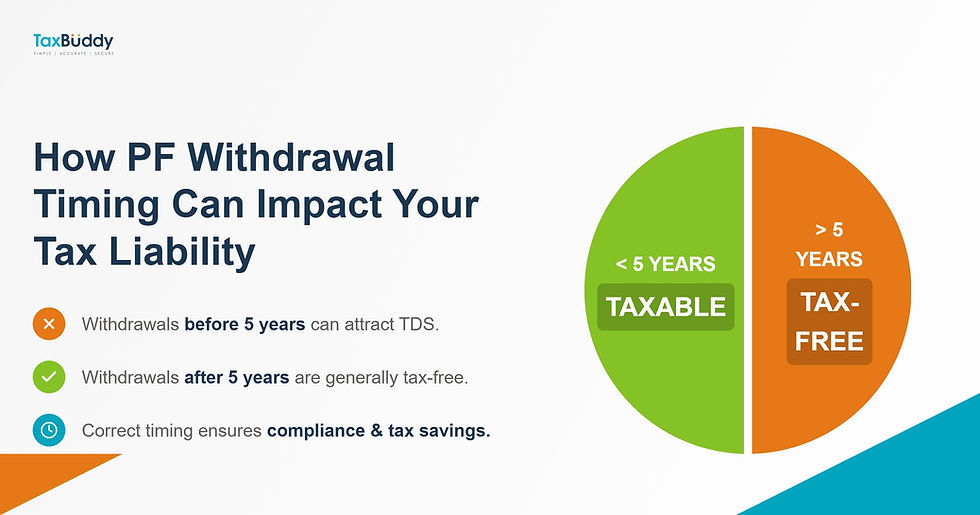
PF withdrawal timing plays a critical role in determining whether the amount received is taxable or fully exempt under the Income Tax Act. Withdrawals made before completing five years of continuous service can attract TDS and additional tax liability, while withdrawals after this period are generally tax-free. Understanding how service duration, withdrawal amount, and purpose influence tax treatment helps avoid unnecessary deductions. Proper planning, including transferring PF during job changes and timing withdrawals correctly, ensures compliance and reduces tax burden significantly.
PF withdrawal timing directly impacts tax liability because withdrawals made before completing five years of continuous service are subject to TDS and taxation on certain components, whereas withdrawals after five years are fully exempt, making timing a key factor in tax planning.
Table of Contents
What Is PF Withdrawal and Why Timing Matters
Provident Fund withdrawal refers to accessing the accumulated balance in an employee’s EPF account, including contributions made by both the employee and employer along with interest earned. While this corpus is meant for long-term financial security, withdrawals are allowed under specific conditions such as retirement, job change, or emergencies.
Timing plays a crucial role because tax treatment depends largely on the duration of continuous service. A withdrawal made too early can attract tax and TDS, while a well-timed withdrawal after meeting eligibility conditions can make the entire amount tax-free. This makes timing a key factor in financial planning.
How PF Withdrawal Timing Affects Tax Liability
The taxability of PF withdrawal is directly linked to the length of continuous service. If the withdrawal is made before completing five years of continuous employment, certain components of the PF amount become taxable.
On the other hand, if the withdrawal is made after completing five years, the entire amount, including contributions and interest, is generally exempt from tax. Timing also determines whether TDS is deducted and how the withdrawal is reported in the income tax return.
Key Tax Rules for PF Withdrawal Under Income Tax Act
The Income Tax Act governs PF withdrawal taxation through specific provisions.
If the total PF withdrawal exceeds ₹50,000 before completing five years of continuous service, TDS is applicable. The withdrawal is then taxed under different heads depending on the component.
If the withdrawal is made after five years of continuous service, it is fully exempt under Section 10(12). Continuous service includes previous employment if the PF balance has been transferred.
These rules ensure that long-term savings are encouraged while discouraging premature withdrawals.
TDS on PF Withdrawal Under Section 192A
Section 192A deals with TDS on EPF withdrawals.
If the withdrawal amount exceeds ₹50,000 and the service period is less than five years, TDS is deducted at 10% if PAN is provided. If PAN is not provided, TDS can be deducted at the maximum marginal rate.
No TDS is deducted if the withdrawal is below the threshold limit or if the withdrawal qualifies for exemption. Proper documentation and PAN linkage are important to avoid higher deductions.
Tax Treatment of PF Components
PF withdrawal consists of three main components, and each has a different tax treatment when withdrawn before five years.
Employee contribution is generally not taxed because it is made from post-tax income.
Employer contribution is taxed as salary income.
Interest earned on both contributions is taxed under income from other sources.
After five years of continuous service, all these components become fully exempt from tax.
When PF Withdrawal Is Tax-Free
PF withdrawal becomes tax-free when it is made after completing five years of continuous service.
In such cases, no TDS is deducted, and the entire amount, including employee contribution, employer contribution, and interest, is exempt from tax.
Additionally, certain specific conditions, such as termination due to ill health or business closure, may also qualify for tax exemption even before five years.
When PF Withdrawal Becomes Taxable
PF withdrawal becomes taxable when it is made before completing five years of continuous service and does not fall under any exemption category.
In such cases, TDS is deducted, and the amount must be reported in the income tax return. The employer’s contribution and interest are taxed accordingly, increasing the overall tax liability.
This highlights the importance of understanding withdrawal timing before making financial decisions.
PF Withdrawal Before 5 Years: Tax Impact Explained
When PF is withdrawn before completing five years of service, the tax impact can be significant.
Employer contributions are taxed as salary, while interest is taxed under income from other sources. TDS is also deducted if the withdrawal exceeds ₹50,000.
This can lead to a higher tax burden, especially if the individual falls into a higher tax bracket during that financial year.
PF Withdrawal After 5 Years: Tax Benefits Explained
Withdrawing PF after completing five years of continuous service provides major tax benefits.
The entire withdrawal amount becomes tax-free, and no TDS is deducted. This makes it one of the most efficient long-term savings instruments.
Maintaining continuity through PF transfers during job changes helps preserve this benefit.
Exceptions Where Early PF Withdrawal Is Not Taxed
Certain exceptions allow tax-free PF withdrawal even before five years.
These include termination due to ill health, the employer’s business closure, or reasons beyond the employee’s control. Partial withdrawals for purposes such as medical emergencies, education, marriage, or housing may also be exempt.
These provisions ensure that genuine financial needs are not penalised with tax.
Role of PAN in PF Withdrawal Taxation
PAN plays a critical role in determining the TDS rate on PF withdrawal.
If PAN is provided, TDS is deducted at 10% on eligible withdrawals. If PAN is not provided, TDS can be deducted at a significantly higher rate.
Linking PAN with the EPF account ensures proper tax reporting and helps avoid unnecessary deductions.
How Form 15G and Form 15H Help Reduce TDS
Form 15G and Form 15H are self-declaration forms used to avoid TDS on PF withdrawal if the individual’s total income is below the taxable limit.
Form 15G is used by individuals below 60 years of age, while Form 15H is used by senior citizens.
Submitting these forms along with PAN helps prevent TDS deduction, although the income must still be reported in the tax return if applicable.
Impact of Job Change on PF Withdrawal Tax Liability
Job changes can affect PF withdrawal taxability depending on how the PF account is handled.
If the PF balance is transferred to the new employer, the service period continues, and the five-year rule remains intact. This helps maintain tax-free status.
If the PF is withdrawn instead of transferred, the service period resets, which may lead to taxation if the withdrawal is made early.
Partial PF Withdrawal Rules and Tax Implications
Partial PF withdrawals are allowed for specific purposes such as medical expenses, home purchase, education, or marriage.
These withdrawals are generally tax-free if they meet EPFO conditions and are used for approved purposes.
Partial withdrawals do not impact the five-year rule for full withdrawal and are useful for managing financial needs without triggering tax liability.
Is PF Withdrawal Tax Benefit Allowed in New Tax Regime
PF withdrawal tax benefits are available under the new tax regime as well.
The exemption for PF withdrawal after five years under Section 10(12) remains applicable regardless of the tax regime chosen.
However, deductions related to contributions may differ between regimes, but the withdrawal exemption itself is not affected.
How PF Withdrawal Taxation Works in the Old Tax Regime
Under the old tax regime, PF contributions may qualify for deductions under Section 80C, and the withdrawal after five years remains tax-free.
If withdrawn before five years, taxation rules apply similarly, with employer contributions and interest becoming taxable.
The old regime may provide additional benefits through deductions during the contribution phase.
Common Mistakes While Withdrawing PF
Several mistakes can lead to higher tax liability.
Withdrawing PF before completing five years without considering tax implications is a common error. Not transferring PF during job changes can also reset the service period.
Failing to link PAN or not submitting Form 15G or 15H may result in higher TDS deductions.
Proper planning helps avoid these mistakes.
Strategies to Minimise Tax on PF Withdrawal
Delaying PF withdrawal until after five years is the most effective way to avoid tax.
Transferring PF during job changes helps maintain continuity. Using partial withdrawals for eligible purposes can meet financial needs without triggering tax.
Ensuring PAN linkage and submitting Form 15G or 15H when applicable also helps reduce TDS.
How Digital Platforms Simplify PF Tax Filing and Compliance
Digital platforms simplify PF-related tax compliance by organising financial data, tracking TDS deductions, and assisting with accurate reporting in income tax returns.
They also help identify exemptions, manage documentation, and ensure timely filing.
Platforms like TaxBuddy provide guidance on reporting PF withdrawals correctly, reducing errors and improving compliance.
Conclusion
PF withdrawal timing has a direct impact on tax liability, making it essential to plan withdrawals carefully. Completing five years of continuous service, maintaining PF transfers during job changes, and understanding exemptions can help avoid unnecessary tax. Managing documentation and reporting requirements can become complex, especially when TDS is involved. For anyone looking for assistance in tax filing, it is highly recommended to download the TaxBuddy mobile app for a simplified, secure, and hassle-free experience.
FAQs
Q1. Why does timing matter so much in PF withdrawal taxation?
Timing determines whether the withdrawal is taxable or fully exempt. If PF is withdrawn before completing five years of continuous service, certain components become taxable and TDS may apply. If withdrawn after five years, the entire amount is generally tax-free. This makes timing a key factor in reducing tax liability.
Q2. What is considered continuous service for PF withdrawal tax purposes?
Continuous service includes the total duration of employment where PF contributions have been made, including previous jobs if the PF balance is transferred. If the PF is withdrawn instead of transferred during a job change, the service period resets, which can impact tax exemption eligibility.
Q3. What happens if PF is withdrawn before completing five years of service?
If PF is withdrawn early, employer contributions are taxed as salary and interest earned is taxed under income from other sources. TDS is also deducted if the withdrawal exceeds ₹50,000. This can increase overall tax liability for that financial year.
Q4. Is there any way to avoid tax on PF withdrawal before five years?
Yes, tax can be avoided in certain cases, such as withdrawal due to medical emergencies, employer closure, or reasons beyond control. Submitting Form 15G or Form 15H can also help avoid TDS if the total income is below the taxable limit, although taxability still depends on overall income.
Q5. What is the role of TDS in PF withdrawal?
TDS is deducted under Section 192A when PF is withdrawn before five years, and the amount exceeds ₹50,000. It acts as an advanced tax collection. However, actual tax liability is determined while filing the income tax return.
Q6. How does PAN affect PF withdrawal taxation?
Providing PAN ensures that TDS is deducted at 10%. If PAN is not provided, TDS can be deducted at a much higher rate. Linking PAN with the EPF account helps avoid unnecessary deductions and ensures accurate tax reporting.
Q7. Are all components of PF taxed equally in early withdrawal?
No, each component is taxed differently. Employee contribution is generally not taxed, employer contribution is taxed as salary, and interest is taxed as income from other sources. This breakdown increases the complexity of tax calculation.
Q8. Does PF withdrawal need to be reported in the income tax return?
Yes, if PF withdrawal is taxable, it must be reported in the income tax return under appropriate heads, such as salary or income from other sources. Even if TDS has been deducted, reporting is necessary to calculate the final tax liability or claim refunds.
Q9. How does partial PF withdrawal impact tax liability?
Partial withdrawals for specific purposes like medical treatment, housing, education, or marriage are usually tax-free if conditions are met. These withdrawals do not affect the five-year rule and can be used without triggering tax liability.
Q10. Does switching jobs impact PF withdrawal tax benefits?
Switching jobs does not impact tax benefits if the PF balance is transferred to the new employer. This helps maintain continuity of service and ensures that the five-year condition for tax-free withdrawal remains intact.
Q11. Is PF withdrawal treated differently under the new and old tax regimes?
The tax exemption on PF withdrawal after five years remains the same under both regimes. However, deductions on contributions may differ between the old and new tax regimes, which can affect overall tax planning.
Q12. What is the best strategy to minimise tax on PF withdrawal?
The most effective strategy is to avoid withdrawing PF before completing five years of continuous service. Transferring PF during job changes, using partial withdrawals for eligible purposes, ensuring PAN linkage, and submitting Form 15G or 15H when applicable can help reduce or eliminate tax liability.


