

How TDS Filing on TaxBuddy Connects With Accounting and Tax Returns
- Kanchan Bhatt

- Feb 15
- 9 min read

TDS filing is no longer an isolated compliance task. Under the Income Tax Act, 1961, every TDS return directly impacts accounting records, Form 26AS, AIS, and the final income tax return of the deductee. Any mismatch between books, challans, or reported income flows straight into notices, disallowed credits, or delayed refunds. Platforms like TaxBuddy bridge this gap by linking TDS data with accounting and return filing in one connected workflow, ensuring accuracy from deduction to final tax assessment. This integration plays a critical role in preventing errors before they surface at the ITR stage.
Table of Contents
How Bank Account and Challan Details Affect TDS and Refund Processing
Common Accounting and TDS Mismatches That Impact Tax Returns
How TaxBuddy Integrates TDS Filing With Accounting Workflows
Impact of TDS Accuracy on Income Tax Return Filing and Notices
Why Integrated TDS Filing Reduces Scrutiny and Compliance Risk
Why TDS Filing Cannot Be Treated as a Standalone Compliance
TDS filing is often mistaken for a quarterly obligation that ends once returns are submitted. In reality, TDS is only one layer of a larger tax reporting chain. Every deduction made affects accounting entries, statutory liabilities, deductee tax credits, and final income computation. If TDS is handled independently without reconciling it with the books of accounts and return data, errors remain hidden until the return is processed. These errors typically surface as mismatches, denied credits, or tax demands. Treating TDS as a standalone task increases compliance risk rather than reducing it.
How TDS Filing Links Accounting Records With Tax Reporting
TDS deductions originate from accounting transactions such as salary payments, professional fees, rent, interest, or contractor bills. These transactions must be recorded net of TDS in expense ledgers, while the deducted tax is shown as a statutory liability. When TDS returns are prepared, the reported figures must match ledger balances and challan payments. Any gap between accounting records and TDS returns leads to incorrect reporting. A connected approach ensures that what is booked in accounts is exactly what is deposited, reported, and later claimed as credit.
Role of Form 26AS and AIS in Connecting TDS and ITR Filing
Form 26AS and AIS act as the bridge between TDS returns and income tax returns. Once a TDS return is processed, the deducted tax is reflected in the deductee’s Form 26AS and AIS. These statements are directly used by the income tax system to verify income and tax credits during return processing. If the TDS data does not appear correctly or appears with errors, the return gets flagged automatically. Accurate TDS filing ensures these statements reflect the correct income and tax paid, allowing seamless credit claims during ITR filing.
How Bank Account and Challan Details Affect TDS and Refund Processing
Bank account details play a critical role in both TDS compliance and refund processing. Challan payments must carry correct CIN details, including BSR code, date, and challan number, to validate tax deposits. Incorrect bank or challan data causes unmatched payments and failed credits. During ITR filing, pre-validated bank accounts are required for refund issuance. If TDS challans or bank details are incorrect, refunds get delayed or blocked. Maintaining accurate banking data across TDS and ITR filings prevents these downstream issues.
Common Accounting and TDS Mismatches That Impact Tax Returns
Several common mismatches arise when TDS is not aligned with accounting records. These include differences between booked expenses and TDS reported, incorrect PAN of deductees, challans paid under wrong sections, and timing mismatches between deduction and payment. Another frequent issue is income reflected in AIS but missing in Form 26AS due to reporting errors. Such mismatches often lead to defective return notices, tax demands, or manual rectification requirements after filing.
How TaxBuddy Integrates TDS Filing With Accounting Workflows
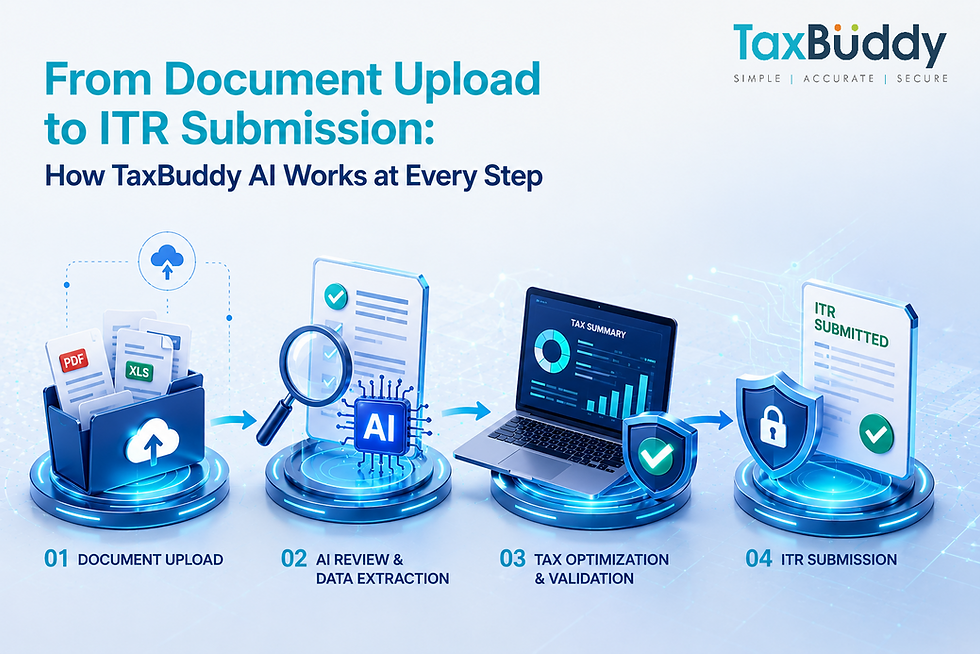
TaxBuddy integrates TDS filing with accounting by validating payment data, PAN details, challans, and statutory sections before submission. The platform allows structured uploads of accounting data and performs automated checks to identify inconsistencies early. TDS data is reconciled with challan payments and validated through system checks, ensuring that accounting entries, statutory filings, and reporting statements remain aligned. This integration reduces manual intervention and prevents post-filing corrections.
Impact of TDS Accuracy on Income Tax Return Filing and Notices
Accurate TDS compliance plays a decisive role in how an income tax return moves through the processing and assessment system. The income tax department relies heavily on reported TDS data as the first validation layer for a return. Once a return is filed, the system automatically cross-verifies the income and tax credits claimed with Form 26AS and the AIS. When these records align perfectly, the return is usually processed smoothly, refunds are issued on time, and no adjustments are required at the summary assessment stage.
When TDS details are accurate, the taxpayer benefits from faster processing and greater certainty. Salary income, bank interest, professional fees, and other TDS-backed incomes get accepted without manual intervention. This reduces the likelihood of automated adjustments under summary processing, where even small mismatches can lead to tax demands or partial denial of credits. Accurate TDS reporting also ensures that refunds, if any, are calculated correctly and released without delays caused by reconciliation issues.
In contrast, inaccurate or incomplete TDS data can trigger a chain of issues during return processing. If the TDS reported by the deductor does not reflect correctly in Form 26AS or AIS, the system treats the credit as unsubstantiated. This often results in adjustments during processing, leading to reduced refunds or additional tax demands. Even when the taxpayer has genuinely suffered TDS, the credit may be denied until the mismatch is resolved, creating avoidable follow-up work.
Repeated inconsistencies in TDS reporting can further elevate compliance risk. The tax system increasingly uses data analytics to identify patterns, and frequent mismatches between income, TDS, and third-party reporting can flag a return for deeper scrutiny. This may increase the chances of notices seeking clarification, additional documentation, or reconciliation statements. Over time, such issues can lead to more frequent interactions with the tax department, even when there is no intent to underreport income.
Ensuring TDS accuracy at the source acts as a preventive measure against these outcomes. Verifying TDS entries, ensuring timely corrections by deductors, and aligning return disclosures with Form 26AS and AIS helps protect the return from unnecessary adjustments and notices. A clean TDS trail not only simplifies return filing but also strengthens the taxpayer’s compliance profile, reducing the likelihood of follow-up proceedings and ensuring a smoother overall tax experience.
How TDS Revisions and Corrections Flow Into ITR Computation
Errors in original TDS returns are fairly common and can arise due to incorrect PAN quoting, wrong assessment year, mismatches in challan details, or incorrect reporting of income and tax deducted. The Income-tax Act allows deductors to correct these mistakes by filing revised TDS statements within the prescribed timelines. These revisions are not merely procedural; they play a critical role in determining whether the deducted tax ultimately becomes available to the taxpayer as a valid credit.
Once a revised TDS return is filed and processed by the system, the corrected information flows automatically into Form 26AS and the Annual Information Statement (AIS). Form 26AS reflects the tax deducted and deposited against the taxpayer’s PAN, while AIS captures a broader picture of income and tax-related data reported by various entities. The income tax return computation engine relies heavily on these two records to validate tax credits claimed in the return. Only the TDS that appears correctly in these statements is considered eligible for adjustment against the final tax liability.
When a TDS correction is carried out on time, it allows the taxpayer to claim the correct credit either in the original return or through a revised return under the permitted provisions. This ensures that the computation of total tax payable or refundable accurately reflects the tax already deducted at source. In contrast, if corrections are delayed or entirely missed by the deductor, the TDS may not appear or may appear incorrectly in Form 26AS and AIS at the time of filing. As a result, the taxpayer may be forced to either forgo the credit temporarily or face mismatches that trigger adjustments during processing.
Such delays often complicate return computation, especially in cases involving multiple deductors, salary changes, bank interest, or professional income. The system may treat the missing or mismatched TDS as unpaid tax, leading to higher computed tax liability, interest under sections 234B or 234C, or even demand notices under section 143(1). Rectifying these issues later usually requires coordination with the deductor for correction, followed by filing a revised or updated return once the corrected data reflects in the tax records.
Timely TDS revisions, therefore, act as the foundation for accurate income tax return computation. They ensure seamless alignment between what has been deducted by the payer, what is reflected in statutory statements, and what is ultimately adjusted against the taxpayer’s liability. When corrections are completed within the allowed timelines, the final tax outcome mirrors the true tax position, reducing disputes, notices, and unnecessary cash outflows.
Why Integrated TDS Filing Reduces Scrutiny and Compliance Risk
An integrated TDS approach ensures consistency across accounting records, statutory returns, and income tax filings. When data flows correctly across systems, the chances of automated flags reduce significantly. Integrated filing also creates a clear audit trail, making responses to queries or audits easier. This alignment lowers scrutiny exposure and strengthens overall compliance confidence for both businesses and individuals.
Conclusion
TDS filing influences far more than quarterly compliance. It determines how income, expenses, tax credits, and refunds are ultimately assessed by the tax department. When TDS is connected with accounting records and income tax returns, errors are identified early, and compliance becomes predictable. Platforms like TaxBuddy help establish this connection by integrating TDS filing with accounting validation and return preparation in a single workflow. For anyone looking for assistance in tax filing, it is highly recommended to download the TaxBuddy mobile app for a simplified, secure, and hassle-free experience.
FAQs
Q1. Why is TDS filing closely linked with accounting records?
TDS is deducted at the time of recording an expense or payment in books. If accounting entries do not correctly reflect the deducted tax and corresponding liability, the TDS return will not match ledger balances. This mismatch later flows into Form 26AS and AIS, impacting tax credits during ITR filing.
Q2. Can TDS be filed correctly even if accounting entries are inaccurate?
Technically, a TDS return can be filed, but inaccuracies in accounting often result in incorrect amounts, wrong sections, or timing differences. These errors usually surface later as mismatches during return processing, leading to denied credits or tax demands.
Q3. How does incorrect TDS filing affect income tax return processing?
Income tax returns are auto-verified against Form 26AS and AIS. If TDS data does not match the return, the system adjusts credits, raises demands, or marks the return as defective. Correct TDS filing is essential for smooth ITR processing.
Q4. What role does Form 26AS play in connecting TDS and ITR filing?
Form 26AS reflects tax deducted, tax collected, and advance tax paid. It acts as the primary source for validating TDS credits claimed in the return. If TDS does not appear or appears incorrectly in Form 26AS, credits may be disallowed.
Q5. How is AIS different from Form 26AS in TDS reporting?
AIS provides a broader view of income and tax-related information, including transactions that may not immediately reflect in Form 26AS. While AIS can indicate missing or mismatched data, Form 26AS remains critical for actual credit allowance during ITR processing.
Q6. Why are challan details important in TDS compliance?
Challan details, such as BSR code, challan number, date, and amount, validate whether the deducted tax has been deposited with the government. Incorrect challan reporting leads to unmatched payments, which can block credit reflection in Form 26AS.
Q7. How do bank account details impact TDS and refund outcomes?
Bank details are required for challan validation, e-verification, and refund processing. Incorrect or unvalidated bank accounts can delay refunds even when TDS credits are correctly reflected, making accurate bank data essential across filings.
Q8. What are the most common TDS and accounting mismatches seen during ITR filing?
Common mismatches include differences between booked expenses and TDS amounts, wrong PAN of deductees, incorrect TDS sections, timing gaps between deduction and deposit, and income reflected in AIS but missing in Form 26AS.
Q9. Can TDS mismatches result in income tax notices?
Yes, mismatches frequently trigger notices such as summary assessment adjustments or defective return communications. These notices require explanations, rectifications, or revised filings, increasing the compliance burden.
Q10. How do revised TDS returns affect income tax returns?
Revised TDS returns update corrected data in Form 26AS and AIS. Once updated, the deductee can claim accurate credits through revised or updated income tax returns, provided timelines are met.
Q11. Why does integrated TDS filing reduce scrutiny risk?
When accounting data, TDS returns, and ITR disclosures are aligned, automated risk flags are reduced significantly. Integrated compliance creates consistency across systems, lowering the chances of adjustments, queries, or detailed scrutiny.
Q12. How does TaxBuddy help connect TDS filing with accounting and ITR filing?
TaxBuddy validates accounting data, challans, PAN details, and statutory sections before filing TDS returns. It then links this data with Form 26AS, AIS, and income tax return preparation, helping ensure consistency across the entire compliance cycle.




Comments