

What End-to-End TDS Compliance Covers Beyond Just Filing Returns
- CA Pratik Bharda

- Mar 6
- 8 min read
Updated: Mar 9
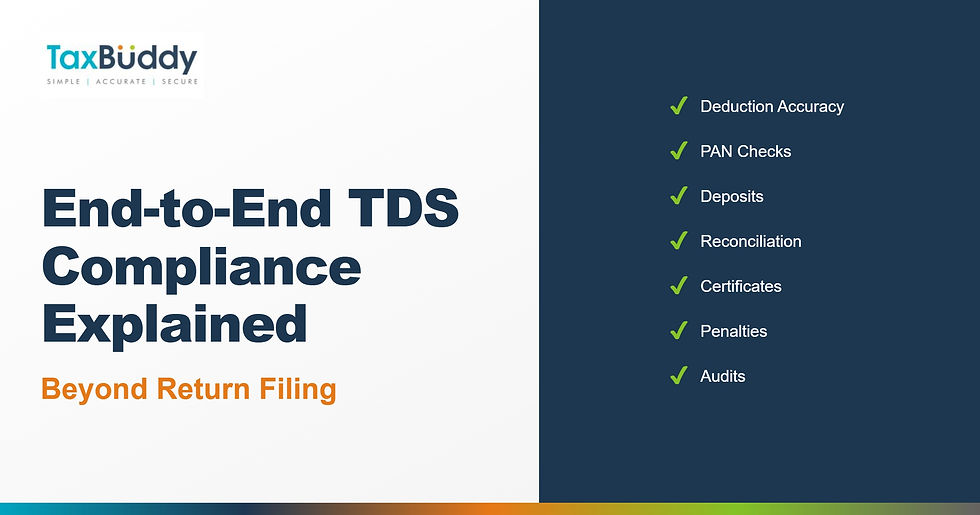
End-to-end TDS compliance under the Income Tax Act goes far beyond filing quarterly forms like Form 26Q or Form 24Q. It covers the entire lifecycle of tax deduction at source, starting from identifying the correct section and rate, verifying PAN, deducting tax accurately, depositing it within statutory timelines, issuing certificates, reconciling credits, and responding to notices. Any break in this chain can result in interest, penalties, loss of credit to deductees, and scrutiny notices. Treating TDS as a standalone filing activity often leads to mismatches in Form 26AS and AIS, which directly impacts income tax return processing.
Table of Contents
Why TDS Compliance Is More Than Just Filing Returns
TDS compliance begins much before a quarterly return is filed and continues well after it is submitted. Filing Form 24Q or 26Q is only a reporting step that reflects actions already taken during the quarter. The real compliance lies in whether tax was deducted under the correct section, at the correct rate, deposited on time, reported accurately, and ultimately credited to the deductee. When any of these steps are missed, the return filing alone does not prevent interest, penalties, or notices. This is why TDS must be treated as a continuous compliance cycle rather than a periodic filing task.
Identifying the Correct TDS Section and Rate at the Time of Payment
Every TDS obligation starts at the time a payment is made or credited. The nature of the transaction determines the applicable section, threshold, and rate. Salary, professional fees, rent, interest, commission, contract payments, and purchase transactions all fall under different provisions. Applying an incorrect section often results in under-deduction or excess deduction, both of which lead to downstream issues. Once a payment is booked incorrectly, later corrections become time-consuming and can still attract interest. Correct classification at the payment stage is the foundation of end-to-end TDS compliance.
PAN Verification and Higher TDS Provisions Under Sections 206AA and 206AB
PAN verification is a mandatory compliance step for both deductors and deductees. When PAN is missing or invalid, tax must be deducted at a higher rate under Section 206AA. In addition, Section 206AB requires a higher deduction for specified persons who have not filed income tax returns despite having significant TDS or TCS in prior years. Identifying such cases requires due diligence before making payments. Failure to apply higher rates when required exposes the deductor to short deduction liability, even if the deductee later files a return.
Timely Deposit of TDS and Interest Implications for Delays
After deduction, TDS must be deposited within the prescribed timelines, usually by the 7th of the following month. Delays in deposit attract interest at different rates depending on whether the tax was deducted late or deposited late. This interest is mandatory and cannot be waived during assessment or appeal. Even if the deductee has paid tax independently, interest for the delayed deposit remains payable by the deductor. Timely deposit is, therefore, a critical compliance checkpoint that operates independently of return filing.
Quarterly TDS Return Filing and Data Accuracy Requirements
Quarterly returns consolidate all deductions and deposits made during the period. These returns must accurately reflect challan details, deductee PANs, amounts paid, and tax deducted. Even small errors such as incorrect PANs, mismatched challan numbers, or wrong sections can prevent credit from appearing in Form 26AS. Late filing also attracts a daily fee, subject to limits. Accurate data entry and validation are essential because the income tax system relies heavily on return data for automated processing.
Issuance of TDS Certificates and Deductee Credit Enablement
Issuing TDS certificates such as Form 16 or Form 16A is not a procedural formality. These certificates are the primary documents used by deductees to verify tax credit and file their returns. Certificates must be issued within prescribed timelines and should match the data reported in quarterly returns. If certificates are delayed or incorrect, deductees may face difficulties in claiming credit, leading to disputes and follow-ups. Certificate issuance directly impacts the deductee’s tax compliance experience.
Reconciliation With Form 26AS and AIS to Prevent Mismatches
Reconciliation ensures that the tax deducted and deposited by the deductor matches what appears in the deductee’s Form 26AS and AIS. Mismatches can occur due to incorrect challan tagging, wrong PANs, or partial reporting. These mismatches often surface only when income tax returns are processed, resulting in credit denial or notices. Regular reconciliation helps identify gaps early and allows timely correction statements to be filed before return filing deadlines.
Bank Accounts, Fixed Deposits, and TDS Linkages With PAN and Forms 15G/15H
Banks apply TDS on interest income once statutory thresholds are crossed. PAN plays a central role in this process, as a missing PAN leads to a higher deduction. Eligible individuals may submit Forms 15G or 15H to prevent unnecessary deduction, but these declarations must be valid and timely. Banks also report TDS to the tax department, making reconciliation essential. Errors at this level often impact individual taxpayers directly during return filing, even though the deductor is the bank.
Handling Corrections, Non-Filers, and Short Deduction Scenarios
Despite best efforts, errors can still occur. Correction statements are required to fix incorrect PANs, challan details, or deduction amounts. Short deduction cases may arise due to incorrect rate application or missed higher-rate provisions. In such cases, the deductor remains liable for differential tax and interest. Non-filer identification under Section 206AB also requires periodic review. Managing these situations promptly reduces exposure to penalties and litigation.
Penalties, Interest, and Prosecution Risks in Incomplete TDS Compliance
Incomplete or incorrect TDS compliance can attract multiple consequences. Interest applies automatically for delays, while penalties may be imposed for non-filing or inaccurate filing. In serious cases involving prolonged defaults or willful non-compliance, prosecution provisions may also apply. These risks exist independently of whether the deductee has paid tax. Understanding the cumulative impact of these provisions highlights why TDS compliance cannot be limited to return filing alone.
Record Maintenance and Audit Readiness Under Income Tax Law
TDS records must be maintained for several years, including challans, working papers, declarations, certificates, and reconciliation statements. These records are often required during assessments, audits, or appellate proceedings. Inadequate documentation weakens the deductor’s position and increases compliance risk. Proper record maintenance ensures audit readiness and simplifies responses to departmental queries.
How Integrated Platforms Like TaxBuddy Simplify End-to-End TDS Compliance
Managing TDS across multiple sections, timelines, and stakeholders can be complex. Integrated platforms such as TaxBuddy help centralise deduction tracking, PAN validation, deposit monitoring, reconciliation, and return filing within a single workflow. This reduces manual errors, improves visibility across compliance stages, and aligns TDS data seamlessly with income tax return filing. Such integration is especially useful for professionals and businesses handling recurring payments and multiple deductees.
Conclusion
End-to-end TDS compliance is a continuous process that connects deduction accuracy, timely deposits, correct reporting, reconciliation, and record maintenance. Treating TDS as a one-time filing activity often leads to mismatches, penalties, and avoidable notices. A structured, integrated approach ensures compliance at every stage while reducing operational and legal risk. For anyone looking for assistance in tax filing and TDS compliance, it is highly recommended to download the TaxBuddy mobile app for a simplified, secure, and hassle-free experience.
FAQs
Q1. Is filing quarterly TDS returns enough to complete TDS compliance?
No. Filing quarterly TDS returns is only one part of compliance. Complete TDS compliance also includes correct deduction at the time of payment, timely deposit of tax, PAN verification, issuance of TDS certificates, reconciliation with Form 26AS and AIS, correction of errors, and proper record maintenance. Missing any of these steps can still lead to interest, penalties, or notices even if returns are filed on time.
Q2. What happens if the wrong TDS section or rate is applied?
Applying the wrong TDS section or rate usually results in a short deduction or an excess deduction. Short deduction exposes the deductor to interest and penalty, while excess deduction causes hardship to the deductee and may require refunds or corrections. Errors at the payment stage are difficult to fix later and often trigger scrutiny during return processing.
Q3. Why is PAN verification critical in TDS compliance?
PAN verification ensures that TDS credit is correctly mapped to the deductee. If PAN is missing or invalid, tax must be deducted at a higher rate, and the deductee may not receive credit in Form 26AS. Incorrect PAN details are one of the most common reasons for TDS mismatches and income tax notices.
Q4. What is higher TDS under Sections 206AA and 206AB?
Section 206AA applies when PAN is not furnished, requiring deduction at a higher rate. Section 206AB applies to specified persons who have not filed income tax returns despite having substantial TDS or TCS in earlier years. Deductors must identify such cases before making payments, as failure to apply higher rates leads to short deduction liability.
Q5. Does late deposit of TDS attract consequences even if returns are filed correctly?
Yes. Interest for late deposit is mandatory and applies independently of return filing. Even if quarterly returns are filed accurately, delays in deposit attract interest that cannot be waived. This interest is payable by the deductor regardless of whether the deductee has already paid tax.
Q6. Why do TDS mismatches appear in Form 26AS or AIS?
Mismatches usually occur due to incorrect PAN reporting, wrong challan tagging, partial reporting of deductions, or late filing of returns. These mismatches can prevent credit from being reflected during income tax return processing, often resulting in demands or adjustments of refunds.
Q7. What is the importance of issuing TDS certificates like Form 16 or 16A?
TDS certificates serve as official proof of tax deduction and enable deductees to claim credit while filing returns. If certificates are delayed or contain incorrect details, deductees may face credit denial or processing delays. Issuing accurate certificates within timelines is a statutory obligation for deductors.
Q8. How do bank accounts and fixed deposits affect TDS compliance?
Banks deduct TDS on interest income once thresholds are crossed and report this data to the tax department. PAN details play a key role in determining the rate of deduction. Errors in bank-reported TDS often impact individual taxpayers directly during return filing, making reconciliation essential.
Q9. When are Forms 15G and 15H relevant in TDS compliance?
Forms 15G and 15H are declarations submitted by eligible individuals to prevent unnecessary TDS when total income is below the taxable limits. These forms must be valid, timely, and correctly reported by the deductor. Incorrect acceptance or reporting of these forms can still lead to compliance issues.
Q10. What are correction statements, and when are they required?
Correction statements are filed to rectify errors in previously filed TDS returns, such as wrong PANs, challan details, or deduction amounts. They are essential to ensure that TDS credit is reflected correctly in Form 26AS and AIS. Delayed corrections often lead to prolonged disputes and notices.
Q11. What penalties apply for incomplete or incorrect TDS compliance?
Penalties may apply for non-filing, late filing, or inaccurate filing of TDS returns. Interest is levied for delayed deduction or deposit, and in serious cases, prosecution provisions may apply. These consequences exist even if the underlying income tax has been paid by the deductee.
Q12. How does an integrated platform help manage end-to-end TDS compliance?
An integrated platform connects deduction tracking, PAN validation, deposit monitoring, reconciliation, and return filing into a single workflow. This reduces manual errors, improves compliance visibility, and ensures alignment with income tax return filing. Platforms like TaxBuddy simplify this process by offering automated checks, alerts, and seamless integration with overall tax filing requirements.


Comments