

ITR-U for Missed Salary Income: Step-by-Step Process and Detailed Guide
- Dipali Waghmode

- Nov 28, 2025
- 8 min read
Missing salary income while filing an income tax return is more common than most taxpayers realise. The Income Tax Department has introduced ITR-U, an updated return mechanism that allows correction of missed or misreported income up to four years after the assessment year. This ensures compliance without penalties, reduces the risk of notices, and helps reconcile TDS mismatches. Taxpayers who overlooked salary income in their original or revised ITR can now report it through a structured and time-bound process. Platforms like TaxBuddy offer guided digital support, making the entire compliance journey smoother, faster, and more accurate.
Table of Contents
What Is ITR-U and When Should It Be Filed?
ITR-U is an updated return introduced under Section 139(8A) to help taxpayers correct or update past income tax returns. It allows reporting missed income, errors, or omissions for up to two years from the end of the relevant assessment year. ITR-U is typically used when income was left out earlier—such as salary, interest, rental income, or capital gains—which resulted in underreporting. It cannot be filed for situations where the taxpayer wants to reduce tax liability, claim additional deductions, or declare a loss return. Filing ITR-U ensures compliance, prevents future notices, and helps regularise missed disclosures.
Eligibility Criteria for Filing ITR-U for Missed Salary Income
Only taxpayers who underreported income or made mistakes in earlier returns can file ITR-U. If salary income was unintentionally missed or incorrectly reported, ITR-U provides a legal remedy to correct it. However, the updated return cannot be filed to claim extra refunds or reduce previously paid taxes. Taxpayers whose cases involve scrutiny, search operations, or prosecution are also not eligible. The return must clearly show the additional salary income that was omitted earlier along with a valid reason for updating.
Required Documents for Updating Missed Salary Income
To accurately update salary income in ITR-U, certain records must be kept ready. These include Form 16, salary slips, employer-issued salary certificates, bank statements reflecting credited salary, details of any perquisites, and TDS records. Form 26AS and AIS/TIS should be matched to ensure consistency with the salary being reported. If the employer deducted TDS inconsistently or belatedly, the updated return must correctly reflect the revised figures to avoid mismatch issues.
Step-by-Step Process to File ITR-U for Missed Salary Income
Filing ITR-U begins with logging into the income tax portal and choosing the ‘File Updated Return’ option under Section 139(8A). The taxpayer must select the assessment year, choose the category of error (such as “Return previously filed but income not reported”), and enter the additional salary income. The system automatically recalculates tax liability based on the additional income. After the updated tax computation under Section 140B, the taxpayer must pay the additional tax, interest, and applicable late fees. Once payment is completed, the return is submitted and verified through Aadhaar OTP, DSC, or net banking.
How to Calculate Additional Tax and Interest Under Section 140B
Section 140B lays down the rules for calculating tax payable while filing an updated return. If the ITR-U is filed within 12 months from the end of the assessment year, an additional 25% of the tax and interest becomes payable. If filed after 12 months but within 24 months, the additional amount rises to 50%. Apart from this, the taxpayer must pay regular tax on the missed salary income, interest under Sections 234A, 234B, and 234C (if applicable), and any shortfall in earlier payments. No updated return is allowed if it results in a refund or lower tax liability.
Updating Bank Account Details While Filing ITR-U
Bank account details must be up to date before filing ITR-U, especially if any future correspondence or refunds might arise from subsequent assessments. The taxpayer should verify bank details under the “My Profile” section of the income tax portal, ensuring the account is active, pre-validated, and linked to PAN. Even though ITR-U does not allow refund claims, updated bank details help in seamless processing and avoid compliance delays.
Common Mistakes to Avoid When Filing ITR-U
Many taxpayers unknowingly make errors while filing ITR-U because they treat it like a regular revised return, even though the rules for updated returns are stricter. One major mistake is miscalculating the updated tax liability by not including the mandatory additional tax of 25% or 50%, depending on how late the ITR-U is filed. Interest under sections 234A, 234B, and 234C must also be recomputed on the updated income, yet many skip this step, leading to underpayment.
Another frequent issue is using ITR-U for purposes it does not allow. ITR-U cannot be filed to claim a refund, reduce income, correct capital gains computations, or claim missed deductions. Filing it for any of these reasons automatically makes the return defective and increases the chances of a notice from the department.
Many taxpayers also forget to check AIS and TIS before filing. Salary income updates, bank interest entries, and high-value transactions must match the department’s data; otherwise, mismatches during processing may trigger scrutiny. Some continue using old Form 16 figures without verifying whether their employer has revised the TDS return (Form 24Q), resulting in inconsistencies between reported TDS and actual data in AIS.
Errors also occur when taxpayers update only one income source while ignoring others. For example, adding missed salary income but forgetting to update interest income, FD maturity receipts, or dividend income can distort the final tax calculation. Failing to consider late employer TDS deposits, taxable allowances, or changes in perquisites may also affect accuracy.
Overall, filing ITR-U requires careful reconciliation of all income sources, TDS entries, and department records. Reviewing AIS/TIS, cross-checking Form 26AS, validating employer TDS updates, and computing the correct additional taxes are essential steps to ensure that the updated return is accurate and compliant.
Can ITR-U Be Filed to Claim Refunds or Reduce Tax Liability?
ITR-U cannot be used to reduce tax liability, increase refunds, or declare losses. The purpose of this return is strictly to correct underreported income or rectify mistakes that increased tax liability. The law ensures that only upward adjustments are made, meaning tax owed will increase with ITR-U, never decrease. Any attempt to use ITR-U for refund purposes will be rejected by the system immediately.
How TaxBuddy Helps Simplify the ITR-U Filing Process
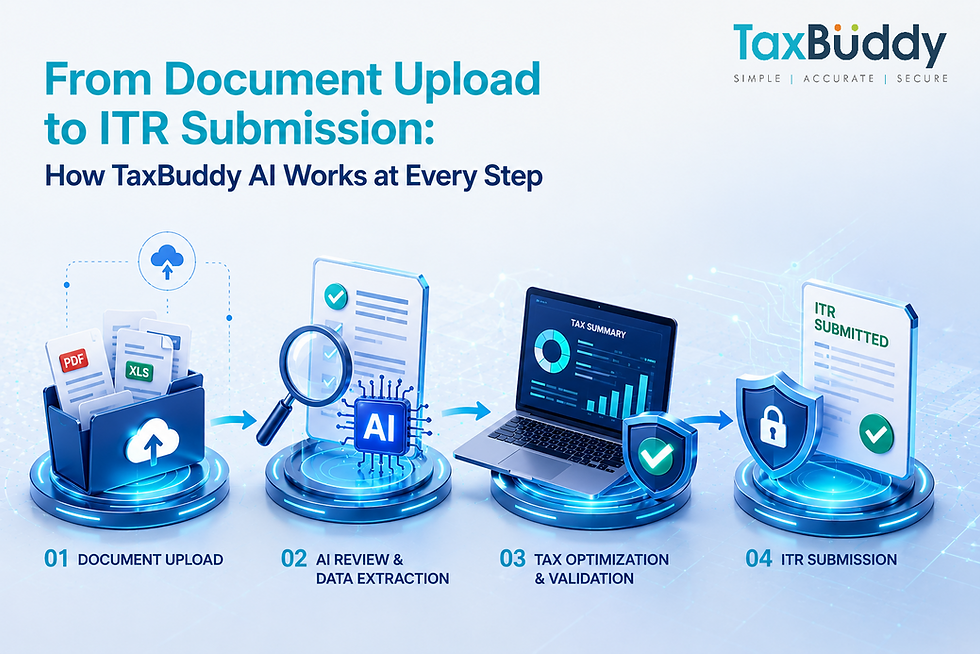
TaxBuddy plays an important role in making the ITR-U filing process easier for individuals who need to correct or update their previously filed income tax returns. Since an Updated Return often involves analysing discrepancies that were missed earlier, the platform begins by identifying mismatches across key data sources such as AIS, TIS, Form 16, and the original ITR filed. These comparisons help taxpayers understand exactly where income was underreported or overlooked, whether it relates to salary components, interest income, TDS credits, or other taxable amounts.
Once the mismatches are identified, the system automatically computes the tax payable under Section 140B, which governs Updated Return payments. This includes recalculating the tax liability, interest, and additional fees that apply based on how late the ITR-U is being filed. Instead of performing these calculations manually, TaxBuddy’s automated engine ensures accuracy and prevents errors that could lead to notices or further corrections.
ITR-U filing can be especially challenging for those who have complex salary structures, multiple employers, or TDS deductions that do not match the AIS records. TaxBuddy’s expert-assisted filing service supports such cases by reviewing documents carefully, verifying employer-wise income, reconciling TDS entries, and ensuring that all underreported amounts are correctly included in the updated return. This greatly reduces the risk of further discrepancies or non-compliance.
The platform also guides users through every compliance requirement attached to ITR-U, such as confirming eligibility, validating the reason for filing an Updated Return, and ensuring that all additional tax calculations align with the rules. With professional review and automated checks, TaxBuddy minimises penalties, avoids repeated recalculations, and ensures that the updated return is filed smoothly and confidently.
Overall, TaxBuddy simplifies the entire ITR-U process by integrating automation with expert support, making it easier for taxpayers to rectify past mistakes and stay fully compliant with the Income Tax Act.
Conclusion
Filing ITR-U for missed salary income helps taxpayers rectify earlier mistakes while ensuring full compliance with tax laws. By reporting omitted salary accurately and calculating the required tax under Section 140B, individuals can avoid penalties, scrutiny notices, and legal complications. For hassle-free and precise filing, using a guided platform makes the process significantly easier and reduces the risk of errors.
FAQs
Q1. Who is eligible to file ITR-U for missed salary income? ITR-U can be filed by any individual taxpayer who forgot to report salary income, underreported part of it, or filed an incorrect ITR earlier. This option is available only if the updated return results in additional tax payable. Taxpayers whose cases are already under scrutiny, reassessment, search, or prosecution cannot file ITR-U. The window to file an updated return remains open for two years from the end of the relevant assessment year.
Q2. Can ITR-U be used to claim a refund for salary income? No. ITR-U cannot be used to claim a refund under any circumstance. The law permits filing an updated return only when the taxpayer is ready to pay additional tax due to missed or underreported income. If filing the return results in a refund or reduction of tax liability, the portal will not accept ITR-U.
Q3. How many times can ITR-U be filed for the same assessment year? Only one updated return can be filed for each assessment year. Once it is submitted, it cannot be revised, edited, or withdrawn. For this reason, taxpayers must recheck all income sources—including salary, interest, capital gains, and other taxable receipts—before submission.
Q4. Is missed salary income always visible in AIS? AIS generally captures salary income when an employer deducts TDS and reports it. However, salary may not appear temporarily due to late employer reporting, a mismatch in PAN, or errors in quarterly TDS returns. Taxpayers should cross-check the AIS with Form 16, employer salary slips, and bank salary credits to ensure no omissions.
Q5. Can an employee file ITR-U if the employer filed incorrect TDS data? Yes. Even if the employer reports incorrect or incomplete TDS details, the employee can still file ITR-U for missed salary income. Once the employer corrects mistakes in their TDS return, the revised figures will automatically reflect in Form 26AS and AIS. The taxpayer can then claim the updated credit.
Q6. What happens if I file ITR-U without paying tax under Section 140B? Such a return becomes invalid. The Income Tax Department accepts ITR-U only after the taxpayer pays the full updated tax, including interest, late fees (if applicable), and the additional 25% or 50% tax prescribed under Section 140B. Without complete payment, the updated return is not considered filed.
Q7. Does filing ITR-U avoid penalties or scrutiny? While filing ITR-U does not guarantee immunity from all scrutiny, it significantly reduces the risk of penalties and assessments. Voluntary disclosures show good faith and usually result in smoother compliance. It also helps avoid future notices for mismatch in AIS or underreported salary income.
Q8. Can freelancers or self-employed individuals file ITR-U for missed income? Yes. The ITR-U framework applies to all categories of taxpayers, including salaried individuals, freelancers, professionals, and business owners. Anyone who has underreported income—whether salary, business receipts, interest, rent, or capital gains—can file ITR-U if the tax liability increases.
Q9. What is the last date to file ITR-U for a specific year? An updated return can be filed up to 24 months from the end of the relevant assessment year. For example:
For AY 2022–23 (FY 2021–22), ITR-U can be filed until 31 March 2025. This extended window allows taxpayers enough time to rectify any oversight in their original filings.
Q10. Is it mandatory to give a reason for filing ITR-U? Yes. The ITR-U form requires selecting a valid reason such as:
Income not reported earlier
Wrong ITR filed
Incorrect details provided
Reduction of carried-forward loss or depreciation The selection helps the department understand the nature of the correction.
Q11. Do taxpayers need to attach documents while filing ITR-U? No supporting documents are required to be uploaded while filing ITR-U. However, taxpayers should keep Form 16, salary slips, AIS/TIS reports, bank statements, and any proof of additional income safely. These may be needed if the Income Tax Department requests verification later.
Q12. How does TaxBuddy simplify filing ITR-U? TaxBuddy checks for missing or mismatched income entries across AIS, Form 16, and bank records. It accurately calculates the additional tax under Section 140B, applies the correct percentage of extra tax, and prepares the updated return without errors. This reduces compliance risks, prevents penalties, and ensures stress-free filing.




Comments