

Online GST Return Filing in India: How TaxBuddy Ensures Error-Free Compliance
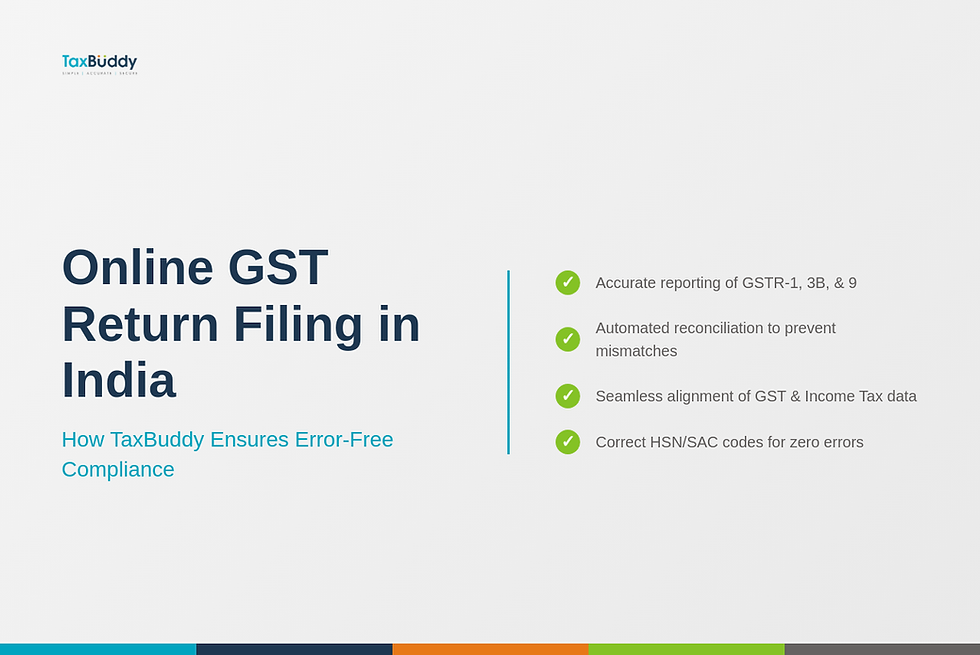
Online GST return filing in India requires accurate reporting of sales, purchases, and tax liabilities through returns such as GSTR-1, GSTR-3B, and GSTR-9. The process demands precision because the GST portal directly cross-verifies taxpayer data with income tax systems, bank statements, and vendor filings. Errors like mismatched turnover, incorrect HSN/SAC codes, or inconsistency between GST and ITR data often lead to notices or delayed processing. TaxBuddy supports businesses by automating reconciliations and ensuring that GST-linked information aligns seamlessly with income reporting, helping taxpayers maintain error-free compliance across both GST and income tax rules.
Table of Contents
Online GST Return Filing in India: An Overview
Online GST return filing in India functions as a structured reporting system where businesses disclose outward supplies, inward supplies, input tax credit, and tax liabilities to the GST Network. Returns such as GSTR-1 for sales, GSTR-3B for monthly summaries, and GSTR-9 for annual disclosures form the backbone of compliance. Each entry flows through government databases, allowing automated cross-checking with vendor filings, e-invoices, e-way bills, and bank transactions. As the tax ecosystem becomes increasingly data-driven, online filing demands accuracy that extends beyond the GST portal. The slightest mismatch can trigger scrutiny, making reliable digital support essential for businesses operating at scale.
Common Errors in Online GST Return Filing
Several filing errors recur across small businesses, professionals, and enterprises. Incorrect reporting of GST turnover remains the most frequent, particularly when outward supplies in GSTR-1 do not align with figures declared in GSTR-3B or the annual return. Missing or inaccurate HSN/SAC codes invite discrepancies during departmental verification. Many taxpayers also overlook credit mismatches between GSTR-2A/2B and purchase records, leading to denied input tax credit claims. Another common issue appears when GST data fails to match income disclosures in the corresponding income tax return. These gaps not only disrupt working capital but also increase the risk of automated notices under compliance monitoring systems.
How TaxBuddy Ensures Error-Free GST Compliance
TaxBuddy addresses GST complexities through an AI-enabled compliance engine designed to prevent manual errors. The system checks for internal inconsistencies across GSTR-1, GSTR-3B, and GSTR-9 before filing is initiated. GST turnover is validated against e-invoice data, vendor filings, and bank transactions to ensure consistency. The platform incorporates updated rules for AY 2025-26, including mandatory GSTIN disclosures and enhanced TDS–GST linkage. Automated prompts guide users when data deviates from GST records, while built-in logic determines whether a taxpayer should file regular returns or avail composition-related reporting. With these checks layered throughout the workflow, TaxBuddy minimizes discrepancies that commonly lead to penalties or departmental queries.
GST Turnover, Bank Deposits, and ITR Integration
GST data now interacts directly with income tax systems, making integration essential for accurate reporting. Turnover reported in GSTR-1 and GSTR-3B is expected to reflect in the income tax return’s business schedules. Bank deposits linked to GST outward supplies must reconcile with both GST and ITR disclosures, especially for taxpayers claiming presumptive income or reporting professional earnings. Any gap between bank data, GST disclosures, and ITR filings may trigger automated notices under Section 143(1). TaxBuddy’s platform links GST records with bank statements and business ledgers, ensuring that turnover, receipts, and tax liabilities flow accurately into ITR schedules without mismatches.
Choosing the Right ITR Form for GST Filers
GST-registered businesses must choose ITR forms based on the nature of operations and turnover. Service providers and businesses reporting regular income typically file ITR-3, which accommodates detailed books of account and GST-linked income. Small taxpayers opting for presumptive taxation under Sections 44AD or 44ADA may use ITR-4, provided their turnover and conditions qualify. Choosing the wrong form may lead to defective return notices under Section 139(9) or mismatches in GST-ITR linkage. TaxBuddy evaluates GST filings, business activities, and deposit patterns to auto-select the correct ITR form and avoid compliance errors during submission.
TaxBuddy’s Automated Reconciliation for GST Data
Reconciliation plays a critical role in GST accuracy. TaxBuddy automates this process by comparing sales reported in GSTR-1 with data filed in GSTR-3B and annual returns. The engine validates input tax credit by matching purchase records against GSTR-2A and GSTR-2B, highlighting entries that require correction or vendor follow-up. For businesses receiving advance payments, the system aligns liability recognition with GST rules. These automated checks reduce the time spent on manual cross-verification and remove bottlenecks during monthly or quarterly filing cycles. By integrating GST and ITR data, TaxBuddy ensures that records remain consistent across tax platforms.
Role of HSN/SAC Codes in GST Return Filing
HSN and SAC codes form a classification framework for goods and services under GST. Accurate reporting is critical because tax rates, compliance checks, and departmental validations depend on correct codes. Incorrect or missing codes can distort tax liability calculations or disrupt matching between supplier and recipient filings. With the introduction of stricter reporting mandates for AY 2025-26, taxpayers must maintain precise classification for every taxable supply. TaxBuddy auto-detects HSN/SAC discrepancies during filing and cross-checks them against GST databases, reducing manual oversight and ensuring seamless compliance across monthly and annual returns.
Preventing GST–Income Tax Mismatches with TaxBuddy
The GST ecosystem shares data with income tax systems, making synchronised reporting essential. Any mismatch between GST turnover and income declared in the ITR may trigger scrutiny or demand explanations. TaxBuddy prevents these errors by pulling GST data directly from the government system and aligning it with business income, professional receipts, bank deposits, and ledger entries. The platform identifies irregularities such as GST turnover exceeding ITR-reported income, unreported outward supplies, or inconsistencies in input tax credit claims. These early validations ensure that GST and income tax data remain fully harmonised before filings reach government systems.
Conclusion
Accurate GST return filing depends on consistency across GSTR filings, business turnover, bank deposits, and income tax disclosures. Automated reconciliation and data checks significantly reduce compliance risks, particularly as tax authorities tighten integration between GST and income tax systems. With its AI-enabled compliance engine and end-to-end validation features, TaxBuddy helps manage GST-linked complexities and ensures error-free filing across platforms. For anyone looking for assistance in tax filing, it is highly recommended to download the TaxBuddy mobile app for a simplified, secure, and hassle-free experience.
FAQs
Q1. Does TaxBuddy offer both self-filing and expert-assisted plans for ITR filing, or only expert-assisted options? TaxBuddy provides two distinct ways to file income tax returns. The self-filing option allows individuals to upload Form 16 or enter income details, after which the platform auto-populates the return using government-verified data. This option works well for straightforward salary or small business cases. For those dealing with GST-linked income, multiple accounts, capital gains, or notices, TaxBuddy’s expert-assisted plan becomes valuable. Trained tax professionals review the information, correct inconsistencies, and provide guidance throughout the filing process. Both options operate on the same secure platform, with data validation tools built into every step.
Q2. Which is the best site to file ITR? The most effective ITR filing platforms combine automated accuracy with expert oversight. Sites that fetch data from Form 26AS, AIS, TIS, GST portal entries, and bank sources reduce the chances of mismatches or defective return notices. Platforms offering reconciliation, pre-fill accuracy, and real-time error detection improve compliance significantly. TaxBuddy stands out for integrating all these features in one system, supported by experienced tax professionals for cases requiring deeper analysis. This blend of automation and human review makes it one of the most reliable platforms for error-free filing.
Q3. Where to file an income tax return? Income tax returns can be filed through the official e-filing portal of the Income Tax Department or through authorised tax platforms. The department portal is suitable for individuals with complete familiarity with filing rules. For those seeking guided filing, third-party platforms such as TaxBuddy provide structured workflows, automated form selection, GST-linked data checks, and expert validation. These platforms simplify the process by reducing manual entries and offering real-time support for complex financial situations.
Q4. Can GST-registered businesses use TaxBuddy for both GST returns and ITR filing? GST-registered businesses frequently juggle monthly and annual GST obligations alongside income tax returns. TaxBuddy accommodates this by integrating GST turnover, outward supplies, and input tax credit data directly into the ITR preparation workflow. The system identifies whether the business should file ITR-3 or ITR-4, aligns GST disclosures with income schedules, and flags mismatches before filing. This dual framework ensures that GST compliance remains synchronised with income reporting throughout the year.
Q5. How does TaxBuddy prevent GST-related mismatches in ITR filing? GST and income tax systems cross-verify data electronically. Mismatches typically arise when GST turnover, bank deposits, or outward supplies differ from the income declared in the return. TaxBuddy’s platform checks these data points using automated tools that compare GSTR-1, GSTR-3B, and bank entries with ITR schedules. If inconsistencies appear, the system alerts the user and provides corrective recommendations. This process reduces the likelihood of receiving notices under Section 143(1) or scrutiny under deeper verification cycles.
Q6. What happens if GST turnover differs from bank deposits in ITR reporting? Discrepancies between GST turnover and bank receipts attract attention during automated data matching. Situations such as cash sales, delayed payments, or advance receipts may result in legitimate differences, but these must be properly explained within the books of accounts. TaxBuddy’s reconciliation engine identifies such gaps early, reviews underlying transactions, and ensures that the income schedules in the ITR reflect the correct figures. By doing so, it prevents misreporting and reduces potential demand notices.
Q7. Is it necessary to reconcile GSTR-2A/2B before claiming input tax credit? Input tax credit can only be claimed when invoices uploaded by suppliers match entries in GSTR-2A/2B. Claiming excess credit may lead to reversal, interest, or penalties. Monthly reconciliation is essential for businesses that depend heavily on purchases. TaxBuddy automates this comparison by reviewing mismatched invoices, highlighting missing supplier uploads, and calculating the eligible credit for each period. This ensures compliance with GST rules and prevents overstated claims.
Q8. Can incorrect HSN or SAC codes cause GST or ITR-related notices? Incorrect classification of goods or services through HSN or SAC codes affects tax rate determination, credit flow, and vendor matching. When codes do not align with vendor filings or departmental records, discrepancies arise in the GST system. For income tax, incorrect codes may influence reporting accuracy in business schedules. TaxBuddy detects incorrect codes during data entry, verifies them against updated government lists, and prompts users to correct them before final submission.
Q9. How does GST data affect the selection of ITR forms? The type of business activity and GST registration status influence ITR form selection. GST-registered individuals engaged in trade or professional services often require ITR-3, which supports detailed books of account and GST-specific disclosures. Small businesses under presumptive taxation may qualify for ITR-4 if certain turnover and compliance conditions are met. TaxBuddy automatically selects the applicable ITR form by reviewing GST filings, nature of income, and transaction patterns to prevent defective return notices under Section 139(9).
Q10. Can GST-linked bank deposits lead to tax notices? Bank deposits associated with GST turnover must match the income declared in the ITR. Automated data matching tools track high-value or inconsistent deposits. When bank receipts exceed reported turnover, notices may be issued under Section 143(1), Section 142(1), or even scrutiny notices in some cases. TaxBuddy integrates bank statement analysis into the filing workflow, ensuring that deposits are traced to invoices, GST returns, or business ledgers, thereby reducing the likelihood of mismatches.
Q11. Are GST-registered professionals eligible to file returns using presumptive taxation? GST registration does not prevent a professional from opting for presumptive taxation under Section 44ADA. However, turnover and compliance rules must be met, and the GST declarations must reflect the nature of services accurately. The declared receipts must match GSTR filings to avoid inconsistencies. TaxBuddy reviews these criteria and confirms eligibility before proceeding with ITR-4 or recommending ITR-3 where detailed reporting is more appropriate.
Q12. How secure is TaxBuddy for GST-integrated ITR filing? Security is built into every step of TaxBuddy’s filing process. Government-authorised data fetches ensure authenticity, while encrypted channels protect sensitive financial information. The platform never alters government-fetched data without explicit validation checks, and AI-driven verification reduces the risk of incorrect reporting. These measures create a secure environment for filing returns that involve GST turnover, bank statements, and multi-source business income.


