

Role of MOA and AOA in Company Incorporation

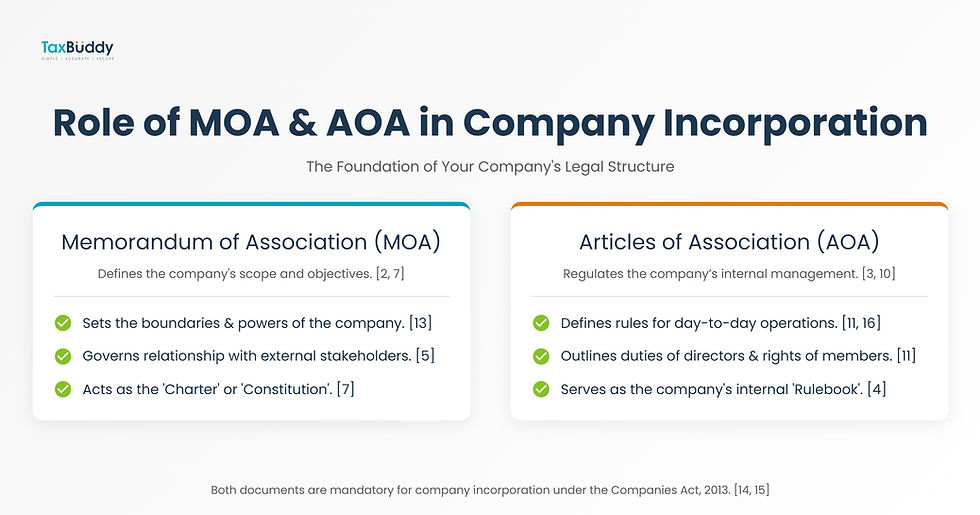
The Memorandum of Association (MOA) and Articles of Association (AOA) are essential legal documents required for company incorporation in India under the Companies Act, 2013. They define the company’s scope, structure, and operational framework. While MOA sets the boundaries of what a company can do, AOA governs how those activities are carried out internally. Both documents must be submitted to the Registrar of Companies during incorporation and remain critical for compliance, governance, and business operations, such as opening bank accounts and dealing with stakeholders.
MOA and AOA together form the legal foundation of a company by defining its objectives, powers, and internal management rules. They ensure that the company operates within a legally approved framework, guide decision-making, and establish clear boundaries between what the company can do externally and how it is governed internally, making them indispensable for incorporation and ongoing compliance.
Table of Contents
What Are MOA and AOA in Company Incorporation
The Memorandum of Association (MOA) and Articles of Association (AOA) are the two most important legal documents required to register a company in India. The MOA acts as the company’s charter and defines its relationship with the outside world. It clearly states what the company is allowed to do. The AOA, on the other hand, governs how the company operates internally by laying down rules for management, decision-making, and administration.
Both documents are filed with the Registrar of Companies (RoC) at the time of incorporation and become binding on the company, its members, and its stakeholders.
Role of MOA and AOA in the Company Incorporation Process
MOA and AOA play a central role in the company incorporation process under the Companies Act, 2013. They are mandatory documents that must be submitted along with the incorporation application through the SPICe+ form.
The MOA defines the purpose and scope of the business, which helps the RoC assess whether the company’s proposed activities are lawful. The AOA provides clarity on how the company will be managed after incorporation.
Without these documents, the company cannot receive a Certificate of Incorporation. They also serve as the legal base for all future operations, compliance requirements, and governance practices.
Key Clauses of Memorandum of Association (MOA)
The MOA contains six essential clauses that define the company’s structure and scope:
Name Clause This specifies the legal name of the company, including “Private Limited” or “Limited” as applicable.
Registered Office Clause It states the state in which the company’s registered office is located.
Object Clause This is one of the most critical clauses. It defines the main business activities and any incidental activities the company can undertake.
Liability Clause It explains whether the liability of members is limited by shares, guarantee, or is unlimited.
Capital Clause This specifies the authorised share capital of the company and its division into shares.
Subscription Clause It includes details of the initial subscribers who agree to form the company.
These clauses ensure that the company operates within a clearly defined legal framework.
Key Provisions Covered Under Articles of Association (AOA)
The AOA outlines the internal rules and operational framework of the company. It provides detailed guidelines on how the company is governed.
Some key provisions include:
Appointment, powers, and responsibilities of directors
Conduct of board meetings and general meetings
Issue and transfer of shares
Dividend declaration and distribution
Voting rights of shareholders
Maintenance of accounts and records
The AOA can be customised based on the needs of the company, but it must always remain consistent with the MOA.
Difference Between MOA and AOA in Company Law
MOA and AOA serve different purposes but work together as complementary documents.
MOA defines the external scope of the company, while AOA governs internal management. MOA contains fixed clauses that cannot be easily altered, whereas AOA is more flexible and can be amended with shareholder approval. MOA has a higher legal status, and any act beyond it is considered invalid. AOA operates within the framework set by MOA. MOA binds the company with outsiders, while AOA binds the company with its members.
Understanding this difference is important for proper compliance and governance.
Legal Importance of MOA and AOA Under Companies Act, 2013
Under the Companies Act, 2013, the MOA and AOA are legally binding documents. They define the rights, responsibilities, and powers of the company and its members.
Any action taken outside the scope of the MOA is considered ultra vires and cannot be enforced. This protects investors and creditors by ensuring that the company does not engage in unauthorised activities.
The AOA ensures smooth internal functioning by providing clear rules for management and operations. Together, these documents ensure transparency, accountability, and legal compliance.
How MOA Defines Company Objectives and Scope
The MOA plays a critical role in defining what a company can and cannot do. The object clause sets clear boundaries for business activities.
For example, if a company is formed to operate in the manufacturing sector, it cannot engage in unrelated activities like financial services unless such activities are included in the MOA.
This clarity helps regulators, investors, and banks understand the nature of the business. It also ensures that the company remains focused on its defined objectives.
How AOA Governs Internal Management and Operations
The AOA acts as the internal rulebook of the company. It governs how decisions are made, how authority is distributed, and how operations are carried out.
It defines the roles of directors, procedures for meetings, and rules for issuing shares. It also sets the framework for handling disputes and decision-making processes.
By providing structured guidelines, the AOA ensures smooth functioning and avoids confusion in day-to-day operations.
Submission of MOA and AOA Through SPICe+ Form
During incorporation, MOA and AOA are submitted electronically through the SPICe+ (Simplified Proforma for Incorporating Company Electronically Plus) form.
This integrated form allows companies to complete multiple registrations in one place, including PAN and TAN. The MOA and AOA are digitally signed by subscribers and professionals before submission.
Once verified, the Registrar of Companies issues the Certificate of Incorporation, making the company legally valid.
Role of MOA and AOA in Opening a Company Bank Account
After incorporation, banks require certified copies of the MOA and AOA to open a current account.
Banks use these documents to verify the company’s objectives, authorised signatories, and governance structure. The object clause is especially important as it helps banks understand the nature of business activities.
If there is any mismatch between the company’s operations and its MOA, it may lead to delays or rejection in account opening.
Amendment Process of MOA and AOA After Incorporation
Changes in business requirements may require amendments to the MOA or AOA.
MOA amendments usually require a special resolution and approval from the Registrar of Companies. In some cases, additional regulatory approvals may also be required.
AOA amendments are comparatively simpler and can be done through a special resolution followed by filing Form MGT-14.
These changes must be properly documented and filed to ensure continued compliance.
Common Mistakes While Drafting MOA and AOA
Many companies face issues due to poorly drafted MOA and AOA. Common mistakes include:
Defining overly narrow or vague object clauses
Missing out on incidental business activities
Drafting an AOA that conflicts with the MOA
Not customising the AOA as per business needs
Ignoring future scalability while drafting clauses
Such mistakes can lead to compliance issues and operational restrictions later.
Recent Updates Related to MOA and AOA Compliance
Recent updates have focused on simplifying the incorporation process through digital filing and e-stamping.
The introduction of SPICe+ has streamlined the submission of MOA and AOA. Digital signatures and online verification have reduced paperwork and improved efficiency.
There have been no major structural changes in MOA and AOA provisions, but continuous improvements in e-governance have made compliance faster and more accessible.
How Professional Platforms Simplify Company Incorporation and Compliance
Managing incorporation documents and ongoing compliance can be complex, especially for new businesses.
Professional platforms simplify this process by assisting with document preparation, filing, and compliance tracking. They help ensure that MOA and AOA are drafted correctly and aligned with legal requirements.
Platforms like TaxBuddy also support businesses after incorporation by managing tax filings, maintaining compliance, and simplifying financial processes through a structured and user-friendly system.
Conclusion
MOA and AOA form the backbone of a company’s legal and operational framework. They define what a company can do and how it will function internally. From incorporation to ongoing compliance, their role remains critical at every stage of business operations.
As businesses grow, managing compliance, documentation, and tax filings becomes equally important. For anyone looking for assistance in tax filing and post-incorporation compliance, it is advisable to use reliable digital solutions. For anyone looking for assistance in tax filing, it is highly recommended to download the TaxBuddy mobile app for a simplified, secure, and hassle-free experience.
FAQs
Q1. What is the role of MOA in company incorporation?
The Memorandum of Association (MOA) defines the company’s legal identity and scope of operations. It outlines what the company is permitted to do, including its main business activities and related functions. During incorporation, the Registrar of Companies reviews the MOA to ensure that the proposed activities are lawful. Once registered, the company must strictly operate within the boundaries defined in the MOA.
Q2. What is the purpose of AOA in a company?
The Articles of Association (AOA) provide the internal rulebook for managing the company. It governs how decisions are made, how directors are appointed, how shares are issued or transferred, and how meetings are conducted. It ensures smooth functioning by clearly defining roles, responsibilities, and procedures within the organisation.
Q3. Why are MOA and AOA mandatory for incorporation?
MOA and AOA are mandatory because they establish the legal and operational framework of the company. Without these documents, the Registrar of Companies cannot assess the nature of the business or how it will be managed. They also ensure transparency for investors, regulators, and other stakeholders.
Q4. What are the key clauses included in the MOA?
The MOA contains six essential clauses:
Name clause specifying the company’s legal name
Registered office clause indicating the state of registration
Object clause defining business activities
Liability clause explaining member liability
Capital clause detailing share capital
Subscription clause listing initial shareholders
These clauses form the foundation of the company’s legal structure.
Q5. Can a company perform activities outside its MOA?
No, a company cannot perform activities outside its MOA. Any such activity is considered ultra vires and is legally invalid. This rule protects shareholders and creditors by ensuring that the company does not engage in unauthorised or risky activities beyond its approved scope.
Q6. How does AOA differ from MOA in practical terms?
In practical terms, MOA defines what a company can do, while AOA defines how it will do it. MOA deals with external relationships and business scope, whereas AOA focuses on internal governance, such as meetings, management decisions, and operational procedures.
Q7. Is it possible to amend the MOA after company incorporation?
Yes, MOA can be amended, but the process is relatively strict. It requires passing a special resolution and obtaining approval from the Registrar of Companies. Certain changes, such as altering the object clause, may require additional regulatory approvals.
Q8. How can AOA be amended after incorporation?
AOA can be amended through a special resolution passed by shareholders. The company must then file the required form with the Registrar of Companies within the prescribed timeline. Compared to MOA, the amendment process for AOA is more flexible.
Q9. What is the role of MOA and AOA in opening a company bank account?
Banks require certified copies of the MOA and AOA to verify the company’s structure and operations. The MOA helps banks understand the nature of the business, while the AOA confirms the authority of directors and authorised signatories. Any mismatch can delay the account opening process.
Q10. Are MOA and AOA available for public inspection?
Yes, both MOA and AOA are public documents. They are filed with the Registrar of Companies and can be accessed through the MCA portal. This transparency helps investors, creditors, and stakeholders verify company details.
Q11. What happens if there is a conflict between MOA and AOA?
In case of a conflict, the MOA prevails over the AOA. Since the MOA defines the fundamental scope of the company, the AOA must always align with it. Any provision in the AOA that contradicts the MOA will be considered invalid.
Q12. Why is the proper drafting of the MOA and AOA important for startups?
Proper drafting is crucial because it directly impacts the company’s flexibility and future growth. A poorly drafted MOA may restrict business expansion, while an unclear AOA can lead to governance issues and disputes. Careful drafting ensures smooth operations, compliance, and scalability as the business grows.


