

How TaxBuddy’s APIs Help Banks Offer Embedded Tax Filing Without Building In-House
- Ankita Murkute

- May 25
- 7 min read
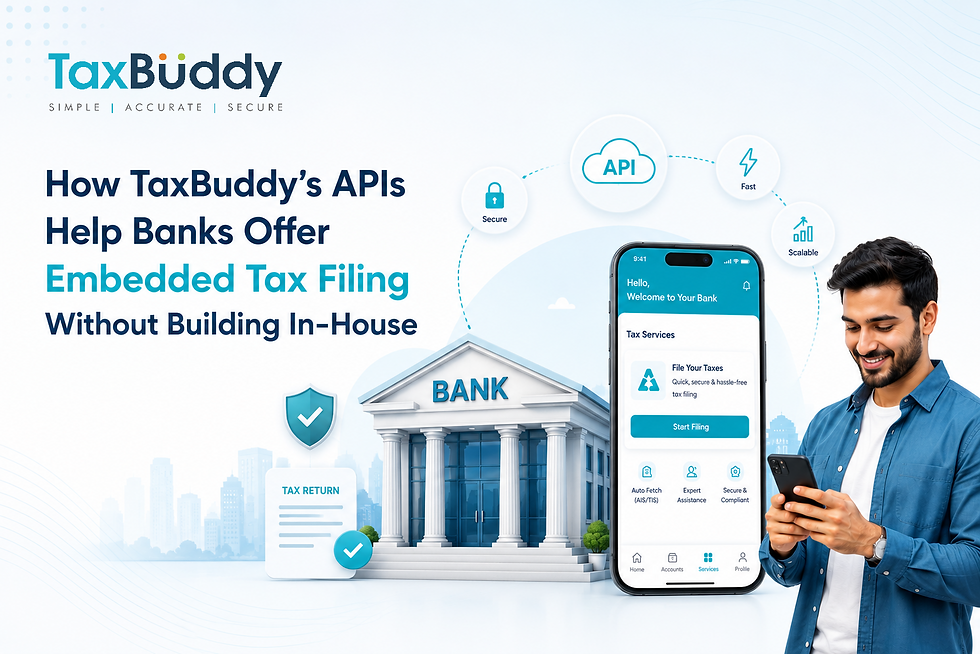
Banking apps are no longer competing only on transactions. Most large banking ecosystems today already offer investing, lending, wealth visibility, insurance, rewards, and financial insights inside the same platform. As customers become more comfortable managing broader aspects of their financial lives digitally, they increasingly expect related financial responsibilities to feel connected as well. Tax filing is gradually becoming part of that expectation.
For banks, this creates an interesting challenge. Customers want smoother and more connected financial experiences during tax season, but banks themselves do not necessarily want to build and maintain large-scale tax infrastructure internally. This is exactly where embedded filing infrastructure and API-led integration models are becoming important across BFSI ecosystems.
Table of Contents
Why Tax Filing Is Becoming Relevant for Banks
Customers increasingly view financial life as one connected experience rather than multiple disconnected activities. A salaried user receiving salary credits inside a banking app may already track investments, savings, spending patterns, loan repayments, and portfolio activity digitally. During filing season, the same customer suddenly has to move outside the banking ecosystem entirely to manage taxes, deductions, refunds, and filing workflows.
This behavioural shift is making tax filing more relevant for banks than before.
The opportunity is not really about tax filing itself. It is about remaining operationally relevant during one of the most financially active periods of the year. Filing season is when customers actively think about investments, deductions, savings behaviour, refunds, and financial planning decisions. Banks increasingly recognise that if these interactions happen completely outside their ecosystem, customer engagement during financially important moments also shifts elsewhere.
The Problem With Building Tax Infrastructure Internally
Although embedded filing sounds attractive from a customer-experience perspective, building tax infrastructure internally is significantly more complex than many people initially assume.
Tax infrastructure is not static. Filing systems constantly evolve with regulatory updates, reporting requirements, deduction structures, reconciliation logic, compliance workflows, and operational changes. Maintaining such infrastructure requires continuous adaptation and highly specialised operational focus.
Banks already manage extremely sophisticated internal ecosystems involving core banking systems, onboarding architecture, lending infrastructure, fraud systems, customer servicing environments, security frameworks, and governance workflows. Adding a continuously evolving compliance infrastructure layer on top of this creates substantial operational overhead.
For most banking ecosystems, the issue is not technological capability. Banks absolutely have strong engineering infrastructure internally. The real issue is whether maintaining specialised filing systems should become part of their long-term operational focus. Increasingly, many banks believe the answer is no.
Why Banks Prefer API-Led Integration Models
API-led integration models solve this problem much more efficiently because they allow banks to support filing journeys without rebuilding entire tax ecosystems internally.
Instead of approaching embedded filing as a large in-house technology project, banks can integrate modular filing workflows into their existing digital environment while continuing to focus internal resources on broader banking priorities. This dramatically changes deployment strategy because the infrastructure becomes an operational layer supporting the ecosystem instead of a completely separate system requiring long-term ownership.
The biggest advantage here is flexibility.
Banks can support filing readiness, tax-planning journeys, and embedded filing workflows without restructuring their broader operational architecture around tax systems. The ecosystem expands in capability without becoming operationally heavy internally.
How Embedded Filing Changes the Banking Experience
Embedded filing changes the customer experience in ways that are often subtle but extremely important.
Customers rarely think in terms of APIs or infrastructure layers. They think in terms of continuity, familiarity, and trust. When a filing workflow feels operationally connected to the banking app itself, the customer experiences the ecosystem as smoother and more financially capable.
This matters because tax filing is psychologically different from many other financial activities. Customers become more sensitive during workflows involving income disclosure, deductions, refunds, compliance interpretation, and financial reporting. If the journey suddenly feels external or operationally disconnected, confidence weakens quickly.
Embedded workflows reduce that interruption.
The banking ecosystem continues feeling familiar even during highly sensitive financial interactions. Over time, this changes how customers emotionally categorise the bank itself. The platform stops feeling like only a transaction utility and starts feeling more like a broader financial operating environment.
Why White-Label Filing Matters in BFSI Ecosystems
Trust behaves differently in banking compared to many other digital ecosystems.
Customers expect banking experiences to feel stable, operationally secure, professionally governed, and consistent across workflows. This is why white-label filing infrastructure matters much more inside BFSI ecosystems than many fintech environments.
The moment customers feel pushed into unfamiliar systems during filing season, the experience starts feeling fragmented. Even if the workflow technically functions well, the operational continuity breaks.
White-label filing infrastructure helps preserve ecosystem consistency because customers continue interacting inside an environment that already feels familiar. The filing experience feels integrated into the broader banking relationship rather than outsourced externally.
For banks, that continuity is extremely important because customer trust is built as much through workflow behaviour as through financial products themselves.
The Operational Advantage of Plug-and-Play APIs
One of the biggest reasons plug-and-play APIs are becoming attractive across BFSI ecosystems is that they reduce operational friction significantly.
Large banking systems cannot afford constant infrastructure disruption every time a new financial workflow is introduced. Traditional enterprise projects often involve lengthy implementation cycles, internal dependency management, governance coordination, operational testing, and multiple approval layers.
Plug-and-play integration models simplify this process considerably.
Banks can integrate embedded filing workflows incrementally without redesigning large parts of their existing infrastructure environment. This improves deployment agility while preserving operational stability, which becomes especially important in highly regulated BFSI ecosystems where governance and continuity matter as much as innovation speed.
How Filing Season Is Becoming a Customer Engagement Layer
Historically, banks treated filing season as operationally external to the banking relationship. That perception is changing. Tax season creates unusually high financial engagement because customers become deeply aware of:
savings
investments
deductions
refunds
liabilities
financial planning decisions
This creates a behavioural window where users actively think about financial organisation and optimisation. Banks increasingly want to remain part of those moments instead of becoming invisible during them.
Embedded filing infrastructure therefore becomes much more than a compliance convenience layer. It becomes part of a larger customer-engagement strategy where the ecosystem stays financially relevant throughout the broader financial journey.
Why Continuity Matters More Than Additional Features
Modern financial ecosystems are increasingly competing on continuity rather than sheer feature count.
Most large digital financial platforms already offer broadly similar capabilities. What differentiates stronger ecosystems is how naturally those workflows operate together. Customers increasingly prefer environments where financial actions feel connected instead of fragmented across multiple operational systems.
Embedded filing supports this continuity because customers no longer feel forced to mentally leave the banking environment during filing season. The experience feels operationally smoother and emotionally easier to navigate.
That continuity quietly strengthens long-term ecosystem trust.
How TaxBuddy Supports Embedded Filing Infrastructure
TaxBuddy’s infrastructure is designed specifically to help banking ecosystems support embedded filing journeys without building large-scale tax systems internally.
The infrastructure supports plug-and-play APIs, white-label ITR filing workflows, scalable compliance systems, BFSI-oriented integration architecture, and embedded tax-planning journeys designed for modern banking ecosystems.
The objective is not to turn banks into tax filing companies. The larger goal is helping banks remain operationally connected during filing season without taking on unnecessary compliance infrastructure complexity internally.
TaxBuddy also supports ecosystem engagement through free tax webinars, financial awareness initiatives, filing-readiness campaigns, and guided customer education programs that help improve customer confidence during tax-heavy periods.
Its 17K+ Google reviews also help reinforce trust across embedded financial workflows where operational reliability strongly influences customer behaviour.
Conclusion
Banks are gradually evolving into broader financial ecosystems where customers increasingly expect financial responsibilities to feel connected rather than fragmented. Tax filing is becoming part of that behavioural shift.
At the same time, building and continuously managing specialised tax infrastructure internally is operationally intensive and strategically inefficient for most BFSI ecosystems. This is why API-led filing infrastructure and plug-and-play integration models are becoming increasingly important.
The value lies not only in enabling filing workflows faster, but in helping banks remain relevant during financially important customer interactions while preserving operational flexibility and ecosystem continuity.
TaxBuddy supports this shift through embedded APIs, scalable filing infrastructure, white-label workflows, and BFSI-oriented integration architecture designed specifically for modern banking ecosystems.
FAQs
Q1. Why are banks becoming interested in embedded tax filing?
Banks increasingly want to remain part of the broader financial journey instead of functioning only as transaction platforms. Filing season creates high customer engagement around savings, investments, deductions, and financial planning, making embedded filing strategically relevant.
Q2. Why don’t banks build tax infrastructure internally?
Maintaining filing infrastructure requires continuous regulatory adaptation, operational governance, reporting updates, and specialised compliance workflows. For most banks, building and managing such infrastructure internally creates significant operational overhead.
Q3. What are plug-and-play APIs in embedded filing infrastructure?
Plug-and-play APIs allow banking ecosystems to integrate filing workflows more efficiently without redesigning their broader infrastructure environment. This improves deployment speed while preserving operational stability.
Q4. Why is white-label filing important for BFSI ecosystems?
Banking customers expect workflows to feel familiar, stable, and operationally secure. White-label filing preserves continuity because the experience remains aligned with the broader banking environment instead of feeling externally disconnected.
Q5. How does embedded filing improve customer experience?
Embedded filing reduces workflow interruption during tax season. Customers can access filing-related workflows inside familiar environments, which improves continuity, confidence, and overall financial experience quality.
Q6. What makes tax infrastructure operationally complex?
Tax systems continuously evolve through regulatory updates, filing logic changes, compliance workflows, reporting structures, and reconciliation requirements. Maintaining such systems requires specialised operational focus.
Q7. Why does continuity matter so much in digital banking?
Modern customers increasingly prefer ecosystems where financial activities feel connected instead of fragmented. Continuity strengthens trust because workflows feel smoother, more predictable, and operationally familiar.
Q8. How does TaxBuddy support banking ecosystems?
TaxBuddy supports banks through plug-and-play APIs, white-label filing infrastructure, scalable compliance systems, embedded filing workflows, and BFSI-oriented integration architecture designed specifically for banking environments.




Comments