

What Happens If a Business Operates Without the Required License in India?

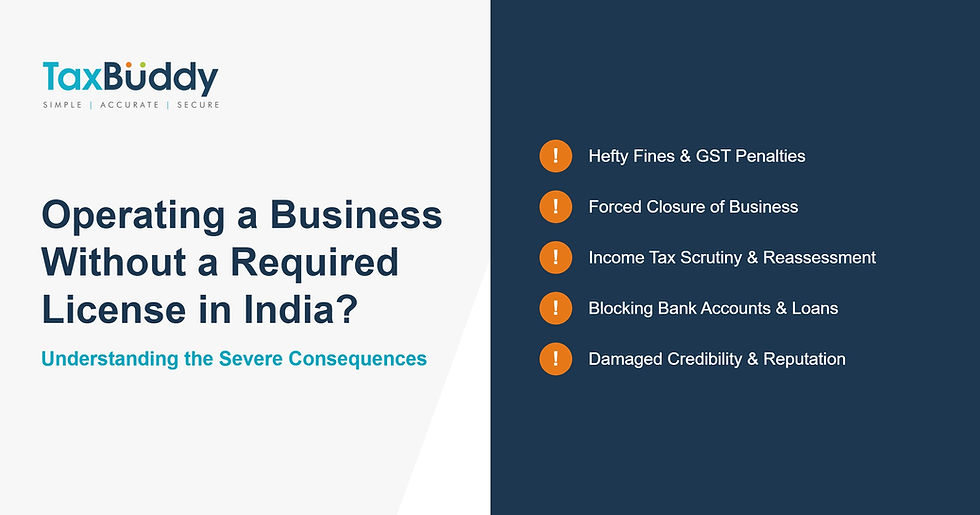
Operating a business without the required license in India can lead to fines, forced closure, GST penalties, and income tax scrutiny. State laws such as the Shops and Establishments Act and central regulations like GST registration make business licenses mandatory for most commercial activities. Non-compliance can block bank account opening, delay loans, attract reassessment under the Income Tax Act, 1961, and damage credibility with customers and authorities. Recent enforcement actions across major states show that authorities are actively penalising unlicensed operations, making compliance essential for sustainable growth.
If a business operates without the required license in India, it may face immediate monetary penalties, closure notices, GST fines, income tax scrutiny, and long-term operational restrictions, such as the inability to open a current account or participate in government tenders. Continued non-compliance can escalate into reassessment proceedings, audit penalties, and prosecution depending on the nature and scale of the violation.
Table of Contents
What Happens If a Business Operates Without the Required License in India?
Operating a business without the required license in India can result in fines, closure orders, GST penalties, and income tax scrutiny. Authorities treat licensing as the first step toward legal recognition. When a business runs without registration under applicable state or central laws, it may receive penalty notices, face inspection raids, or be sealed by municipal authorities. In addition, the absence of proper registration can trigger compliance mismatches under GST and the Income Tax Act, 1961, especially where turnover, PAN linkage, or tax reporting does not align with declared records.
Legal Framework Governing Business Licenses in India
Business licensing in India operates through a mix of state and central laws. The Shops and Establishments Act, adopted and modified by each state, mandates registration for shops, service providers, offices, restaurants, and commercial establishments. Municipal corporations also require trade licenses based on the nature of the activity.
On the central side, GST registration becomes mandatory once turnover crosses the prescribed limits or in specified cases such as inter-state supply. The Income Tax Act, 1961, governs PAN, TAN, audit requirements under Sections 44AA and 44AB, and reporting obligations. These laws are interconnected. Non-compliance under one often reflects in the others through data-sharing mechanisms between departments.
Is a Trade License Mandatory Under the Shops and Establishments Act?
Yes, in most states, obtaining registration under the respective Shops and Establishments Act is mandatory before commencing operations. This applies to physical shops, offices, warehouses, eateries, consultancies, and service providers.
State authorities require businesses to register within a prescribed number of days from commencement. Operating without this registration is treated as a statutory violation. Municipal bodies can issue notices, levy fines, or direct closure until compliance is completed.
Penalties for Operating Without a Trade License in India
Penalties vary by state and type of violation, but typically include:
Monetary fines for non-registration
Additional penalties for delayed renewal
Closure or sealing of premises
Suspension of business activity until compliance
In many states, delayed renewal attracts a penalty that may extend up to 50 per cent of the license fee. Operating entirely without a license can result in heavy fines and closure orders. Repeated violations may lead to prosecution under municipal or state regulations.
GST Registration and Business License Non-Compliance
If a business crosses the GST threshold but operates without registration, it can face penalties under GST law. The minimum penalty is often Rs. 10,000 or 10 per cent of the tax due, whichever is higher, along with interest.
Unlicensed businesses may also fail to issue proper tax invoices or file GST returns. This creates a mismatch in the GST network and may invite inspection. Since GST data is integrated with income tax systems, discrepancies in turnover reporting can raise red flags during assessments.
Income Tax Implications of Unlicensed Business Operations
Under the Income Tax Act, 1961, businesses must maintain books of account in certain cases and undergo an audit if turnover exceeds the prescribed limits. An unlicensed business often attempts to operate informally, which increases the risk of under-reporting income.
If turnover reported in GST, bank statements, or third-party information does not match income declared in returns, the Assessing Officer may initiate proceedings. Penalties under Sections 271B or other relevant provisions can apply for audit failures or inaccurate reporting.
Can an Unlicensed Business Face Income Tax Reassessment?
Yes. If tax authorities receive information about undisclosed turnover or suspicious transactions, reassessment proceedings may be initiated. Data from banks, GST filings, and financial intelligence reporting under Section 285BA can trigger scrutiny.
An unlicensed status can intensify scrutiny because it indicates potential non-compliance. In severe cases, prosecution proceedings may follow if deliberate concealment is established.
Bank Account Opening Challenges Without a Business License
Banks require documentation such as a trade license, a GST registration certificate, and proof of business existence when opening a current account. Account Opening Forms and KYC compliance standards under RBI guidelines make these documents essential.
Without proper licensing:
Current account applications are rejected
Loan applications are delayed
Suspicious transaction reporting increases
Compliance checks become stricter
This directly impacts operational liquidity and vendor payments.
Impact on Loans, Tenders, and Government Approvals
Government tenders and institutional contracts require proof of legal registration. An unlicensed business cannot typically participate in public procurement processes.
Financial institutions also demand license copies while sanctioning working capital loans or term loans. Lack of compliance reduces creditworthiness and restricts growth opportunities.
Recent Enforcement Actions Against Unlicensed Businesses in India
Recent enforcement drives in major states have shown stricter monitoring. Municipal authorities have conducted inspection campaigns targeting non-registered establishments. Businesses have faced significant fines and temporary shutdowns.
Authorities increasingly rely on digital data matching between GST, municipal records, and income tax databases. This integrated monitoring reduces the scope for informal operations.
Financial and Reputational Risks of Non-Compliance
Beyond fines, the long-term risks include:
Loss of customer trust
Vendor reluctance to engage
Difficulty in securing funding
Reduced brand credibility
Once a business is flagged for non-compliance, reputational damage can extend beyond the immediate penalty. Compliance failures may also be publicly recorded in government databases.
How to Regularise an Unlicensed Business in India
Regularisation generally involves:
Applying for registration under the relevant Shops and Establishments Act
Obtaining or updating GST registration if applicable
Aligning PAN and bank details
Clearing outstanding penalties
Updating tax filings to reflect accurate income
The process may take 7 to 30 days, depending on the state and the nature of the violation. It is advisable to ensure that GST returns and income tax filings are updated simultaneously to avoid mismatches.
How TaxBuddy Helps Businesses Stay Compliant with GST and Income Tax
Compliance requires coordination across multiple registrations and filings. TaxBuddy assists businesses in managing GST filings, tracking income tax obligations, and ensuring alignment between reported turnover and tax returns.
Digital dashboards help monitor due dates, while professional support ensures accurate documentation. Structured compliance support reduces the risk of reassessment and penalty exposure, especially for small and medium businesses transitioning into formal operations.
Conclusion
Operating without the required license exposes a business to legal penalties, tax scrutiny, and operational restrictions. Compliance under state trade license laws, GST regulations, and the Income Tax Act, 1961 is essential for sustainable growth. Early registration and consistent tax reporting protect both reputation and revenue stability.
For anyone looking for assistance in business tax compliance and filings, it is advisable to download the TaxBuddy mobile app for a simplified, secure, and hassle-free experience.
FAQs
Q1. Is it illegal to operate a business in India without a trade license?
Yes. In most states, operating a business without obtaining the required trade license or registration under the Shops and Establishments Act is considered a statutory violation. Municipal authorities can issue penalty notices, impose fines, and even order the temporary closure of the establishment until compliance is completed.
Q2. What is the penalty for running a business without a required license in India?
Penalties vary by state and type of business, but typically include monetary fines, additional charges for delayed registration or renewal, and closure notices. In GST-related cases, penalties may include at least Rs. 10,000 or 10 per cent of the tax due, along with applicable interest.
Q3. Can authorities shut down an unlicensed business immediately?
Yes. Local municipal bodies and enforcement officers have the power to seal or shut down establishments operating without proper registration. In many cases, closure continues until the business completes registration and pays applicable penalties.
Q4. Does operating without a license affect GST compliance?
Yes. If GST registration is mandatory and not obtained, the business may face GST penalties, interest, and scrutiny. Non-registration can also lead to invalid invoices, blocked input tax credit for customers, and an investigation by tax authorities.
Q5. How does operating without a license impact income tax assessments?
An unlicensed business may attract closer scrutiny during income tax assessments. If reported income does not match bank transactions, GST data, or third-party reports, reassessment proceedings may be initiated under the Income Tax Act, 1961.
Q6. Can a business open a current account without a trade license?
In most cases, no. Banks require proof of business registration, trade license, GST registration (if applicable), and PAN details to open a current account. Without these documents, account opening applications are often rejected or delayed.
Q7. Is GST registration mandatory even if a business does not have a trade license?
If turnover exceeds the prescribed GST threshold or the business falls under compulsory registration categories, GST registration is mandatory regardless of trade license status. However, authorities may question the absence of a trade license during verification.
Q8. Can an unlicensed business participate in government tenders?
No. Government tenders and institutional contracts require valid business registration documents, including a trade license and GST registration. Without these, the business becomes ineligible for public procurement opportunities.
Q9. How long does it take to regularise an unlicensed business?
The timeline depends on the state and nature of the business. In many cases, registration under the Shops and Establishments Act can be completed within 7 to 30 days, provided all required documents are submitted and penalties are cleared.
Q10. Does non-compliance affect loan eligibility?
Yes. Financial institutions require business registration certificates, GST details, and tax returns while processing working capital or term loan applications. An unlicensed business may face rejection or reduced creditworthiness.
Q11. Are there reputational risks associated with operating without a license?
Yes. Enforcement actions, penalty notices, or public records of non-compliance can damage business credibility. Customers, vendors, and financial institutions may hesitate to engage with a business that lacks proper registration.
Q12. What steps should a business take immediately after receiving a notice for operating without a license?
The business should review the notice carefully, apply for the required registration through the appropriate state portal, clear outstanding penalties, and align GST and income tax records. Prompt corrective action reduces the risk of escalation, including reassessment or prosecution.


