

Who Is Eligible to Apply for a Lower Deduction Certificate

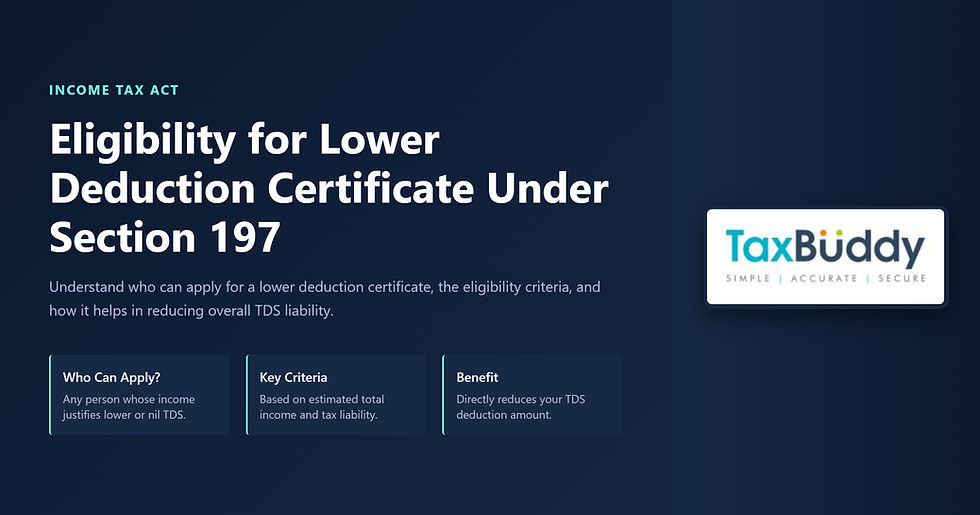
A lower deduction certificate under Section 197 of the Income Tax Act allows taxpayers to reduce or avoid excess TDS when their actual tax liability is lower than the standard rates. Many individuals, businesses, and NRIs face higher TDS deductions despite having lower taxable income. This creates cash flow issues and delays refunds. Eligibility depends on income estimation, applicable deductions, and the nature of income subject to TDS. Understanding who qualifies helps taxpayers plan better, reduce unnecessary deductions, and ensure smoother tax compliance throughout the financial year.
A taxpayer is eligible to apply for a lower deduction certificate if their estimated total income justifies a lower or nil TDS compared to standard rates, subject to approval by the Assessing Officer.
Table of Contents
What Is a Lower Deduction Certificate Under Section 197
A Lower Deduction Certificate under Section 197 of the Income Tax Act allows a taxpayer to request a deduction of tax at source at a reduced rate or at nil. This is issued by the Assessing Officer when the taxpayer’s actual tax liability is expected to be lower than the standard TDS rate applicable to a particular income.
Instead of waiting for refunds after filing returns, the certificate helps align TDS with actual tax liability, improving cash flow and reducing unnecessary deductions.
Who Is Eligible to Apply for a Lower Deduction Certificate
Any taxpayer whose estimated income results in a lower tax liability than the prescribed TDS rate can apply for a lower deduction certificate.
This includes individuals, businesses, NRIs, professionals, and other entities, provided they can justify their lower tax liability through proper computation and documentation.
Core Eligibility Criteria for Lower Deduction Certificate
To qualify, two main conditions must be satisfied.
First, the income must be subject to TDS under the Income Tax Act. Second, the estimated total income after deductions and exemptions should result in a lower tax liability than the standard TDS rate.
Income Types Eligible for Lower TDS Certificate
Various types of income are eligible for lower TDS.
These include rent, interest income, professional fees, contract payments, dividend income, and property transactions. The eligibility depends on whether these incomes attract TDS and the taxpayer’s final tax liability.
Categories of Taxpayers Eligible for Lower Deduction Certificate
Different categories of taxpayers can apply for a lower deduction certificate.
These include resident individuals, NRIs, companies, LLPs, partnership firms, trusts, and professionals. Each category must meet the eligibility criteria based on income and tax computation.
Resident Individuals and Eligibility for Lower TDS
Resident individuals can apply when their total income after deductions falls below the taxable limits or results in a lower tax liability.
This is common in cases where significant deductions or exemptions reduce the final tax payable.
Eligibility of NRIs for Lower Deduction Certificate
NRIs often face higher TDS rates on income, such as property sales, rent, and interest.
If their actual tax liability is lower, they can apply for a lower deduction certificate to avoid excessive tax deduction.
Eligibility of Companies, Firms, and LLPs
Companies, firms, and LLPs can apply when their projected income leads to lower tax liability compared to standard TDS rates.
This is relevant for contract payments, professional fees, and other business income streams.
Eligibility of Freelancers and Professionals
Freelancers and professionals receiving income subject to TDS can apply for a lower deduction certificate.
If their actual tax liability is lower due to expenses and deductions, they can reduce TDS through this mechanism.
When the Lower Deduction Certificate Is Not Applicable
A lower deduction certificate is not available for certain types of income where fixed TDS rates apply or where the law restricts reduction.
In such cases, taxpayers must follow standard TDS provisions and claim refunds if applicable.
How Eligibility Is Assessed by the Assessing Officer
The Assessing Officer evaluates eligibility based on past tax returns, current income projections, and supporting documents.
They verify whether the claimed lower tax liability is reasonable and consistent with the taxpayer’s financial records.
Role of Estimated Income in Determining Eligibility
Estimated income plays a key role in determining eligibility.
Taxpayers must provide a detailed computation of expected income, deductions, and tax liability for the financial year. This helps justify the request for lower or nil TDS.
Documents Required to Prove Eligibility for LDC
Applicants must submit supporting documents such as income projections, past tax returns, financial statements, and details of deductions and exemptions.
Accurate documentation ensures faster processing and increases the chances of approval.
Benefits of Applying for a Lower Deduction Certificate
The primary benefit is improved cash flow.
By reducing unnecessary TDS, taxpayers can retain more funds during the year instead of waiting for refunds. It also simplifies tax planning and reduces compliance burden.
Common Mistakes While Assessing Eligibility
Assessing eligibility for a lower deduction certificate requires careful evaluation of income, deductions, and overall tax liability. However, many applicants make mistakes at this stage, which can lead to rejection of the application or issuance of a certificate at an incorrect rate.
One of the most common errors is incorrect estimation of income. Taxpayers often underestimate their total income for the financial year by overlooking variable components such as bonuses, additional contracts, interest income, or capital gains. Since the certificate is issued based on projected income, any underestimation can result in a mismatch between actual tax liability and the approved TDS rate, which may lead to complications later.
Incomplete or inadequate documentation is another frequent issue. The Assessing Officer relies on supporting documents such as past income tax returns, financial statements, and detailed income projections to verify the claim. If these documents are missing, inconsistent, or not properly prepared, it can delay processing or lead to rejection of the application.
Failure to consider all income sources is also a critical mistake. Many applicants focus only on the income for which they are seeking lower TDS and ignore other sources, such as interest from bank deposits, rental income, or freelance earnings. Since eligibility is based on total income across all sources, excluding any component can result in an incorrect tax computation.
Another common oversight is not accounting for changes in income during the year. Business income, professional receipts, or investment returns may fluctuate, and relying on static estimates without considering possible variations can affect the accuracy of the application.
In some cases, applicants also fail to factor in existing tax liabilities or pending dues. Outstanding taxes can influence the Assessing Officer’s decision, and ignoring them may reduce the chances of approval.
Overall, careful planning, accurate estimation, and complete documentation are essential while assessing eligibility. A well-prepared application not only improves the chances of approval but also ensures that the certificate reflects the correct tax position, avoiding future compliance issues.
How Digital Platforms Simplify LDC Application and Compliance
Digital platforms have significantly simplified the process of applying for a lower deduction certificate by bringing together all required steps into a single, structured system. Instead of managing multiple documents manually and coordinating with different authorities, taxpayers can organise their information digitally, making the entire process more efficient and easier to handle.
One of the key advantages is document management. Digital platforms allow users to store identity proofs, income details, previous tax returns, and supporting documents in one place. This ensures consistency across filings and reduces the risk of missing or incorrect information during the application. Having all documents readily available also speeds up the preparation of Form 13.
Another important benefit is automated income computation. Platforms assist in calculating estimated income, applicable deductions, and expected tax liability for the financial year. This helps taxpayers present accurate data to the Assessing Officer, improving the chances of approval and reducing the need for follow-ups or corrections.
Tracking the application status is also simplified. Digital systems provide real-time updates on the progress of the application, allowing taxpayers to respond quickly to any queries or additional requirements raised by the tax authorities. This reduces delays caused by communication gaps and helps move the process forward efficiently.
In addition to application support, digital platforms help maintain ongoing compliance. They assist in managing tax filings, monitoring deadlines, and ensuring that all requirements related to the lower deduction certificate are fulfilled. This is especially useful when multiple income sources are involved.
Solutions like TaxBuddy further enhance this process by offering structured workflows for Form 13 preparation, guided assistance in submitting applications, and support for tax filing and compliance management. By combining automation with expert guidance, such platforms reduce errors, improve accuracy, and ensure that taxpayers can complete the entire process smoothly and efficiently.
Conclusion
A lower deduction certificate helps taxpayers align TDS with their actual tax liability, improving cash flow and reducing unnecessary deductions. Understanding eligibility and preparing accurate documentation is essential for approval.
Using digital tools makes the process more efficient and reduces errors. For anyone looking for assistance in tax filing and LDC application, it is highly recommended to download the TaxBuddy mobile app for a simplified, secure, and hassle-free experience.
FAQs
Q1. Who is eligible to apply for a lower deduction certificate under Section 197?
Any taxpayer, including individuals, NRIs, companies, firms, LLPs, and professionals, can apply if their estimated total income results in a lower tax liability than the standard TDS rate applicable to their income.
Q2. What are the basic conditions to qualify for a lower deduction certificate?
Two main conditions must be met. The income must be subject to TDS, and the taxpayer must demonstrate that their total tax liability for the financial year will be lower than the prescribed TDS rate after considering deductions and exemptions.
Q3. Can a taxpayer with no taxable income apply for a nil deduction certificate?
Yes, if the estimated total income after deductions falls below the basic exemption limit, the taxpayer can apply for a nil deduction certificate, subject to approval by the Assessing Officer.
Q4. Are salaried individuals eligible for a lower TDS certificate?
Salaried individuals can apply if they have additional income subject to TDS, such as rent or interest, and their overall tax liability is lower than the TDS deducted on such income.
Q5. Can NRIs apply for a lower deduction certificate?
Yes, NRIs are eligible and often apply in cases such as property sales, rent, or interest income, where standard TDS rates are higher than their actual tax liability.
Q6. Do companies and LLPs qualify for a lower deduction certificate?
Yes, companies, partnership firms, and LLPs can apply if their projected income results in lower tax liability compared to the standard TDS rates applicable to their income streams.
Q7. Is the lower deduction certificate applicable to all types of income?
No, it applies only to income categories where TDS is applicable under specific sections of the Income Tax Act. Certain incomes with fixed deduction rules may not qualify.
Q8. How does the Assessing Officer determine eligibility for LDC?
The Assessing Officer evaluates past tax returns, estimated income for the current year, deductions, and any outstanding tax liabilities. The decision is based on whether the lower tax claim is justified.
Q9. Can freelancers and professionals apply for a lower deduction certificate?
Yes, freelancers and professionals earning income subject to TDS, such as under professional fees, can apply if their net taxable income is lower after expenses and deductions.
Q10. Is the lower deduction certificate valid for multiple income sources?
The certificate is valid only for the income types and TDS sections specified in the application. Separate or comprehensive details must be provided for each income source.
Q11. What happens if actual income differs from the estimated income provided?
If actual income is significantly higher than estimated, the taxpayer must inform the Assessing Officer. The certificate may be revised or cancelled, and additional tax liability may arise.
Q12. How often does a taxpayer need to apply for a lower deduction certificate?
A lower deduction certificate is issued for a specific financial year only. Taxpayers must apply each year again if they continue to meet the eligibility criteria.


