

Why TaxBuddy DIY Filing Accuracy Is Driven by Structured Inputs and Smart Validation
- CA Pratik Bharda

- Mar 6
- 8 min read
DIY income tax filing errors usually happen due to unstructured data entry, incorrect regime selection, or mismatches with government records like Form 26AS and AIS. TaxBuddy addresses these risks by combining structured, guided inputs with intelligent validation checks aligned with the Income Tax Act, 1961. Every step is designed to reduce guesswork, prevent manual mistakes, and ensure data consistency before submission. This approach allows individuals to file returns confidently while maintaining accuracy across income reporting, deductions, and bank details—without needing advanced tax knowledge.
Table of Contents
Why DIY ITR Filing Accuracy Depends on Structured Inputs
DIY ITR filing accuracy depends heavily on how information is captured and organised during the filing process. In many cases, errors do not arise because taxpayers are careless or uninformed, but because the data is entered in an unstructured manner. When figures are typed freely without clear prompts or validations, important details can be overlooked. Income may be reported without linking it to the correct schedule, deductions may be entered without verifying eligibility, or mandatory disclosures may be skipped entirely. These gaps often surface only after the return is processed, leading to adjustments, notices, or refund delays.
Structured inputs address this problem by aligning the filing experience with the actual structure of the income tax return prescribed by the Income Tax Department. Instead of asking users to provide information in a generic format, the system breaks the process into clearly defined sections and fields, each corresponding to a specific schedule, income head, or disclosure requirement. This ensures that salary income, interest income, capital gains, and other components are captured in the correct place and sequence, reducing the risk of misreporting.
Another key advantage of structured inputs is format control. Each field is designed to accept only the type of data it requires, such as numerical values, dates, or identifiers like PAN and IFSC. This prevents common issues like entering text where numbers are expected, using incorrect date formats, or omitting decimal values. By standardising how data is entered, structured inputs help maintain internal consistency across the return.
Structured data entry also ensures completeness. Mandatory fields cannot be left blank, and dependent disclosures are triggered automatically when certain types of income or claims are selected. For example, selecting a particular income head prompts the relevant additional details required under the ITR schema. This reduces the likelihood of filing a technically defective return due to missing schedules or incomplete disclosures.
Overall, structured inputs act as a built-in guide throughout the DIY filing journey. They translate complex ITR requirements into an intuitive, step-by-step process that mirrors statutory reporting rules. By reducing ambiguity, enforcing format discipline, and ensuring completeness, structured inputs play a crucial role in improving the accuracy and reliability of DIY income tax filing.
How TaxBuddy Uses Structured Inputs to Minimise Filing Errors
TaxBuddy uses a structured, guided input system that mirrors the official income tax return format prescribed by the Income Tax Department. Instead of allowing free-text or open-ended entries, the platform breaks the filing process into clearly defined steps that correspond to specific income heads, deduction sections, and disclosure schedules. This ensures that every piece of information provided by the taxpayer fits into the correct legal and technical framework required under Indian tax laws.
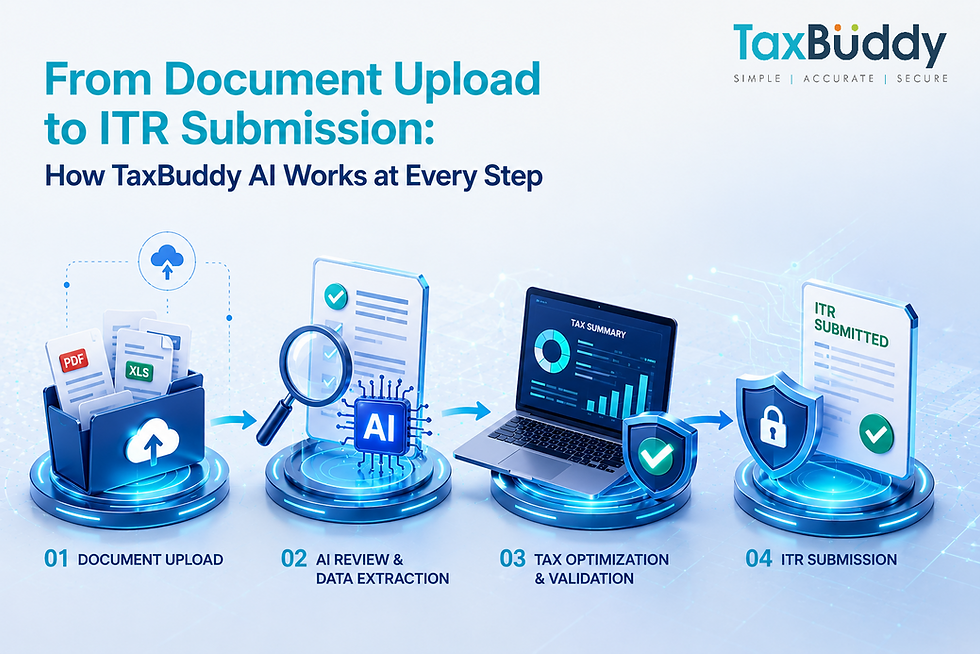
The filing flow prompts users to upload relevant documents such as Form 16, interest certificates, capital gains statements, or bank summaries at appropriate stages. Once uploaded, the system extracts relevant figures and maps them directly to the corresponding fields in the return. For example, salary components are placed under the correct salary schedules, interest income is routed to the appropriate income-from-other-sources section, and tax deductions are aligned with the correct Chapter VIA provisions. This structured placement reduces the risk of income being reported under the wrong head or deductions being claimed in incorrect sections.
By relying on form-based inputs rather than manual data entry, the system significantly reduces typing-related mistakes such as digit errors, skipped values, or incorrect totals. Users are guided through only those fields that are relevant to their income profile, which avoids confusion and prevents unnecessary or incorrect disclosures. This approach also helps taxpayers who are unfamiliar with ITR terminology, as they are not required to interpret complex schedules or decide where a particular figure should be reported.
Structured inputs also support consistency across the return. Since values are captured once and reused wherever required, mismatches between income totals, tax credits, and computation summaries are minimised. This consistency is critical because even small structural errors can lead to processing issues, automated adjustments, or notices after filing. By aligning data entry with the underlying ITR schema from the outset, the platform helps ensure that the final return is both accurate and compliant, reducing avoidable post-filing corrections and delays.
Role of Smart Validation in TaxBuddy DIY Filing Accuracy
Structured inputs alone reduce errors, but smart validation ensures correctness. Validation works as a real-time checkpoint that reviews every entry against applicable tax rules and government data. If an entry does not align with filing logic, the system flags it instantly. This prevents errors from travelling forward into the final submission and ensures that inconsistencies are corrected while the filer is still engaged in the process.
How AI Validation Checks Income, TDS, and Deductions
AI-driven validation checks compare entered income and tax details against Form 26AS and AIS data. Salary income is matched with TDS credits, interest income is cross-verified with bank-reported figures, and deductions under sections such as 80C or 80D are validated for eligibility and limits. If any mismatch appears, alerts are triggered before filing, allowing corrections to be made proactively rather than through post-filing notices.
Bank Detail Accuracy Through Structured Inputs and Smart Validation
Bank details remain one of the most common causes of refund failures. Structured inputs require precise details such as account number, IFSC, and account type. Validation layers then verify whether these details meet e-filing portal standards. This dual-layer approach ensures that incorrect or incomplete bank information does not slip through unnoticed.
Preventing Refund Delays Using IFSC and Account Validation
Refund delays usually occur due to invalid IFSC codes or non-prevalidated accounts. Smart validation checks IFSC formats, maps them to bank branch data, and confirms that the account type matches PAN records. If the account is not eligible for refunds, the filer is guided to correct or validate the account before submission, preventing delays later in the assessment cycle.
Handling Multiple Bank Accounts and Interest Income Reporting
Many taxpayers maintain multiple savings or deposit accounts, leading to fragmented interest income reporting. Structured inputs allow each account to be added individually, while validation checks reconcile interest figures with bank-reported data under Section 194A. This prevents under-reporting or duplication, ensuring complete disclosure across all accounts.
Old vs New Tax Regime Validation During DIY Filing
Incorrect regime selection is a major source of filing errors. Validation logic checks whether claimed deductions are compatible with the selected tax regime. If deductions applicable only under the old tax regime are entered while the new regime is selected, the system flags the inconsistency. This ensures that regime selection aligns with the income structure and deduction eligibility before final submission.
Error Prevention for First-Time and Non-Technical Filers
First-time filers often struggle with terminology, schedules, and compliance logic. Structured inputs simplify this by converting complex tax concepts into plain, sequential questions. Smart validation ensures that even if a user misunderstands a term, the system identifies inconsistencies and prompts clarification. This reduces dependency on external assistance while maintaining filing accuracy.
Compliance Alignment With the Income Tax Act, 1961
Every structured field and validation rule is mapped to provisions of the Income Tax Act, 1961. Income classification, deduction limits, reporting schedules, and disclosure requirements follow statutory rules rather than user interpretation. This alignment ensures that filings remain compliant with current law and departmental processing standards.
Why Structured DIY Filing Reduces Notices and Revisions
Most income tax notices arise from mismatches between filed data and departmental records. Structured inputs reduce omission errors, while smart validation eliminates mismatches before submission. As a result, returns are processed smoothly, reducing the need for revisions, rectifications, or explanations during scrutiny.
Conclusion
Structured inputs and intelligent validation together create a reliable DIY filing environment where accuracy is built into the process rather than corrected later. By guiding users through compliant data entry and validating every critical field against tax rules and government records, TaxBuddy significantly lowers the risk of errors, refund delays, and notices. For anyone looking for assistance in tax filing, it is highly recommended to download the TaxBuddy mobile app for a simplified, secure, and hassle-free experience.
FAQs
Q1. Why do most DIY ITR filing errors occur despite using online platforms?
Most DIY filing errors occur due to unstructured data entry, incorrect classification of income, or mismatches with government records such as Form 26AS and AIS. When platforms allow free-text inputs or lack validation checks, even small mistakes can lead to incorrect tax computation or compliance issues.
Q2. How do structured inputs improve accuracy in DIY income tax filing?
Structured inputs guide users through predefined fields that mirror official ITR forms. Each field expects a specific type of information, reducing ambiguity, preventing skipped disclosures, and ensuring that data is captured in the correct schedule and income head.
Q3. What role does smart validation play in DIY ITR filing?
Smart validation acts as a real-time error-detection layer that checks entered data against tax rules and government records. It flags inconsistencies, missing information, or incorrect selections before submission, allowing corrections to be made proactively.
Q4. How are income and TDS mismatches detected during filing?
Validation systems cross-check declared income and TDS with Form 26AS and AIS data. If salary, interest income, or tax credits do not align with reported figures, alerts are generated to prevent incorrect filings.
Q5. Why are bank details a critical accuracy factor in ITR filing?
Incorrect bank details can lead to refund failures or processing delays. Structured inputs ensure precise entry of account number, IFSC, and account type, while validation confirms compliance with income tax portal requirements.
Q6. How does structured filing help taxpayers with multiple bank accounts?
Structured filing allows each bank account to be added individually, ensuring complete disclosure. Validation reconciles interest income across accounts, reducing the risk of under-reporting or duplication.
Q7. Can structured inputs prevent errors in tax regime selection?
Yes. Validation logic checks whether claimed deductions are compatible with the selected tax regime. If deductions applicable only under the old regime are entered under the new regime, the system flags the inconsistency before filing.
Q8. Is DIY filing suitable for first-time or non-technical taxpayers?
DIY filing becomes suitable for first-time and non-technical users when structured guidance replaces technical terminology, and validation handles compliance logic. This reduces dependency on prior tax knowledge.
Q9. How does structured DIY filing reduce income tax notices?
Most notices arise from mismatches between filed data and departmental records. Structured inputs reduce omission errors, while validation prevents mismatches, significantly lowering the likelihood of scrutiny or clarification notices.
Q10. Are deduction limits and eligibility checked automatically?
Yes. Smart validation checks deductions for eligibility, statutory limits, and regime compatibility, ensuring that incorrect or excess claims are identified before submission.
Q11. How does compliance with the Income Tax Act, 1961, improve filing accuracy?
When structured inputs and validations are mapped directly to provisions of the Income Tax Act, 1961, filings follow statutory requirements rather than user interpretation, reducing legal and procedural errors.
Q12. Why do platforms like TaxBuddy emphasise structured inputs and validation for DIY filing?
Structured inputs standardise data entry, while smart validation ensures correctness against tax laws and government records. Together, they create a controlled filing environment where accuracy is built into the process rather than corrected after submission.




Comments