

Why Gig Platforms Are Adding TaxBuddy’s Embedded Tax SDKs for Worker Tax Compliance

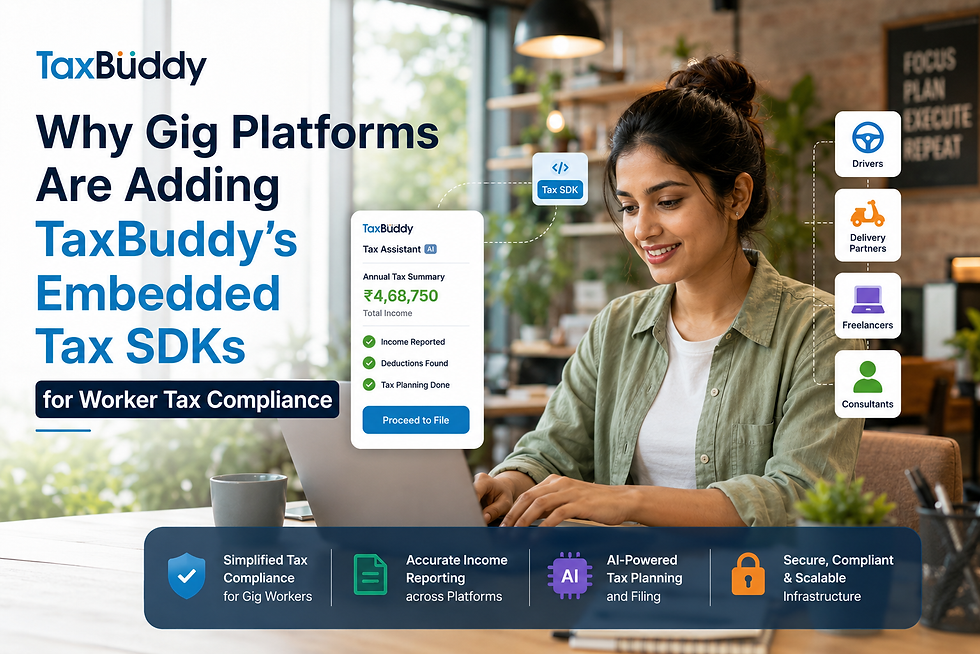
The gig economy changed how millions of people earn income. Drivers, delivery partners, freelancers, creators, consultants, and app-based workers today operate through highly digital ecosystems where onboarding, work allocation, payouts, incentives, and performance tracking happen almost entirely through mobile apps. For many workers, the platform itself has become the primary financial operating environment. But one important part of the journey still often feels disconnected. Tax compliance.
Many gig workers still struggle with questions around income tax filing, income reporting, deductions, income classification, and filing applicability. Unlike salaried employees who usually receive structured payroll support, gig workers often manage tax responsibilities independently while handling multiple income streams across platforms.
This is exactly why gig platforms are beginning to explore embedded tax SDK infrastructure and connected filing workflows. The objective is not turning gig apps into standalone tax advisory systems. The larger shift is about helping workers access smoother filing guidance, tax planning support, and AI-assisted filing journeys directly inside ecosystems they already use daily.
Table of Contents
How Gig Platforms Became Financial Ecosystems
Gig platforms today do much more than distribute work opportunities.
Most workers interact with these ecosystems daily for:
Earnings visibility
Incentive tracking
Wallet management
Payment settlements
Work scheduling
Performance monitoring
Financial activity tracking
For many workers, these apps are no longer only work platforms.
They are financial ecosystems.
This naturally changes user expectations.
Workers increasingly expect financial support workflows to exist inside the same platforms where their earnings, incentives, and payouts already operate.
This is one reason embedded financial infrastructure is becoming increasingly important across gig ecosystems.
Why Tax Compliance Feels Difficult for Gig Workers
Tax compliance often feels significantly more complicated for gig workers compared to salaried employees.
Many workers struggle with questions such as:
Should income be treated as business income?
Is tax filing mandatory?
Which ITR form applies?
Are deductions available?
What happens if multiple gig platforms are used?
Is advance tax applicable?
How should expenses be handled?
The issue is not lack of willingness to comply.
The issue is lack of accessible and contextual filing guidance connected to gig-worker realities.
Most gig workers do not operate inside structured payroll ecosystems where tax support is already built into salary systems.
The Hidden Operational Stress Around Gig Worker Taxation
One of the least discussed challenges inside the gig economy is compliance anxiety.
Many workers remain uncertain about:
Filing deadlines
Income reporting
Tax-saving opportunities
Compliance obligations
Expense treatment
Filing readiness
This uncertainty often creates delayed filing behaviour or complete avoidance until deadlines become urgent.
The operational stress increases because workers already manage highly dynamic earning structures with variable monthly income and multiple payout sources.
This is exactly where embedded tax SDK infrastructure becomes operationally valuable.
Why Embedded Tax SDKs Are Becoming Important for Gig Platforms
Gig platforms increasingly recognise that worker experience extends beyond payouts and incentives.
Financial understanding now plays an important role in long-term platform trust and worker engagement.
Embedded tax SDKs help platforms support connected workflows around:
Tax planning
Filing readiness
AI-assisted filing journeys
Compliance awareness
Filing support
Financial wellness
The objective is not replacing accountants or fully automating worker taxation.
The objective is making tax compliance feel more accessible and less intimidating for gig workers.
How Mobile-First Filing Journeys Improve Worker Experience
Most gig-worker engagement today is entirely mobile-first.
Workers already use apps daily for:
Work allocation
Earnings tracking
Incentive visibility
Payment management
As a result, tax workflows feel significantly easier when they operate inside mobile-first environments workers already trust and understand.
Mobile SDK-led filing journeys help platforms create experiences that feel:
Native
Guided
Accessible
Less operationally fragmented
This becomes especially important during filing season when many workers may be filing returns independently for the first time.
Why AI-Assisted Tax Filing Matters for Gig Workers
Many gig workers are not tax experts.
They often need simplified guidance around:
Filing applicability
Tax-saving opportunities
Income classification
Filing timelines
Deduction understanding
This is where AI-assisted filing workflows become extremely valuable.
Workers increasingly prefer guided filing experiences that help simplify tax understanding instead of forcing them through highly technical compliance-heavy journeys.
AI-assisted workflows can help reduce confusion and improve filing confidence significantly.
How Tax Workflow SDKs Improve Platform Continuity
Embedded tax workflow SDKs help gig platforms remain useful during financially important moments instead of limiting engagement only to operational work activity.
Platforms can now support connected journeys around:
Filing readiness
Tax awareness
Financial guidance
Embedded filing workflows
Worker financial wellness
This improves continuity because workers no longer feel disconnected from the ecosystem during tax season.
The platform relationship becomes deeper and more financially relevant.
Why Gig Workers Prefer Filing Support Inside Familiar Apps
People generally prefer handling financial workflows inside ecosystems they already use regularly.
Gig workers already trust these platforms for:
Earnings information
Payment visibility
Financial activity
Wallet management
Income tracking
As a result, filing workflows feel less intimidating when they appear inside familiar platform environments instead of disconnected external systems.
Convenience matters.
But familiarity matters equally.
The Business Value of Embedded Tax Infrastructure for Platforms
Embedded tax infrastructure also creates strategic value for gig platforms themselves.
Platforms increasingly compete on:
Worker retention
Ecosystem engagement
Financial trust
User experience quality
Supporting tax compliance workflows helps platforms create stronger long-term worker relationships because the ecosystem remains operationally relevant beyond daily work activity itself.
This transforms the platform from only a work-allocation system into a broader worker-support ecosystem.
How TaxBuddy Supports Gig Worker Filing Journeys
TaxBuddy’s infrastructure is designed specifically to help gig platforms support connected filing and tax-planning workflows more smoothly.
The ecosystem support includes:
Embedded tax SDK infrastructure
Mobile SDK-led filing journeys
AI-assisted filing workflows
Tax workflow continuity
Filing-readiness support
Embedded financial wellness journeys
The objective is helping platforms simplify worker filing experiences without creating operational complexity inside the ecosystem.
TaxBuddy also supports awareness through:
Free tax webinars
Gig-worker education initiatives
Filing-readiness campaigns
Tax guidance programs
Financial awareness sessions
These initiatives help improve filing confidence while reducing compliance confusion across worker ecosystems.
TaxBuddy’s 17K+ Google reviews also help reinforce trust during filing workflows where confidence and clarity become highly important for workers.
Why Gig Platforms Are Realising Compliance Directly Impacts Worker Retention
One of the biggest behavioural shifts inside the gig economy is that workers increasingly evaluate platforms beyond earning opportunities alone.
A few years ago, most workers primarily focused on:
Faster onboarding
Better incentives
Higher order availability
Faster payouts
But as gig work became a long-term income source for millions of people, worker expectations evolved significantly.
Today, many workers also evaluate platforms based on how easy they make broader financial responsibilities connected to those earnings.
Tax compliance is becoming part of that experience.
For example, a worker may comfortably earn income throughout the year, but filing season often creates uncertainty around income reporting, deductions, filing applicability, or income treatment. If the worker feels completely unsupported during this period, the overall platform experience starts feeling operationally incomplete.
This is why gig platforms are increasingly recognising that financial support infrastructure can directly influence worker trust, long-term engagement, and platform stickiness.
The conversation is gradually moving from:
“How do we help workers earn?”
toward:
“How do we help workers manage the financial side of those earnings as well?”
Embedded tax SDK infrastructure fits naturally into this shift because it helps platforms support workers during financially important moments instead of remaining relevant only during work allocation or payout activity.
How Embedded Filing Infrastructure Helps Platforms Build Stronger Worker Ecosystems
Embedded filing workflows create value not only for workers, but for platforms as well.
Gig ecosystems today operate in highly competitive environments where multiple apps often compete for the same worker base. In such ecosystems, long-term engagement increasingly depends on how useful and supportive the platform feels beyond transactional activity.
Tax workflows create an important opportunity here.
When platforms help workers with:
Filing readiness
Tax planning guidance
AI-assisted filing journeys
Financial awareness
Compliance understanding
the relationship becomes much deeper than a simple earnings interaction.
The platform begins functioning more like a worker-support ecosystem.
This becomes especially important because many gig workers do not have access to structured financial guidance traditionally available inside salaried environments. There is no HR team, payroll desk, or internal finance support helping them navigate filing season.
As a result, even small compliance-support workflows can significantly improve worker confidence and platform trust.
Embedded SDK infrastructure helps make these workflows operationally scalable because platforms can support connected filing experiences without building complete tax systems internally from scratch.
For gig ecosystems, this creates multiple long-term advantages:
Better worker engagement
Stronger ecosystem trust
Improved platform differentiation
More financially aware worker communities
Better continuity during filing season
The value therefore goes far beyond tax filing itself.
It becomes part of how gig platforms strengthen worker relationships in an increasingly competitive digital economy.
Conclusion
Gig platforms have already transformed how millions of people earn income digitally. The next evolution is helping workers navigate the financial and compliance side of that income more confidently.
This is why embedded tax SDKs and AI-assisted filing workflows are becoming increasingly relevant across gig ecosystems. The objective is not replacing tax professionals or fully automating worker compliance. The real value lies in creating smoother filing journeys, better tax awareness, and more connected financial experiences for workers directly inside platforms they already use regularly.
TaxBuddy supports this shift through embedded tax SDK infrastructure, mobile-first filing journeys, AI-assisted filing workflows, worker education initiatives, and filing-readiness support designed specifically for modern gig ecosystems.
FAQs
Q1. What is an embedded tax SDK for gig platforms?
An embedded tax SDK helps gig platforms integrate filing workflows, tax-planning journeys, and filing-readiness support directly inside their app ecosystem. This allows workers to access connected tax workflows without depending entirely on separate external platforms during filing season.
Q2. Why are gig platforms integrating tax filing workflows?
Gig platforms increasingly recognise that workers need support not only while earning income, but also while managing the financial responsibilities connected to those earnings. Embedded filing workflows help improve worker confidence and reduce compliance-related friction.
Q3. What is a mobile SDK for AI-assisted tax filing?
A mobile SDK for AI-assisted tax filing helps platforms offer guided filing experiences directly inside mobile apps. These workflows help simplify filing journeys through structured assistance, filing prompts, and easier navigation for workers.
Q4. Why does tax compliance feel difficult for gig workers?
Many gig workers deal with variable income, multiple payout sources, incentive structures, and business-income reporting without access to structured payroll systems. This often creates confusion around filing applicability, deductions, and compliance requirements.
Q5. How do embedded filing workflows improve worker experience?
Embedded workflows help workers access filing support, tax planning guidance, and compliance-related assistance inside familiar platform environments. This reduces operational fragmentation and makes filing journeys feel more approachable.
Q6. Why are mobile-first filing journeys important in gig ecosystems?
Most gig-worker engagement already happens entirely through mobile apps, including earnings tracking and payout visibility. Mobile-first filing workflows therefore feel significantly more natural and accessible for workers during tax season.
Q7. How do tax workflow SDKs improve platform continuity?
Tax workflow SDKs help gig platforms remain useful during financially important moments such as filing season and tax planning periods. This improves worker engagement beyond day-to-day operational activity.
Q8. How does TaxBuddy support gig-worker filing journeys?
TaxBuddy supports gig ecosystems through embedded tax SDK infrastructure, AI-assisted filing workflows, filing-readiness journeys, and worker-focused tax awareness initiatives. The objective is to simplify filing experiences without creating operational complexity for platforms.
Q9. What role do webinars and awareness programs play?
Free tax webinars and worker-awareness initiatives help gig workers better understand filing timelines, deductions, income reporting, and compliance basics. These programs improve filing confidence and reduce tax-related confusion during reporting season.
Q10. Is the objective complete automation of worker taxation?
No. The objective is not eliminating filing responsibilities entirely, but reducing friction and improving filing guidance for workers. Workers may still need to review information, validate disclosures, and complete compliance steps where required.
Q11. Why are gig platforms becoming more financially focused?
Gig platforms increasingly understand that workers evaluate ecosystems based on broader financial support and not only income opportunities. Financial wellness and filing support therefore play an important role in long-term worker engagement.
Q12. How does embedded tax infrastructure help gig platforms strategically?
Embedded tax infrastructure helps platforms improve worker trust, strengthen engagement, and create more supportive worker ecosystems. It also helps platforms differentiate themselves in highly competitive gig-economy environments where worker retention matters significantly.


