

How TaxBuddy DIY Filing Simplifies Income Tax Compliance for Individual Taxpayers
- Pritish Sahoo

- Mar 5
- 8 min read
Tax compliance under the Income Tax Act, 1961, has become increasingly data-driven, with returns now verified against AIS, Form 26AS, and past filings. Even small mismatches can result in adjustments or notices. Individual taxpayers often struggle with selecting the correct ITR form, reporting income accurately, and choosing between tax regimes. TaxBuddy’s DIY Filing platform addresses these challenges by simplifying return filing through guided workflows, automated validations, and system-based checks that align filings with Income Tax Department data. The result is faster, more accurate compliance without the need for professional assistance in straightforward cases.
Table of Contents
Understanding Income Tax Compliance for Individual Taxpayers
Income tax compliance for individual taxpayers in India involves a structured and ongoing obligation rather than a one-time act of filing a return. The Income Tax Department assesses each return not only on the figures reported for the current year but also on how those figures compare with historical filings and third-party information available in its systems. Past return data, trends in income levels, and consistency in reporting play a critical role in determining whether a return is processed smoothly or selected for further verification.
A key component of modern compliance is alignment with AIS and Form 26AS. These statements capture income and tax data reported by employers, banks, mutual funds, registrars, and other reporting entities. Salary income, interest from bank deposits, dividends, capital gains, and TDS credits are all pre-reported to the department. If the figures declared in the return do not reasonably match these datasets, the system flags the discrepancy automatically. Even small differences, such as unreported savings account interest or mismatched TDS credits, can result in processing adjustments or intimation notices.
Correct application of provisions under the Income Tax Act, 1961 is another essential aspect of compliance. Income must be classified under the appropriate heads, deductions must be claimed only where eligible, and tax benefits must align with the chosen tax regime. Claiming deductions that are not permitted under the selected regime, applying incorrect slab rates, or misreporting exemptions can lead to recomputation of tax liability during processing. With frequent changes to rules, thresholds, and reporting requirements, keeping track of these provisions manually becomes increasingly difficult for individual taxpayers.
Timely compliance is equally important. Filing returns within prescribed deadlines, completing e-verification on time, and ensuring bank account validation for refunds are all part of the compliance framework. Delays or omissions at any of these stages can result in late fees, interest, or delayed refunds. In a fully digitised environment, most of these checks are automated, leaving little room for post-submission correction without additional procedures such as revised returns or responses to notices.
For salaried individuals, freelancers, and taxpayers with investment income, managing all these elements manually can be both time-consuming and error-prone. Income sources are often spread across employers, banks, and investment platforms, making consolidation challenging. When combined with annual regulatory updates, this complexity increases the risk of inadvertent non-compliance. As a result, understanding income tax compliance today requires not only awareness of filing requirements but also careful attention to data consistency, accurate classification, and adherence to evolving digital validation standards.
What Is TaxBuddy DIY Filing Platform
TaxBuddy DIY Filing is a guided income tax return filing platform designed for individual taxpayers who want to file their returns accurately without expert intervention. The platform simplifies compliance by breaking down the filing process into structured steps, auto-fetching tax data from official records, and validating entries against Income Tax Department databases. Instead of manually interpreting ITR utilities and schedules, taxpayers are guided through relevant disclosures based on their income profile, ensuring compliance with applicable provisions and reducing the scope for incorrect reporting.
How TaxBuddy DIY Filing Simplifies Income Tax Compliance
TaxBuddy DIY Filing simplifies compliance by combining automation with contextual guidance. It removes the need for taxpayers to interpret complex tax forms or manually cross-check multiple statements. The platform identifies applicable income heads, highlights mandatory disclosures, and validates information in real time. Aligning return data with AIS and Form 26AS, it ensures that filings are consistent with departmental records, which is a critical factor in preventing scrutiny, defective returns, or processing delays.
Automated ITR Form Selection Based on Income Sources
Choosing the correct ITR form is one of the most common causes of filing errors. TaxBuddy DIY Filing automatically selects the appropriate ITR form based on income sources declared by the taxpayer. Whether the income is from salary, interest, capital gains, house property, or presumptive business income, the platform maps it to the correct return form, such as ITR-1, ITR-2, ITR-3, or ITR-4. This automation ensures that income is reported under the correct schedules and prevents returns from being marked defective due to incorrect form selection.
Data Pre-Fill and Validation With AIS and Form 26AS
TaxBuddy DIY Filing pre-fills income details, TDS credits, and financial transactions using data available in AIS and Form 26AS. This reduces manual entry and ensures that reported income matches what has already been shared with the tax department by employers, banks, and other reporting entities. The system validates entries and flags mismatches such as unreported interest income or missing TDS credits, allowing taxpayers to correct them before submission. This alignment plays a key role in ensuring smooth return processing.
Tax Regime Selection and Deduction Guidance
Tax regime selection has a direct impact on tax liability. TaxBuddy DIY Filing guides taxpayers through the choice between the old and new tax regimes by evaluating eligibility for deductions and exemptions. It prompts users to declare deductions under applicable sections where allowed and ensures that benefits are claimed only under the correct regime. By clearly separating regime-specific benefits, the platform prevents incorrect claims that could otherwise lead to adjustments or denial of deductions during processing.
Step-by-Step DIY Income Tax Filing Process on TaxBuddy
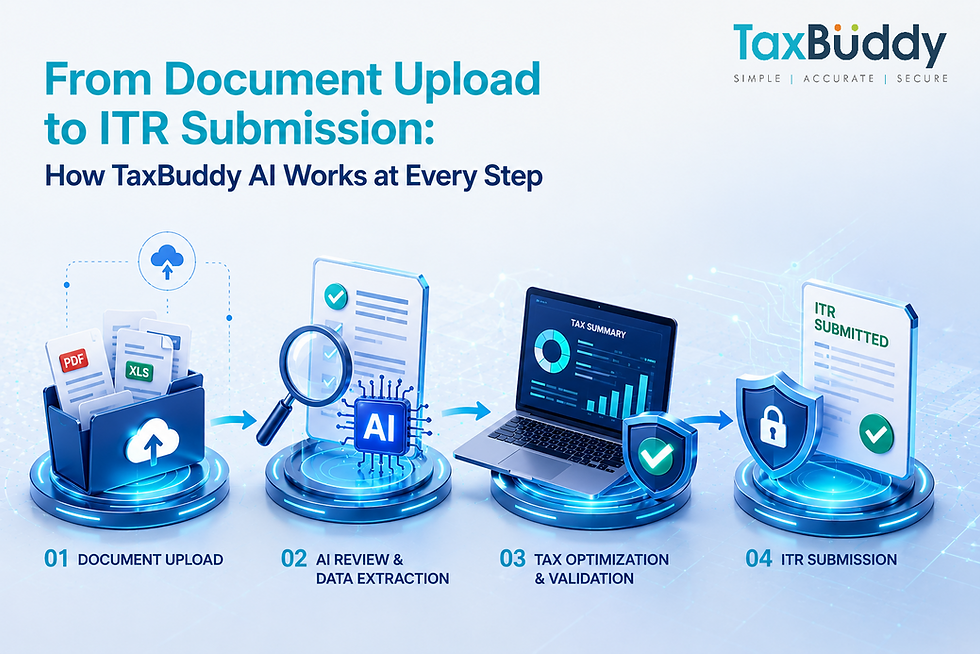
The filing process on TaxBuddy DIY is structured into clear steps, starting with data import and income declaration. Taxpayers are guided through income heads, deduction sections, tax credits, and bank account disclosures. Each step includes contextual prompts and checks to ensure completeness. Before submission, the platform provides a consolidated review of the return, highlighting any inconsistencies or missing information. This step-by-step approach reduces confusion and ensures that all mandatory disclosures are addressed before filing.
Ensuring Accuracy and Reducing Notice Risk
One of the primary objectives of DIY filing is to reduce the risk of notices. TaxBuddy DIY Filing achieves this by validating reported data against AIS, Form 26AS, and standard compliance rules. It flags inconsistencies such as income mismatches, missing disclosures, or incorrect classification of income. By resolving these issues at the filing stage, taxpayers significantly reduce the likelihood of receiving notices related to under-reporting, incorrect credits, or defective returns.
Compliance With Filing Timelines and Penalty Provisions
Timely filing is essential to avoid penalties and loss of benefits. TaxBuddy DIY Filing keeps taxpayers aligned with applicable filing deadlines and highlights consequences of late filing, such as penalties under Section 234F or interest liabilities. The platform also supports the filing of revised or updated returns where corrections are required. By guiding users through compliance timelines, it helps ensure that statutory obligations are met without last-minute errors or omissions.
Handling Complex Scenarios in DIY Filing
While designed for self-filing, TaxBuddy DIY Filing also accommodates moderately complex scenarios such as multiple bank accounts, joint ownership of assets, capital gains, and presumptive income. The platform prompts additional disclosures where required and simplifies schedule-level reporting through guided inputs. This allows taxpayers with non-standard income patterns to file accurate returns without navigating complex schedules manually.
Security, E-Verification, and Filing Completion
Security and completion are integral to the filing process. TaxBuddy DIY Filing supports secure e-verification methods such as Aadhaar OTP and electronic verification codes, ensuring timely completion of the filing process. A filing dashboard allows taxpayers to track return status, verification completion, and acknowledgements. This end-to-end visibility ensures that returns are not only filed but also successfully verified and processed.
Conclusion
TaxBuddy DIY Filing offers a structured and reliable approach to income tax compliance for individual taxpayers by combining automation, guided disclosures, and real-time validations. It addresses common filing challenges such as incorrect form selection, data mismatches, and missed deadlines, making the compliance process simpler and more accurate. For anyone looking for assistance in tax filing, a practical option is to download the TaxBuddy mobile app for a simplified, secure, and hassle-free experience.
FAQs
Q1. Does TaxBuddy offer both self-filing and expert-assisted plans for ITR filing, or only expert-assisted options?
TaxBuddy offers both options. Individual taxpayers can choose the DIY self-filing platform if they are comfortable filing on their own, or opt for expert-assisted plans when income structures are complex or professional review is preferred. This flexibility allows taxpayers to switch between self-service and expert support based on their needs for a particular financial year.
Q2. Which is the best site to file ITR?
The best site to file an income tax return is one that ensures accuracy, compliance with the Income Tax Act, 1961, and ease of use. Platforms that provide automated form selection, data validation with AIS and Form 26AS, guided disclosures, and secure e-verification help reduce filing errors and post-filing issues. These features are especially important for individual taxpayers filing without professional assistance.
Q3. Where to file an income tax return?
Income tax returns can be filed through the official Income Tax Department portal or through authorised digital platforms that facilitate return filing. Such platforms act as an interface over the government system, offering structured workflows, validations, and filing support while submitting returns directly to the department.
Q4. Is TaxBuddy DIY Filing suitable for salaried individuals with only Form 16 income?
Yes, TaxBuddy DIY Filing is well-suited for salaried individuals with income reported in Form 16. The platform auto-populates salary details, TDS credits, and basic deductions, ensuring that income is reported correctly and aligned with Form 26AS and AIS data.
Q5. Can taxpayers with capital gains use DIY filing without expert help?
Taxpayers with straightforward capital gains, such as listed shares or mutual funds, can use DIY filing. The platform guides users through capital gains schedules and validates disclosures against available transaction data. However, for complex scenarios involving multiple asset classes or exemptions, expert review may still be advisable.
Q6. How does DIY filing help avoid defective income tax returns?
DIY filing reduces defective returns by ensuring the correct ITR form is selected, mandatory schedules are completed, and disclosures are consistent with departmental data. Built-in checks flag missing information or incorrect classifications before submission, which helps prevent returns from being marked defective.
Q7. Does TaxBuddy DIY Filing support both old and new tax regimes?
Yes, the platform supports both tax regimes. It guides taxpayers through regime selection and ensures that deductions and exemptions are claimed only where permitted. This prevents incorrect claims that could lead to adjustments or denial of benefits during return processing.
Q8. How are deductions under sections like 80C or 80D handled in DIY filing?
The platform prompts taxpayers to declare eligible deductions and validates them based on the selected tax regime. This structured approach ensures deductions are neither missed nor incorrectly claimed, improving accuracy and compliance.
Q9. Can DIY filing handle multiple bank accounts and interest income?
Yes, TaxBuddy DIY Filing allows reporting of interest income from multiple bank accounts. It cross-verifies reported amounts with AIS data and flags discrepancies, ensuring complete disclosure and reducing the risk of notices related to unreported interest income.
Q10. Is e-verification mandatory after filing an income tax return?
Yes, e-verification is mandatory to complete the filing process. DIY filing platforms support Aadhaar OTP and other electronic verification methods, ensuring returns are verified promptly and considered valid by the Income Tax Department.
Q11. What happens if a mismatch is found between AIS and the details entered by the taxpayer?
If a mismatch is detected, the system alerts the taxpayer and allows corrections before submission. This helps resolve discrepancies at the filing stage instead of during post-filing scrutiny or assessment.
Q12. Can revised returns be filed through DIY filing platforms?
Yes, revised returns can be filed if errors or omissions are discovered after submission. The platform guides users through revising previously filed returns while maintaining consistency with earlier disclosures and updated tax data.




Comments