

Is ITR Filing, Tax Planning, and Notice Management the Next Layer in Financial Apps?

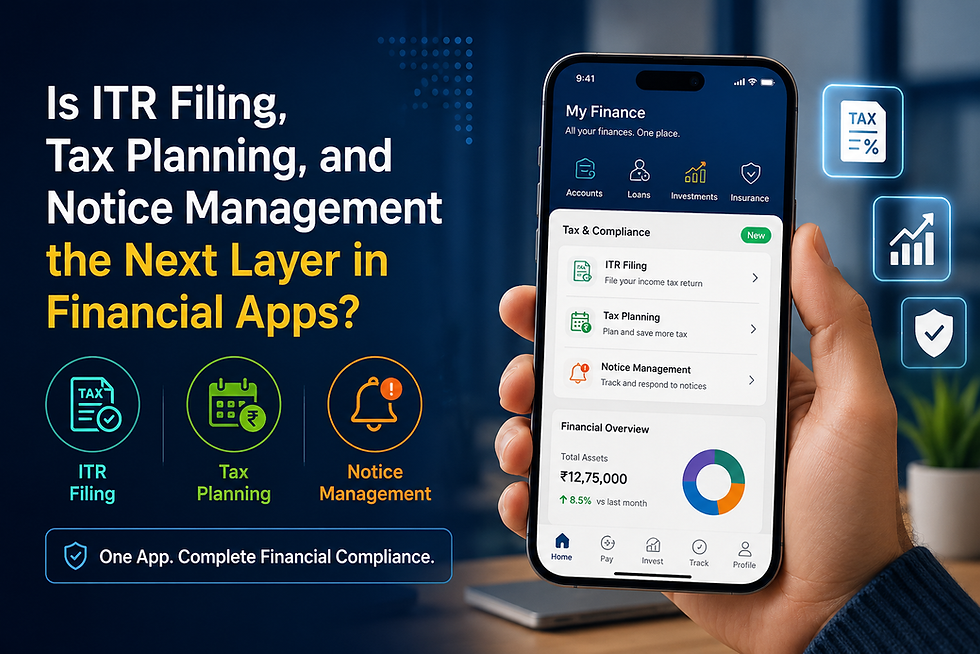
Financial apps today do far more than process transactions. Users now rely on them to manage loans, investments, payments, and multiple financial decisions within a single platform.
This shift is already visible in platforms like Jio Financial Services, where multiple financial services are brought together into one ecosystem.
However, one important layer still remains largely separate. Tax.
While users actively manage their finances within these apps, tax planning, ITR filing, and notice handling are often managed elsewhere. This creates a disconnect between financial decisions and their compliance outcomes.
As financial apps evolve into broader financial ecosystems, this separation is beginning to feel increasingly outdated. Which raises an important question.
Is tax becoming the next layer financial apps need to integrate?
Table of Contents
Financial Apps Have Already Consolidated Most Financial Activities
Why Tax Still Feels Detached From the Digital Financial Journey
Why Tax Planning Is Becoming a Daily Financial Conversation Instead of a Year-End Activity
How Finance Apps Are Moving From Transaction Platforms to Financial Operating Systems
Why Embedded ITR Filing Changes User Behaviour More Than Expected
Notice Management Could Become the Trust Layer for Financial Apps
The Real Opportunity Is Not Filing. It Is Financial Engagement
How Tax Integration Creates New Moments for Product Discovery and Advisory
Why Financial Platforms Do Not Need to Build Tax Infrastructure From Scratch
The Emerging Shift Towards Continuous Compliance Experiences
Financial Apps Have Already Consolidated Most Financial Activities
Financial apps have expanded rapidly over the last few years.
What started with payments has gradually evolved into lending, investments, insurance, and wealth management. Instead of using separate platforms for different needs, users now expect a single app to support a larger part of their financial journey.
This shift has changed the role of financial apps completely.
They are no longer just transaction tools. They are becoming platforms where users:
make financial decisions
discover products
manage long-term financial activity
This is why platforms are continuously adding layers that keep users engaged within the ecosystem.
As these ecosystems become more complete, the expectation also changes. Users no longer want disconnected experiences for closely related financial activities. And that naturally brings tax into the picture.
Why Tax Still Feels Detached From the Digital Financial Journey
Despite the expansion of financial apps, tax is still handled separately in most cases.
A user may:
invest through an app
manage loans digitally
track expenses online
but still leave the platform for tax planning or ITR filing. This creates a break in the journey.
Financial decisions and tax outcomes are deeply connected, yet they are managed through disconnected systems. As a result, users often think about taxes only during filing season rather than while making financial decisions.
This separation also creates friction. Users switch between platforms, repeat processes, and rely on external support for activities closely linked to their finances.
For financial apps, this means losing engagement during one of the most important financial periods of the year. As platforms move towards becoming more complete ecosystems, this gap is becoming increasingly difficult to ignore.
Every Financial Decision Eventually Leads to a Tax Outcome
Tax is no longer a separate financial activity that happens only at the end of the year.
Almost every important financial decision now has a direct or indirect tax impact.
For example:
investment choices influence deductions and capital gains
loan structures can affect tax benefits
income patterns impact overall tax liability
selling assets can create compliance obligations
Yet in most digital financial journeys, these decisions and their tax implications are still disconnected. Users often make financial choices first and think about taxes later. By the time filing season arrives, the opportunity to optimize outcomes may already be limited.
This is why tax is gradually moving closer to the centre of financial decision-making. As users become more financially aware, they increasingly expect platforms to help them understand not just the transaction, but also its financial impact over time.
For financial apps, this changes the role they play. The platform is no longer just facilitating activity. It is becoming part of how users plan and evaluate decisions. Once that shift happens, integrating tax starts feeling less like an additional feature and more like a natural extension of the experience.
Why Tax Planning Is Becoming a Daily Financial Conversation Instead of a Year-End Activity
Traditionally, tax planning was treated as a seasonal task. Most users thought about taxes only near filing deadlines or toward the end of the financial year. The process was largely reactive.
That behaviour is now starting to change. As digital financial platforms become more integrated into daily life, users are engaging with financial decisions more frequently. Investments, expenses, savings, and income management are no longer occasional activities. They happen continuously throughout the year.
This is pushing tax planning into regular financial conversations. Users increasingly want clarity around:
how current decisions affect future tax liability
whether they are making tax-efficient choices
what actions can improve long-term outcomes
For platforms, this creates a significant engagement opportunity.
Tax planning interactions are high-intent moments where users are actively evaluating their finances. These moments allow platforms to:
build stronger engagement
guide users toward better decisions
introduce more contextual financial products and services
This is also why many financial apps are starting with tax planning before expanding into filing and notice support.
Planning creates the entry point. Once users begin engaging with tax proactively, the transition into filing and broader compliance becomes much more natural.
How Finance Apps Are Moving From Transaction Platforms to Financial Operating Systems
Financial apps are no longer competing only on features. They are competing on how central they can become to a user’s financial life.
Earlier, the focus was largely transactional:
enabling payments
facilitating investments
processing loans
The relationship between the user and the app was activity-based. Users opened the app for a specific action and left once it was completed.
That model is changing. Today, financial platforms are trying to become continuous engagement ecosystems where users return not just for transactions, but for ongoing financial management.
This is where the idea of a “financial operating system” starts becoming relevant. A financial operating system does not simply execute tasks. It helps users:
monitor financial activity
evaluate decisions
optimise outcomes
manage long-term financial goals
In this model, tax becomes highly relevant because it sits across multiple financial activities.
A user investing through the app may want to understand tax implications before investing. Someone evaluating income or expenses may want visibility into future tax liability. Borrowing decisions may also connect with tax-saving considerations.
As financial apps move deeper into decision-making and planning, tax naturally becomes part of the same ecosystem.
This shift is already visible in platforms like Jio Financial Services, where the financial experience is expanding beyond individual products into a broader connected journey.
The transition from transaction platform to financial operating system is important because it changes how platforms think about user value.
The objective is no longer just to enable actions. It is to become the primary interface through which users manage their financial lives.
Why Embedded ITR Filing Changes User Behaviour More Than Expected
At first glance, embedded ITR filing may appear to be just another convenience feature.
In reality, it changes user behaviour in much deeper ways.
Traditionally, tax filing has been treated as an isolated annual activity. Users gather documents, switch to another platform, complete compliance, and move on.
The process feels disconnected from the rest of their financial journey. When filing is embedded within financial apps, that separation begins to disappear. Instead of treating tax as an external obligation, users start seeing it as part of ongoing financial management. This changes behaviour in several ways.
First, users engage earlier. When filing exists within the same ecosystem as investments, loans, and payments, users become more aware of tax implications throughout the year rather than only near deadlines.
Second, users engage more consistently. Instead of a single filing interaction, platforms can create continuous engagement through:
tax planning prompts
deduction discovery
filing reminders
educational nudges
Third, users become more comfortable with compliance. Guided filing experiences simplify the process significantly. Instead of navigating complicated tax forms independently, users move through structured workflows that reduce confusion and hesitation.
This lowers the psychological barrier around tax filing. Over time, filing becomes less stressful and more integrated into regular financial behaviour. For financial platforms, this behavioural shift is extremely valuable. It increases:
engagement frequency
platform dependency
long-term retention
More importantly, it strengthens the perception of the app as a complete financial ecosystem rather than just a transactional utility.
Notice Management Could Become the Trust Layer for Financial Apps
Among all tax-related activities, notice management is likely to become the most important trust-building layer for financial platforms. Planning and filing help users stay compliant. Notices test how supported users feel when something goes wrong. This is where the relationship between the user and the platform changes significantly.
Most users are not comfortable handling tax notices on their own. Notices are often:
technical in language
unclear in implications
associated with fear of penalties or scrutiny
Even financially aware users may struggle to understand:
why the notice was issued
whether immediate action is required
how to respond correctly
As a result, users usually move outside the platform and seek external assistance.
This creates a major break in the experience.
A platform may support users through:
payments
investments
tax planning
ITR filing
but still lose relevance during the most sensitive compliance moment.
This is why notice management has the potential to become the next major trust layer. When users know they can access structured guidance or expert assistance within the same ecosystem, their confidence in the platform increases significantly. The platform stops being viewed as just a financial utility and starts being viewed as a long-term support system.
For financial apps, this matters because trust directly impacts retention and engagement. Users are more likely to stay within ecosystems that support them not only during routine activities, but also during complex or stressful situations.
This is one of the reasons why notice management is gradually moving from being a specialised service into a broader ecosystem capability.
The Real Opportunity Is Not Filing. It Is Financial Engagement
At a surface level, integrating tax services may appear to be about compliance. In reality, the bigger opportunity lies in engagement. Tax interactions are fundamentally different from routine financial activity. During tax-related moments, users actively:
review finances
evaluate decisions
think about future planning
seek ways to optimise outcomes
This creates one of the highest-intent engagement windows in the financial lifecycle. Most financial platforms already compete heavily for daily engagement through payments and transactions. Tax creates a different kind of interaction. It brings users into a planning mindset.
For example:
users exploring deductions may start evaluating investment products
users comparing tax regimes may seek broader financial guidance
users planning early may become more engaged with wealth-building tools
This creates opportunities for platforms to build more meaningful relationships. Instead of generic engagement, platforms can move toward contextual engagement based on what users are actively trying to achieve. This also changes how financial products are introduced.
Cross-sell and upsell opportunities become more relevant because they are connected to an existing financial objective rather than appearing as unrelated promotions. At the same time, engagement extends beyond products. Platforms can build stronger user relationships through:
tax awareness campaigns
educational content
free webinars and financial guidance initiatives
Support from infrastructure providers like TaxBuddy helps strengthen this engagement layer by enabling both product integration and user education initiatives within the ecosystem.
This is why the long-term opportunity is much larger than simply adding filing functionality. The real shift is that tax creates deeper and more continuous financial engagement inside the platform.
How Tax Integration Creates New Moments for Product Discovery and Advisory
One of the biggest shifts happening inside financial apps is the move from transactional engagement to advisory-driven engagement. Tax integration plays a major role in accelerating this transition. Traditionally, financial platforms interacted with users mainly during actions:
making payments
investing money
applying for loans
These interactions were important, but often short-lived. Tax-related interactions are different because they are tied to financial intent and future planning. When users engage with:
tax planning tools
deduction discovery features
regime comparisons
filing workflows
they are actively evaluating their financial position. This creates highly valuable moments for financial platforms. For example:
a user exploring tax-saving deductions may also be considering long-term investments
a salaried professional comparing tax regimes may need broader financial planning guidance
a business owner preparing for filing may require advisory support around expenses or compliance
These interactions naturally create opportunities for product discovery. The key difference is that the engagement feels contextual rather than promotional. Instead of pushing unrelated products, the platform can introduce financial solutions aligned with what the user is already trying to achieve.
This improves both user experience and engagement quality. Tax integration also creates opportunities for platforms to strengthen their advisory positioning. Users increasingly expect financial apps to do more than execute transactions. They expect guidance.
By integrating tax planning and compliance journeys, platforms can become more involved in helping users:
make informed financial decisions
optimise long-term outcomes
understand the broader impact of their actions
This shift is important because it changes how users perceive the platform itself. The app evolves from being a utility into a more intelligent financial companion.
Why Financial Platforms Do Not Need to Build Tax Infrastructure From Scratch
One of the reasons tax integration is accelerating is that financial platforms no longer need to build every component internally.
Historically, integrating tax services would have required:
specialized compliance expertise
complex workflow development
continuous regulatory updates
dedicated support systems
For many financial platforms, this made tax integration difficult and resource-intensive.
That environment is changing rapidly.
Today, infrastructure providers like TaxBuddy enable financial platforms to integrate tax capabilities through modular and embedded solutions.
This allows platforms to introduce:
tax planning journeys
guided ITR filing workflows
deduction discovery systems
expert-assisted support
without building the underlying infrastructure from the ground up.
This approach is important for two reasons. First, it reduces operational complexity.
Financial apps can continue focusing on their core strengths such as user experience, engagement, and product distribution while specialised infrastructure handles compliance workflows in the background.
Second, it accelerates go-to-market timelines. Instead of spending years building internal tax systems, platforms can launch integrated experiences much faster and continuously evolve them over time.
The role of infrastructure providers also extends beyond technology. Successful tax integration depends heavily on user adoption and engagement. This is why ecosystem support has become
equally important. Partners like TaxBuddy support platforms through:
tax awareness campaigns
free educational webinars
user engagement initiatives during filing periods
simplified educational content
These initiatives help platforms not only launch tax services, but also drive meaningful usage within the ecosystem. As financial apps continue expanding into tax and compliance, infrastructure-led integration models are likely to become the standard approach rather than the exception.
The Emerging Shift Towards Continuous Compliance Experiences
Tax compliance has traditionally been treated as a once-a-year activity.
Most users engage with taxes only during filing season. The process is often rushed, reactive, and disconnected from the rest of the financial year.
That model is beginning to change. As financial apps become more integrated into everyday financial management, compliance is gradually shifting from a periodic activity to a continuous experience.
This shift is important because financial decisions no longer happen in isolation.
Users continuously:
invest money
adjust income structures
manage expenses
evaluate financial products
Each of these activities can influence future tax outcomes. As a result, users increasingly expect visibility and guidance throughout the year rather than only at filing time.
This is where financial apps are starting to rethink compliance journeys. Instead of limiting
engagement to annual filing workflows, platforms are gradually introducing:
year-round tax planning prompts
deduction tracking
periodic compliance reminders
proactive financial insights
This changes the nature of tax engagement completely. Compliance becomes embedded within ongoing financial activity instead of appearing as a separate task once deadlines arrive.
For users, this reduces stress and improves decision-making. For platforms, it creates more frequent and meaningful engagement opportunities across the financial lifecycle.
This is why the future of tax integration is unlikely to revolve only around filing. The larger shift is toward continuous compliance experiences where tax becomes part of regular financial management rather than an isolated annual process.
What the Next Generation of Financial Apps May Look Like
The next generation of financial apps will likely look very different from the transaction-focused platforms that originally defined the fintech ecosystem.
The focus is gradually shifting from isolated features to connected financial ecosystems.
In this model, users will not think in terms of separate categories such as:
payments
investments
taxes
compliance
Instead, they will expect a single platform to help them manage their financial lives more holistically. This evolution is already becoming visible in platforms like Jio Financial Services, where multiple financial journeys are being brought together into one ecosystem.
As this model matures, tax is expected to become a much deeper layer inside financial platforms.
Future financial apps may increasingly support users through:
ongoing tax planning
embedded filing experiences
proactive compliance guidance
notice resolution support
contextual financial recommendations
The relationship between the user and the platform will also evolve. Instead of interacting with the
app only for transactions, users may begin relying on it for:
financial clarity
decision-making support
long-term optimisation
compliance management
This changes the role of the financial platform significantly. The app stops being just a service provider and starts becoming a central operating layer for financial life management.
For the broader fintech ecosystem, this represents a major strategic shift.
The platforms that successfully integrate planning, engagement, advisory, and compliance into one connected experience are likely to build stronger long-term user relationships than those focused only on transactions.
Conclusion
Financial apps have already transformed how users manage money. Payments, lending, investments, and insurance have gradually moved into connected ecosystems where users expect a more seamless financial experience. As this evolution continues, tax is increasingly beginning to look like the next logical layer of integration.
This shift is not happening only because of compliance needs. It is happening because tax now sits at the centre of financial decision-making.
Investment choices, income structures, borrowing decisions, and long-term planning all eventually lead to tax outcomes. As users become more financially aware, they increasingly expect platforms to help them manage both sides of the journey together.
This is why financial apps are gradually moving beyond transactions and toward broader financial operating systems.
FAQs
Q1. Why are financial apps expanding into tax planning and ITR filing?
Financial apps are expanding into tax services because users increasingly expect connected financial experiences. Since loans, investments, payments, and savings all have tax implications, integrating tax planning and filing helps platforms create a more complete ecosystem.
Q2. Why does tax still feel separate from most financial apps?
Tax compliance has traditionally evolved through separate systems due to regulatory complexity and specialised workflows. However, as financial apps become central to financial decision-making, this separation is starting to feel increasingly disconnected.
Q3. Why is tax planning becoming important inside financial platforms?
Tax planning influences major financial decisions such as investments, deductions, and savings strategies. Integrating planning inside financial apps allows users to evaluate tax impact earlier instead of reacting during filing season.
Q4. How does embedded ITR filing change user behaviour?
Embedded filing reduces friction and keeps users within the same ecosystem. Over time, users begin treating tax filing as part of ongoing financial management rather than a stressful once-a-year activity.
Q5. Why is notice management becoming relevant for financial apps?
Tax notices are often confusing and stressful for users. Platforms that support notice management can build stronger trust by helping users during complex compliance situations rather than only during routine filing.
Q6. What is the biggest opportunity for platforms integrating tax services?
The biggest opportunity is not just compliance. It is a deeper financial engagement. Tax interactions are high-intent moments where users actively review finances and evaluate decisions, creating stronger engagement opportunities.
Q7. How does tax integration support product discovery inside financial apps?
Tax-related interactions reveal financial intent. Users exploring deductions or tax-saving strategies are often also evaluating investments, insurance, or advisory services, creating more contextual engagement opportunities.
Q8. Do financial apps need to build tax infrastructure internally?
Not necessarily. Infrastructure providers like TaxBuddy allow financial platforms to integrate tax planning, filing, and support workflows without building the entire compliance stack internally.
Q9. Why are educational initiatives important in tax integration?
Many users still find taxes complicated. Educational content, webinars, reminders, and awareness campaigns help improve adoption and encourage users to engage with tax features more confidently.
Q10. What are continuous compliance experiences?
Continuous compliance experiences involve integrating tax engagement throughout the year rather than limiting it to filing season. This can include planning prompts, deduction tracking, reminders, and proactive guidance.
Q11. How are financial apps evolving into financial operating systems?
Financial apps are gradually moving beyond transactions and becoming platforms where users manage decisions, planning, optimisation, and compliance within one connected ecosystem.
Q12. What might the future of financial apps look like?
The next generation of financial apps will likely combine payments, lending, investments, tax planning, filing, compliance, and advisory into unified financial ecosystems where users manage their complete financial lives in one place.


