

When DIY Tax Filing Is Enough — and When Expert Support Becomes Necessary

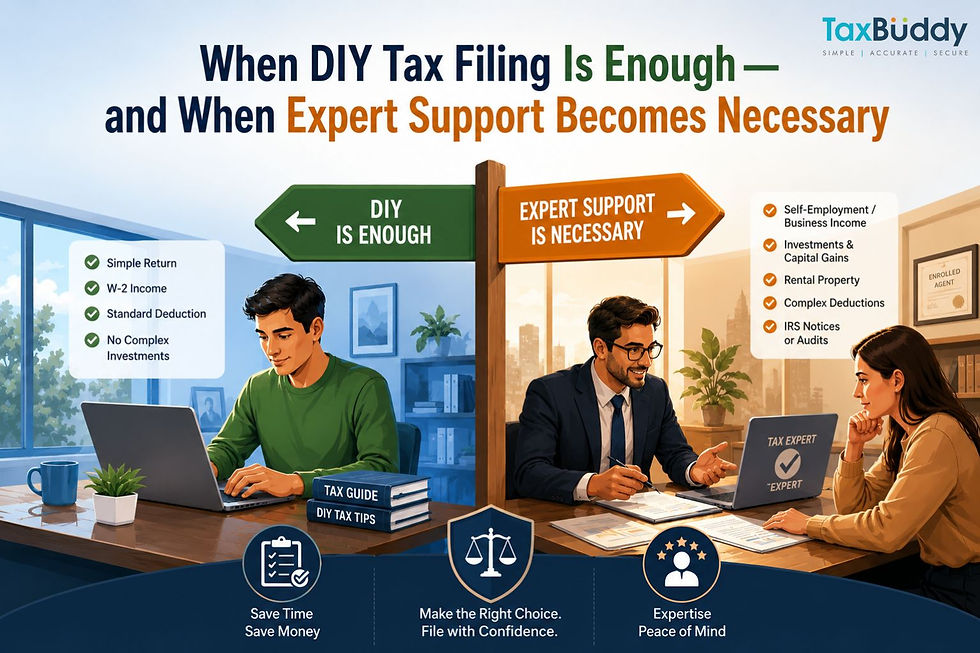
Filing income tax returns has become easier with digital tools and pre-filled data, but not every situation can be handled with a do-it-yourself approach. While many taxpayers can file their returns independently using Form 16, Form 26AS, and AIS, complexities such as multiple income sources, capital gains, or business income often require expert intervention. TaxBuddy supports both simple and complex cases by offering guided filing and expert-assisted services. Understanding when self-filing is sufficient and when professional help is needed can help avoid errors, notices, and compliance issues under the Income Tax Act, 1961.
DIY tax filing is enough when income is simple, well-documented, and pre-filled, but expert support becomes necessary when income sources are complex, involve business, capital gains, foreign assets, or carry a higher risk of scrutiny or compliance errors.
Table of Contents
When DIY Tax Filing Is Enough and When Expert Support Becomes Necessary
Tax filing decisions depend on the complexity of income and the level of compliance required. For simple financial situations, self-filing can be efficient and cost-effective. However, as income sources diversify and compliance requirements increase, the risk of errors also rises. Understanding the difference between simple and complex cases helps in choosing the right approach and avoiding penalties or notices.
What Is DIY Tax Filing Under the Income Tax Act 1961
DIY tax filing refers to preparing and submitting an income tax return without professional assistance. It typically involves using the income tax portal or a guided platform to report income, claim deductions, and calculate tax liability. The process is supported by pre-filled data such as Form 16, Form 26AS, and AIS, which simplifies filing for straightforward cases.
Situations Where DIY Tax Filing Is Enough
DIY filing works well when financial records are clear, income sources are limited, and tax deductions are straightforward. In such cases, pre-filled data matches actual financial transactions, reducing the need for manual adjustments. Taxpayers can complete the process independently without significant risk of errors.
Income Profiles Suitable for Self-Filing
Self-filing is most suitable for salaried individuals with a single employer, limited bank interest income, and standard deductions. Individuals with no business income, no capital gains, and no foreign assets generally fall into this category. Their tax returns are easier to prepare and verify.
Documents and Data Required for DIY Filing
DIY filing requires essential documents such as Form 16, bank statements, interest certificates, investment proofs, and tax credit statements like Form 26AS and AIS. Accurate documentation ensures that all income and deductions are correctly reported.
Common Mistakes in DIY Tax Filing
Common errors include selecting the wrong ITR form, missing income sources, incorrect deduction claims, and mismatches between reported income and tax records. These mistakes can lead to notices, delays in refunds, or additional tax liability.
When Expert Support Becomes Necessary in Tax Filing
Expert support becomes important when financial situations involve complexity or higher compliance risk. Professionals help ensure accurate reporting, proper classification of income, and adherence to tax laws.
Multiple Income Sources and Complex Financial Structures
Individuals with multiple income streams, such as salary, rental income, freelance work, or investments, require careful classification and reporting. Managing these correctly often requires expert guidance.
Capital Gains, Investments, and Property Transactions
Capital gains from shares, mutual funds, or property involve specific rules for calculation, indexation, and set-off of losses. Incorrect reporting can lead to compliance issues, making expert assistance valuable.
Business and Professional Income Compliance Requirements
Freelancers and business owners must maintain records, calculate profits, and comply with audit requirements if applicable. These obligations make professional support necessary to ensure accuracy and compliance.
Foreign Income, Assets, and Advanced Disclosures
Foreign income and assets require detailed disclosures under specific schedules. Errors in reporting can lead to serious compliance issues, so expert assistance is recommended in such cases.
Handling Tax Notices, Scrutiny, and Assessments
Tax notices and scrutiny cases require a proper understanding of legal provisions and documentation. Responding incorrectly can escalate issues, making expert guidance essential.
Is DIY Filing Allowed in the New Tax Regime
Yes, DIY filing is allowed in the new tax regime. The simplified structure with fewer deductions makes it easier for taxpayers with straightforward income to file returns independently.
How Tax Filing Works in the Old Tax Regime
Under the old tax regime, multiple deductions and exemptions are available. Proper calculation and documentation are required to maximise benefits, which can increase complexity and the need for expert assistance.
Role of TaxBuddy in DIY and Expert-Assisted Filing
TaxBuddy supports both self-filing and expert-assisted filing. It provides guided workflows for simple cases and professional support for complex situations. This flexibility allows users to choose based on their needs.
How TaxBuddy Helps Reduce Errors and Improve Compliance
TaxBuddy verifies data, reconciles information with official records, and flags inconsistencies before submission. This reduces errors and ensures compliance with tax laws.
Choosing Between DIY Filing and Expert Support Based on Risk
The decision between DIY tax filing and expert support is largely driven by the level of risk associated with a taxpayer’s financial situation. Risk, in this context, refers to the chances of making errors, facing mismatches with tax records, or attracting scrutiny from the tax department. When income is simple and well-documented, the risk is low, and self-filing can be a practical and efficient option. However, as financial complexity increases, the likelihood of errors also rises, making expert support more valuable.
In low-risk scenarios, such as a salaried individual with a single source of income and standard deductions, most of the required data is already pre-filled through Form 16, Form 26AS, and AIS. If these documents are consistent and there are no additional disclosures required, DIY filing can be completed with confidence. The risk of incorrect reporting in such cases is minimal, provided the information is verified carefully before submission.
In contrast, medium-risk situations involve additional layers of income or deductions that require careful interpretation. For example, individuals with rental income, multiple bank accounts, or moderate investment activity need to ensure proper classification of income and accurate reporting of interest, capital gains, or losses. While DIY filing is still possible, the margin for error increases. In such cases, opting for a guided platform or seeking partial expert review can help reduce the risk.
High-risk scenarios typically include business or professional income, frequent trading in securities, property transactions, or foreign income and assets. These situations involve detailed calculations, multiple reporting requirements, and strict compliance rules. Errors in these areas can lead to notices, penalties, or prolonged scrutiny. Expert support becomes essential in such cases to ensure that all aspects of the return are handled correctly and in line with applicable tax laws.
Another important factor is the taxpayer’s familiarity with tax rules and comfort level with handling financial data. Even in relatively simple cases, a lack of understanding can lead to mistakes. On the other hand, individuals who are well-versed in tax provisions and regularly track their financial records may manage DIY filing more effectively.
Evaluating risk also involves considering the consequences of potential errors. A small mistake in a low-risk case may only lead to minor corrections, whereas an error in a high-value or complex return can result in significant financial implications. This makes it important to assess not just the complexity of income but also the impact of any possible mistake.
By assessing income structure, documentation accuracy, compliance requirements, and personal comfort with tax filing, taxpayers can choose the most suitable approach. A balanced decision ensures that filing is both efficient and compliant, reducing the chances of future complications while maintaining control over the process.
Why a Hybrid Approach Works for Most Taxpayers
A hybrid approach to tax filing combines the flexibility of self-filing with the assurance of expert review, making it a practical solution for a wide range of taxpayers. Instead of choosing between complete independence and full reliance on a professional, this method allows individuals to prepare their returns on their own while still having access to expert validation before final submission. This balance helps maintain control over personal financial information while ensuring that the return is accurate and compliant.
One of the main advantages of this approach is improved accuracy without losing visibility. Taxpayers can upload documents, review income details, and claim deductions themselves, which helps them stay aware of their financial position. At the same time, an expert review acts as a safety layer that identifies errors, missing disclosures, or incorrect classifications that may not be obvious during self-filing. This reduces the chances of notices, penalties, or delayed refunds.
The hybrid model is particularly useful for individuals whose financial situation is moderately complex. For example, someone with salary income along with some capital gains, interest income, or freelance earnings may find DIY filing manageable but still risky without validation. In such cases, expert input ensures that all income heads are correctly reported and that tax calculations are accurate.
Another benefit is cost efficiency. Fully expert-assisted filing may not always be necessary for simple cases, while pure DIY filing may not provide enough confidence for slightly complex situations. A hybrid approach allows taxpayers to limit professional involvement to the final review stage, making it a more economical option while still maintaining reliability.
This approach also improves learning and awareness. By participating in the preparation process, taxpayers gain a better understanding of their income structure, deductions, and tax obligations. Over time, this familiarity helps them make better financial decisions and reduces dependency on external support for basic tasks.
Finally, a hybrid approach aligns well with modern tax platforms that offer both guided workflows and expert assistance. These platforms enable users to start the process independently and seek help only when needed. This flexibility ensures that taxpayers can adapt their approach based on the complexity of their financial situation each year.
By combining independence, expert validation, cost efficiency, and flexibility, a hybrid approach provides a balanced solution that works effectively for most taxpayers, especially those who want both control and confidence in their tax filing process.
Conclusion
Choosing between DIY filing and expert support depends on the complexity of financial information and compliance requirements. While simple cases can be managed independently, complex situations require professional guidance to avoid errors and notices. Platforms like TaxBuddy provide both options, helping users manage tax filing efficiently. For anyone looking to balance ease and accuracy in tax filing, it is highly recommended to download the TaxBuddy mobile app for a simplified, secure, and hassle-free experience.
FAQs
Q. When is DIY tax filing considered safe and sufficient?
DIY tax filing is generally safe when income is limited to salary and basic interest income, and all details are accurately reflected in Form 16, Form 26AS, and AIS. If there are no complex deductions, capital gains, or business income, self-filing can be done with minimal risk.
Q. What are the key indicators that expert support is needed for tax filing?
Expert support becomes necessary when there are multiple income sources, capital gains transactions, foreign assets, or business income. It is also recommended when there is uncertainty in selecting the correct ITR form or claiming deductions.
Q. Can salaried individuals always rely on DIY tax filing?
Salaried individuals can rely on DIY filing only if their income is straightforward and properly documented. If they have additional income, such as rental income or capital gains, expert review may be required.
Q. How do capital gains impact the choice between DIY and expert filing?
Capital gains involve complex calculations such as indexation, set-off of losses, and classification of short-term and long-term gains. Errors in these calculations can lead to notices, making expert assistance advisable.
Q. Is expert support required for freelancers and professionals?
Freelancers and professionals often need expert support due to compliance requirements such as maintaining books of accounts, calculating profits, and handling GST or advance tax obligations.
Q. Can DIY filing lead to tax notices?
Yes, incorrect reporting of income, mismatches with Form 26AS or AIS, or wrong deduction claims can trigger notices from the tax department. Expert support helps minimise such risks.
Q. How does the complexity of income affect filing decisions?
As income sources increase, such as combining salary, business income, capital gains, and rental income, the complexity of filing also increases. This makes expert assistance more valuable for accurate reporting.
Q. Is DIY filing easier under the new tax regime?
Yes, the new tax regime has fewer deductions and a simplified structure, making it easier for taxpayers with simple income profiles to file returns independently.
Q. Why is the old tax regime more complex for DIY filing?
The old tax regime involves multiple deductions and exemptions that require proper documentation and calculation. This increases the chances of errors, making expert guidance more useful.
Q. What role does documentation play in choosing DIY filing?
Accurate and complete documentation is essential for DIY filing. Missing or incorrect documents can lead to errors, making expert support necessary in such situations.
Q. Can a taxpayer switch from DIY filing to expert assistance later?
Yes, many taxpayers start with DIY filing and then opt for expert review before final submission. This hybrid approach helps ensure accuracy while maintaining control.
Q. How does using a guided platform improve DIY filing accuracy?
Guided platforms provide validation checks, data reconciliation, and step-by-step workflows. This reduces errors and helps users file returns more accurately compared to manual filing.


